Groundswell: Winning in a World Transformed by Social Technologies
by Charlene Li, Josh Bernoff
On This Page
Description
Corporate executives struggle to harness the power of social technologies. Twitter, Facebook, blogs, YouTube are where customers discuss products and companies, write their own news, and find their own deals but how do you integrate these activities into your broader marketing efforts? It's an unstoppable groundswell that affects every industry -- yet it's still utterly foreign to most companies running things now. When consumers you've never met are rating your company's products in show more public forums with which you have no experience or influence, your company is vulnerable. In Groundswell, Josh Bernoff and Charlene Li explain how to turn this threat into an opportunity. In this updated and expanded edition of Groundswell, featuring an all new introduction and chapters on Twitter and social media integration, you'll learn to evaluate new social technologies as they emerge, determine how different groups of consumers are participating in social technology arenas, apply a four-step process for formulating your future strategy, build social technologies into your business Groundswell is required listening for executives seeking to protect and strengthen their company's public image. show lessTags
Recommendations






















Member Recommendations

Member Reviews
I learned about Groundswell: Winning in a World Transformed by Social Technologies (2008) by Charlene Li and Josh Bernoff from the HBR IdeaCast Episode 91: Be a Social Technology Provocateur. I was intrigued enough to check it out from the library that employs me but it was quickly recalled. Luckily, I had gotten far enough to sign up for the Groundswell blog where I learned that Forrester was giving away 100 copies of the book to bloggers for review. I was lucky enough to snag a copy and I've finally read it so I can fulfill my end of the bargain.
The basic gist of Groundswell is that new social networking tools allow the general public to greatly influence how companies and products are viewed by people at large. The authors define the show more groundswell as "A social trend in which people use technologies to get the things they need from each other, rather than from traditional institutions like corporations," (p. 9). Many companies see this as a threat but the authors encourage organizations to embrace social technologies to give them competitive advantage in business.
Now I'm someone who recoils at the concept of "viral marketing" in particular and really the whole corporate-consumerist ideology in general, but what impresses me about this book is that it comes down to people. This is not about marketers telling people what to buy, it is about engaging people and learning about what products/services would enrich their lives, how to respond to problems, and even how to influence the purchasing decisons of other customers. One interesting notion is that while corporations have "product managers," they rarely have "people managers" although that's going to be necessary to continue in business in a groundswell environment. They even make a good point that the customers, not the company, own the brand.
"Marketers tell us they define and manage brands. Some spend millions, or hundreds of millions, of dollars on advertising. They carefully extend brand names, putting Scope on a tube of toothpaste to see what happens. We bought this brand, they say. We spent on it. We own it.
Bull.
Your brand is whatever the customers say it is. And in the groundswell where they communicate with each other, they decide," (p. 78).
Many executives want to join the groundswell and think it is as easy as putting a blog or comment pages on their website. The authors warn that engaging the groundswell requires planning with particular goals in mind or one's efforts will fail. Groundswell is like a manual for managers that offers case studies, lessons from those cases, and how those lessons may be applied to one's own business.
I'm obviously not a corporate executive, but I read this book from the perspective that libraries can benefit from the instruction of this book. Like corporations, libraries would do well to listen to the ideas of their biggest supporters, respond to concerns of those having problems with the library, and engage people in making the library a better place for everyone. I'd suggest this book be read by any librarians interested in ideas for transforming the library in the web 2.0 world. show less
The basic gist of Groundswell is that new social networking tools allow the general public to greatly influence how companies and products are viewed by people at large. The authors define the show more groundswell as "A social trend in which people use technologies to get the things they need from each other, rather than from traditional institutions like corporations," (p. 9). Many companies see this as a threat but the authors encourage organizations to embrace social technologies to give them competitive advantage in business.
Now I'm someone who recoils at the concept of "viral marketing" in particular and really the whole corporate-consumerist ideology in general, but what impresses me about this book is that it comes down to people. This is not about marketers telling people what to buy, it is about engaging people and learning about what products/services would enrich their lives, how to respond to problems, and even how to influence the purchasing decisons of other customers. One interesting notion is that while corporations have "product managers," they rarely have "people managers" although that's going to be necessary to continue in business in a groundswell environment. They even make a good point that the customers, not the company, own the brand.
"Marketers tell us they define and manage brands. Some spend millions, or hundreds of millions, of dollars on advertising. They carefully extend brand names, putting Scope on a tube of toothpaste to see what happens. We bought this brand, they say. We spent on it. We own it.
Bull.
Your brand is whatever the customers say it is. And in the groundswell where they communicate with each other, they decide," (p. 78).
Many executives want to join the groundswell and think it is as easy as putting a blog or comment pages on their website. The authors warn that engaging the groundswell requires planning with particular goals in mind or one's efforts will fail. Groundswell is like a manual for managers that offers case studies, lessons from those cases, and how those lessons may be applied to one's own business.
I'm obviously not a corporate executive, but I read this book from the perspective that libraries can benefit from the instruction of this book. Like corporations, libraries would do well to listen to the ideas of their biggest supporters, respond to concerns of those having problems with the library, and engage people in making the library a better place for everyone. I'd suggest this book be read by any librarians interested in ideas for transforming the library in the web 2.0 world. show less
Let me start with this: This book could have been written just as well (make that, better) if it had been shorter. There were some repetitive bits that could have easily been cut, not to mention the many times the authors introduce a topic just to say that they will talk about it further in another chapter. Still, this book is certainly interesting, flows easily, and is a fairly quick read (it took me less than a week to read, and that was during a particularly busy time). The brief summary: the book discusses how businesses can embrace the growing trends in web 2.0 to enhance customer and employee satisfaction. The authors provide a lot of insights by using case studies (both of what worked and what didn't), making this not a book show more about abstract concepts with no real-life grounding or applicability. My biggest caveat: this is a book designed for corporations and businesses, not for public relations specialists like me who work in non-profit settings. Nonetheless, there is still plenty that I learned from this book and much that I will explore. show less
Groundswell is a great book providing a thorough and up to date discussion of how to use social media, and more, to connect with and energize your customers. The book approaches the discussion from the reader's objectives - listening to customers, talking to them, energizing them, empowering them - rather than from technologies or approaches. It has plenty of discussion of how to use technology like blogs, wikis, social networks, bulletin boards and more but always in the context of what you are trying to achieve. I particularly liked the way it brought in approaches not based on new technology and integrated them with the story.
The book is well written and readable - a real book not a long analyst report (despite the authors being show more Forrester analysts). It should also remain current for a while as it is focused on problems (and how to solve them) and opportunities (and how to exploit them) rather than on the nitty gritty of a particular technology. It's examples are truly illustrative and the authors do a nice job helping the reader place themselves in the context of the opportunity to see what will work in their organization rather than providing a one-size-fits all mandate.
If you are in marketing and have been wondering how all this social "stuff" is going to affect you and what you can do about it, this book will help. A lot. show less
The book is well written and readable - a real book not a long analyst report (despite the authors being show more Forrester analysts). It should also remain current for a while as it is focused on problems (and how to solve them) and opportunities (and how to exploit them) rather than on the nitty gritty of a particular technology. It's examples are truly illustrative and the authors do a nice job helping the reader place themselves in the context of the opportunity to see what will work in their organization rather than providing a one-size-fits all mandate.
If you are in marketing and have been wondering how all this social "stuff" is going to affect you and what you can do about it, this book will help. A lot. show less
This book would be great for someone currently not immersed in social media. It's a very thorough outline of technologies and strategies, complete with case studies. Good info, but a tad boring if you've heard them before.
I like that this is a quick read, and even though a lot of the information was not new to me, I will keep this book as a reference. It will be especially helpful in explaining Web 2.0 or social media or whatever you want to call it to people who "don't get it." There are also useful tables to help illustrate the ROI of these technologies.
I like that this is a quick read, and even though a lot of the information was not new to me, I will keep this book as a reference. It will be especially helpful in explaining Web 2.0 or social media or whatever you want to call it to people who "don't get it." There are also useful tables to help illustrate the ROI of these technologies.
I liked some of the ideas in this book but on the whole it sounded too much like a plug for Forrester Reasearch and their 'Social Technographic Profile' for me to really embrace it. The idea that there are levels of participation in the Groundswell (ie. Web 2.0) from listening to the groundswell, through talking with the groundswell up to energizing the groundswell is right on the money. It's just that I was hoping for some more lo-fi examples of how to put these ideas into practice. The target of the book is really major companies with significant funding (hence my impression that the book is a bit of a plug for the consulting firm the authors work for).
this is a bit dated by 2018, but I found it to be very valuable. Loads of details on how people use social media and internet sites.
After starting to read Groundswell, I devoured it over the last few days. Charlene Li and Josh Bernoff write a good book. If you are involved in social media you should definitely read this book.
I admit that I jumped ahead to chapter 11 of the book: The Groundswell Inside Your Company. That chapter seemed the most interesting to me since I am mostly interested in the impact of social media within the enterprise. That chapter provided a great deal of insight, so I decided to jump back to page 1.
Charlene and Josh group consumers into six different categories of participation: Inactives, Spectators, Joiners, Collectors, Critics and Creators. They use a paradigm of a ladder to show the level of participation and call it the Social show more Technographics ladder.
[Photo]
When designing an online community or when reaching out to your customers with social media, you should look at where they stand on the ladder. Forrester's offers a basic tool for Building Your Customers' Social Technographics Profile on the Groundswell Website.
The focus of the book is not about technology, although technology has a role. The book is about listening to your customers, your clients and your employees to improve your business. The book shows that there are some new ways to do that listening and to interact with your constituencies.
For full disclosure, Josh did send me a copy of the book gratis. But you should buy it. It is definitely worth adding to your bookshelf. show less
I admit that I jumped ahead to chapter 11 of the book: The Groundswell Inside Your Company. That chapter seemed the most interesting to me since I am mostly interested in the impact of social media within the enterprise. That chapter provided a great deal of insight, so I decided to jump back to page 1.
Charlene and Josh group consumers into six different categories of participation: Inactives, Spectators, Joiners, Collectors, Critics and Creators. They use a paradigm of a ladder to show the level of participation and call it the Social show more Technographics ladder.
[Photo]
When designing an online community or when reaching out to your customers with social media, you should look at where they stand on the ladder. Forrester's offers a basic tool for Building Your Customers' Social Technographics Profile on the Groundswell Website.
The focus of the book is not about technology, although technology has a role. The book is about listening to your customers, your clients and your employees to improve your business. The book shows that there are some new ways to do that listening and to interact with your constituencies.
For full disclosure, Josh did send me a copy of the book gratis. But you should buy it. It is definitely worth adding to your bookshelf. show less
Members
- Recently Added By
Author Information

11 Works 941 Members
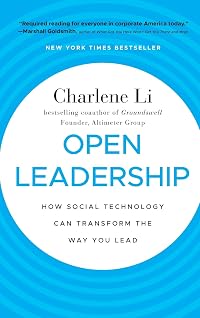
Charlene Li is founder and CEO of Altimeter Group and the author of the New York Times bestseller Open Leadership: How Social Technology Can Transform How You Lead. She is also the coauthor of the critically acclaimed, bestselling Groundswell: Winning in a World Transformed by Social Technologies, which was named one of the best business books in show more 2008. show less
5 Works 836 Members
Classifications
- Genres
- Technology, Business, Nonfiction, General Nonfiction
- DDC/MDS
- 303.4833 — Society, government, & culture Social sciences, sociology & anthropology Social processes Social change Causes of change Development of science and technology Communication
- LCC
- HC79 .I55 .L48 — Social sciences Economic history and conditions Economic history and conditions Special topics
- BISAC
Statistics
- Members
- 653
- Popularity
- 44,497
- Reviews
- 18
- Rating
- (3.78)
- Languages
- 7 — Danish, English, Finnish, French, German, Portuguese, Spanish
- Media
- Paper, Audiobook, Ebook
- ISBNs
- 14
- ASINs
- 6