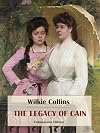
The Legacy of Cain
by Wilkie Collins
On This Page
Description
Are our morals imbued in us through teaching and example, or do we come into this world with our personality and values written in our genes? The Legacy of Cain is novelist Wilkie Collins' engrossing take on the age-old nature-or-nurture question. When a woman sentenced to death begs a man of the cloth to care for her soon-to-be-orphaned child, the situation presents itself as a profound conundrum: is the offspring inevitably doomed to repeat the sins and transgressions of its ancestors, or show more is there a chance for redemption?. show less
Tags
Recommendations


















Member Recommendations

Member Reviews
Wilkie Collins never disappoints with a good sensationalist plot, with the excuse of illustrating a scientific or social question - in this case, whether it's nurture or nature that builds character. Colllins complicates this (or has his cake and eats it) by drawing his two specimens, girls brought up together by a virtuous father, both from families where the mother is flawed. Cat fights galore, sinister nurses, an ineffectual lead easily swayed, the clang of the prison door, all add up to another sensational read
This is basically a sloppy treatise on the old nature v. nurture debate. Specifically inherited evil v. inculcated goodness. In the end though, Collins can't decide which is right and ends up making a case for both or neither depending on your outlook on life. Despite its fuzzy moralizing, it's an entertaining tale and well-paced. What makes it less-than-stellar in comparison to Collins's more famous works (The Woman in White and The Moonstone) is that the characters are lifeless stand-ins for moral positions and a lot of the action is just plain contrived for the sake of illustrating Collins' ideas of nature v. nurture. The journals are the most blatant example. Normally a journal is a pretty private affair, but not here. No, the show more journal keeping sisters share their writings and Helena even makes the monumentally dopey mistake of showing the Governor a synopsis of a story she liked featuring a poison murder plot. And overall the suspense and where-will-this-go-next quality just isn't there like it is with TWIW and TM.
Eunice is sweet, innocent and heart-breakingly wronged by Helena, who is scheming, back-biting and a temptress. Minister father has raised them to be the best of friends and through his educational strictures he keeps them as mindlessly ignorant of the world as it seems most Victorian women were; the proper ones anyway. Two hangers-on figure into the drama, but neither are much more than tools for the plot; neither of the women are important in themselves, only in what they do, see and report. That could have been done by anyone. And poor Philip is such a wet noodle devoid of any real personality. He's just a walk-on for romance and there's so little substance to him that I don't understand either girl's attraction. Sigh. Actually, I take it back that the hangers-on were just tools. They were interesting tools at least with more quirks and personality than any of the main players. Helena had moments though, her brazen coolness is pretty amazing at times (must be those illicit novels she sneaks). The Governor (who Helena amazes the most since daddy lost his marbles) is there to orchestrate the tale and to add reasons for the Minister's eventual slide into insanity.
Victorian madness is really interesting to me. So many of these tales have mentally weak, unstable or outright insane characters. I don't get it. How the heck do these people slip so easily from reality's grasp? Is it the same thing as our modern need for a panoply of psychoactive drugs like Wellbutrin and Prozac? Is it overwrought imagination? Literary device? Whatever it is I found the Minister's condition pretty funny, especially the knitting. I don't suppose that was Collins's intent and it probably horrified his contemporaries.
Oh and speaking of horror, what was with Eunice's laudanum-induced nightmare and sleep-walking business? That came out of the blue and was the very first real indication of which girl was which. I didn't like it though since it was so supernaturally stupid. I don't recall other incidents like this in his books, but since I've only read the two biggies plus this, maybe it's a habit. Was it supposed to be her mother's ghost? Inherited madness? Eh, it was kind of annoying and I don't think it needed to be in there. I did like the encore scene though when Eunice scares Helena away from Philip's room and back upstairs. Miss Jillgall certainly seemed horrified, too. I think that if Eunice didn't have the whispering voices or the nightmare, this same kind of protective/murderous instinct could have still been used.
You'd think from this that I didn't enjoy The Legacy of Cain, but I did. It was preachy and trying hard to be more morally ambiguous than most novels of its ilk, but it was enjoyable. That's because Collins knew how to spin a yarn. It follows his trademark use of multiple narrators and he gives each a distinct voice. The action comes at regular intervals interspersed by a little suspense and 'ah ha' moments that give the reader both satisfaction and a reason to keep reading. The requisite happy-ending is there, but the comeuppance for the villain is not, surprisingly. Maybe it's because it's a female villain this time and he felt he had to pull his punch for that reason. Certainly he made Percival Glyde pay for his crimes well enough.
Read more: http://thebookmarque.blogspot.com/2012/08/the-legacy-of-cain-by-wilkie-collins.h... show less
Eunice is sweet, innocent and heart-breakingly wronged by Helena, who is scheming, back-biting and a temptress. Minister father has raised them to be the best of friends and through his educational strictures he keeps them as mindlessly ignorant of the world as it seems most Victorian women were; the proper ones anyway. Two hangers-on figure into the drama, but neither are much more than tools for the plot; neither of the women are important in themselves, only in what they do, see and report. That could have been done by anyone. And poor Philip is such a wet noodle devoid of any real personality. He's just a walk-on for romance and there's so little substance to him that I don't understand either girl's attraction. Sigh. Actually, I take it back that the hangers-on were just tools. They were interesting tools at least with more quirks and personality than any of the main players. Helena had moments though, her brazen coolness is pretty amazing at times (must be those illicit novels she sneaks). The Governor (who Helena amazes the most since daddy lost his marbles) is there to orchestrate the tale and to add reasons for the Minister's eventual slide into insanity.
Victorian madness is really interesting to me. So many of these tales have mentally weak, unstable or outright insane characters. I don't get it. How the heck do these people slip so easily from reality's grasp? Is it the same thing as our modern need for a panoply of psychoactive drugs like Wellbutrin and Prozac? Is it overwrought imagination? Literary device? Whatever it is I found the Minister's condition pretty funny, especially the knitting. I don't suppose that was Collins's intent and it probably horrified his contemporaries.
Oh and speaking of horror, what was with Eunice's laudanum-induced nightmare and sleep-walking business? That came out of the blue and was the very first real indication of which girl was which. I didn't like it though since it was so supernaturally stupid. I don't recall other incidents like this in his books, but since I've only read the two biggies plus this, maybe it's a habit. Was it supposed to be her mother's ghost? Inherited madness? Eh, it was kind of annoying and I don't think it needed to be in there. I did like the encore scene though when Eunice scares Helena away from Philip's room and back upstairs. Miss Jillgall certainly seemed horrified, too. I think that if Eunice didn't have the whispering voices or the nightmare, this same kind of protective/murderous instinct could have still been used.
You'd think from this that I didn't enjoy The Legacy of Cain, but I did. It was preachy and trying hard to be more morally ambiguous than most novels of its ilk, but it was enjoyable. That's because Collins knew how to spin a yarn. It follows his trademark use of multiple narrators and he gives each a distinct voice. The action comes at regular intervals interspersed by a little suspense and 'ah ha' moments that give the reader both satisfaction and a reason to keep reading. The requisite happy-ending is there, but the comeuppance for the villain is not, surprisingly. Maybe it's because it's a female villain this time and he felt he had to pull his punch for that reason. Certainly he made Percival Glyde pay for his crimes well enough.
Read more: http://thebookmarque.blogspot.com/2012/08/the-legacy-of-cain-by-wilkie-collins.h... show less
In Legacy of Cain, my beloved Victorian author Wilkie Collins again takes a social/philosophical issue and builds his story around it. In Poor Miss Finch, it is blindness and society's perception of it. In No Name, it is the plight of illegitimate children. In this tale, it's the age-old question of nature versus nurture. It was fascinating to see which side is vindicated by the events of the story — though as usual, Collins lands somewhere in the middle, leaving the reader to interpret according to his wont.
In this story, a young and beautiful woman is about to be hanged for the coldblooded murder of her husband. She is not in the least remorseful, and the only living thing she cares for is her infant daughter. The prison chaplain show more despairs of her soul until she demands to see a Congregational minister she had once heard. When he comes, she offers a hard bargain: she will repent her sin if the minister will adopt her daughter as one of his own children, and never make known the child's criminal parentage. After some hesitation, the minister accepts the charge.
The prison doctor and the Governor then debate whether or not the child will inevitably inherit the murderous nature of her mother or if she will be more strongly influenced by the godly home of the minister. Collins also dwells on the possible horrors of living with this adopted daughter; if a child with such a heritage were angered by some parental correction, who knows but that she might not devise a murderous revenge? One's own home would not be safe. This is the responsibility the minister accepted when he took the child from the prison and from the infamy of her identity.
The tale is narrated first by the Governor of the prison, by the diaries of Eunice and Helena, and by various letters the characters write to one another. Each person's voice is believable and distinct. It was fascinating to see how Collins is able to change the reader's mind about a character, depending on who is currently telling the story. I also thought it brilliant how Collins never really tells us which of the girls is which. We figure it out eventually, of course, but Collins keeps us guessing.
Collins' characters are interesting. Miss Jillgall was probably one of the most interesting to me; she appears on the scene in the most disagreeable way possible — a Hyacinth Claire with none of her beauty or winning ways. But slowly we begin to realize that although Miss Jillgall is highly unpleasant on purpose, she only acts that way toward people who are unkind to her, and there is something better beneath the surface. I almost thought Miss Jillgall might end up married to the Governor, but it didn't happen.
Dorothy Sayers was not quite accurate in Gaudy Night when she says Collins was less of an author than Le Fanu because Collins always explains away the supernatural things that occur in his stories, while Le Fanu allows his to stand unexplained. There is a terrifying vision in this book and although it is aided by a sleeping drug, ultimately it is attributed to the evil spirit of the executed mother.
I wasn't really satisfied with Helena Gracedieu's ending. It was characteristic that she should rise to a position of some prominence, but she would have wanted revenge after what happened to her. I'm trying not to give too much away. Perhaps I'm really the one who wants revenge and justice, and what happens in the story doesn't seem quite bad enough for her. It's interesting too that Helena displays some signs of megalomania.
This isn't my favorite of Collins' works; the plot was a bit too loose in places for that, and the characters, though fascinating, were not really the kind I really felt I could cheer for wholeheartedly. There were a lot of lucky (or unlucky) coincidences that carried the story along, and sometimes the characters' motivations seemed a bit thin. I'm still not sure I have figured out why Mrs. Tenbruggen did what she did. But I'm not disappointed in the book. It kept me reading and thinking, and overall it's another exciting tale from a master storyteller. Recommended! show less
In this story, a young and beautiful woman is about to be hanged for the coldblooded murder of her husband. She is not in the least remorseful, and the only living thing she cares for is her infant daughter. The prison chaplain show more despairs of her soul until she demands to see a Congregational minister she had once heard. When he comes, she offers a hard bargain: she will repent her sin if the minister will adopt her daughter as one of his own children, and never make known the child's criminal parentage. After some hesitation, the minister accepts the charge.
The prison doctor and the Governor then debate whether or not the child will inevitably inherit the murderous nature of her mother or if she will be more strongly influenced by the godly home of the minister. Collins also dwells on the possible horrors of living with this adopted daughter; if a child with such a heritage were angered by some parental correction, who knows but that she might not devise a murderous revenge? One's own home would not be safe. This is the responsibility the minister accepted when he took the child from the prison and from the infamy of her identity.
The tale is narrated first by the Governor of the prison, by the diaries of Eunice and Helena, and by various letters the characters write to one another. Each person's voice is believable and distinct. It was fascinating to see how Collins is able to change the reader's mind about a character, depending on who is currently telling the story. I also thought it brilliant how Collins never really tells us which of the girls is which. We figure it out eventually, of course, but Collins keeps us guessing.
Collins' characters are interesting. Miss Jillgall was probably one of the most interesting to me; she appears on the scene in the most disagreeable way possible — a Hyacinth Claire with none of her beauty or winning ways. But slowly we begin to realize that although Miss Jillgall is highly unpleasant on purpose, she only acts that way toward people who are unkind to her, and there is something better beneath the surface. I almost thought Miss Jillgall might end up married to the Governor, but it didn't happen.
Dorothy Sayers was not quite accurate in Gaudy Night when she says Collins was less of an author than Le Fanu because Collins always explains away the supernatural things that occur in his stories, while Le Fanu allows his to stand unexplained. There is a terrifying vision in this book and although it is aided by a sleeping drug, ultimately it is attributed to the evil spirit of the executed mother.
I wasn't really satisfied with Helena Gracedieu's ending. It was characteristic that she should rise to a position of some prominence, but she would have wanted revenge after what happened to her. I'm trying not to give too much away. Perhaps I'm really the one who wants revenge and justice, and what happens in the story doesn't seem quite bad enough for her. It's interesting too that Helena displays some signs of megalomania.
This isn't my favorite of Collins' works; the plot was a bit too loose in places for that, and the characters, though fascinating, were not really the kind I really felt I could cheer for wholeheartedly. There were a lot of lucky (or unlucky) coincidences that carried the story along, and sometimes the characters' motivations seemed a bit thin. I'm still not sure I have figured out why Mrs. Tenbruggen did what she did. But I'm not disappointed in the book. It kept me reading and thinking, and overall it's another exciting tale from a master storyteller. Recommended! show less
highly decorative fron cover - staining of some sort on back cover, otherwise intact - scarce
Un asesinato. Un juicio. Una condena. Una mujer, madre de una niña, es ahorcada. Así se disponen las primeras piezas del engranaje. Helena y Eunice no son hermanas, aunque no lo saben. Una es la hija de la asesina; la otra de un predicador. Ambas se adoran. El destino, sin embargo, les deparará una sorpresa: ambas se enamorarán del mismo hombre. ¿Puede el amor tornarse en odio? ¿Puede ese odio conducir al crimen?
Jun 3, 2019Spanish
Intrigante, entretenido y divertido, pero el final es un poco apresurado.
Jun 24, 2011Spanish
Ratings
Members
- Recently Added By
Author Information

396+ Works 40,179 Members
Wilkie Collins was born in London, England on January 8, 1824. He worked first in business and then law, but eventually turned to literature. During his lifetime, he wrote 30 novels, more than 60 short stories, at least 14 plays, and more than 100 non-fiction pieces. His works include Antonia, The Woman in White, The Moonstone, The Haunted Hotel, show more and Heart and Science. He was a close friend of Charles Dickens and collaborated with him. He died on September 23, 1889. (Bowker Author Biography) show less
Series
Belongs to Publisher Series
Common Knowledge
- Canonical title
- The Legacy of Cain
- Original publication date
- 1888
- People/Characters
- Eunice Gracedieu; Helena Gracedieu; Selina Jillgall; Mrs. Tenbruggen; Philip Dunboyne
- Important places
- England, UK
Classifications
Statistics
- Members
- 109
- Popularity
- 298,961
- Reviews
- 6
- Rating
- (3.50)
- Languages
- English, Spanish
- Media
- Paper, Audiobook, Ebook
- ISBNs
- 54
- ASINs
- 13