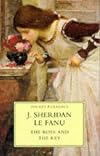
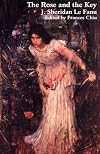
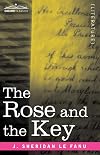
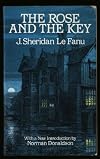
The Rose and the Key
by Sheridan Le Fanu
On This Page
Description
The foremost teller of scary stories in his day and a profound influence on both the novelists and filmmakers of the 20th century, Anglo-Irish author JOSEPH THOMAS SHERIDAN LE FANU (1814-1873) has, sadly, fallen out of scholarly and popular favor, and unfairly so. To this day, contemporary readers who happen across his works praise his talent for weaving a tense literary atmosphere tinged by the supernatural and bolstered by hints of ambiguous magic. A splendid instance of the "sensation show more novel"--a genre that was wildly popular in the Victorian era, with its focus on lurid crime invading previously cheerful, ordinary, and domestic places--this 1871 novel creates a sinister stew that encompasses obsessive love, a domineering mother, a menacing doctor, and a peek inside a lunatic asylum. A classic of Gothic terror, The Rose and the Key still horrifies readers today. With a series of new editions of Le Fanu's works, Cosimo is proud to reintroduce modern book lovers to the writings of the early master of suspense fiction who pioneered the concept of "psychological horror." show lessTags
Recommendations















Member Reviews
"You can't explain, or deny it—I am to infer that," persisted Antomarchi; "you can't."
"I can't—can I?—I can't—oh! what is it?—I feel so strangely." She shook her ears as if a fly was humming at them, and lifted her pretty fingers towards her temple vaguely. (344-45)
This incredibly dull novel focuses on a young woman who is wrongfully committed to a mental asylum (as the Victorians were always worried about); I read it as part of my project on Victorian scientists, curious about Doctor Antomarchi, the overseer of the asylum. Antomarchi might write some of the best papers in scientific journals (179), but he doesn't do much science-y stuff on the page. Mostly he's a malevolent mesmerist, as in the above passage, where he show more won't let our young hero say that she's not really suicidal, thanks to the malign power of his gaze. The actual asylum part is interesting, but it's just the last hundred pages or so in a four-hundred-page novel. Nothing that interesting happens prior to that; just people dancing and arguing. Not worth it at all.
(The introduction to my Valancourt edition is weird, spending dozens of pages telling you about Irish political history before it even gets to the novel. Establish a context for me to care before you begin going on about this! I tuned out long before she made any kind of claims about why knowing Irish political history would enhance my interpretation of the novel.) show less
"I can't—can I?—I can't—oh! what is it?—I feel so strangely." She shook her ears as if a fly was humming at them, and lifted her pretty fingers towards her temple vaguely. (344-45)
This incredibly dull novel focuses on a young woman who is wrongfully committed to a mental asylum (as the Victorians were always worried about); I read it as part of my project on Victorian scientists, curious about Doctor Antomarchi, the overseer of the asylum. Antomarchi might write some of the best papers in scientific journals (179), but he doesn't do much science-y stuff on the page. Mostly he's a malevolent mesmerist, as in the above passage, where he show more won't let our young hero say that she's not really suicidal, thanks to the malign power of his gaze. The actual asylum part is interesting, but it's just the last hundred pages or so in a four-hundred-page novel. Nothing that interesting happens prior to that; just people dancing and arguing. Not worth it at all.
(The introduction to my Valancourt edition is weird, spending dozens of pages telling you about Irish political history before it even gets to the novel. Establish a context for me to care before you begin going on about this! I tuned out long before she made any kind of claims about why knowing Irish political history would enhance my interpretation of the novel.) show less
While on holiday with an elderly relative, Maud Medwyn is stalked by a one-eyed preacher. When she returns home she is caught up in a plot to hide a terrible family secret.
It's clear who the Bad People are in this story - it's also clear that Something Dreadful will happen. The mystery lies in what the evil is, how it manifests and how the various Bad People fit into the story. The tension builds slowly but surely, with a gripping plot and terrifying villains. The speedy resolution comes more as a happy relief than a disappointment.
It's clear who the Bad People are in this story - it's also clear that Something Dreadful will happen. The mystery lies in what the evil is, how it manifests and how the various Bad People fit into the story. The tension builds slowly but surely, with a gripping plot and terrifying villains. The speedy resolution comes more as a happy relief than a disappointment.
Ratings
Members
- Recently Added By
Author Information

267+ Works 12,431 Members
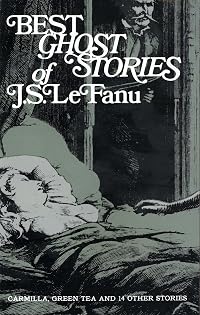
The greatest author of supernatural fiction during the nineteenth century was undoubtedly J. Sheridan Le Fanu. Le Fanu was born in Dublin and, as with so many other English popular fiction authors of his time, entered the genre of fiction by way of journalism, working on such publications as the Evening Mail and the Dublin University Magazine. Le show more Fanu came from a middle-class background; his family was of Huguenot descent. He graduated from Trinity College and married in 1844. After his wife died in 1858, until his own death, Le Fanu was known as a recluse, creating his ghost fiction late at night in bed. Probably he began writing ghost fiction in 1838; his earliest supernatural story is often cited as being either "The Ghost and the Bone-Setter" or the "Fortunes of Sir Robert Ardagh," both of which were later collected in the anthology entitled The Purcell Papers (1880). Writing most effectively in the short story form, Le Fanu's tales such as "Carmilla" (a vampire story that is thought possibly to have influenced Bram Stoker's Dracula) and the problematic "Green Tea" are considered by many literary scholars to be classics of the supernatural genre. His lengthy Gothic novels, such as Uncle Silas (1864), though less highly regarded than his shorter fiction, are nonetheless wonderfully atmospheric. Le Fanu's particular brand of literary horror tends toward the refined, subtle fright rather than the graphic sensationalism of Matthew Gregory Lewis. His work influenced other prominent horror fiction authors, including M. R. James. (Bowker Author Biography) show less
Some Editions
Series
Belongs to Publisher Series
Work Relationships
Common Knowledge
- Original publication date
- 1871
- First words
- The level light of a summer sunset, over a broad heath, is brightening its brown undulations with a melancholy flush, and turning all the stalks of heather in the foreground into twisted sticks of gold.
- Last words
- (Click to show. Warning: May contain spoilers.)Maximilla almost lives with her old friend Maud, and over the gateway of Warhampton stands, in well-chiselled relief, the time-honoured device of THE ROSE AND THE KEY.
Classifications
Statistics
- Members
- 106
- Popularity
- 306,458
- Reviews
- 2
- Rating
- (3.64)
- Languages
- English
- Media
- Paper, Ebook
- ISBNs
- 9
- ASINs
- 3