On This Page
Description
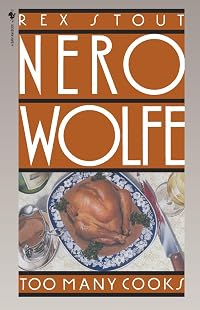
As Nero Wolfe prepares to speak at a gathering of the world’s great chefs, one is found indelicately murdered. When the target for killing shifts to himself, the great detective must close this case quickly or his next meal may be his last.World-class cuisine, charming company . . . The secret ingredient is poison.
Everyone knows that too many cooks spoil the broth, but you'd hardly expect it to lead to murder. But that's exactly what's on the menu at a five-star gathering of the show more world's greatest chefs. As guest of honor, Wolfe was lured from his brownstone to a posh southern spa to deliver the keynote address. He never expected that between courses of haute cuisine he and Archie would be compelled to detect a killer with a poison touch—a killer preparing to serve the great detective his last supper.
“It is always a treat to read a Nero Wolfe mystery. The man has entered our folklore.”—The New York Times Book.... show less
Tags
Recommendations



























Member Reviews
Yes, there’s a mystery, and yes, there are great characters here, and yes, there’s a fascinating lecture on North American cuisine. There is excellent Wolfe and Archie interaction, including a scene where Archie undresses Wolfe while comparing himself to the heroine of a gothic novel. But this is all not so much overshadowed as obliviated by the racism.
If you’re interested in how Nice White Liberals thought in the 1930s, this is the book for you. Stout was certainly a white liberal, and he definitely tried to be ... not horrible in this book, but oh my god how he failed. And at the end of the day, I read these books for Wolfe and Archie. I want to be able to like them, and I absolutely cannot do that when Archie is being show more hideously racist. So, as always, I’m rating this for the amount of fun I had reading it, which was essentially no fun at all. I was too busy recoiling. show less
If you’re interested in how Nice White Liberals thought in the 1930s, this is the book for you. Stout was certainly a white liberal, and he definitely tried to be ... not horrible in this book, but oh my god how he failed. And at the end of the day, I read these books for Wolfe and Archie. I want to be able to like them, and I absolutely cannot do that when Archie is being show more hideously racist. So, as always, I’m rating this for the amount of fun I had reading it, which was essentially no fun at all. I was too busy recoiling. show less
Six-word review: 1930s Southern racism makes story painful.
Extended review:
I've stated my opinion that an author oughtn't to be faulted for accurately reflecting prevailing or common views and attitudes of his or her own time and place; or, I suppose, of others' if faithfully represented. For every way in which social progress has improved conditions, there was a time before that progress in which views were held that we would now consider unacceptable; for example, demeaning attitudes toward women.
Several recent readings have tested my commitment to that opinion, most notably the novels of John Buchan (1910s) and Neville Shute (1940s), with their depiction of native Africans and Australians, respectively; or, more precisely, their show more depiction of white men's view of them. I've managed to read through the portions that are objectionable by today's standards, saying that people really did think and speak that way and that we shouldn't forget what it is that people have struggled to overcome.
Rex Stout's Too Many Cooks, however, exceeds my limits of tolerance. It is set in a Southern state in 1938, and the race of black Americans is a key issue in the plot. Even though the most offensive speech and behavior are expressed as those of characters belonging to that culture, the language of the narrator and various other characters throughout is simply too condescending, superior, and even contemptuous to be read with equanimity in 2016. Not only blacks but women and even Chinese come in for some heavy-handed stereotyping that is bound to choke most modern readers. Nero Wolfe makes a speech against racism and for justice:
"The ideal human agreement is one in which distinctions of race and color and religion are totally disregarded; anyone helping to preserve those distinctions is postponing that ideal...." (page 110)
but that is not enough to offset the effects of unapologetically racist representations expressed--perhaps even with harmless intent--throughout.
For that reason, even though the story is a good enough series mystery, solved by fair means--an interesting setup, and the clues are all present, but only Nero Wolfe puts them all together--I regret rereading this one and can't recommend it except to students of evolving social attitudes in the United States of the twentieth century. show less
Extended review:
I've stated my opinion that an author oughtn't to be faulted for accurately reflecting prevailing or common views and attitudes of his or her own time and place; or, I suppose, of others' if faithfully represented. For every way in which social progress has improved conditions, there was a time before that progress in which views were held that we would now consider unacceptable; for example, demeaning attitudes toward women.
Several recent readings have tested my commitment to that opinion, most notably the novels of John Buchan (1910s) and Neville Shute (1940s), with their depiction of native Africans and Australians, respectively; or, more precisely, their show more depiction of white men's view of them. I've managed to read through the portions that are objectionable by today's standards, saying that people really did think and speak that way and that we shouldn't forget what it is that people have struggled to overcome.
Rex Stout's Too Many Cooks, however, exceeds my limits of tolerance. It is set in a Southern state in 1938, and the race of black Americans is a key issue in the plot. Even though the most offensive speech and behavior are expressed as those of characters belonging to that culture, the language of the narrator and various other characters throughout is simply too condescending, superior, and even contemptuous to be read with equanimity in 2016. Not only blacks but women and even Chinese come in for some heavy-handed stereotyping that is bound to choke most modern readers. Nero Wolfe makes a speech against racism and for justice:
"The ideal human agreement is one in which distinctions of race and color and religion are totally disregarded; anyone helping to preserve those distinctions is postponing that ideal...." (page 110)
but that is not enough to offset the effects of unapologetically racist representations expressed--perhaps even with harmless intent--throughout.
For that reason, even though the story is a good enough series mystery, solved by fair means--an interesting setup, and the clues are all present, but only Nero Wolfe puts them all together--I regret rereading this one and can't recommend it except to students of evolving social attitudes in the United States of the twentieth century. show less
One of the more interesting Wolfe stories for two reasons. One is that he breaks most of his own rules in this one, spending no time at home in New York. More interestingly, this book tackles race more directly than any of his books I've read so far, and while there are some obvious racists in this book, Wolfe isn't one. I found it fascinating, especially because this is a book written in 1938,when the type of thinking that Wolfe has about black men was not at all prevalent.
Although private detective Nero Wolfe rarely leaves his New York brownstone, his reputation as a gourmand leads to an invitation to deliver the keynote address to an intimate gathering of the world’s greatest chefs. The book opens with Wolfe and his assistant, Archie Goodwin, on a train headed for the Kanawha Spa in West Virginia. From conversations on the train and at the spa after their arrival, it’s apparent that chef Philip Laszio is universally disliked. When Laszio is murdered while supervising a tasting contest, all clues point to one suspect. However, Wolfe realizes that there is more to this case than meets the eye. Will he survive long enough to expose the real killer?
This is the kind of impossible crime that made Wolfe show more such a famous fictional detective. The book was written in the Jim Crow era and set in the southern U.S., and several of the spa’s African American staff are crucial witnesses. While other characters in the book use highly offensive racial slurs for the African American service workers as well as for other ethnic minority characters, Wolfe never uses this offensive language, and he treats the African American staff with respect. show less
This is the kind of impossible crime that made Wolfe show more such a famous fictional detective. The book was written in the Jim Crow era and set in the southern U.S., and several of the spa’s African American staff are crucial witnesses. While other characters in the book use highly offensive racial slurs for the African American service workers as well as for other ethnic minority characters, Wolfe never uses this offensive language, and he treats the African American staff with respect. show less
Decent enough mystery story. Not stellar, just OK all round - enjoyable, just nothing that stands out among other books. The denouement doesn't have the force it should because there are too many named characters who don't really do anything but you need to be aware of - I honestly didn't really recognise the culprit and I got a couple of place names mixed up. I'm well aware this is more my own fault than the books, but I do feel it could have been pared down.
Also I feel it's important to note the way race is handled in this book is... dodgy. I can buy that the use of the n-word by several southern sheriffs is intended as character rather than endorsing the use of it, but the way Wolfe treats the black characters in the book is at best show more pretty patronising although it's clearly intended to be a "non-racist" contrast. In addition, "blacking up" is a plot point. It's not down-right awful, but it's definitely not very good. show less
Also I feel it's important to note the way race is handled in this book is... dodgy. I can buy that the use of the n-word by several southern sheriffs is intended as character rather than endorsing the use of it, but the way Wolfe treats the black characters in the book is at best show more pretty patronising although it's clearly intended to be a "non-racist" contrast. In addition, "blacking up" is a plot point. It's not down-right awful, but it's definitely not very good. show less
I have just completed the fifth Nero Wolfe mystery, Too Many Cooks by Rex Stout and believe me, reading a Nero Wolf novel is totally satisfying on many levels. The arrogant, gourmandizing sedentary sleuth that is Nero Wolf is a treat on his own, but add in his man-about-town, the suave Archie Goodwin, admired by the likes of Agatha Christie and P. G. Wodehouse, and you have characters that are a delight to read about.
This novel was originally published in 1938, and Nero Wolfe and Archie have travelled south to a five-star resort to attend the gathering of the world’s greatest chefs. As guest of honor, Wolfe is served both haute cuisine and murder. Reluctantly at first, Wolfe eventually decides he does need to solve this case.
At that show more time, much of the hotel staff were black and although Wolfe actually did address and deal with some of the outright and obvious prejudice, there was still a number of racial slurs and condescending speech about and towards these black characters. This brings thoughts of today’s policy of pulling these types of books from the shelves. I have mixed feelings about this, yes, it is distasteful to read, but how are we going to remember how hurtful this casual racism is and improve upon it if we don’t see where this type of prejudice comes from. I would rather books like this come with a foreword discussing the situation than to see them disappear.
Rex Stout delivers interesting, intricate mysteries that give the reader plenty to puzzle upon. The interplay between Wolfe and Archie make these books well worth picking up. I enjoyed Too Many Cooks and fully intend on continuing my exploration of this series. show less
This novel was originally published in 1938, and Nero Wolfe and Archie have travelled south to a five-star resort to attend the gathering of the world’s greatest chefs. As guest of honor, Wolfe is served both haute cuisine and murder. Reluctantly at first, Wolfe eventually decides he does need to solve this case.
At that show more time, much of the hotel staff were black and although Wolfe actually did address and deal with some of the outright and obvious prejudice, there was still a number of racial slurs and condescending speech about and towards these black characters. This brings thoughts of today’s policy of pulling these types of books from the shelves. I have mixed feelings about this, yes, it is distasteful to read, but how are we going to remember how hurtful this casual racism is and improve upon it if we don’t see where this type of prejudice comes from. I would rather books like this come with a foreword discussing the situation than to see them disappear.
Rex Stout delivers interesting, intricate mysteries that give the reader plenty to puzzle upon. The interplay between Wolfe and Archie make these books well worth picking up. I enjoyed Too Many Cooks and fully intend on continuing my exploration of this series. show less
Nero Wolfe’s grumpy under the best of circumstances, so imagine how grumpy the dour detective is in the wilds of West Virginia without his orchids, his personal chef, the niceties of his brownstone on West 35th Street! Wolfe was snarling from the moment he entered the train from New York to Kanawha, W.V., for a weekend with Les Quinze Maîtres, the finest chefs in the world. Needless to say, one of them will end up murdered — there wouldn’t be a detective novel otherwise, would there? — and Wolfe reluctantly agrees to discover who killed Philip Lazio, the reprobate who stole one chef’s wife, another chef’s job and, more or less, inspired hatred from the other top chefs.
I don’t know what it is about Nero Wolfe out of his show more element, be it this or The Black Mountain (where he goes to Yugoslavia), that makes the novels not as good as the ones set in New York City. (Incidentally, restauranteur Marko Vukcic, Wolfe’s bestie, from this novel also appears in The Black Mountain.) But I found Too Many Cooks to drag quite a bit until Lazio’s murdered, and drag after Lazio’s stabbed in the back, although much less than before. Not as good as author Rex Stout’s usual fare, but still better than most authors routinely publish. show less
I don’t know what it is about Nero Wolfe out of his show more element, be it this or The Black Mountain (where he goes to Yugoslavia), that makes the novels not as good as the ones set in New York City. (Incidentally, restauranteur Marko Vukcic, Wolfe’s bestie, from this novel also appears in The Black Mountain.) But I found Too Many Cooks to drag quite a bit until Lazio’s murdered, and drag after Lazio’s stabbed in the back, although much less than before. Not as good as author Rex Stout’s usual fare, but still better than most authors routinely publish. show less
Members
- Recently Added By
Lists

Crime and Mysteries to Read
746 works; 31 members

Barzun and Taylor's Classics of Crime
93 works; 3 members

Detective Stories
343 works; 5 members

A Smorgasbord of Culinary Fiction
221 works; 94 members

Must Read Detective Stories (Nick Fuller)
278 works; 2 members

Michael Dirda's 100 Best Comic Novels
100 works; 1 member
Author Information

376+ Works 50,368 Members
Author Rex Stout was born on December 1, 1886. A child prodigy with a gift for mathematics, Stout drifted as he became an adult, holding odd jobs in many places---cook, cabinetmaker, bellhop, hotel manager, salesman, bookkeeper, and even a guide in a pueblo. But his true talent lay in storytelling; he sold his first story, about William Howard show more Taft, in 1912. His most famous creation is Nero Wolfe, a 286-pound detective genius who, with sidekick Archie Goodwin, can often solve a case without leaving his room. It is the way in which the puzzle is solved that intrigues Nero Wolfe, who is much like Sherlock Holmes in his ability to use deductive reasoning. More than 60 million copies (in 24 languages) of Stout's books have been sold. Stout writes quickly, drawing upon a lifetime of impressions. He neither uses an outline nor revises; he lets his characters take over as the story develops. The classy, erudite Nero Wolfe presents for readers an alternative to the hard-boiled branch of the genre. He died on October 27, 1975 (Bowker Author Biography) show less

Rex Stout has a Legacy Library. Legacy libraries are the personal libraries of famous readers, entered by LibraryThing members from the Legacy Libraries group.
Some Editions
Awards and Honors
Distinctions
Series

Belongs to Publisher Series
Work Relationships
Common Knowledge
- Canonical title
- Too Many Cooks
- Original title
- Too Many Cooks
- Original publication date
- 1938
- People/Characters
- Jerome Berin; Archie Goodwin; Marko Vukcic; Nero Wolfe; Constanza Berin; Barry Tolman
- Important places
- Kanawha Spa, West Virginia, USA
- First words
- Walking up and down the platform alongside the train in the Pennsylvania Station, having wiped the sweat from my brow, I lit a cigarette with the feeling that after it had calmed my nerves a little I would be prepared to subm... (show all)it bids for a contract to move the Pyramid of Cheops from Egypt to the top of the Empire State Building with my bare hands, in a swimming suit; after what I had just gone through.
- Last words
- (Click to show. Warning: May contain spoilers.)Then I went over and picked up his morning paper and sat down where he had been.
- Original language*
- Inglese
*Some information comes from Common Knowledge in other languages. Click "Edit" for more information.
Classifications
Statistics
- Members
- 1,095
- Popularity
- 23,276
- Reviews
- 36
- Rating
- (3.90)
- Languages
- 14 — Danish, Dutch, English, Estonian, Finnish, French, German, Italian, Norwegian (Bokmål), Norwegian, Portuguese, Russian, Spanish, Swedish
- Media
- Paper, Audiobook, Ebook
- ISBNs
- 47
- UPCs
- 3
- ASINs
- 30