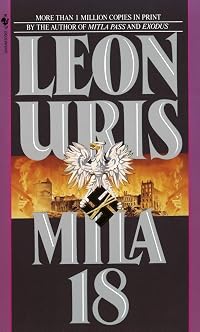
Mila 18
by Leon Uris
On This Page
Description
It was a time of crisis, a time of tragedy--and a time of transcendent courage and determination. Leon Uris's blazing novel is set in the midst of the ghetto uprising that defied Nazi tyranny, as the Jews of Warsaw boldly met Wehrmacht tanks with homemade weapons and bare fists. Here, painted on a canvas as broad as its subject matter, is the compelling of one of the most heroic struggles of modern times.Tags
Recommendations






















Member Recommendations
Member Reviews
I just read 3 World War II Holocaust survivor books- back to back. "Mila" 18 is a fictional account of life in the Warsaw Ghetto. The story begins in 1939 as Germany invades Poland and ends a few years later with the Jewish uprising and the final liquidation. Mila 18 is actually a street address in the Warsaw ghetto – the location of the underground headquarters bunker of the Jewish resistance where the final battle took place.
The 2nd book is a memoir titled "The Survivor" by Jack Eisner. Eisner himself, not only managed to survive the Warsaw ghetto uprising, but also survived a death march, the infamous cattle car ride to the Majdanek concentration camp, a failed escape that resulted in a near death beating, and life in the Budzyn show more labor camp and Flossenburg concentration camp- both of these also extermination facilities.
The 3rd book is also a memoir titled "For Those I Loved" by Martin Gray. However, there have been reputable sources proclaiming not every detail in Gray’s book are accurate. A ghost writer- Max Gallo- a well-known French journalist and author of both biographies and fiction actually penned the story. Perhaps Mr. Gallo embellished some of the details. Such speculation is a shame because it casts doubt on Gray’s entire story. He went by the nick-name Mietek in parts of the story and Jack Eisner (of The Survivor) recalls knowing someone of that name. Martin Gray was authentically documented as part of the group of partisans who fought the Nazi’s from hidden camps within the forests of Poland. Following the Russian invasion of Poland, Gray joined the Red Army to assist in capturing Nazi leaders.
But let us get back to "Mila 18". One question that stayed with me throughout the story was, just how fictional was Uris’s story? Don’t you always wonder that when reading historic fiction? Thus, the main purpose for immediately reading several memoirs was to compare fact to fiction. Leon Uris clearly did an immense amount of research. It surprised me how closely the story correlated with the memoirs – including many of the same people, same streets, and same details of events. And to my surprise, "Mila 18" was an understatement of the horrors Jewish people experienced. Even Christians who aided Jewish friends and neighbors- or showed the least bit of sympathy- were tortured and killed.
The amazing thing about Leon Uris’s writing is his capacity to take real events, real facts, many of the real people who lived through this catastrophic time in history, and tell a fictional tale that reeks with authenticity and heart-felt emotion… including people of various cultures and backgrounds: Polish peasants, Jewish heroes, cruel Nazi war mongers, assorted street thugs, journalists, revolutionaries and the Zionist Underground. Portions of the story are told from the point of view of powerful German Nazis leaders as well, graphically showing the reader the barbaric, monstrous mentality of the Nazis.
Uris explores the mental anguish and guilt experienced by both Jews and Gentiles. To succumb to Nazi orders and assist in evil deeds, or even turn ones back and pretend not to see gave the appearance of collaboration with the Nazis. But to helplessly fight or openly defy the Nazis was sure death and a risk to all family members and loved ones.
Leon Uris is a wonderful storyteller. He explains in detail how the revolt in the ghetto occurred. He interweaves facts about the Jewish faith and the Zionists. He does a phenomenal job of character development and tells the age-old story of good against evil. "Mila 18" is an incredible story of faith, hope, honor, dedication, love, perseverance, and determination. Even though the Warsaw ghetto uprising had a tragic ending, it was impossible to read this story without praying for the victims, hoping that somehow, through a miracle that some of them would escape.
The only somewhat neutralizing thing about "Mila 18" is this: By being regarded as a fictional account of the true catastrophe, some delusional or perhaps wicked people on this earth will deny the Holocaust ever happened. Thus, fictional accounts can sometimes lead readers to believe the entire event never really happened. show less
The 2nd book is a memoir titled "The Survivor" by Jack Eisner. Eisner himself, not only managed to survive the Warsaw ghetto uprising, but also survived a death march, the infamous cattle car ride to the Majdanek concentration camp, a failed escape that resulted in a near death beating, and life in the Budzyn show more labor camp and Flossenburg concentration camp- both of these also extermination facilities.
The 3rd book is also a memoir titled "For Those I Loved" by Martin Gray. However, there have been reputable sources proclaiming not every detail in Gray’s book are accurate. A ghost writer- Max Gallo- a well-known French journalist and author of both biographies and fiction actually penned the story. Perhaps Mr. Gallo embellished some of the details. Such speculation is a shame because it casts doubt on Gray’s entire story. He went by the nick-name Mietek in parts of the story and Jack Eisner (of The Survivor) recalls knowing someone of that name. Martin Gray was authentically documented as part of the group of partisans who fought the Nazi’s from hidden camps within the forests of Poland. Following the Russian invasion of Poland, Gray joined the Red Army to assist in capturing Nazi leaders.
But let us get back to "Mila 18". One question that stayed with me throughout the story was, just how fictional was Uris’s story? Don’t you always wonder that when reading historic fiction? Thus, the main purpose for immediately reading several memoirs was to compare fact to fiction. Leon Uris clearly did an immense amount of research. It surprised me how closely the story correlated with the memoirs – including many of the same people, same streets, and same details of events. And to my surprise, "Mila 18" was an understatement of the horrors Jewish people experienced. Even Christians who aided Jewish friends and neighbors- or showed the least bit of sympathy- were tortured and killed.
The amazing thing about Leon Uris’s writing is his capacity to take real events, real facts, many of the real people who lived through this catastrophic time in history, and tell a fictional tale that reeks with authenticity and heart-felt emotion… including people of various cultures and backgrounds: Polish peasants, Jewish heroes, cruel Nazi war mongers, assorted street thugs, journalists, revolutionaries and the Zionist Underground. Portions of the story are told from the point of view of powerful German Nazis leaders as well, graphically showing the reader the barbaric, monstrous mentality of the Nazis.
Uris explores the mental anguish and guilt experienced by both Jews and Gentiles. To succumb to Nazi orders and assist in evil deeds, or even turn ones back and pretend not to see gave the appearance of collaboration with the Nazis. But to helplessly fight or openly defy the Nazis was sure death and a risk to all family members and loved ones.
Leon Uris is a wonderful storyteller. He explains in detail how the revolt in the ghetto occurred. He interweaves facts about the Jewish faith and the Zionists. He does a phenomenal job of character development and tells the age-old story of good against evil. "Mila 18" is an incredible story of faith, hope, honor, dedication, love, perseverance, and determination. Even though the Warsaw ghetto uprising had a tragic ending, it was impossible to read this story without praying for the victims, hoping that somehow, through a miracle that some of them would escape.
The only somewhat neutralizing thing about "Mila 18" is this: By being regarded as a fictional account of the true catastrophe, some delusional or perhaps wicked people on this earth will deny the Holocaust ever happened. Thus, fictional accounts can sometimes lead readers to believe the entire event never really happened. show less
It has been a very long time since I read this book. It had a profound effect on me, and for that I have marked it as amazing. Though I'm not certain how fond I would be of it now, I think that it made me search my soul for certain answers about humanity, its strengths and weaknesses. In short it is about war, genocide, the human spirit, and taking a stand even when you know the action is futile. Though, as I've recently read in another book, wouldn't it be far less meaningful if we knew that we would prevail in our efforts against death in its finality?
Een boek dat iedereen zo moeten lezen, opdat wij de waarheid nooit vergeten. Een boek over de verschrikkingen in het getto van Warschau, maar ook over de moed, de kracht en saamhorigheid van de bewoners.
Door te vechten kregen de Joodse inwoners hun gevoel van eigenwaarde weer terug. Hoewel de personages in dit boek fictief zijn, zijn de setting en de achtergronden van het boek wel degelijk op waarheid gebaseerd.
Door te vechten kregen de Joodse inwoners hun gevoel van eigenwaarde weer terug. Hoewel de personages in dit boek fictief zijn, zijn de setting en de achtergronden van het boek wel degelijk op waarheid gebaseerd.
After writing "Exodus", Leon Uris produced this novel, also a description of Jewish heroism. Warsaw, capital of Poland was the site of two uprisings against the German occupation. While the one in 1944, when the bulk of the city was finally destroted by the German army while the Russian Army sat just outside town, watching rather than assisting the Polish uprising, this work deals with the earlier uprising in 1943 when the Warsaw ghetto rose up and died fighting rather than be deported to the labour and extermination camps. The tale is compelling and well written. The Polish resistance did not aid the earlier uprising, either.
M18 is a fictionalized account of the almost forgotten Warsaw Uprising of 1943. Rich and resonant characters and a gripping narrative make this a wonderful and fast read. After QB7 this is my favorite Uris novel. So many of his books play a critical role in making important historical events accessible to readers who prefer human stories.
My favorite aspect of Uris's writing is his multidimensional characters. He has a knack for making people in heroic positions imperfect, just as all heroes are imperfect. That makes the stories so real and exciting that it is hard to put the books down.
My favorite aspect of Uris's writing is his multidimensional characters. He has a knack for making people in heroic positions imperfect, just as all heroes are imperfect. That makes the stories so real and exciting that it is hard to put the books down.
A compelling book about the Warsaw Ghetto during World War II. Not an enjoyable book to read, but very important to get some insight into the terror that the Germans/Nazis inflicted on the people they conquered, especially on the Jews.
The story focuses on a small group of people who show immense leadership and courage (and on a few other who did not).
One thing I do not understand is that there are two characters who appear at the start of the book, and one gets the impression that they will stay central to the story - yet they drift in and out of the narrative, and in the end become almost incidental.
The story focuses on a small group of people who show immense leadership and courage (and on a few other who did not).
One thing I do not understand is that there are two characters who appear at the start of the book, and one gets the impression that they will stay central to the story - yet they drift in and out of the narrative, and in the end become almost incidental.
Remember the read. Here's what I wrote after reading in 1983: "Another great. Technically fiction, yet based on the true events in Warsaw during the Nazi occupation of WWII. Special treatment given to the Jewish ghetto and to the brave men and women who lived therein. Why did the world let these things happen?
Members
- Recently Added By
Lists

Stories of War and Revolution
160 works; 55 members

Books about World War II
241 works; 22 members

discontinued
24 works; 4 members

Publisher's Weekly Bestsellers - Part II - 1940 - 1979
355 works; 6 members
Author Information

46+ Works 21,189 Members
Writer Leon Uris was born in Baltimore on August 3, 1924. He dropped out of school to join the Marines during World War II, but later returned to attend Baltimore City College. His first novel, Battle Cry (1953), was based on his time as a marine. He followed it with a series of New York Times bestsellers, including The Angry Hills, Exodus, Topaz, show more and Trinity. QB VII was adapted into a TV mini-series starring Ben Gazzara and Anthony Hopkins. Uris has also written non-fiction (including Ireland: A Terrible Beauty and Jerusalem: Song of Songs) and screenplays (Battle Cry and Gunfight at the O. K. Corral). He has won the John F. Kennedy Memorial Award from the Irish-American Society and the Scopus Award from the Hebrew University in Jerusalem. (Bowker Author Biography) show less
Some Editions
Awards and Honors
Distinctions
Work Relationships
Is contained in
Contains
Common Knowledge
- Canonical title
- Mila 18
- Original title
- Mila 18
- Original publication date
- 1961
- Important places
- Warsaw, Poland; Warsaw Ghetto; 18 Mila Street, Warsaw, Poland; Poland
- Important events
- Warsaw Ghetto Uprising; World War II
- Dedication
- Dit boek wordt opgedragen aan Antek-Itzhak Zuckerman, Ziviah Lubetkin en de anderen die een aandeel hebben bijgedragen in gebeurtenissen van groot gewicht ten behoeve van de menselijke waardigheid en de vrijheid, maar in het ... (show all)bijzonder aan Dr. Israel I. Blumenfeld
This book is dedicated to Antek-Itshak Zuckerman, Ziviah Lubetkin and the others who participated in an immortal moment in behalf of human dignity and freedom, and to one in particular, Dr. Isreal I. Blumenfeld - First words
- Journal Entry--August 1939
This is the first entry in my journal. I cannot help but feel that the war will begin in a few weeks. If the lessons of the past three years are any barometer, something awesome is apt to happe... (show all)n if Germany makes a successful invasion. what with three and a half million Jews in Poland. Perhaps the tensions of the moment are making me overdramatic. My journal may prove completely worthless and a waste of time. Yet, as a historian, I must satisfy the impulse to record what is happening around me.
ALEXANDER BRANDEL - Last words
- (Click to show. Warning: May contain spoilers.)And what is more, we Jews have avenged our honor as a people.
- Original language*
- Inglese
- Canonical DDC/MDS
- 813.54
- Canonical LCC
- PS3541.R46
*Some information comes from Common Knowledge in other languages. Click "Edit" for more information.
Classifications
Statistics
- Members
- 2,016
- Popularity
- 10,464
- Reviews
- 28
- Rating
- (4.02)
- Languages
- 16 — Danish, Dutch, English, Finnish, French, German, Hungarian, Italian, Norwegian (Bokmål), Polish, Portuguese, Russian, Serbian, Sinhalese, Spanish, Swedish
- Media
- Paper, Audiobook, Ebook
- ISBNs
- 52
- ASINs
- 41