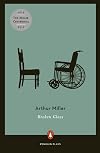
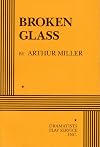
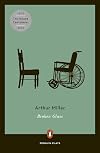
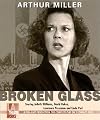
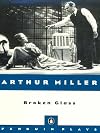
Broken Glass
by Arthur Miller
On This Page
Description
This 1994 Broadway play mixes Freudian ideals with human weakness as Sylvia Gellburg becomes paralyzed after learning of the pogroms in Nazi Germany. Her husband, Phillip has a stroke after an argument with his boss. Together, with the help of their doctor, the couple discovers that their ailing marriage may be to blame.Tags
Recommendations






















Member Reviews
The juxtaposition of the rise of nazism with a failing marriage, with the themes of jewish identity, self-hate, love triangles and by implication impotence and denial all sounds like someone pulled trusty theatre clichés out of a hat and tried putting it together. The performances are great, but the material is so hackneyed it made me wince.
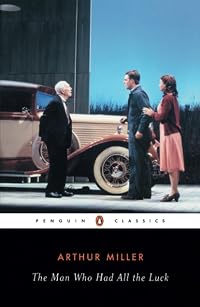
Arthur Miller, it’s me, not you. I realize that Broken Glass, nominated for the Tony Award in 1994, is obviously a searing work revealing — something. Like everyone else, I read The Crucible and The Death of a Salesman in high school, and I adored both plays. Even a naïf like me could see the symbolism, the meaning, the perfection. In my 40s and 50s, I read The Man Who Had All the Luck and Incident at Vichy, and I enjoyed both.
But I don’t get Broken Glass.
Sylvia Gellburg is married to the kind of man who thinks changing his name to Gellburg makes him sound less Jewish, although that was something that quite a few Jews wanted in 1938 — even in Brooklyn. All of sudden, Sylvia collapses and can no longer walk. Her visits from show more handsome Dr. Harry Hyman uncover a lot more than a medical diagnosis.
Sylvia’s ailment is clearly psychosomatic — something Dr. Hyman realizes even if Sylvia refuses to. The partial paralysis began shortly after the climate for Jews in Nazi Germany took another turn for the worse with Kristallnacht. Sylvia’s husband, Philip Gellburg, thinks that obsessing about German Jews is causing her sickness; Dr. Hyman blames Philip’s treatment; Sylvia’s sister thinks the cause dates to the early days of the Gellburgs’ marriage. Who’s right? And what does it mean? I still don’t know. show less
But I don’t get Broken Glass.
Sylvia Gellburg is married to the kind of man who thinks changing his name to Gellburg makes him sound less Jewish, although that was something that quite a few Jews wanted in 1938 — even in Brooklyn. All of sudden, Sylvia collapses and can no longer walk. Her visits from show more handsome Dr. Harry Hyman uncover a lot more than a medical diagnosis.
Sylvia’s ailment is clearly psychosomatic — something Dr. Hyman realizes even if Sylvia refuses to. The partial paralysis began shortly after the climate for Jews in Nazi Germany took another turn for the worse with Kristallnacht. Sylvia’s husband, Philip Gellburg, thinks that obsessing about German Jews is causing her sickness; Dr. Hyman blames Philip’s treatment; Sylvia’s sister thinks the cause dates to the early days of the Gellburgs’ marriage. Who’s right? And what does it mean? I still don’t know. show less
Cast: Jane Brucker, David Dukes, Lawrence Pressman, Linda Purl, John Vickery, JoBeth Williams.
Description: Set in 1938 Brooklyn, this gripping psychological mystery begins when attractive, level-headed Sylvia Gellburg suddenly loses her ability to walk. The only clue lies in Sylvia’s obsession with news accounts from Germany. Though safe in Brooklyn, Sylvia is terrified by Nazi violence - or is it something closer to home?
Description: Set in 1938 Brooklyn, this gripping psychological mystery begins when attractive, level-headed Sylvia Gellburg suddenly loses her ability to walk. The only clue lies in Sylvia’s obsession with news accounts from Germany. Though safe in Brooklyn, Sylvia is terrified by Nazi violence - or is it something closer to home?
Ratings
Members
- Recently Added By
Lists

Troublesome bodies
110 works; 7 members
Author Information

194+ Works 43,229 Members
The son of a well-to-do New York Jewish family, Miller graduated from high school and then went to work in a warehouse. He was born on October 17, 1915, in Harlem, New York City. His plays have been called "political," but he considers the areas of literature and politics to be quite separate and has said, "The only sure and valid aim---speaking show more of art as a weapon---is the humanizing of man." The recurring theme of all his plays is the relationship between a man's identity and the image that society demands of him. After two years, he entered the University of Michigan, where he soon started writing plays. All My Sons (1947), a Broadway success that won the New York Drama Critics Circle Award in 1947, tells the story of a son, home from the war, who learns that his brother's death was due to defective airplane parts turned out by their profiteering father. Death of a Salesman (1949), Miller's experimental yet classical American tragedy, received both the Pulitzer Prize and the New York Drama Critics Circle Award in 1949. It is a poignant statement of a man facing himself and his failure. In The Crucible (1953), a play about bigotry in the Salem witchcraft trials of 1692, Miller brings into focus the social tragedy of a society gone mad, as well as the agony of a heroic individual. The play was generally considered to be a comment on the McCarthyism of its time. Miller himself appeared before the Congressional Un-American Activities Committee and steadfastly refused to involve his friends and associates when questioned about them. His screenplay for The Misfits (1961), from his short story, was written for his second wife, actress Marilyn Monroe (see Vol. 3); After the Fall (1964) has clear autobiographical overtones and involves the story of this ill-fated marriage as well as further dealing with Miller's experiences with McCarthyism. In the one-act Incident at Vichy (1964), a group of men are picked off the streets one morning during the Nazi occupation of France. The Price (1968) is a psychological drama concerning two brothers, one a police officer, one a wealthy surgeon, whose long-standing conflict is explored over the disposal of their father's furniture. The Creation of the World and Other Business (1973) is a retelling of the story of Genesis, attempted as a comedy. The American Clock (1980) explores the impact of the Depression on the nation and its individual citizens. Among Miller's most recent works is Danger: Memory! (1987), a study of two elderly friends. During the 1980s, almost all of Miller's plays were given major British revivals, and the playwright's work has been more popular in Britain than in the United States of late. Miller died of heart failure after a battle against cancer, pneumonia and congestive heart disease at his home in Roxbury, Connecticut. He was 89 years old. (Bowker Author Biography) Arthur Miller, American playwright, was born on October 17, 1915, in New York City. He earned an AB from the University of Michigan and began to write plays while still a student. He won the first of his many awards, the Avery Hopwood Prize of the University of Michigan, for his first play, Honors at Dawn. This was followed by many other award-winning plays. One of the best-known of these, Death of a Salesman, won the Pulitzer Prize in Drama in 1949 as well as a Drama Critics Circle Award; it continues to be one of the most frequently performed and adapted plays of this century. Some of his other titles include The Crucible, A View From the Bridge, The Misfits, After the Fall, and Vichy. Miller also wrote several travel pieces, including In Russia and Chinese Encounters (both in collaboration with his third wife, Ingeborg Morath); a novel, Focus; and the autobiography, Timebends: A Life. Arthur Miller was married to Mary Grace Slattery in 1940. They had two children and were divorced in 1952. In 1956, he married actress Marilyn Monroe and they divorced in 1961. He married Morath in 1962 and they have two children together. (Bowker Author Biography) show less
Awards and Honors
Awards
Work Relationships
Is contained in
Common Knowledge
- Canonical title
- Broken Glass
- Original title
- Broken Glass
- Original publication date
- 1994
- People/Characters
- Sylvia Gellburg; Phillip Gellburg; Harry Hyman; Margaret Hyman; Harriet; Stanton Case
- Important places
- Brooklyn, New York, New York, USA; New York, New York, USA; New York, USA
- Important events
- Kristallnacht (1938)
- Related movies
- Broken Glass (1996 | IMDb)
Classifications
Statistics
- Members
- 161
- Popularity
- 204,173
- Reviews
- 4
- Rating
- (3.29)
- Languages
- English, German, Hungarian
- Media
- Paper, Audiobook, Ebook
- ISBNs
- 18
- UPCs
- 1
- ASINs
- 2