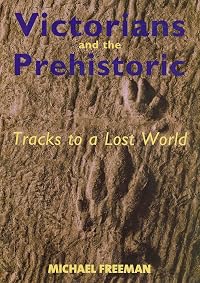
Victorians and the Prehistoric: Tracks to a Lost World
by Michael Freeman
On This Page
Description
As the Victorians excavated the earth to create canals and railways in the early part of the nineteenth century, geological discoveries brought to light new narratives of the prehistoric, ideas that resounded in British society, art, and literature of the period. This engaging and generously illustrated book explores the Victorian fascination with all things prehistoric. Michael Freeman shows how men and women were both energized and unsettled by the realization that the formation of the show more earth over hundreds of millions of years and Darwin’s theories about the origins of life contradicted what they had read in the Bible. He describes the rock and fossil collecting craze that emerged, the sources of inspiration and imagery discovered by writers and artists, and the new importance of geologists and paleontologists. He also discusses the cathedral-like museums that sprang up in cities and towns, shrines to all that was progressive in the age but still clothed in the trappings of traditional ideas. show lessTags
Recommendations















Member Reviews
This book is dense with detail, but pretty readable anyway, in that the details matter less than the overall story that Freeman is building. Freeman is a professor of geography, and the book apparently emerged from a previous project about railways:
It was appropriate that I read the book so soon after finishing the anthology of nineteenth-century apocalyptic fiction, The End of the World, because the kind of perception of "deep time" that made those stories imaginable came from the scientific advances that Freeman chronicles here. There's a lot of good stuff in this book, but Freeman is at his best when discussing that change in the "time-worlds," how in the nineteenth century we went from seeing the world as six thousand years old to untold millions, and how the new vision of the past was filled with a constant stream of upheavals and extinctions and apocalypses. (Of course, H. G. Wells—also briefly discussed by Freeman—gave us the greatest Victorian depiction of deep time of them all in The Time Machine.)
There's some great artwork illustrating the new imagination. I was particularly struck by J. C. Bourne's sketch of the Blisworth cutting from 1838 (scroll down a bit here to see it), which really uses perspective effectively, and juxtaposes the new technology of the train with the antiquity of the strata. I also really liked John Martin's The Great Day of His Wrath (1852); surely there is a straight line from this to the kind of apocalyptic fiction that emerged in the 1870s and '80s. Freeman effectively chronicles how popular this all was; these were no abstract scientific debates, but bestselling books. Geology was a popular pastime. I found his discussion of how Darwin's ideas about time emerged from this new geological understanding particularly effective. Overall, I found this a quick, easy read, and given my own research interests, I wish I had read it earlier. show less
The task of railways excavation brought surveyors, engineers and navvies face to face with a perspective on earth history that was as raw as it was vast. As contractors' gangs cut their way through successive bands of rock to try to make for a level permanent way, they exposed not only sedimentary formations in all their rainbow-like hues... but fossil beds by the score. Just as the speed of railway travel turned the Victorians' everyday time-world upside down (what once seemed quick becameshow more
slow in comparison), so the view from the track-bed opened their eyes to a succession of long-lost time-worlds, hitherto the province of fable and fairy story. (vii)(Freeman does briefly discuss Thomas Hardy, and you can see both of those new time worlds in his work; in novels like Jude the Obscure, the countryside is criss-crossed so quickly in a way not possible in earlier Hardy novels, while in A Pair of Blue Eyes, you have the immensity of all time embodied in a trilobite.)
It was appropriate that I read the book so soon after finishing the anthology of nineteenth-century apocalyptic fiction, The End of the World, because the kind of perception of "deep time" that made those stories imaginable came from the scientific advances that Freeman chronicles here. There's a lot of good stuff in this book, but Freeman is at his best when discussing that change in the "time-worlds," how in the nineteenth century we went from seeing the world as six thousand years old to untold millions, and how the new vision of the past was filled with a constant stream of upheavals and extinctions and apocalypses. (Of course, H. G. Wells—also briefly discussed by Freeman—gave us the greatest Victorian depiction of deep time of them all in The Time Machine.)
There's some great artwork illustrating the new imagination. I was particularly struck by J. C. Bourne's sketch of the Blisworth cutting from 1838 (scroll down a bit here to see it), which really uses perspective effectively, and juxtaposes the new technology of the train with the antiquity of the strata. I also really liked John Martin's The Great Day of His Wrath (1852); surely there is a straight line from this to the kind of apocalyptic fiction that emerged in the 1870s and '80s. Freeman effectively chronicles how popular this all was; these were no abstract scientific debates, but bestselling books. Geology was a popular pastime. I found his discussion of how Darwin's ideas about time emerged from this new geological understanding particularly effective. Overall, I found this a quick, easy read, and given my own research interests, I wish I had read it earlier. show less
A good introduction to the Victorian interest in geology, paleontology, evolution, &c. Well illustrated throughout.
Ratings
Members
- Recently Added By
Author Information
2 Works 74 Members
Classifications
Statistics
- Members
- 26
- Popularity
- 1,040,791
- Reviews
- 2
- Rating
- (3.25)
- Languages
- English
- Media
- Paper
- ISBNs
- 1