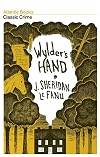
Wylder's Hand
by Joseph Sheridan Le Fanu
On This Page
Description
Wylder's Hand is a novel from Gothic and mystery writer Sheridan Le Fanu. "There was a little fair-haired child playing on the ground before the steps as I whirled by. The old rector had long passed away; the shorts, gaiters, and smile -- a phantom; and nature, who had gathered in the past, was providing for the future. The pretty mill-road, running up through Redman's Dell, dank and dark with tall romantic trees, was left behind in another moment; and we were now traversing the homely and show more antique street of the little town, with its queer shops and solid steep-roofed residences. Up Church-street I contrived a peep at the old gray tower where the chimes hung; and as we turned the corner a glance at the "Brandon Arms." How very small and low that palatial hostelry of my earlier recollections had grown! There were new faces at the door. It was only two-and-twenty years ago, and I was then but eleven years old. A retrospect of a score of years or so, at three-and-thirty, is a much vaster affair than a much longer one at fifty. The whole thing seemed like yesterday; and as I write, I open my eyes and start and cry, "can it be twenty, five-and-twenty, aye, by Jove! five-and-thirty, years since then?" How my days have flown! And I think when another such yesterday shall have arrived, where shall I be?". show less
Tags
Recommendations
























Member Recommendations

Member Reviews
I had anticipated a slog, but was pleasantly surprised! For its faults, I found this a pretty solid Victorian crime thriller. Though I read Le Fanu’s novels hoping to see some of the horror elements of his quite scary short fiction, I’m slowly accepting that human horrors are what he’s concerned with most of the time outside of short stories.
As others have mentioned, the narration style is bizarre as Le Fanu chose to make his narrator a character, but declined to develop that character or include him in most of the action, and switched between first person and omniscient narration in the same chapter sometimes. If Le Fanu had edited out 75% of the sentences containing the word “futurity” as well as the incessant duplicate show more physical descriptions of the main characters every time they reappear (Stanley’s yellow eyes, Larkin’s dove-like eyes and oblong head), he would have had more room to unfold major events instead of reporting that they had occurred and that he did not know how. Were there not editors back in the day?
The primary female character(s) here are, amazingly, developed with a depth and force of character very unusual for Le Fanu or Dickens, which allowed me to invest in the story to a degree I wouldn’t have otherwise. I wished more of the action had included the heroine rather than the movements of the antagonists. show less
As others have mentioned, the narration style is bizarre as Le Fanu chose to make his narrator a character, but declined to develop that character or include him in most of the action, and switched between first person and omniscient narration in the same chapter sometimes. If Le Fanu had edited out 75% of the sentences containing the word “futurity” as well as the incessant duplicate show more physical descriptions of the main characters every time they reappear (Stanley’s yellow eyes, Larkin’s dove-like eyes and oblong head), he would have had more room to unfold major events instead of reporting that they had occurred and that he did not know how. Were there not editors back in the day?
The primary female character(s) here are, amazingly, developed with a depth and force of character very unusual for Le Fanu or Dickens, which allowed me to invest in the story to a degree I wouldn’t have otherwise. I wished more of the action had included the heroine rather than the movements of the antagonists. show less
The second of Le Fanu's novels that I've read, and this one's about on par with Uncle Silas. I liked it very much, although there is a bit of a structural difficulty when the narration begins in first-person and then shifts suddenly to omniscience and then back again without much warning.
Other than that, though, some really excellent characters and a good Victorian-style thriller, with dark copses between fancy country houses, mistaken identities, and complicated financial machinations. Good stuff!
Other than that, though, some really excellent characters and a good Victorian-style thriller, with dark copses between fancy country houses, mistaken identities, and complicated financial machinations. Good stuff!
When Mark Wylder, engaged by convenience to his cousin, Dorcas Brandon, disappears with only a few unaddressed letters giving hint to his movements, the marriage and estate falls into the hands of Stanley Lake, a schemer ruled by his temper and jealousies; but is the change merely seized upon by Lake, or influenced by him from the beginning? And why is his sister Rachel thrown into despair by his – and her own – actions? Le Fanu’s novel, though not perfect, sustains a tense air of mystery and subtle horror.
The strengths of the novel are the charm of the narrative, the author’s crafty suspension of the mystery, and the liveliness of the characters, both vile and sympathetic… the self-interested attorney, Larkin and the naïve show more Vicar, William Wylder, are a splendid contrast, particularly when the one arrays himself against the other, and that part of the story is utterly satisfying. The narrator, however, begins well and is then proven a pointless addition to the cast, disappearing for hundreds of pages at a time while merrily recounting events he can have had no knowledge of, after his own part had dwindled into the distance… this was somewhat irritating, for had he been absent from the start, the reader would have needed no ‘on scene’ narrator, but once he’d been introduced, the question of his absentee storytelling, and the distraction of suddenly encountering the immediate ‘I’, seemingly for the sake of letting the reader know that the author hadn’t forgotten how he’d begun, detracted from the story quite a bit.
There’s a pacing problem… it’s not too apparent but for a lag in the middle, until the end, when the mystery of Wylder’s disappearance is resolved with an almost negligent summarising, and part of it is resolved unsatisfactorily, to my mind.
It was, however, worth the read; the air of mystery and menace were skilfully handled, and I enjoyed each and every character encountered. I read Lady Audley’s Secret by Mary Elizabeth Braddon only last year, and rate that much more highly, but Wylder’s Hand is still a reasonably engaging work of classic crime fiction. show less
The strengths of the novel are the charm of the narrative, the author’s crafty suspension of the mystery, and the liveliness of the characters, both vile and sympathetic… the self-interested attorney, Larkin and the naïve show more Vicar, William Wylder, are a splendid contrast, particularly when the one arrays himself against the other, and that part of the story is utterly satisfying. The narrator, however, begins well and is then proven a pointless addition to the cast, disappearing for hundreds of pages at a time while merrily recounting events he can have had no knowledge of, after his own part had dwindled into the distance… this was somewhat irritating, for had he been absent from the start, the reader would have needed no ‘on scene’ narrator, but once he’d been introduced, the question of his absentee storytelling, and the distraction of suddenly encountering the immediate ‘I’, seemingly for the sake of letting the reader know that the author hadn’t forgotten how he’d begun, detracted from the story quite a bit.
There’s a pacing problem… it’s not too apparent but for a lag in the middle, until the end, when the mystery of Wylder’s disappearance is resolved with an almost negligent summarising, and part of it is resolved unsatisfactorily, to my mind.
It was, however, worth the read; the air of mystery and menace were skilfully handled, and I enjoyed each and every character encountered. I read Lady Audley’s Secret by Mary Elizabeth Braddon only last year, and rate that much more highly, but Wylder’s Hand is still a reasonably engaging work of classic crime fiction. show less
First published in London in 1864, this is the work of a genial writer, but certainly no genius. If you enjoy the discursive mid-Victorian style, you probably be able to overlook the clunky plot-mechanics and improbabilities of this story of disappearance and and confused identities. If he is remembered at-all, Lefanu is generally regarded as one of the founders of the modern tale of suspense, and by extension, the modern mystery-thriller. If WYLER'S HAND is any indication, those genres grew up as much despite him as because of him. Still, I enjoyed it, though if there had been just one more late-night walk between the rural houses, I probably would have pitched it --r myself -- into the sea.
Fairly disappointing effort from one of the Victorian sensation era's masters of suspense. Started out quite promisingly, with fine atmosphere and interesting characters. Got bogged down in the middle with a lot of incomprehensible legal talk. I had to finish it to find out what was going on (something rather nasty, of course!), but the payoff wasn't really worth the time expended. I am sorry to say that I would not recommend this except to the sensation completist.
Mark Wylder’s marriage to Dorcas Brandon will bring about a truce between their families, after centuries of avaricious squabbling over titles, incomes and the ownership of Brandon Hall itself. But, as Charles De Cresseron travels down from London for the festivities, he can’t help marvelling that Mark has pulled it off. Despite their long acquaintance, Charles has never really liked Mark, and his raffish old acquaintance seems unworthy of a stately and beautiful woman like Dorcas Brandon. She, for her part, maintains an air of queenly indifference to her impending marriage: this is clearly no love match. When Mark unaccountably vanishes, shortly before the wedding, all the evidence suggests that he has cut and run; but what has show more prompted his disappearance? To make matters worse, his departure leaves a convenient gap on the stage at Brandon Hall, and Dorcas has another admirer waiting in the wings: the devilish Captain Stanley Lake, all too eager to take advantage of his rival’s absence. All the components of Victorian Gothic are present and correct: rambling old houses; dark secrets; ghosts and devilry; dastardly plots; innocence under threat; and an abiding mystery at its heart.
For the full review, please see my blog:
https://theidlewoman.net/2021/04/28/wylders-hand-1864-joseph-sheridan-le-fanu/ show less
For the full review, please see my blog:
https://theidlewoman.net/2021/04/28/wylders-hand-1864-joseph-sheridan-le-fanu/ show less
A rather underwhelming and weak mystery novel, marred as well by inconsistencies in the narrative voice, as it switches unnanouced from a first person witness narrative to an omniscient one.
Members
- Recently Added By
Lists

Mysteries to Read, PD
42 works; 1 member

Books mentioned in Julian Symons’ Bloody Murder
438 works; 6 members
Author Information

266+ Works 12,399 Members
The greatest author of supernatural fiction during the nineteenth century was undoubtedly J. Sheridan Le Fanu. Le Fanu was born in Dublin and, as with so many other English popular fiction authors of his time, entered the genre of fiction by way of journalism, working on such publications as the Evening Mail and the Dublin University Magazine. Le show more Fanu came from a middle-class background; his family was of Huguenot descent. He graduated from Trinity College and married in 1844. After his wife died in 1858, until his own death, Le Fanu was known as a recluse, creating his ghost fiction late at night in bed. Probably he began writing ghost fiction in 1838; his earliest supernatural story is often cited as being either "The Ghost and the Bone-Setter" or the "Fortunes of Sir Robert Ardagh," both of which were later collected in the anthology entitled The Purcell Papers (1880). Writing most effectively in the short story form, Le Fanu's tales such as "Carmilla" (a vampire story that is thought possibly to have influenced Bram Stoker's Dracula) and the problematic "Green Tea" are considered by many literary scholars to be classics of the supernatural genre. His lengthy Gothic novels, such as Uncle Silas (1864), though less highly regarded than his shorter fiction, are nonetheless wonderfully atmospheric. Le Fanu's particular brand of literary horror tends toward the refined, subtle fright rather than the graphic sensationalism of Matthew Gregory Lewis. His work influenced other prominent horror fiction authors, including M. R. James. (Bowker Author Biography) show less
Some Editions
Work Relationships
Common Knowledge
- Original publication date
- 1864
- People/Characters
- Mark Wylder; Dorcas Brandon; Captain Stanley Lake
- Dedication
- To the Hon. Mrs Norton, whose kindness will overlook its many faults, this tale is inscribed by the Author
- First words
- It was late in the autumn, and I was skimming along, through a rich English county, among tall hedge-rows gilded, like all the landscape, with the slanting beams of sunset.
Classifications
Statistics
- Members
- 224
- Popularity
- 145,902
- Reviews
- 8
- Rating
- (3.27)
- Languages
- English, French
- Media
- Paper, Ebook
- ISBNs
- 21
- ASINs
- 5