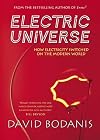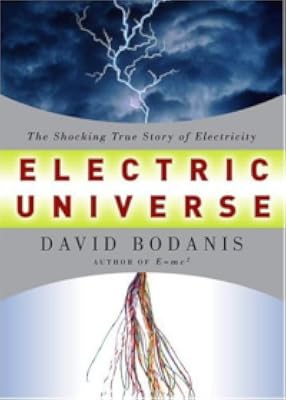
Electric Universe: The Shocking True Story of Electricity
by David Bodanis
On This Page
Description
From the author of the bestselling E=MC2, comes a mesmerizing journey of discovery illuminating the wondrous yet unseen force that permeates our world and the scientists who've probed its secrets. Before 1790, when Alessandro Volta began the scientific investigation that spurred an explosion of knowledge and invention, electricity was perceived as little more than a property of certain substances that sparked when rubbed. Now we know that this formerly thought an inconsequential force is show more responsible for everything from the structure of the atom to the functioning of our brains. Bodanis, a superb storyteller, tells a story filled with romance, divine inspiration, fraud, and scientific breakthroughs revealing how we learned to harness its powers. The great scientists such as Michael Faraday and Samuel Morse come to life, complete with all their brilliance and idiosyncrasy. show lessTags
Recommendations


















Member Reviews
Entertaining and occasionally enlightgening, particularly the rather touching part about Alexander Graham Bell's courtship of his deaf wife. I think I would have enjoyed it more, however, if Bodanis had spent a little more time on what we normally consider as electricity. Instead, he jams it all in, including the birth of computers, the wartime morals of the bombing of Hamburg, and how our brain and body work on electricity as well. As a result, nothing is quite as in-depth as I would have liked.
I have mixed feelings about this book--the breezy tone struck me as condescending rather than friendly, and most of the stories Bodanis tells are familiar--Michael Faraday's struggles with class prejudice, the work of Edison, Galvani and Volta, etc. But Bodanis did teach me a few things and as I got used to his style I found it less distracting.
This is not, however, anything like a complete history of the discovery of electricity and its applications--Tesla, for example, is nowhere mentioned. And the story pretty much ends with the development of the transistor and the discovery that electric charges pass signals through our nervous systems.
I'm not sure I'd recommend this to anyone over 40...
This is not, however, anything like a complete history of the discovery of electricity and its applications--Tesla, for example, is nowhere mentioned. And the story pretty much ends with the development of the transistor and the discovery that electric charges pass signals through our nervous systems.
I'm not sure I'd recommend this to anyone over 40...
This entertaining look at how electricity works and affects our daily lives is highlighted by Bodanis's charming narrative voice and by clever, fresh analogies that make difficult science accessible. Bodanis examines electricity's theoretical development and how 19th- and 20th-century entrepreneurs harnessed it to transform everyday existence. Summary BPL
I listened the audio version of this book with much pleasure. The author manages to make science understandable--how novel!--and absorbing. I was particularly taken by the story of Alan Turing, inventor of the (idea, anyway) modern computer.
8 out of 10 Highly recommended to all who want to investigate science painlessly!
I listened the audio version of this book with much pleasure. The author manages to make science understandable--how novel!--and absorbing. I was particularly taken by the story of Alan Turing, inventor of the (idea, anyway) modern computer.
8 out of 10 Highly recommended to all who want to investigate science painlessly!
Seemed pretty lightweight, like it was written for the YA market and not really for adults. Heavy on casually inaccurate narrative, light on the actual technology, with pretty poor metaphors. I listened to it on audio; I intend to give it a try in physical form to see if it seems more substantive that way.
It seems vastly more substantial in physical form than on audio book.
Detailed Review:
The guiding them is about how the expanding understanding of electrons and electrical behavior lead to different technologies.
Part I: Wires
Electrons flowing through a wire.
1. The Frontiersman and the Dandy
Albany, 1830 and Washington, DC., 1836
The stories of Joseph Henry and Samuel Morse. At 30, Joseph Henry is a brilliant elementary school teacher show more constructing an enormously powerful electromagnet and inventing the telegraph. Samuel Morse is a would be painter and the son of rather wealthy east-coasters who decides to patent Henry's invention. In the meantime, Henry has become a professor at the college soon to be named Princeton.
2. Aleck and Mabel
Boston, 1875
Alexander Graham Bell, a young immigrant from Scotland, invents the telephone, which will replace the telegraph. Thomas Alva Edison is hired by Western Union to try to undermine Bell's patents. He makes a lot of money for his efforts, but Bell has wisely married into Boston big money and commercial interests, and his father-in-law manages to help him face up to Western Union.
3. Thomas and J. J.
New York, 1878
Thomas Alva Edison sets to work to convince everybody to light their houses by electricity that they buy from him. J. J. Thompson devises some experiments and determines the existence of the electron. There is a model of electricity as electrons flowing through a wire.
Part II: Waves
4. Faraday's God
London, 1831
This is pretty poor. Claims that Faraday's lack of formal mathematical education and his Sandemanian faith were essential to his discoveries in electromagnetism. This seems to me far too simplistic. Also unfairly maligns Humphry Davy, who is not even named. I know that part of the reason for being so simplistic was the lack of space, but this part goes too far.
5. Atlantic Storms
H.M.S. Agamemnon, 1858 and Scotland, 1861
Cyrus Field and the laying of the first transatlantic cable. It's a disaster, but William Thomson, eventually Lord Kelvin, helps put it right.
Part III: Wave Machines
Radio and radar.
6. A Solitary Man
Karlsruhe, Germany, 1887
Entries from Heinrich Hertz's diary as well as some excerpts from letters about him. It breaks things up nicely, but doesn't communicate all that much. Sadly, my local library system doesn't seem to have a single book about him.
7. Power in the Air
Suffolk Coast, 1939 and Bruneval, France, 1942
The first work on radar. Nothing about Bruneval actually, that's for a later chapter.
8. Power Unleashed
Hamburg, 1943
This is the chapter about Bruneval actually. A bunch of British paratroopers land on the French coast and cart off important bits of a German radar station. The station is well-made but idiot proof and unadjustable. The British tailor their chaff to the precise wavelength of the German radar, and then proceed to bomb Hamburg and lots of other German cities.
Part IV: A Computer Built of Rock
Modern Computers
9. Turing
Cambridge, 1936 and Bletchley Park, 1942
A brief bio of Turing. Gay, worked at Bletchley Park, killed himself. A little too grand about computers. They can't do anything, they just compute. They _are_ universal computing machines, but computing isn't everything. Robots are not just computers, they need those special-purpose mechanical bits.
10. Turing's Legacy
New Jersey, 1947
About the invention of the transistor. Solid state. The miniaturization that the transistor enables makes possible small computers.
Part V: The Brain and Beyond
11. Wet Electricity
Plymouth, England, 1947
Work on squid nerves which are big! The transmitters of electricity in nerves are big old ions, like sodium. I somehow don't know or didn't remember this.
12. Electric Moods
Indianapolis, 1972 and today
The operation of neurotransmitters and the mechanism of Prozac.
What Happened Next
A sort of epilogue to all the chapters.
Mr. Amp, Mr. Volt, and Mr. Watt
A quick bit about these units of measurement.
=============================================================
Second review: where I already know much, seems glib and misleading.
Where I don't know anything, seems kind of helpful and informative. show less
It seems vastly more substantial in physical form than on audio book.
Detailed Review:
The guiding them is about how the expanding understanding of electrons and electrical behavior lead to different technologies.
Part I: Wires
Electrons flowing through a wire.
1. The Frontiersman and the Dandy
Albany, 1830 and Washington, DC., 1836
The stories of Joseph Henry and Samuel Morse. At 30, Joseph Henry is a brilliant elementary school teacher show more constructing an enormously powerful electromagnet and inventing the telegraph. Samuel Morse is a would be painter and the son of rather wealthy east-coasters who decides to patent Henry's invention. In the meantime, Henry has become a professor at the college soon to be named Princeton.
2. Aleck and Mabel
Boston, 1875
Alexander Graham Bell, a young immigrant from Scotland, invents the telephone, which will replace the telegraph. Thomas Alva Edison is hired by Western Union to try to undermine Bell's patents. He makes a lot of money for his efforts, but Bell has wisely married into Boston big money and commercial interests, and his father-in-law manages to help him face up to Western Union.
3. Thomas and J. J.
New York, 1878
Thomas Alva Edison sets to work to convince everybody to light their houses by electricity that they buy from him. J. J. Thompson devises some experiments and determines the existence of the electron. There is a model of electricity as electrons flowing through a wire.
Part II: Waves
4. Faraday's God
London, 1831
This is pretty poor. Claims that Faraday's lack of formal mathematical education and his Sandemanian faith were essential to his discoveries in electromagnetism. This seems to me far too simplistic. Also unfairly maligns Humphry Davy, who is not even named. I know that part of the reason for being so simplistic was the lack of space, but this part goes too far.
5. Atlantic Storms
H.M.S. Agamemnon, 1858 and Scotland, 1861
Cyrus Field and the laying of the first transatlantic cable. It's a disaster, but William Thomson, eventually Lord Kelvin, helps put it right.
Part III: Wave Machines
Radio and radar.
6. A Solitary Man
Karlsruhe, Germany, 1887
Entries from Heinrich Hertz's diary as well as some excerpts from letters about him. It breaks things up nicely, but doesn't communicate all that much. Sadly, my local library system doesn't seem to have a single book about him.
7. Power in the Air
Suffolk Coast, 1939 and Bruneval, France, 1942
The first work on radar. Nothing about Bruneval actually, that's for a later chapter.
8. Power Unleashed
Hamburg, 1943
This is the chapter about Bruneval actually. A bunch of British paratroopers land on the French coast and cart off important bits of a German radar station. The station is well-made but idiot proof and unadjustable. The British tailor their chaff to the precise wavelength of the German radar, and then proceed to bomb Hamburg and lots of other German cities.
Part IV: A Computer Built of Rock
Modern Computers
9. Turing
Cambridge, 1936 and Bletchley Park, 1942
A brief bio of Turing. Gay, worked at Bletchley Park, killed himself. A little too grand about computers. They can't do anything, they just compute. They _are_ universal computing machines, but computing isn't everything. Robots are not just computers, they need those special-purpose mechanical bits.
10. Turing's Legacy
New Jersey, 1947
About the invention of the transistor. Solid state. The miniaturization that the transistor enables makes possible small computers.
Part V: The Brain and Beyond
11. Wet Electricity
Plymouth, England, 1947
Work on squid nerves which are big! The transmitters of electricity in nerves are big old ions, like sodium. I somehow don't know or didn't remember this.
12. Electric Moods
Indianapolis, 1972 and today
The operation of neurotransmitters and the mechanism of Prozac.
What Happened Next
A sort of epilogue to all the chapters.
Mr. Amp, Mr. Volt, and Mr. Watt
A quick bit about these units of measurement.
=============================================================
Second review: where I already know much, seems glib and misleading.
Where I don't know anything, seems kind of helpful and informative. show less
This book was a great reading during the summer. I study for a degree in electrical engineering and it was really an eye-opening experience to read the history of electricity. How much it has effected our way of life and how hard it can be to be recognised as an inventor.
It is very simply written and David Bodanis even managed to bring in tiny bits of humor into an area of science that, at least in Sweden, is not very appealing to many young people these days.
It is very simply written and David Bodanis even managed to bring in tiny bits of humor into an area of science that, at least in Sweden, is not very appealing to many young people these days.
I really enjoyed this book about the how electricity transformed the world from the late 19th century onwards, it is quick and easy to read and engagingly written.
This is series of descriptions of somewhat unrelated items related to electricity. It talks about such pioneers in the science of electricity as Joseph Henry, Michale Faraday, Thomas Edison, J. J. Thomson, etc. I found the part about the first transatlantic cable the most engaging. It's amazing how little they know about electricity before they went and put in a cable all the way across the ocean. I got a little bit tired of the language the author uses to describe electricity, current, voltage, power, etc. Being a physics professor, I found it too simplistic and "poetic".
Members
- Recently Added By
Lists

Books in the Bibliography of The Alchemy of Us by Ainissa Ramirez
181 works; 1 member
Author Information

14+ Works 4,192 Members
David Bodanis taught for many years a survey of intellectual history at the University of Oxford
Some Editions
Awards and Honors
Series
Belongs to Publisher Series
Common Knowledge
- Canonical title
- Electric Universe: The Shocking True Story of Electricity
- Original title
- Electric Universe: The Shocking True Story of Electricity
- Original publication date
- 2005
- Blurbers
- Bryson, Bill; King, Ross; Singh, Simon
- Disambiguation notice
- ISBN 0349117667 is for Electric Universe: The Shocking True Story of Electricity by David Bodanis
Classifications
Statistics
- Members
- 708
- Popularity
- 40,199
- Reviews
- 12
- Rating
- (3.61)
- Languages
- 10 — Dutch, English, German, Greek, Italian, Portuguese, Russian, Slovenian, Spanish, Swedish
- Media
- Paper, Audiobook, Ebook
- ISBNs
- 25
- UPCs
- 1
- ASINs
- 4