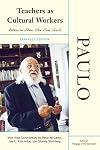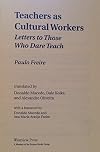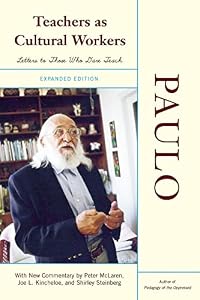
Teachers As Cultural Workers: Letters to Those Who Dare Teach With New Commentary by Peter McLaren, Joe L. Kincheloe, and Shirley Steinberg Expanded Edition
by Paulo Freire
On This Page
Description
Upon its original publication in Portuguese Teachers as Cultural Workers became an instant success. Translated and published in English and now reissued in paperback with new essays from leading education scholarsTags
Recommendations



Member Reviews
The presence of the word "letters" in the title should perhaps have warned me what to expect, but as my first exposure to Freire's writing it fell far short of his reputation. I did learn something from the 95 pages of this book, but I could have learned as much in ten were it not for the rambling and repetition throughout. I suspect that starting with Freire's classic Pedagogy of the Oppressed would have been a better use of my time.
Another "problem" with this book is that Freire's critique is specific to the context of his work in Brazil: not just the words but the lessons themselves may require translation. For those who are more interested in a radical critique of education in the US, I'd recommend Schooling in Capitalist America: show more Educational Reform and the Contradictions of Economic Life as a better starting point.
[2007-7-22] show less
Another "problem" with this book is that Freire's critique is specific to the context of his work in Brazil: not just the words but the lessons themselves may require translation. For those who are more interested in a radical critique of education in the US, I'd recommend Schooling in Capitalist America: show more Educational Reform and the Contradictions of Economic Life as a better starting point.
[2007-7-22] show less
I finished this a couple of days ago, but it took me a while to finally get around to reviewing it. I am giving it three stars, but it is not because it is a bad book. The book can be a bit repetitive, especially if you have read some of Freire's other works, and a few passages can be a little dry. Having said that, there is a lot in this book for teachers and educators to reflect upon. I found myself making notes in my personal journal at various times, jotting down passages and quotes I wanted to remember for later. Freire covers a lot of ground in this book from the teaching of reading to the behavior of teachers, from the teaching act to political action and activism. I think a lot of what Freire wrote in this book is very relevant show more today if educators would take the time to read the book, reflect on it, then take action. I also think that the book has a lot to say to librarians, who are educators as well, and who often do a lot of teaching (especially if you are an instruction librarian, but even at the reference desk some degree of teaching goes on). Some of it also speaks to our profession in terms of the idea of library neutrality, a topic I have considered before (I have a book just on that topic listed in my GoodReads lists if anyone is interested).
I took this book with me when I went to Immersion (ACRL Institute on Information Literacy for those not in librarianship, an intensive institute for instruction librarians) this past summer. In part, I was looking for a bit of inspiration. I think I also longed to read something that is not necessarily present in the Immersion curriculum (or if it is, it is very well hidden or unacknowledged). I think Freire has a lot that can speak to librarians, if we take the time to listen. show less
I took this book with me when I went to Immersion (ACRL Institute on Information Literacy for those not in librarianship, an intensive institute for instruction librarians) this past summer. In part, I was looking for a bit of inspiration. I think I also longed to read something that is not necessarily present in the Immersion curriculum (or if it is, it is very well hidden or unacknowledged). I think Freire has a lot that can speak to librarians, if we take the time to listen. show less
I hope that everyone that finds themselves in a classroom will read this book.
Ratings
Members
- Recently Added By
Author Information

148+ Works 8,537 Members
Paulo Freire (1921-1997) was one of the most significant educational thinkers of the 20th century. He is the author of Education for Critical Consciousness, Pedagogy in Process, Pedagogy of Hope, Pedagogy of the City, and Pedagogy of the Heart, all published by Bloomsbury.
Classifications
Statistics
- Members
- 190
- Popularity
- 171,732
- Reviews
- 3
- Rating
- (3.96)
- Languages
- English, Greek, Portuguese, Spanish
- Media
- Paper, Ebook
- ISBNs
- 8
- ASINs
- 6