
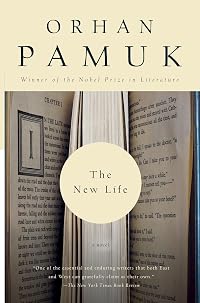
The New Life
by Orhan Pamuk
On This Page
Description
Osman is a young university student whose life is changed by a chance encounter with a mysterious book. Osman becomes obsessed with the book, which seems to contain all the magic and power of life and love. Romantic and elusive, Orhan Pamuk's The New Life is a rhapsody to love and an investigation into the shadowy nature of self.Tags
Recommendations



Member Recommendations
Member Reviews
Osman first comes across a book called The new life when he sees a pretty girl carrying it around in the university refectory. He spots a copy on a bookstall, reads it himself, and finds his life transformed in some weird way by what he reads. Osman and the lovely (but regrettably unavailable) Janan set out on a quest for Janan’s lost lover that involves criss-crossing Turkey on an apparently endless series of bus journeys, a considerable number of which end in deadly bus-collisions.
Repeatedly, Pamuk seems to side-step any straightforward interpretation of the book, allowing the plot to shift directions unpredictably whenever we seem to be getting close to some kind of resolution. It’s a sweetly-ironic account of young love, a show more study of how conspiracies and counter-conspiracies work and of how ready young people are to allow themselves to be influenced by ideas that promise to bring an escape from the everyday, a look at how the power of an idea can become detached from its originator’s intentions when it is put into a book, and it's often also a gently satirical look back at life in provincial Turkey a few decades ago. And a nostalgic homage to obsolete Turkish brand names, overnight buses, rail travel, bad films and the low-grade children’s literature of the author’s youth. But it also brings in Dante, Rilke, and a whole bunch of other apparently incongruent threads, so you need to keep your wits about you.
Puzzling, but often quite captivating. If you are looking for a book about how many angels can dance on a candy-wrapper, this is the one. show less
Repeatedly, Pamuk seems to side-step any straightforward interpretation of the book, allowing the plot to shift directions unpredictably whenever we seem to be getting close to some kind of resolution. It’s a sweetly-ironic account of young love, a show more study of how conspiracies and counter-conspiracies work and of how ready young people are to allow themselves to be influenced by ideas that promise to bring an escape from the everyday, a look at how the power of an idea can become detached from its originator’s intentions when it is put into a book, and it's often also a gently satirical look back at life in provincial Turkey a few decades ago. And a nostalgic homage to obsolete Turkish brand names, overnight buses, rail travel, bad films and the low-grade children’s literature of the author’s youth. But it also brings in Dante, Rilke, and a whole bunch of other apparently incongruent threads, so you need to keep your wits about you.
Puzzling, but often quite captivating. If you are looking for a book about how many angels can dance on a candy-wrapper, this is the one. show less
'I read a book one day and my whole life was changed. Even on the first page I was so affected by the book's intensity I felt my body sever itself and pull away from the chair where I sat reading the book that lay before me on the table.' Light surging from its pages illumines his face: 'Its incandescence dazzled my intellect but also endowed it with brilliant lucidity.' The book seems to be about him, so that 'my point of view was transformed by the book, and the book was transformed by my point of view.'
Pamuk is a writer that helps me understand why I like reading; for the discovery of ideas, cultures, language, worlds, and most importantly, self. When reading his novels, the space and things around me just disappear. His plot lines show more are at times tenuous, something seen peripherally, weaving in and out of focus. I don't read Pamuk for the pleasure of a well-crafted story-line (though I do find the story-lines well-crafted). I read him for his style. He continually pulls me into his writing. I can't leave his books alone once started and when finished, cannot easily forget them.
'A good book is something that reminds us of the whole world - Perhaps that’s how every book is, or what each and every book ought to be.'
In The New Life, Osman (maybe that's his name), reads a book (also called The New Life) that completely changes his life and propels him on a quest to find the meaning of the book, and life. Along the way he falls in love, aimlessly travels on buses, visits bus crashes to walk among the dead and dying, hunts down spies code-named after watch brands, and he speaks to the Angel for guidance and absolution.
'Some went into solitude with the book, but at the threshold of a serious breakdown they were able to open up to the world and shake off their affliction. There were also those who had crises and tantrums upon reading the book, accusing their friends and lovers of being oblivious to the world in the book, of not knowing or desiring the book, and thereby criticising them mercilessly for not being anything like the persons in the book’s universe.'
.
.
.
DAMN! I wrote the above with 50 pages left to go. Well, I just had lunch unknowingly eating a chicken pie as I pored through the final pages. When I closed the book I found myself fighting back tears, not tears for the characters in the book, tears for myself. It's more than puzzling to me. Magical words these were. And although I immersed myself in the first 250 pages enjoying every single word I was not fully aware what the story was about. I had a hint. I imagined. I guessed. And then the last 50 pages. And then the last 2 pages. Nothing is black and white. I still can't tell you the secret to the mystery of The New Life. I only know that this book hit a nerve with me and I can only now appreciate Osman's (if that's his name) opening line... 'I read a book one day and my whole life was changed' and understand what it feels like to have 'my body sever itself and pull away from the chair where I sat reading the book that lay before me on the table'. I'm still shaking...
.
.
.
The book is a labyrinth. There are hidden traps. The words deceive. The words tease. Pamuk plays games with text from other books by Jules Verne, Dante, Rilke, Ib'n Arabi... Comparing Pamuk to Borges? I can understand. This is not a book that I think many would appreciate or enjoy. It is filled with thoughts on Westernization, Islamic fundamentalism, Turkish nationalism... Ultimately, 'what is important [of a book:] is your own perception, what you read into it...' show less
Pamuk is a writer that helps me understand why I like reading; for the discovery of ideas, cultures, language, worlds, and most importantly, self. When reading his novels, the space and things around me just disappear. His plot lines show more are at times tenuous, something seen peripherally, weaving in and out of focus. I don't read Pamuk for the pleasure of a well-crafted story-line (though I do find the story-lines well-crafted). I read him for his style. He continually pulls me into his writing. I can't leave his books alone once started and when finished, cannot easily forget them.
'A good book is something that reminds us of the whole world - Perhaps that’s how every book is, or what each and every book ought to be.'
In The New Life, Osman (maybe that's his name), reads a book (also called The New Life) that completely changes his life and propels him on a quest to find the meaning of the book, and life. Along the way he falls in love, aimlessly travels on buses, visits bus crashes to walk among the dead and dying, hunts down spies code-named after watch brands, and he speaks to the Angel for guidance and absolution.
'Some went into solitude with the book, but at the threshold of a serious breakdown they were able to open up to the world and shake off their affliction. There were also those who had crises and tantrums upon reading the book, accusing their friends and lovers of being oblivious to the world in the book, of not knowing or desiring the book, and thereby criticising them mercilessly for not being anything like the persons in the book’s universe.'
.
.
.
DAMN! I wrote the above with 50 pages left to go. Well, I just had lunch unknowingly eating a chicken pie as I pored through the final pages. When I closed the book I found myself fighting back tears, not tears for the characters in the book, tears for myself. It's more than puzzling to me. Magical words these were. And although I immersed myself in the first 250 pages enjoying every single word I was not fully aware what the story was about. I had a hint. I imagined. I guessed. And then the last 50 pages. And then the last 2 pages. Nothing is black and white. I still can't tell you the secret to the mystery of The New Life. I only know that this book hit a nerve with me and I can only now appreciate Osman's (if that's his name) opening line... 'I read a book one day and my whole life was changed' and understand what it feels like to have 'my body sever itself and pull away from the chair where I sat reading the book that lay before me on the table'. I'm still shaking...
.
.
.
The book is a labyrinth. There are hidden traps. The words deceive. The words tease. Pamuk plays games with text from other books by Jules Verne, Dante, Rilke, Ib'n Arabi... Comparing Pamuk to Borges? I can understand. This is not a book that I think many would appreciate or enjoy. It is filled with thoughts on Westernization, Islamic fundamentalism, Turkish nationalism... Ultimately, 'what is important [of a book:] is your own perception, what you read into it...' show less
It's been a few hours since I finished reading the last page of Orhan Pamuk's The New Life, and I feel like I know everything, and that there's nothing to know. On the surface, the book is a post-modern mess. As you read through the first few chapters, you start questioning the honesty and genuineness of the narrator. I don't think many will disagree with the absurdity of someone declaring that reading a book changed one's life, and then going on a nonsensical journey to seek the truth in that book, only to end up committing a crime to eliminate his lover's previous partner.
The plot itself has still not sunk in for me but I'll give it a go. A young boy (Osman) reads a book that influences him strongly. At college, he meets a beautiful show more girl (Janan) who introduces him to her partner (Mehmet) who has read the same book. Osman then witnesses the assassination of Mehmet, which no one else seems to notice. This raises Osman's suspicions of a wider conspiracy so he goes to find Janan, and together they embark on an indefinite journey around Turkey to meet people who are involved with the book. While they are journeying, they watch Western movies on buses, and witnesses many brutal accidents. Somehow, they end up in a town where a man by the name of Doctor Fine lives. Doctor Fine believes that his son (Mehmet - the same Mehmet?) died as a result of him reading the book. So to stop this 'conspiracy', he appoints several spies (all with codenames of brands of watches) to find, monitor, and assassinate all those who read the book. At the same time, while reading all the reports written by the spies to Doctor Fine, Osman realises that Mehmet had not died. So to rid the world of Mehmet and ensure that Janan does not meet him again, Osman goes on his own quest to kill Mehmet, which he does mid-way through the novel. The novel ends many years later, when Osman goes back to his main mission to find out what the book means.
Underlying the absurd storyline are themes that are often considered Pamuk's trademarks such as the issue of East vs. West. The main characters in the book spend a lot of time on buses watching replays of Western movies. Is this perhaps, Pamuk telling us that we (as Middle Eastern people) spend most of our lives in vehicles controlled by others, while we passively watch the West develop and create for itself a core identity? Throughout the novel, the identify theme is reinforced in other ways. For example, there are several references to products and brands that change from being 'local' to 'mass-produced'. There are also times where the narrator travels from dark little towns, and returns to the lands of billboards, burgers, and Coca-Cola. On a metaphysical level, perhaps this all means that what we're reading is not really a story about a young delusional man who falls in love with a girl and then goes on a mission to kill her former lover. What Pamuk is trying to say is that Turkey is so lost in the middle of modernisation and Westernisation that it has really assassinated itself despite all the attempts of maintaining its ancient identity. One particular quote that has stayed with me from the book is to the effect of - if maintaining old things to keep our identity is called enlightenment, then flea markets should be full of it!
At times, it felt like Pamuk was talking to us directly, telling us how he likes to read books and how prefers to write. These passages become more apparent towards the end of the book, where there is a noticeable jump in time from when the narrator was a teenager to 'now' - where he is married and has a daughter. I personally found these passages engaging, but there was a sense of detachment that came with them as there was a subtle shift in voice from a confused and irritated narrator to a calm, and focused voice.
Despite the changing circumstances of being 'normal' again, the narrator goes on a final road-trip, which brings the books to its morbid conclusion.
Overall, this is a book that you could read if you wanted to have a deep and meaningful discussion with someone about the meaning behind the words, or if you have an interest in the issues of identity and absurdity. It's a short read, but by no means a light one. show less
The plot itself has still not sunk in for me but I'll give it a go. A young boy (Osman) reads a book that influences him strongly. At college, he meets a beautiful show more girl (Janan) who introduces him to her partner (Mehmet) who has read the same book. Osman then witnesses the assassination of Mehmet, which no one else seems to notice. This raises Osman's suspicions of a wider conspiracy so he goes to find Janan, and together they embark on an indefinite journey around Turkey to meet people who are involved with the book. While they are journeying, they watch Western movies on buses, and witnesses many brutal accidents. Somehow, they end up in a town where a man by the name of Doctor Fine lives. Doctor Fine believes that his son (Mehmet - the same Mehmet?) died as a result of him reading the book. So to stop this 'conspiracy', he appoints several spies (all with codenames of brands of watches) to find, monitor, and assassinate all those who read the book. At the same time, while reading all the reports written by the spies to Doctor Fine, Osman realises that Mehmet had not died. So to rid the world of Mehmet and ensure that Janan does not meet him again, Osman goes on his own quest to kill Mehmet, which he does mid-way through the novel. The novel ends many years later, when Osman goes back to his main mission to find out what the book means.
Underlying the absurd storyline are themes that are often considered Pamuk's trademarks such as the issue of East vs. West. The main characters in the book spend a lot of time on buses watching replays of Western movies. Is this perhaps, Pamuk telling us that we (as Middle Eastern people) spend most of our lives in vehicles controlled by others, while we passively watch the West develop and create for itself a core identity? Throughout the novel, the identify theme is reinforced in other ways. For example, there are several references to products and brands that change from being 'local' to 'mass-produced'. There are also times where the narrator travels from dark little towns, and returns to the lands of billboards, burgers, and Coca-Cola. On a metaphysical level, perhaps this all means that what we're reading is not really a story about a young delusional man who falls in love with a girl and then goes on a mission to kill her former lover. What Pamuk is trying to say is that Turkey is so lost in the middle of modernisation and Westernisation that it has really assassinated itself despite all the attempts of maintaining its ancient identity. One particular quote that has stayed with me from the book is to the effect of - if maintaining old things to keep our identity is called enlightenment, then flea markets should be full of it!
At times, it felt like Pamuk was talking to us directly, telling us how he likes to read books and how prefers to write. These passages become more apparent towards the end of the book, where there is a noticeable jump in time from when the narrator was a teenager to 'now' - where he is married and has a daughter. I personally found these passages engaging, but there was a sense of detachment that came with them as there was a subtle shift in voice from a confused and irritated narrator to a calm, and focused voice.
Despite the changing circumstances of being 'normal' again, the narrator goes on a final road-trip, which brings the books to its morbid conclusion.
Overall, this is a book that you could read if you wanted to have a deep and meaningful discussion with someone about the meaning behind the words, or if you have an interest in the issues of identity and absurdity. It's a short read, but by no means a light one. show less
L'inizio è lentissimo e decisamente pretenzioso, e non c'è alcun modo di capire dove l'autore voglia andare a parare, anche perché molto probabilmente non lo sa nemmeno lui.
Poi, per lunghi tratti, pare di leggere Ballard, con le sue visioni di incidenti automobilistici con sfondo sessuale (vedi Crash), solo che invece che di automobili si parla di pullman.
Dalla metà in avanti il libro migliora un pochino, nonostante continui a rimanere allucinato piuttosto che visionario.
Verso la fine si capisce che tutto quello che agita il protagonista ha a che fare col buon tempo antico, quasi che ci sia un Gozzano a muovere i fili, ma a questo punto il protagonista, assai opportunamente, muore.
Sopravvalutato.
Poi, per lunghi tratti, pare di leggere Ballard, con le sue visioni di incidenti automobilistici con sfondo sessuale (vedi Crash), solo che invece che di automobili si parla di pullman.
Dalla metà in avanti il libro migliora un pochino, nonostante continui a rimanere allucinato piuttosto che visionario.
Verso la fine si capisce che tutto quello che agita il protagonista ha a che fare col buon tempo antico, quasi che ci sia un Gozzano a muovere i fili, ma a questo punto il protagonista, assai opportunamente, muore.
Sopravvalutato.
Wonderful beginning - - a fantastically gripping opening 30 pages. And it's deliciously meta- as it's about someone beginning to read a book. For me, New Life is the key to Pamuk's later work, as you see more clearly the almost recursive yet open-ended narrative loops or movements that tantalize in Snow and Red. Not that I'm diligent enough to really study this, but it's this feeling of movement, returning, repeating, looping inwards and outwards that is so intriguing in Pamuk.
I first read The New Life cerca 1997 or 1998 and fell in love with it then. I "won" the novel in an English Dept. Xmas party book exchange. The new prof of postcolonial lit (among other areas of expertise), Lisa Nakamura, at Sonoma State University was my "anonymous" gift-giver. I was prompted to reread the novel recently after a friend who read it with her book group admitted she found the writing (style)clunky and unsatisfying. (I had suggested the novel to them). One can admire Pamuk's novel through the looking-glass of postmodernism or postcolonialism or one can simply enjoy it as a surreal kind-of sort-of road novel cum romance cum Bildingsroman. Set in "modern" Turkey, where the existential mode of transport for young seekers is show more neither the railroads of the European Lost Generation nor the automobile of 50's and forward American youth, but the bus. On the Road here means On the Bus and it is on board that life, love, death, politics and philosophy play themselves out. show less
A book of two halves.
The first part was rather slow and confusing but with something indefinable, a lyric quality, the sense of something unfolding, a promise of better things – that urged me to carry on and I’m glad I did because the second half, in which Osman, the protagonist, searches for the meaning of life, thinks he may have found it, kills the man who seems to have found it, loses it again, finds it again, loses it again, and finally… *
Is quite astonishing.
There is no big reveal, no explosive finish, it’s a slow burn but a beautiful one. I intend to read it again, in six months time or so, I think it’s a book that will improve a great deal on a repeat run.
The writing is poetic, romantic, colourful, delicious. The story show more - it’s not a page turner, but it’s very well worth the effort of reading.
*I’m not going to spoil the ending, read it and see for yourself. show less
The first part was rather slow and confusing but with something indefinable, a lyric quality, the sense of something unfolding, a promise of better things – that urged me to carry on and I’m glad I did because the second half, in which Osman, the protagonist, searches for the meaning of life, thinks he may have found it, kills the man who seems to have found it, loses it again, finds it again, loses it again, and finally… *
Is quite astonishing.
There is no big reveal, no explosive finish, it’s a slow burn but a beautiful one. I intend to read it again, in six months time or so, I think it’s a book that will improve a great deal on a repeat run.
The writing is poetic, romantic, colourful, delicious. The story show more - it’s not a page turner, but it’s very well worth the effort of reading.
*I’m not going to spoil the ending, read it and see for yourself. show less
Members
- Recently Added By
Lists

Overdue Podcast
803 works; 9 members

Best public-transport fiction
72 works; 17 members
Author Information

107+ Works 32,875 Members
Orhan Pamuk was born in Istanbul, Turkey on June 7, 1952. After graduating from Robert College in Istanbul, he studied architecture at the Istanbul Technical University. After three years, he decided to become a writer and graduated from the Institute of Journalism at the University of Istanbul in 1976. In 1982, he published his first novel Cevdet show more Bey and His Sons, which received both the Orhan Kemal and Milliyet literary prizes. His novel, My Name Is Red, won the French Prix Du Meilleur Livre Etranger, the 2002 Italian Grinzane Cavour, and the 2003 International IMPAC Dublin Literary Award. He has received numerous Turkish and international literary awards for his works including the 2006 Nobel Prize in Literature. His recent work includes A Strangeness in My Mind. (Bowker Author Biography) Orhan Pamuk is the author of six previous novels, including "The White Castle" & "The New Life". He lives in Istanbul with his family. (Publisher Provided) show less
Some Editions
Awards and Honors
Awards
Series
Belongs to Publisher Series
Work Relationships
Common Knowledge
- Canonical title*
- Het nieuwe leven
- Original title
- Yeni Hayat
- Alternate titles*
- La Vida Nueva
- Original publication date
- 1994
- People/Characters*
- Osman
- Important places*
- Turkije
- Epigraph
- «Aunque habían escuchado los mismos cuentos, los otros no habían vivido nada semejante.»
NOVALIS
The others experienced nothing like it even though they heard the same tales.
NOVALIS - Dedication
- A Şekure
For Sekure - First words
- Un día leí un libro y toda mi vida cambió. Ya desde las primeras páginas sentí de tal manera la fuerza del libro que creí que mi cuerpo se distanciaba de la mesa y la silla en la que estaba sentado.
I read a book one day and my whole life was changed. - Last words
- (Click to show. Warning: May contain spoilers.)Comprendí que aquél era el final de toda mi vida. Pero yo quería volver a casa, no quería en absoluto pasar a una vida nueva, morir.
1992-1994
(Click to show. Warning: May contain spoilers.)And yet I had only wanted to return home; I absolutely had no wish for death, nor for crossing over into the new life. - Original language
- Turkish
*Some information comes from Common Knowledge in other languages. Click "Edit" for more information.
Classifications
- Genres
- Fiction and Literature, General Fiction
- DDC/MDS
- 894.3533 — Literature & rhetoric Asian Literature Literatures of Altaic, Uralic, Hyperborean, Dravidian languages; literatures of miscellaneous languages of south Asia Turkic languages Turkish Turkish fiction 1850–2000
- LCC
- PL248 .P34 .Y4613 — Language and Literature Languages and literatures of Eastern Asia, Africa, Oceania Languages of Eastern Asia, Africa, Oceania Turkic languages
- BISAC
Statistics
- Members
- 1,217
- Popularity
- 20,275
- Reviews
- 20
- Rating
- (3.31)
- Languages
- 22 — Catalan, Chinese, Czech, Danish, Dutch, English, Finnish, French, German, Greek, Hungarian, Indonesian, Italian, Japanese, Norwegian (Bokmål), Polish, Russian, Serbian, Spanish, Swedish, Turkish, Portuguese (Portugal)
- Media
- Paper, Audiobook, Ebook
- ISBNs
- 64
- ASINs
- 13