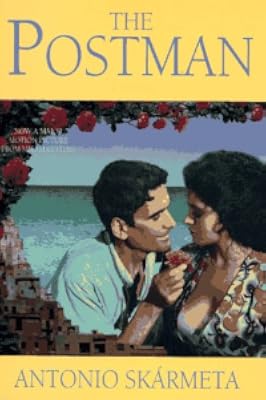
The Postman
by Antonio Skármeta
On This Page
Description
The unforgettable inspiration for the Academy Award-winning Il Postino, this classic novel established Antonio Skármeta's reputation as "one of the most representative authors of the post-boom generation in contemporary Latin American letters" (Christian Science Monitor). Boisterously funny and passionate, The Postman tells of young love ignited by the poetry of Pablo Neruda. Set in the colorful, ebullient years preceding the Pinochet dictatorship in Chile, the book has been translated into show more nearly twenty-five languages around the world. show lessTags
Recommendations




















Member Recommendations

Member Reviews
I saw this charming movie years ago and wanted to read the book, which is equally charming, though a little gritty. The unlikely friendship between Pablo Neruda and his postman, a young, lazy, dreamy youth ripe for the poetry experience is recounted in this fictional story. Mario Jimenez is a little star-struck by his client's fame, but also is buring up with love for beautiful Beatriz and needs the poet's help and advice. Without even trying, Mario spins out metaphor after metaphor recounting his love for the beautiful girl whose heart he is trying to win (and whose mother he is trying to avoid). Pablo tutors him in the language of poetry, turning his raw material into verse and cheering him on. Meanwhile, the great poet is contending show more with his Nobel prize nomination and Chile's need for him to become politically active. Inititally a nominee for President, he leaves the seaside town for awhile, until Allende emerges as the favored candidate; Neruda is later his ambassador to France, coming home in time for the revolution that assassinates his friend and puts him under house arrest. During this time, Mario is steadfastly loyal, helping Neruda as Neruda once helped him. A sensual love story, a testimony to the power of words, and a friendship narrative for the ages. show less
I found this largely enjoyable, being so much a love letter to the power of poetry, but I sometimes found Mario and the whole machismo of it all a bit obnoxious. Also having read The House of the Spirits fairly recently, the eventual fate of Neruda and of Chile as a whole weighed even more heavily on me as I read this than it might have otherwise.
A delightfully different book, imagining a friendship between a postal worker and poet Pablo Neruda (though this description is misleadingly simple). Here's a bit of a conversation between two characters:
Rosa: "What were you talking about?"
Beatriz: "Politics."
R: "Oh no, so he's a communist too?!"
B: "Mother, Neruda is going to be the next president of Chile."
R: "My dear, if you start confusing poetry with politics, you'll end up a single mother. What did he say to you?"
Beatriz had the word on the tip of her tongue, where she held it for a few seconds to savor its connotations.
B: "Metaphors."
Rosa: "What were you talking about?"
Beatriz: "Politics."
R: "Oh no, so he's a communist too?!"
B: "Mother, Neruda is going to be the next president of Chile."
R: "My dear, if you start confusing poetry with politics, you'll end up a single mother. What did he say to you?"
Beatriz had the word on the tip of her tongue, where she held it for a few seconds to savor its connotations.
B: "Metaphors."
When I read a novel, I want to be rock thrown *kerplunk* into the story, totally immersed. Reading this book I felt like a stone the author was skimming across the surface of the story. The metaphors were fun, but overall I was bored because I felt like I wasn't being allowed in.
Heillandi saga, ljúfsár, myndræn saga og umfram allt hlýlegt ástarævintýri. Við kynnumst verðandi nóbelsskáldinu Pablo Neruda og póstmanninum Mario Jiménez sem hrífst af ljóðlist Nerudas. Hann er hins vegar óframfærinn og fellur fyrir ungri stúlku en getur ekki stunið upp orði nærri henni. Til að heilla hana afræður Jiménez að fá aðstoð Nerudas sem kennir honum undirstöðuatriði ljóðlistarinnar og þá sérstaklega myndhverfingar.
Þetta er ein af þeim bókum sem mér leið afskaplega vel við að lesa og heillandi myndhverfingarnar juku bara nautnina. Ekki var verra að mér fannst þýðing Svanhvítar Lilju Ingólfsdóttur frá Engi í Laugarási stórfín og hún á hrós skilið.
Þetta er ein af þeim bókum sem mér leið afskaplega vel við að lesa og heillandi myndhverfingarnar juku bara nautnina. Ekki var verra að mér fannst þýðing Svanhvítar Lilju Ingólfsdóttur frá Engi í Laugarási stórfín og hún á hrós skilið.
This quick read led me straight to the Internet to research Pablo Neruda, Salvador Allende, Allende's death at the hands of Augusto Pinochet, and to see a picture of Neruda's house in Isla Negra. A historical context of Chile in the early 1970s was crucial to fully appreciating this work of fiction which draws heavily and quite accurately on true events. The essence of this book, however, was the Postman (of course) and his discovery of poetry and love. This is also a book whose setting in the idyllic seaside community of Isla Negra casts its own spell over the story and characters. The movie based on this book was nominated for five Academy Awards and I saw the movie when it first came out in 1995 but never sought out the book it was show more based upon until now. Good book for piquing interest in a little world history. show less
A love story - and how! Like a modern Cyrano Bergerac, an un-named poet living in the Italian countryside teaches a young postman how to write beautiful prose to woo the woman of his dreams. What begins as such an idyllic and romantic story ends so sadly - the presence of fascist oppression is only ever a post-script away.
Members
- Recently Added By
Lists

Lives of the Poets (and Philosophers)
110 works; 5 members

Same Title
115 works; 3 members

Las 100 Mejores Novelas en Castellano del Siglo XX
105 works; 13 members
Author Information

56+ Works 2,630 Members
Author Antonio Skármeta was born in Antofagasta, Chile on November 7, 1940. He studied literature and philosophy in Chile and at Columbia University. He taught literature at the University of Chile from 1967 to 1973. He left his country in 1973 because he was profoundly affected by his country's political travail. After the collapse of Pinochet's show more military dictatorship, Skármeta returned to Chile and hosted a television program on literature and the arts. He served as the Chilean ambassador in Germany from 2000 to 2003. He has written several novels including Ardiente Paciencia, which inspired the 1994 Academy Award-winning movie Il Postino (The Postman); The Insurrection, about the Nicaraguan Revolution just before Somoza's fall; and Chileno!, a young adult book drawing on Skármeta 's own experience of exile. (Bowker Author Biography) show less
Some Editions
Awards and Honors
Series
Belongs to Publisher Series
Work Relationships
Is retold in
Has the adaptation
Common Knowledge
- Canonical title
- The Postman
- Original title
- Ardiente paciencia
- Alternate titles
- The Postman; Burning Patience; El cartero de Neruda
- Original publication date
- 1985
- People/Characters
- Pablo Neruda
- Important places
- San Antonio, Chile
- Important events*
- Colpo di stato cileno (1973)
- Related movies
- Il postino (1994 | IMDb); The Postman (Il Postino | 1994 | IMDb)
- Dedication
- To Matilde Urrutia, Neruda's inspiration,
and through him, that of his humble plagiarists.
Für Matilde Urrutia, die Neruda inspirierte und damit auch seine bescheidenen Plagiatoren. - First words
- As a result of two trivial yet fortunate circumstances, Mario Jimenez launched himself on a new career in the month of June 1969.
Vor vielen Jahren arbeitete ich als Kulturredakteur eines drittklassigen Blattes. - Last words
- (Click to show. Warning: May contain spoilers.)"No thank you," I said. "I drink it bitter."
(Click to show. Warning: May contain spoilers.)"Nein, danke", sagte ich, "keinen Zucker". - Original language
- French
*Some information comes from Common Knowledge in other languages. Click "Edit" for more information.
Classifications
Statistics
- Members
- 1,371
- Popularity
- 17,335
- Reviews
- 37
- Rating
- (3.62)
- Languages
- 16 — Arabic, Bengali, Chinese, Danish, Dutch, English, Finnish, French, German, Italian, Norwegian (Bokmål), Polish, Portuguese, Spanish, Swedish, Turkish
- Media
- Paper, Audiobook, Ebook
- ISBNs
- 107
- ASINs
- 21