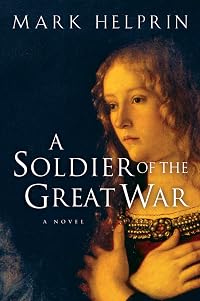
A Soldier of the Great War
by Mark Helprin
On This Page
Description
For Alessandro Giullani, the young son of a prosperous Roman Lawyer, golden trees shimmer in the sun beneath a sky of perfect blue. At night the moon is amber and the city of Rome seethes with light. He races horses across the country to the sea, and in the Alps he practices the precise and sublime art of mountain climbing. At the ancient university in Bologna he is a student of painting and the science of beauty. And he falls in love. His is a world of adventure and dreams, of music, storm, show more and the spirit. Then the Great War intervenes. Half a century later, in August of 1964, Alessandro, a white-haired professor, still tall and proud, finds himself unexpectedly on the road with an illiterate young factory worker. As they walk toward Monte Prato, a village seventy kilometers distant, the old man tells the story of his life. How he became a soldier. A hero. A prisoner. A deserter. A wanderer in the hell that claimed Europe. And how he tragically lost one family and gained another. The boy is dazzled by the action and envious of the richness and color of the story, and realizes that the old man's magnificent tale of love and war is more than a tale: it is the recapitulation of his life, his reckoning with mortality, and above all, a love song for his family. This e-book includes a sample chapter of IN SUNLIGHT AND IN SHADOW. show lessTags
Recommendations










Member Recommendations
Member Reviews
Imagine a novelization of Giorgione's renaissance painting, La Tempesta. In Mark Helprin's interpretation the man in the painting is a soldier on leave from a war still brewing in the background, represented by the storm. His salvation and sanity are preserved by the woman and child - the beauty in the world. In the novel the soldier is Alessandro, who in 1964 is an aged figure grown wise as a professor of aesthetics. Helprin is also playing with the 'great war' appellation usually describing World War I and the setting for this novel, encompassing also the struggle with mortality and its meaning.
In some respects this is a fairy tale for adults like 'Winter's Tale'. This one strips away all of the magical realism, but Alessandro leads show more a charmed life in which when things go well they go ecstatically well, and when they go wrong it can be hilariously wrong or provides opportunity. Alessandro feels that, and he lives his life with tremendous risk and daring. His true talent is for rolling with the punches and finding beauty everywhere he turns. He is especially keen on discovering it in women, and it is the women he meets who empower him to persevere more than anything else. But he finds it as well in children, in art, in poignant moments with his father, and in the spirit of the men who fight alongside him on the Italian-Austrian front.
Alessandro's outlook is optimistic without being naive, and in passing through the madness of war it is subjected to one of the most rigorous tests a man can know. He leaves his sanity open to question without resisting the madness, and in this way it washes over him. His unshakeable faith in a god also helps to see him through, without the need for organized religion. If there is any confusion about how his philosophy informs his life story and vice versa, Helpin makes it all subtly clear in the final part. Bravo. show less
In some respects this is a fairy tale for adults like 'Winter's Tale'. This one strips away all of the magical realism, but Alessandro leads show more a charmed life in which when things go well they go ecstatically well, and when they go wrong it can be hilariously wrong or provides opportunity. Alessandro feels that, and he lives his life with tremendous risk and daring. His true talent is for rolling with the punches and finding beauty everywhere he turns. He is especially keen on discovering it in women, and it is the women he meets who empower him to persevere more than anything else. But he finds it as well in children, in art, in poignant moments with his father, and in the spirit of the men who fight alongside him on the Italian-Austrian front.
Alessandro's outlook is optimistic without being naive, and in passing through the madness of war it is subjected to one of the most rigorous tests a man can know. He leaves his sanity open to question without resisting the madness, and in this way it washes over him. His unshakeable faith in a god also helps to see him through, without the need for organized religion. If there is any confusion about how his philosophy informs his life story and vice versa, Helpin makes it all subtly clear in the final part. Bravo. show less
The Great War in Italy had its share of trench warfare, but most of the fighting was up north in the mountains, where Italy abuts what was then the AustroHungarian Empire. The soldier of this story, Alessandro, grows up in Rome, and is studying aesthetics when the war begins; he enlists because he feels he can better avoid the worst of it if he volunteers.
Alas, that was not to be. While he leads what seems to be a charmed life, the war in all its cruelty and fatality whirling around him in various venues and battles.
The story is enclosed in the simple adventure of an old man walking to a distant village with a young man, to whom he tells the history of his war and also much more. Helprin uses the character's love of beauty as permission show more for vivid and often beautiful descriptions of even ugly and terrifying events, but does not forget to show how Alessandro learns, hardens, and finds meaning in life in spite of, or because of, the war.
There are funny scenes as well as tragic ones, some of them just short of magical realism; some villains get their comeuppance promptly, some long after it does any good, some not at all. Many good people die, some almost by accident, some quite deliberately. Ultimately, Alessandro is left with the idea of beauty as that with which God comforts his broken children, and the idea of life as the balance of risk and hope. show less
Alas, that was not to be. While he leads what seems to be a charmed life, the war in all its cruelty and fatality whirling around him in various venues and battles.
The story is enclosed in the simple adventure of an old man walking to a distant village with a young man, to whom he tells the history of his war and also much more. Helprin uses the character's love of beauty as permission show more for vivid and often beautiful descriptions of even ugly and terrifying events, but does not forget to show how Alessandro learns, hardens, and finds meaning in life in spite of, or because of, the war.
There are funny scenes as well as tragic ones, some of them just short of magical realism; some villains get their comeuppance promptly, some long after it does any good, some not at all. Many good people die, some almost by accident, some quite deliberately. Ultimately, Alessandro is left with the idea of beauty as that with which God comforts his broken children, and the idea of life as the balance of risk and hope. show less
I just finished reading A Soldier of the Great War and think I'm going to remember this as one of the best books I've read. I know this is personal but it spoke to me on a bunch of levels I'm interested in like aesthetics, religion, mountaineering, WW1, father-son relationships, love, adventure, the pointlessness of war, etc. However this novel was much more than the themes. The writing kept me going with zippy, interesting and often unexpected dialog, delightful observations of small details, a story structure that was unusual but in the end, it might have been the only way to spin this yarn. I identified with Alessandro as a young man, an old man and almost everything between. At about 800 pages, I don't think this book could have show more been much shorter -- author Mark Helpin has just so much to say, it is breathtaking.
Some people have criticized it as being too long, the use of magical realism, excessive, etc but I think, personally, that they have missed the point of the book -- which was to describe a remarkable life that was buffeted and shaped by events totally out of his control, and also a world that was just plain out of control. Yes, it's unrealistic that Alessandro survives some of the events and experiences but if he didn't, the book would have been exactly that much shorter. Only those who survive get to write their story, but hopefully they bring the dead along with them and that is exactly what Helprin does with Alessandro. To me, there was one use of magical realism, maybe, in that of the character Orfeo. I believe Helprin is saying it is the only possible explanation for the inexplicable lunacy of Italy's military decisions during the Great War.
A worthwhile, memorable and rewarding read, in my opinion. show less
Some people have criticized it as being too long, the use of magical realism, excessive, etc but I think, personally, that they have missed the point of the book -- which was to describe a remarkable life that was buffeted and shaped by events totally out of his control, and also a world that was just plain out of control. Yes, it's unrealistic that Alessandro survives some of the events and experiences but if he didn't, the book would have been exactly that much shorter. Only those who survive get to write their story, but hopefully they bring the dead along with them and that is exactly what Helprin does with Alessandro. To me, there was one use of magical realism, maybe, in that of the character Orfeo. I believe Helprin is saying it is the only possible explanation for the inexplicable lunacy of Italy's military decisions during the Great War.
A worthwhile, memorable and rewarding read, in my opinion. show less
I really wanted to dislike this book after being annoyed by Helprin's sometimes pompous (and even empty) writing style (i.e. too many of his descriptors mean nothing but the sound of their words on the ear), but, my goodness, I loved this book. Against my better judgement, I found myself mesmerized by the main character, the landscape, the war, and the consistently engaging conversation about beauty, truth, life, and God. This is one of those books that needs to be over 700 pages, so you can spend quality time with the character and story. I was very upset to finish it.
Confusing ‘epic’ with just ‘very long’, this book has entertaining sections but cannot justify an investment of 860 pages. It tells the story of one Alessandro Giuliani, an Italian soldier who goes off to fight in 1914 and soon shows a propensity for escaping death and injury which is only matched by his proficiency as a rider, his irresistibility to women, his prowess as a mountain-climber, his fortitude, his moral strength, his physical strength, his perceptive art criticism, his religious insight, his cutting one-liners, his rakish anti-authoritarianism, and his ability to attract woodland creatures like a Disney princess:
Perhaps because he had been without his family, solitary for so long, the deer in deer preserves and even show more in the wild sometimes allowed him to stroke their cloud-spotted flanks and touch their faces. And on the hot terra cotta floors of roof gardens and in other, less likely places, though it may have been accidental, doves had flown into his hands. Most of the time they held in place and stared at him with their round gray eyes until they sailed away with a feminine flutter of wings that he found beautiful not only for its delicacy and grace, but because the sound echoed through what then became an exquisite silence.
That's from page one, and had me muttering ‘oh fuck off…’ under my breath already. As well as being overwritten it is also just clunky (that long, commaless string of words that begins the third sentence is especially unwieldy), and although what follows is usually perfectly readable, this paragraph does get to the heart of the book's core problem, which is that it takes itself far too seriously while not taking its subject seriously enough.
Although Helprin is pitching this as a grown-up literary treatment of war, it has almost nothing in common with the works of writers who were actually in the First World War and who are talked up on the book's back cover. It reminded me more of historical romances like The Three Musketeers than of anything by Hemingway or Remarque; Helprin's hero is just not living a plausible experience of the conflict. He is whisked away from certain death so many times and in such unlikely ways (seconds before his execution by firing squad, for instance) that it is hard not to start finding it comic as he saunters through yet another cliff-hanger untouched while the poor mortals around him drop like malnourished flies.
Alessandro is, indeed, a kind of virile superman. Again, we are supposed to take this seriously but I found it mostly laughable. He is always the biggest, bravest, most commanding presence in every scene. He cannot walk ten feet away from his division without women falling at his feet: on one occasion he sleeps with a woman sitting next to him on an overnight train, while on another he arranges a sexual liaison with someone seconds after meeting them while jogging across a city square. He refuses to have sex with an adoring prostitute, however, because he is also a paragon of moral fibre. In reality, of course, sexual desperation among soldiers was almost pathological, most of them were not very good at speaking to real women, and queues for the run-down brothels went literally around the block. A braver and better book might have attempted that story, but instead we are treated to some kind of weird heroic wish-fulfilment figure.
Alessandro's exemplary traits might have been more bearable had he at least been forced to change or develop them in adversity, but he doesn't. He begins the book with an unerring sense of the truth of the world, and his losses and hardships do nothing but confirm him in his convictions. Indeed, he seems to treat the pain and misery of war as something like the ritual mortification undergone by a Christian saint. This is not inappropriate given the religious nature of Alessandro's worldview. Helprin would like his hero to come across as a kind of Herman Hesse-style magus figure, and there are many wistful and high-minded passages in here about God's beauty and consolation and how the light and truth of the world can be apprehended by those with an eye for it. These sections sound wise and sensible, but if you look at them for a second, they turn out to say nothing much at all except that you just have to have faith. In the context of the First World War, I found this a bizarre, offensive, and ultimately very conservative kind of snake-oil for an author to be pushing.
Still, there are some lovely descriptions of Rome along the way. show less
Perhaps because he had been without his family, solitary for so long, the deer in deer preserves and even show more in the wild sometimes allowed him to stroke their cloud-spotted flanks and touch their faces. And on the hot terra cotta floors of roof gardens and in other, less likely places, though it may have been accidental, doves had flown into his hands. Most of the time they held in place and stared at him with their round gray eyes until they sailed away with a feminine flutter of wings that he found beautiful not only for its delicacy and grace, but because the sound echoed through what then became an exquisite silence.
That's from page one, and had me muttering ‘oh fuck off…’ under my breath already. As well as being overwritten it is also just clunky (that long, commaless string of words that begins the third sentence is especially unwieldy), and although what follows is usually perfectly readable, this paragraph does get to the heart of the book's core problem, which is that it takes itself far too seriously while not taking its subject seriously enough.
Although Helprin is pitching this as a grown-up literary treatment of war, it has almost nothing in common with the works of writers who were actually in the First World War and who are talked up on the book's back cover. It reminded me more of historical romances like The Three Musketeers than of anything by Hemingway or Remarque; Helprin's hero is just not living a plausible experience of the conflict. He is whisked away from certain death so many times and in such unlikely ways (seconds before his execution by firing squad, for instance) that it is hard not to start finding it comic as he saunters through yet another cliff-hanger untouched while the poor mortals around him drop like malnourished flies.
Alessandro is, indeed, a kind of virile superman. Again, we are supposed to take this seriously but I found it mostly laughable. He is always the biggest, bravest, most commanding presence in every scene. He cannot walk ten feet away from his division without women falling at his feet: on one occasion he sleeps with a woman sitting next to him on an overnight train, while on another he arranges a sexual liaison with someone seconds after meeting them while jogging across a city square. He refuses to have sex with an adoring prostitute, however, because he is also a paragon of moral fibre. In reality, of course, sexual desperation among soldiers was almost pathological, most of them were not very good at speaking to real women, and queues for the run-down brothels went literally around the block. A braver and better book might have attempted that story, but instead we are treated to some kind of weird heroic wish-fulfilment figure.
Alessandro's exemplary traits might have been more bearable had he at least been forced to change or develop them in adversity, but he doesn't. He begins the book with an unerring sense of the truth of the world, and his losses and hardships do nothing but confirm him in his convictions. Indeed, he seems to treat the pain and misery of war as something like the ritual mortification undergone by a Christian saint. This is not inappropriate given the religious nature of Alessandro's worldview. Helprin would like his hero to come across as a kind of Herman Hesse-style magus figure, and there are many wistful and high-minded passages in here about God's beauty and consolation and how the light and truth of the world can be apprehended by those with an eye for it. These sections sound wise and sensible, but if you look at them for a second, they turn out to say nothing much at all except that you just have to have faith. In the context of the First World War, I found this a bizarre, offensive, and ultimately very conservative kind of snake-oil for an author to be pushing.
Still, there are some lovely descriptions of Rome along the way. show less
Re-read -- I found it much more affecting now that I have children.
It wouldn't do for me to be an old man. Alessandro, can I be a child for the sake of my father, and a father for the sake of my children. Will God grant that?
-----
And here, added, is my review from over a decade ago (the benefits of keeping a commonplace book!)
-----
The positive with Helprin one may take as given: he loves the earth, his religion is the true faith of gratitude to God for the marvels of earthly life which abolish all doubts, he has thought about the past, he focuses on what is noble, he writes angelic prose. And he may be the only current writer of talent who dares to essay these themes. He is a living negation of Philip Roth.
That said, Soldier of the show more Great War is the least good and least funny of the Helprin novels. Cinematic in a bad way – replete with grinding clichés. Worse, the characters are elves, Tolkein elves. Helprin creates creatures with virtues and desires perfected for this world: savants (300 words of French in a minute), alpinists, fencers, all capable of magnificent and at times fantastic feats of physical endurance. Every conversation is a discourse, every life a song, screwing (and here we see the seeds of the Dark Side of aestheticism) is achieved in perfect circumstances for periods of improbable duration. So let me say this. It is not only perfect justice for man that does not occur within this life. Our perfection can not occur within this life. Here is where the Christians are right: Love of a wife, love of a parent, love of a child: immense, incalculable, transcendent -- but heaven is not just this. Our perfection is not just this. Know yourself. You are fallible, you are flawed, you know yourself to be worse than those who love you (parent, spouse, child) think you to be. You know you are not worthy of that love. They love your faults, you do not. And so too, they do not love their faults. They wish, you wish, to overcome these flaws. As you would not deny yourself this, do not deny it of them. Understand that even your love cannot be their whole heaven.
Helprin makes men elves, without man’s doom, without man’s purpose, and with virtues that push beyond the limits of man’s capacities – like Legolas walking balanced on high snow. This approach works far better in the settings which are wholly fantastic – as in Winter’s Tale. show less
It wouldn't do for me to be an old man. Alessandro, can I be a child for the sake of my father, and a father for the sake of my children. Will God grant that?
-----
And here, added, is my review from over a decade ago (the benefits of keeping a commonplace book!)
-----
The positive with Helprin one may take as given: he loves the earth, his religion is the true faith of gratitude to God for the marvels of earthly life which abolish all doubts, he has thought about the past, he focuses on what is noble, he writes angelic prose. And he may be the only current writer of talent who dares to essay these themes. He is a living negation of Philip Roth.
That said, Soldier of the show more Great War is the least good and least funny of the Helprin novels. Cinematic in a bad way – replete with grinding clichés. Worse, the characters are elves, Tolkein elves. Helprin creates creatures with virtues and desires perfected for this world: savants (300 words of French in a minute), alpinists, fencers, all capable of magnificent and at times fantastic feats of physical endurance. Every conversation is a discourse, every life a song, screwing (and here we see the seeds of the Dark Side of aestheticism) is achieved in perfect circumstances for periods of improbable duration. So let me say this. It is not only perfect justice for man that does not occur within this life. Our perfection can not occur within this life. Here is where the Christians are right: Love of a wife, love of a parent, love of a child: immense, incalculable, transcendent -- but heaven is not just this. Our perfection is not just this. Know yourself. You are fallible, you are flawed, you know yourself to be worse than those who love you (parent, spouse, child) think you to be. You know you are not worthy of that love. They love your faults, you do not. And so too, they do not love their faults. They wish, you wish, to overcome these flaws. As you would not deny yourself this, do not deny it of them. Understand that even your love cannot be their whole heaven.
Helprin makes men elves, without man’s doom, without man’s purpose, and with virtues that push beyond the limits of man’s capacities – like Legolas walking balanced on high snow. This approach works far better in the settings which are wholly fantastic – as in Winter’s Tale. show less
In 1964, Alessandro Giuliani, an old man who is a professor of aesthetics, catches the last streetcar from Rome to Monte Prato, where he wishes to visit his granddaughter and her family. Through a bizarre circumstance, he finds himself walking to Monte Prato along with Nicoló Sambucca, a 17 year old illiterate factory worker. Taking the high road over the mountains for a journey of days and nights, Alessandro tells an increasingly fascinated Nicoló the story of his life.
Alessandro Giuliani is the son of a well-to lawyer who is enthralled by beauty--not just the classical beauty of art, but also of music and nature, of life itself. He is exuberant, living life as he finds it, and reveling in the beauty that is everywhere around him. show more His family is a close one, and Alessandro loves them passionately. He races locomotives on his horse Enrico, he rows, he climbs mountains. He lives, utterly.
But in 1914, war engulfs Europe and Alessandro is drawn into the conflict. For four years, Alessandro is a soldier of the line, fighting in the trenches under unspeakable conditions, a hero, a prisoner, and finally a deserter. He falls deeply in love--only to lose his beloved to the war as he has lost everyone else he has loved to the war in one way or another. But Alessandro never loses his exaltation in beauty even in the midst of unimaginable horror, his quest for a God in which he alternates belief and disbelief with utter serenity, and his realized hope of redemption and resurrection.
As far as I’m concerned, there is no way to summarize this book adequately in a review, because I personally can not find a way to describe the dazzling richness of the prose, the always off-center viewpoint of Alessandro who is both deeply affected by the war and yet unscathed at his core, the lyrical descriptions especially of the mountains the sheer exaltation of the prose. In hands less skilled, Alessandro would be a caricature, a joke. Instead, for 860 pages, Alessandro burns as brilliantly as any of the stars over the Alto Adige, totally believable, completely real, in a world gone mad.
The other characters in the story, both major and minor, are utterly real and unforgettable as well: his gentle father, his fried Rafi, his wartime comrades in his regiment, the brief, searing acquaintances with other Italian soldiers whose names he doesn’t ever know but whose memories stay with him, his beloved Ariane, and most especially, because he epitomizes the insanity of war, the dwarf Orfeo. All are etched with prose that is as lucid as it is extravagant, no mean feat.
The last chapter is so heartbreaking that it is painful to read.
I have never read a work of fiction that so deeply moved me, both when I read when it was published in 1991, and now, in a much different time, in 2009. It is magnificent, a tour de force, both an epic saga and a paean to love of family. Written by an American, it is also very Italian, and captures that skeptical attitude that Italians bring to war in particular. Its descriptions of the war are searing. The people in it are unforgettable. It is a masterpiece. show less
Alessandro Giuliani is the son of a well-to lawyer who is enthralled by beauty--not just the classical beauty of art, but also of music and nature, of life itself. He is exuberant, living life as he finds it, and reveling in the beauty that is everywhere around him. show more His family is a close one, and Alessandro loves them passionately. He races locomotives on his horse Enrico, he rows, he climbs mountains. He lives, utterly.
But in 1914, war engulfs Europe and Alessandro is drawn into the conflict. For four years, Alessandro is a soldier of the line, fighting in the trenches under unspeakable conditions, a hero, a prisoner, and finally a deserter. He falls deeply in love--only to lose his beloved to the war as he has lost everyone else he has loved to the war in one way or another. But Alessandro never loses his exaltation in beauty even in the midst of unimaginable horror, his quest for a God in which he alternates belief and disbelief with utter serenity, and his realized hope of redemption and resurrection.
As far as I’m concerned, there is no way to summarize this book adequately in a review, because I personally can not find a way to describe the dazzling richness of the prose, the always off-center viewpoint of Alessandro who is both deeply affected by the war and yet unscathed at his core, the lyrical descriptions especially of the mountains the sheer exaltation of the prose. In hands less skilled, Alessandro would be a caricature, a joke. Instead, for 860 pages, Alessandro burns as brilliantly as any of the stars over the Alto Adige, totally believable, completely real, in a world gone mad.
The other characters in the story, both major and minor, are utterly real and unforgettable as well: his gentle father, his fried Rafi, his wartime comrades in his regiment, the brief, searing acquaintances with other Italian soldiers whose names he doesn’t ever know but whose memories stay with him, his beloved Ariane, and most especially, because he epitomizes the insanity of war, the dwarf Orfeo. All are etched with prose that is as lucid as it is extravagant, no mean feat.
The last chapter is so heartbreaking that it is painful to read.
I have never read a work of fiction that so deeply moved me, both when I read when it was published in 1991, and now, in a much different time, in 2009. It is magnificent, a tour de force, both an epic saga and a paean to love of family. Written by an American, it is also very Italian, and captures that skeptical attitude that Italians bring to war in particular. Its descriptions of the war are searing. The people in it are unforgettable. It is a masterpiece. show less
Members
- Recently Added By
Lists

1001 Books You Must Read Before You Die
1,448 works; 1,134 members

Best Historical Fiction
620 works; 257 members

Favorite Long Books
330 works; 41 members

Top-Rated Books on LibraryThing
272 works; 117 members

Favorite Literary Love Stories
182 works; 101 members

Books Set in Italy
167 works; 19 members

Stories of War and Revolution
143 works; 54 members

Books That Made Me Cry
199 works; 105 members
Favourite Books
1,819 works; 316 members

Fiction For Men
142 works; 11 members

Top Five Books of 2015
811 works; 241 members
World War I Fiction
94 works; 15 members

War Literature
101 works; 19 members
LibraryThingers' 1001 Books You Must Read Before You Die
442 works; 30 members
Five star books
1,767 works; 110 members
Best War Fiction Books
41 works; 4 members

Love Triangles in Literature
108 works; 15 members

Books about World War I
80 works; 14 members

Global Reads: Books Set in Western Europe
186 works; 10 members

Books mentioned in Vandermeer's Wonderbook
34 works; 2 members

Books That Made Us Cry
278 works; 145 members
Books We Couldn't Put Down
443 works; 197 members
Books We Want To Read Again For The First Time
384 works; 160 members
Author Information

21+ Works 13,850 Members
Mark Helprin was born in Manhattan, New York on June 28, 1947. He received degrees from Harvard College and Harvard's Graduate School of Arts and Sciences, and did postgraduate work at the University of Oxford, Princeton University, and Columbia University. He has served in the British Merchant Navy, the Israeli infantry, and the Israeli Air show more Force. He is the author of numerous novels including Refiner's Fire, A Soldier of the Great War, Memoir from Antproof Case, Freddy and Fredericka, and In Sunlight and In Shadow. Winter's Tale was adapted into a movie in 2014. His short story collection, Ellis Island and Other Stories, was nominated for a National Book Award in 1981. His other short story collections include A Dove of the East and Other Stories and The Pacific and Other Stories. He also writes children's books including Swan Lake, A City in Winter, and The Veil of Snows. He has received several awards including the National Jewish Book Award, the Prix de Rome, the Peggy V. Helmerich Distinguished Author Award in 2006, and the Salvatori Prize in the American Founding in 2010. (Bowker Author Biography) show less
Some Editions
Awards and Honors
Awards
Distinctions
Notable Lists
Common Knowledge
- Original title
- A Soldier of the Great War
- Original publication date
- 1991
- People/Characters
- Alessandro Giuliani
- Important places
- Rome, Italy
- Important events
- World War I
- First words
- On the ninth of August, 1964, Rome lay asleep in afternoon light as the sun swirled in a blinding pinwheel above its roofs, its low hills, and its gilded domes.
- Quotations
- Numbers, as you well know, are delicate illusions. You don't have to have Archimedes talking about rabbits and turtles to know that when you start in with negative numbers, as we do with young schoolchildren, you are singing... (show all) like a Druid.
In war, the terror, the compression of eschatological questions, the abridgement of the laws of man, the lack of sense in it, the confusion, the entropy...All combine to demolish completely the meaning and integrity of numbers.
"If you think you've said everything you have to say," his father told him, "talk to the opposition." - Last words
- (Click to show. Warning: May contain spoilers.)And then it all ran together, like a song.
Classifications
Statistics
- Members
- 1,924
- Popularity
- 11,069
- Reviews
- 37
- Rating
- (4.28)
- Languages
- 5 — Dutch, English, French, German, Spanish
- Media
- Paper, Audiobook, Ebook
- ISBNs
- 26
- UPCs
- 2
- ASINs
- 14