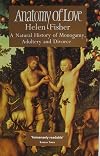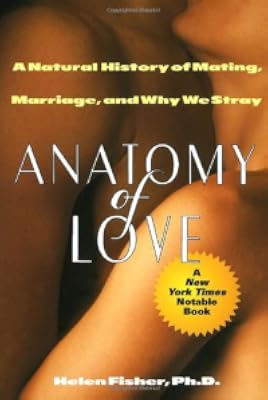
Anatomy of Love: A Natural History of Mating, Marriage, and Why We Stray
by Helen E. Fisher
On This Page
Description
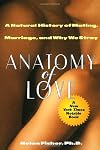
First published in 1992, Helen Fisher's Anatomy of Love quickly became a classic. Since then, Fisher has conducted pioneering brain research on lust, romantic love, and attachment; gathered data on more than 80,000 people to explain why you love who you love; and collected information on more than 30,000 men and women on sexting, hooking up, friends with benefits, and other current trends in courtship and marriage. This is a cutting-edge tour de force that traces human family life from its show more origins in Africa over 20 million years ago to the Internet dating sites and bedrooms of today. It's got it all: the copulatory gaze and other natural courting ploys; the who, when, where, and why of adultery; love addictions; Fisher's discovery of four broad chemically based personality styles and what each seeks in romance; the newest data on worldwide (biologically based) patterns of divorce; how and why men and women think differently; the real story of women, men, and power; the rise-and fall-of the sexual double standard; and what brain science tells us about how to make and keep a happy partnership. show lessTags
Recommendations














Member Reviews
Packed with fascinating information and analysis. The writing is clear, organized and consistent. She uses great quotes and analogies. She shows incredible insight! There are huge subjects and competing powers at play in this study and discussion. The anthropology is given a great weight and she has obviously studied, thought and compared to draw her conclusions. The book is certainly "food for thought" and will rattle in my brain for a long time. The battle of moving humanity toward less selfishness and more love is not ruled out of the book. The scientific and genetic focus leave me wondering if she may have given too little attention to the power of the human soul to reduce the conflict among the urges she documents so well.
Why do we chose a partner over others? Why do we behave in certain ways when we intend to seduce? Is monogamy natural? What about polygamy? Incest? Can love even last at all?
These questions might be from disconcerting to plain embarrassing, if not taboo, yet, the anthropologist Helen Fisher, helped by ethnology, ethology, evolutionary biology, prehistory, and neurosciences, here attempts to answer them.
It's an engrossing and enthralling read, challenging our preconceptions more than once (about love, marriage, divorce, re-marriages, sexism, and else!). The thing is, it all reads as a collection of just-so stories, and, therefore, the hypotheses she puts forward cannot but strike as being, well, dubious... Another disappointment: I was show more expecting more about homosexuality/bisexuality and, the topic is just brushed over in a matter of a few lines...
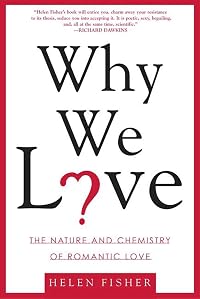
It's not bad; just questionable, and, far from being as enlightening as one of her other book, Why We Love: The Nature and Chemistry of Romantic Love. show less
These questions might be from disconcerting to plain embarrassing, if not taboo, yet, the anthropologist Helen Fisher, helped by ethnology, ethology, evolutionary biology, prehistory, and neurosciences, here attempts to answer them.
It's an engrossing and enthralling read, challenging our preconceptions more than once (about love, marriage, divorce, re-marriages, sexism, and else!). The thing is, it all reads as a collection of just-so stories, and, therefore, the hypotheses she puts forward cannot but strike as being, well, dubious... Another disappointment: I was show more expecting more about homosexuality/bisexuality and, the topic is just brushed over in a matter of a few lines...
It's not bad; just questionable, and, far from being as enlightening as one of her other book, Why We Love: The Nature and Chemistry of Romantic Love. show less
Hmmm. It is difficult to rate. As far as a scholarly work it seems to do well, as far as how I can apply it to my life as a conservative Catholic who has struggled with infidelity I don't know. I had hoped to spur good conversation with my wife based on its content but all it did was make her depressed that there was no hope for true love.
An interesting discussion on just how many of the emotions supposedly behind love, are in fact largely determined by our evolutionary animal nature and are often controlled by chemicals in our brain.
The best example of Twain's statement on science, that "one gets such wholesale returns of conjecture out of such a trifling investment of fact", that I've seen in an awfully long time.
I'm not sure why I even gave it as many as 1½ stars. Perhaps because it seems churlish to give fewer than that to someone who took the time to write a book.
I'm not sure why I even gave it as many as 1½ stars. Perhaps because it seems churlish to give fewer than that to someone who took the time to write a book.
I just re-read this... still REALLY REALLY like it. :)
Ratings
Members
- Recently Added By
Lists

Psicología - Clásicos
165 works; 2 members

Books Read in 2006
424 works; 8 members

Read in 2006
140 works; 1 member
Author Information

9+ Works 1,381 Members
Common Knowledge
- Canonical title*
- Anatomía del amor: historia natural de la monogamia, el adulterio y el divorcio
- Dedication
- For Ray Carroll
*Some information comes from Common Knowledge in other languages. Click "Edit" for more information.
Classifications
- Genres
- Anthropology, Nonfiction, General Nonfiction, Science & Nature
- DDC/MDS
- 302.3 — Society, government, & culture Social sciences, sociology & anthropology Mass Communication & Media Social interaction within groups
- LCC
- HQ728 .F454 — Social sciences The family. Marriage, Women and Sexuality The Family. Marriage. Women The family. Marriage. Home
- BISAC
Statistics
- Members
- 356
- Popularity
- 88,790
- Reviews
- 6
- Rating
- (3.35)
- Languages
- English, French, Spanish
- Media
- Paper, Audiobook, Ebook
- ISBNs
- 13
- ASINs
- 3