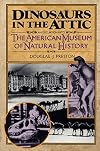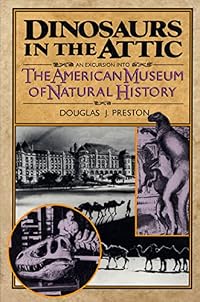
Dinosaurs in the Attic: An Excursion into the American Museum of Natural History
by Douglas J. Preston
On This Page
Description
Dinosaurs in the Attic is a chronicle of the expeditions, discoveries, and scientists behind the greatest natural history collection every assembled. Written by former Natural History columnist Douglas Preston, who worked at the American Museum of Natural History for seven years, this is a celebration of the best-known and best-loved museum in the United States.Tags
Recommendations














Member Reviews
3.5***
Subtitle: An Excursion into the American Museum of Natural History
Preston, who is best known for the thrillers he co-writes with Lee Child, worked at the American Museum of Natural History for seven years, ending in 1985 when he was Manager of Publications. His complete access allowed him to write this very informative, detailed and interesting history. Although it’s been forty-plus years since publication, it still provides a great background on this extraordinary institution.
The work is divided into two sections: “The first (part) focuses on the explorers, scientists and collectors who accumulated the Museum’s vast collections…. The second part is something of a walking tour of the Museum, the most discursive armchair show more ramble imaginable.” The first section stands the test of time since publication; the second is rather dated for today’s reader.
Still, I found the entire work fascinating. I’ll admit I’m a natural history geek. I have always loved museums and exploring nature. I sat on the board of my own county’s Public Museum for several years, and had the opportunity to explore the “back alleys” of that institution. Yes, I’ve visited the “bug trailer” on the roof, and the giant freezer room where animal carcasses are kept before being professional mounted for display.
I think Preston does a fine job of explaining not only the history, but also the purpose of the institution and making it interesting for even non-geeks. show less
Subtitle: An Excursion into the American Museum of Natural History
Preston, who is best known for the thrillers he co-writes with Lee Child, worked at the American Museum of Natural History for seven years, ending in 1985 when he was Manager of Publications. His complete access allowed him to write this very informative, detailed and interesting history. Although it’s been forty-plus years since publication, it still provides a great background on this extraordinary institution.
The work is divided into two sections: “The first (part) focuses on the explorers, scientists and collectors who accumulated the Museum’s vast collections…. The second part is something of a walking tour of the Museum, the most discursive armchair show more ramble imaginable.” The first section stands the test of time since publication; the second is rather dated for today’s reader.
Still, I found the entire work fascinating. I’ll admit I’m a natural history geek. I have always loved museums and exploring nature. I sat on the board of my own county’s Public Museum for several years, and had the opportunity to explore the “back alleys” of that institution. Yes, I’ve visited the “bug trailer” on the roof, and the giant freezer room where animal carcasses are kept before being professional mounted for display.
I think Preston does a fine job of explaining not only the history, but also the purpose of the institution and making it interesting for even non-geeks. show less
In Dinosaurs in the Attic: An Excursion into the American Museum of Natural History, Douglas J. Preston writes, “If you look behind and beyond the glass display cases of the famous halls, you will learn more about human passions than about birds and butterflies and mummies. This is what this book is all about” (p. x). The first half of the book examines the museum’s origins as well as early collecting activities. Discussing Carl Akeley’s collecting policies, Preston writes, “He wanted to preserve Africa in its unspoiled state in a great Hall of Africa at the American Museum of Natural History” (p. 81). This reflects colonial mindsets that viewed the continent as a wild place devoid of human interaction from locals even as show more imperialists recognized their impact. In the second half, Preston explores the current state of the Museum through a survey of some of its departments. He notes, “The Museum today is a very different place from the Museum of half a century ago. Now, high technology laboratories filled with computers and electronic equipment can be found next door to storerooms full of human mummies or snakes coiled in jars of alcohol” (p. 118). Preston concludes, “Museum personnel will come and go, papers will be published and debated, new exhibitions will be constructed and old ones closed. New wings will be built, storage areas will be renovated, and data will be entered and retrieved from large computers. Discoveries will be made, new hypotheses will be proposed, and scientists will venture forth to return with even more materials for study. But the collections – the real Museum – will remain forever” (p. 231).
Preston notes that bone collecting changed amid new ideas of conservation (p. 126), but this is as close as he comes to a serious critique of previous collections policies that reflected imperialist ideologies. While many of the scientists likely had the best of intentions in their goals to preserve knowledge, they removed materials from foreign countries with little concern for preserving local culture and knowledge. Worse, many of the materials collected in North America would now fall under the strictures of NAGPRA like those collected by MacMillan, Green, and Ekblaw (p. 45-59). This dates the work, but discussions of these topics were less common at the time Preston wrote and certainly not found in most popular publications. Preston’s own enthusiasm shines through each chapter and this work influenced his fiction with Lincoln Child, in particular Relic and its sequels. On a personal note, as a lifelong Rochesterian, I particularly enjoyed the Rochester connections to the American Museum of Natural History’s actions from George Eastman sponsoring collecting expeditions (p. 83) to Ward’s collections (p. 80, 134). show less
Preston notes that bone collecting changed amid new ideas of conservation (p. 126), but this is as close as he comes to a serious critique of previous collections policies that reflected imperialist ideologies. While many of the scientists likely had the best of intentions in their goals to preserve knowledge, they removed materials from foreign countries with little concern for preserving local culture and knowledge. Worse, many of the materials collected in North America would now fall under the strictures of NAGPRA like those collected by MacMillan, Green, and Ekblaw (p. 45-59). This dates the work, but discussions of these topics were less common at the time Preston wrote and certainly not found in most popular publications. Preston’s own enthusiasm shines through each chapter and this work influenced his fiction with Lincoln Child, in particular Relic and its sequels. On a personal note, as a lifelong Rochesterian, I particularly enjoyed the Rochester connections to the American Museum of Natural History’s actions from George Eastman sponsoring collecting expeditions (p. 83) to Ward’s collections (p. 80, 134). show less
(#11 in the 2008 book challenge)
Now this was satisfying from nearly beginning to end. It's a look at New York City's natural history museum, split into two parts. The first is a more straightforward history of the institution, both how it came about as well as how the philosophy of managing an enormous natural history collection developed over the years. The second half is a look at some of the specific pieces in the collection, selected to illustrate various aspects of the mission of the museum. And, let me stress, it had A LOT of Ripley's Believe It Or Not type trivia facts. Isn't that what really sparks the interest of a six year old kid in a museum in the first place? And did you know there are broken plaster casts of dinosaurs show more buried in Central Park? Coincidentally, this book was written in the mid 80s, which was about the time I first became very familiar with the AMNH, and shortly before the explosion of brightly colored and loud interactive displays at museums. I know I'm a curmudgeon, but I cannot express how much I hate that trend in museums. Oftentimes, the display is broken to begin with, and even if it's not, I'm put off by how manky all the buttons and screens are after having been touched by countless grabby people, many of whom would seem to have recently eaten greasy food. In addition to being generally informative, I loved this book because it created such a vivid picture of the natural history museums I remember. Museums where you were supposed to be quiet and contemplative and smell like floor polish. If you need me, I'll be yelling at kids to get off my lawn.
Grade: A+
Recommended: To armchair naturalists, fans of natural history museums, and people who enjoy reminiscing about New York City cultural touchstones. show less
Now this was satisfying from nearly beginning to end. It's a look at New York City's natural history museum, split into two parts. The first is a more straightforward history of the institution, both how it came about as well as how the philosophy of managing an enormous natural history collection developed over the years. The second half is a look at some of the specific pieces in the collection, selected to illustrate various aspects of the mission of the museum. And, let me stress, it had A LOT of Ripley's Believe It Or Not type trivia facts. Isn't that what really sparks the interest of a six year old kid in a museum in the first place? And did you know there are broken plaster casts of dinosaurs show more buried in Central Park? Coincidentally, this book was written in the mid 80s, which was about the time I first became very familiar with the AMNH, and shortly before the explosion of brightly colored and loud interactive displays at museums. I know I'm a curmudgeon, but I cannot express how much I hate that trend in museums. Oftentimes, the display is broken to begin with, and even if it's not, I'm put off by how manky all the buttons and screens are after having been touched by countless grabby people, many of whom would seem to have recently eaten greasy food. In addition to being generally informative, I loved this book because it created such a vivid picture of the natural history museums I remember. Museums where you were supposed to be quiet and contemplative and smell like floor polish. If you need me, I'll be yelling at kids to get off my lawn.
Grade: A+
Recommended: To armchair naturalists, fans of natural history museums, and people who enjoy reminiscing about New York City cultural touchstones. show less
Dinosaurs in the Attic: An Excursion into the American Museum of Natural History by Douglas Preston
★★★★
Dinosaurs in the Attic is a chronicle of the expeditions, discoveries, and scientists behind the greatest natural history collection ever assembled – found at the American Museum of Natural History in New York. I love museums and I love books (obviously), so this was right up my alley. This book doesn’t delve into the most of the more known objects and people associated with the museum but those behind the scenes that made it what it is such as the collectors, explorers, and researchers. And what tales they are! Adventure, murder, and deceit – and that’s only in the first 60 pages. The first half of the book deals with show more the beginning of the museum while the second part deals with more “modern” technology and research. There were also 36 photos that were quite good and I enjoyed them.
It must be said that this book was written in 1986 so it is a little out of date and no doubt the museum has been updated to some extent since then not to mention the naming of some countries (for example, Zaire is mentioned in this book, a country that no longer exists). This was a very enjoyable book and I had trouble putting it down. It’s a subject that may sound boring to some but it was far from. My one annoyance was my Kindle copy I have. It’s fairly obvious that it didn’t convent properly in some places, such as words with “in” in them came through as “m” on my Kindle. So for example, “finalized” came out as “fmalized”. A minor bother that I was able to get through. show less
★★★★
Dinosaurs in the Attic is a chronicle of the expeditions, discoveries, and scientists behind the greatest natural history collection ever assembled – found at the American Museum of Natural History in New York. I love museums and I love books (obviously), so this was right up my alley. This book doesn’t delve into the most of the more known objects and people associated with the museum but those behind the scenes that made it what it is such as the collectors, explorers, and researchers. And what tales they are! Adventure, murder, and deceit – and that’s only in the first 60 pages. The first half of the book deals with show more the beginning of the museum while the second part deals with more “modern” technology and research. There were also 36 photos that were quite good and I enjoyed them.
It must be said that this book was written in 1986 so it is a little out of date and no doubt the museum has been updated to some extent since then not to mention the naming of some countries (for example, Zaire is mentioned in this book, a country that no longer exists). This was a very enjoyable book and I had trouble putting it down. It’s a subject that may sound boring to some but it was far from. My one annoyance was my Kindle copy I have. It’s fairly obvious that it didn’t convent properly in some places, such as words with “in” in them came through as “m” on my Kindle. So for example, “finalized” came out as “fmalized”. A minor bother that I was able to get through. show less
If you are familiar with the American Museum of Natural History, this book will provide fascinating back stories of many of the star exhibits in the museum collection. The first chapters about the early struggles of the museum lost my interest, but revisiting the place revived my enthusiasm to start reading again. By telling the stories of how different objects in the collection were acquired, the author does a good job of explaining how the scientific mission of the museum has changed through its history, how the understanding of natural history has evolved in the last 150 years, as well as giving us some campfire stories of explorers and their difficult journeys.
The leitmotif running through all of these exotic adventure tales is the show more boundless drive of men & women of science to discover the undiscovered, to capture it and bring it in chains to the domestic confines of New York City, where casual tourists can gaze hurriedly at row upon row of these spiritless prizes. show less
The leitmotif running through all of these exotic adventure tales is the show more boundless drive of men & women of science to discover the undiscovered, to capture it and bring it in chains to the domestic confines of New York City, where casual tourists can gaze hurriedly at row upon row of these spiritless prizes. show less
This book is divided into three parts. In the first (fairly short) part the author discusses the founding of the museum, in the second he describes the major specimen-gathering expeditions organized by the museum, and in the third he takes the reader on a tour of the museum, including the parts unseen by the general public.
Douglas Preston is an excellent writer and manages to make anything he writes about sound interesting, even the history of the founding of the museum or the process of reducing a corpse to a skeleton. He introduces all the key personalities associated with the AMNH who’ve made it one of the premier natural history museums in the world, starting with Albert Bickmore who succeeded in getting the museum off the ground show more after two false starts (the first attempt failed when only $700 were collected for the future museum; the second was killed off by Tweed when he couldn’t see how he could profit from it and didn’t want to create a precedent). Bickmore, fresh from a three-year expedition to the East Indian archipelago during which he survived an earthquake, a fall into a crater of a volcano and a landslide, managed to impress even people Tweed couldn’t afford to offend, such as J. P. Morgan and Theodore Roosevelt. But it took Morris Jesup, a self-made millionaire with a sixth-grade education, to understand what would make the museum popular with the public, bring it an endowment and organize over a thousand expeditions to all the corners of the earth.
The golden age of exploration (1880-1930) was started by Franz Boas who wanted to prove the migration of men to the New World through the Bering Straight. He hired two Russians, Waldemar Borgoras and Waldemar Jochelson, who were exiled by the tsar to Siberia to collect data among the natives there. In the years to come they crisscrossed Siberia from the Chinese border to the Arctic by packhorses and sled dogs and on rafts, while Berthold Laufer, a German hired by Boas, collected data in China, undeterred even by the anti-foreign Boxer Rebellion. Boas himself did fieldwork among the Pacific Indians, collecting lots of valuable data, but regretting the necessity for numerous potluck dinners, casual chit-chat and other trappings of social life that he had to endure in the process. The Museum also funded a number of polar expeditions, including many of Robert Peary’s. Jesup made a deal with him, pulling strings to keep him on leave from the Navy in return for specimens for the museum, such as a 30-ton meteorite from Greenland, the largest ever recovered. Douglas Preston also describes the lively dinosaur wars between rivaling paleontologists, which escalated to such heights as to land them in tabloids – a spot now firmly secured by movie stars and politicians – and to shock their colleagues across the ocean – although why that would be, I cannot see, since, according to Bill Bryson’s descriptions in A History of Nearly Everything in the chapter appropriately titled “Science Red in Tooth and Claw” some British paleontologists of the time could be quite vicious themselves. A series of expeditions in Central Asia discovered the first dinosaurs’ eggs and fossils of early mammals which had co-existed with dinosaurs. Members of these expeditions had to contend with Mongolian bandits, Chinese civil wars and sandstorms so strong that after one of them the sandblasted windshields had to be knocked out of the vehicles to enable the drivers to see ahead. Preston says that the leader of these expeditions, Roy Chapman Andrews, was allegedly the real-life prototype of Indiana Jones. One of their vehicles carried a mounted machine gun, and “Andrews had no qualms about training his guns on an obstructive border guard or petty Mongolian bureaucrat to get what he wanted. As for bandits, he seemed to welcome an exciting confrontation.” Originally, Andrews obtained a job scrubbing the museum’s floors, then began collecting whales, eventually joined expeditions to Alaska and Japan, got an MA in biology and published several papers. It’s hard to imagine that today a janitor might be allowed to do scientific work – he’d just be told that it’s not in his job description. Then again, today someone with a Bachelor degree would probably not be able to get a foothold in a major scientific organization by way of scrubbing floors, to begin with – he’d be told that he’s overqualified.
The development of aviation made such huge and lengthy expeditions obsolete, with the single exception of the 1984-1985 expedition to isolated tabletop mountains in the Amazon which were so difficult to get to, that once the helicopters with the supplies couldn’t get through for 9 days, forcing the people on the mountains to make soup from their tiny bird specimens (preserving skins and skeletons for study, of course), while the people down below could resort to hunting a more plentiful menu of caimans and capybaras.
The third part of the book focuses on the work of various departments of the museum, their exhibits and their holdings not shown to the general public (about 99% of them). I learned from it that paleontologists today collect entire “fossil communities” (they can tell which bones had been in other creatures’ stomachs because these bones are etched with acid) and that dinosaurs became extinct before the asteroid impact. One photograph shows a team of paleontologists assembling a huge dinosaur from bone fragments the size of golfballs. The author writes that entomologists who study insects discover hundreds of new species during their careers. They also “often discover strange-looking structures on insects that they can’t even imagine the purpose of,” because they can’t take their specimens apart or even observe the behavior of the smaller ones. In the Meteorite Hall, there’s a fragment of the Allende meteorite which is older than the solar system, while the Minerals and Gems Hall contains the Star of India, a golfball-sized sapphire donated by J. P. Morgan, and an orange sapphire from Sri Lanka, as well as a ten-pound garnet disc found during the excavation of a sewer in Manhattan and a 596 lb topaz crystal from Brazil. The author describes a major burglary that once took place there, but nowadays they have a security system which had to be re-adjusted because it had been triggered by passing cockroaches.
This is a fascinating book which has taught me a lot about how anthropologists, biologists and paleontologists work and has made the museum’s collections much more meaningful to me. show less
Douglas Preston is an excellent writer and manages to make anything he writes about sound interesting, even the history of the founding of the museum or the process of reducing a corpse to a skeleton. He introduces all the key personalities associated with the AMNH who’ve made it one of the premier natural history museums in the world, starting with Albert Bickmore who succeeded in getting the museum off the ground show more after two false starts (the first attempt failed when only $700 were collected for the future museum; the second was killed off by Tweed when he couldn’t see how he could profit from it and didn’t want to create a precedent). Bickmore, fresh from a three-year expedition to the East Indian archipelago during which he survived an earthquake, a fall into a crater of a volcano and a landslide, managed to impress even people Tweed couldn’t afford to offend, such as J. P. Morgan and Theodore Roosevelt. But it took Morris Jesup, a self-made millionaire with a sixth-grade education, to understand what would make the museum popular with the public, bring it an endowment and organize over a thousand expeditions to all the corners of the earth.
The golden age of exploration (1880-1930) was started by Franz Boas who wanted to prove the migration of men to the New World through the Bering Straight. He hired two Russians, Waldemar Borgoras and Waldemar Jochelson, who were exiled by the tsar to Siberia to collect data among the natives there. In the years to come they crisscrossed Siberia from the Chinese border to the Arctic by packhorses and sled dogs and on rafts, while Berthold Laufer, a German hired by Boas, collected data in China, undeterred even by the anti-foreign Boxer Rebellion. Boas himself did fieldwork among the Pacific Indians, collecting lots of valuable data, but regretting the necessity for numerous potluck dinners, casual chit-chat and other trappings of social life that he had to endure in the process. The Museum also funded a number of polar expeditions, including many of Robert Peary’s. Jesup made a deal with him, pulling strings to keep him on leave from the Navy in return for specimens for the museum, such as a 30-ton meteorite from Greenland, the largest ever recovered. Douglas Preston also describes the lively dinosaur wars between rivaling paleontologists, which escalated to such heights as to land them in tabloids – a spot now firmly secured by movie stars and politicians – and to shock their colleagues across the ocean – although why that would be, I cannot see, since, according to Bill Bryson’s descriptions in A History of Nearly Everything in the chapter appropriately titled “Science Red in Tooth and Claw” some British paleontologists of the time could be quite vicious themselves. A series of expeditions in Central Asia discovered the first dinosaurs’ eggs and fossils of early mammals which had co-existed with dinosaurs. Members of these expeditions had to contend with Mongolian bandits, Chinese civil wars and sandstorms so strong that after one of them the sandblasted windshields had to be knocked out of the vehicles to enable the drivers to see ahead. Preston says that the leader of these expeditions, Roy Chapman Andrews, was allegedly the real-life prototype of Indiana Jones. One of their vehicles carried a mounted machine gun, and “Andrews had no qualms about training his guns on an obstructive border guard or petty Mongolian bureaucrat to get what he wanted. As for bandits, he seemed to welcome an exciting confrontation.” Originally, Andrews obtained a job scrubbing the museum’s floors, then began collecting whales, eventually joined expeditions to Alaska and Japan, got an MA in biology and published several papers. It’s hard to imagine that today a janitor might be allowed to do scientific work – he’d just be told that it’s not in his job description. Then again, today someone with a Bachelor degree would probably not be able to get a foothold in a major scientific organization by way of scrubbing floors, to begin with – he’d be told that he’s overqualified.
The development of aviation made such huge and lengthy expeditions obsolete, with the single exception of the 1984-1985 expedition to isolated tabletop mountains in the Amazon which were so difficult to get to, that once the helicopters with the supplies couldn’t get through for 9 days, forcing the people on the mountains to make soup from their tiny bird specimens (preserving skins and skeletons for study, of course), while the people down below could resort to hunting a more plentiful menu of caimans and capybaras.
The third part of the book focuses on the work of various departments of the museum, their exhibits and their holdings not shown to the general public (about 99% of them). I learned from it that paleontologists today collect entire “fossil communities” (they can tell which bones had been in other creatures’ stomachs because these bones are etched with acid) and that dinosaurs became extinct before the asteroid impact. One photograph shows a team of paleontologists assembling a huge dinosaur from bone fragments the size of golfballs. The author writes that entomologists who study insects discover hundreds of new species during their careers. They also “often discover strange-looking structures on insects that they can’t even imagine the purpose of,” because they can’t take their specimens apart or even observe the behavior of the smaller ones. In the Meteorite Hall, there’s a fragment of the Allende meteorite which is older than the solar system, while the Minerals and Gems Hall contains the Star of India, a golfball-sized sapphire donated by J. P. Morgan, and an orange sapphire from Sri Lanka, as well as a ten-pound garnet disc found during the excavation of a sewer in Manhattan and a 596 lb topaz crystal from Brazil. The author describes a major burglary that once took place there, but nowadays they have a security system which had to be re-adjusted because it had been triggered by passing cockroaches.
This is a fascinating book which has taught me a lot about how anthropologists, biologists and paleontologists work and has made the museum’s collections much more meaningful to me. show less
A fascinating read. I'd love to go and spend days or weeks there. Well written, but would have liked more pictures.
Members
- Recently Added By
Author Information

114+ Works 85,549 Members
Douglas Jerome Preston was born on May 20, 1956 in Cambridge, Massachusetts. He received a B.A. in English literature from Pomona College in 1978. His career began at the American Museum of Natural History, where he worked as an editor and writer from 1978 to 1985. He also was a lecturer in English at Princeton University. He became a full-time show more writer of both fiction and nonfiction books in 1986. Many of his fiction works are co-written with Lincoln Child including Relic, Riptide, Thunderhead, The Wheel of Darkness, Cemetery Dance, and Gideon's Corpse. His nonfiction works include Dinosaurs in the Attic; Cities of Gold: A Journey Across the American Southwest in Pursuit of Coronado; Talking to the Ground; and The Royal Road. He has written for numerous magazines including The New Yorker; Natural History; Harper's; Smithsonian; National Geographic; and Travel and Leisure. He became a New York Times Best Selling author with his titles Two Graves and Crimson Shores which he co-wrote with Lincoln Child, and his titles White Fire, The Lost Island Blue Labyrinth and The Lost City of the Monkey God. (Bowker Author Biography) show less
Common Knowledge
- Original publication date
- 1986
- People/Characters
- Carl Akeley; Roy Chapman Andrews; P. T. Barnum; Albert S. Bickmore; Franz Boas; Roger Frederick Clark (show all 17); Edward Drinker Cope; Fitzhugh Green; Morris K. Jesup; Waldemar Jochelson; Jumbo the Elephant; Little Finger Nail; Meshie Mungkut; Jack Roland Murphy "Murph the Surf"; Henry Fairfield Osborn; Robert E. Peary; Harry Shapiro
- Important places
- American Museum of Natural History, New York, New York, USA; New York, USA; New York, New York, USA; USA
- Dedication
- For Mom and Dad
and
The Magic School - First words
- As I write this, I am in New York City, sitting in a deck chair on the roof of a building physically larger than the Empire State Building.
- Last words
- (Click to show. Warning: May contain spoilers.)And yet, like the love letter, each object in the Museum—just as in the world at large—carries with it a rich and secret lode of history, of information, and of meaning.
Classifications
- Genres
- Nonfiction, Anthropology, General Nonfiction
- DDC/MDS
- 069.9508 — Computer science, information & general works Associations, organizations & museums Museology (Museum science) For Specific Subjects [No Longer Used]
- LCC
- QH70 .U62 .N486 — Science Natural history – Biology Natural history (General) General
- BISAC
Statistics
- Members
- 331
- Popularity
- 95,249
- Reviews
- 11
- Rating
- (4.02)
- Languages
- English, German, Italian
- Media
- Paper, Ebook
- ISBNs
- 5
- ASINs
- 3