On This Page
Description
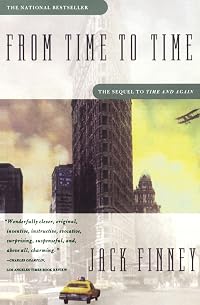
The New York Times Bestseller -- Jack Finney's long-awaited sequel to his classic illustrated novel Time and Again. Simon Morley, whose logic-defying trip to the New York City of the 1880's in Time and Again has enchanted readers for twenty-five years, embarks on another trip across the borders of time. This time Reuben Prien at the secret, government-sponsored Project wants Si to leave his home in the 1880's and visit New York in 1912. Si's mission: to protect a man who is traveling across show more the Atlantic with vital documents that could avert World War I. So one fateful day in 1912, Si finds himself aboard the world's most famous ship...the Titanic. show lessTags
Recommendations
















Member Reviews
Strange, somewhat forced, good story with immense detail in the oddest sometimes unnecessary places. Kind of saw the end coming...though the rationale did not really match the flow of other time altering events presented earlier. Glad to have read it though!
I had heard that this book was not nearly as good as it's predecessor, Time and Again. Since I didn't think Time and Again was so great, I wasn't even sure there was a point to reading this one. But I was curious, so I did. And in some ways, I actually thought this book was better than the first one, or at least it had more potential.
This book begins with a group of people gathering to compare evidence of what I'll call "echoes" from alternate timestreams. I thought this was a very interesting way to begin: those who had read Time and Again would, of course, suspect that the echoes were caused by Si Morley's presence in the 19th century, but group didn't seem to have any idea what was causing the echoes. If Finney had chosen to continue show more with the thread of this question, this could have been a really interesting book.
Unfortunately, this line of thinking is never really developed. Instead, Finney gives us something that is really just an echo of the first book. First Finney essentially changes the ending of Time and Again, so that the Project exists, and then sends Si back to the present because he wants to find out what's going on with his old friends. He finds Rube, who has evidence of a timestream where WWI never happened (this is the only furtherance we see of the plotline from the beginning) and Si agrees to go back to 1912 to see if he can prevent the Great War.
In some ways it was more interesting to follow Si on his first time travel adventure, when all he was really trying to do was observe, rather than change things. Ultimately, however, Si's efforts to change things don't amount to much, so all he really does is observe things in a different time, making this largely the same story that Finney told already, but with more unfulfilled potential. show less
This book begins with a group of people gathering to compare evidence of what I'll call "echoes" from alternate timestreams. I thought this was a very interesting way to begin: those who had read Time and Again would, of course, suspect that the echoes were caused by Si Morley's presence in the 19th century, but group didn't seem to have any idea what was causing the echoes. If Finney had chosen to continue show more with the thread of this question, this could have been a really interesting book.
Unfortunately, this line of thinking is never really developed. Instead, Finney gives us something that is really just an echo of the first book. First Finney essentially changes the ending of Time and Again, so that the Project exists, and then sends Si back to the present because he wants to find out what's going on with his old friends. He finds Rube, who has evidence of a timestream where WWI never happened (this is the only furtherance we see of the plotline from the beginning) and Si agrees to go back to 1912 to see if he can prevent the Great War.
In some ways it was more interesting to follow Si on his first time travel adventure, when all he was really trying to do was observe, rather than change things. Ultimately, however, Si's efforts to change things don't amount to much, so all he really does is observe things in a different time, making this largely the same story that Finney told already, but with more unfulfilled potential. show less
This is the sequel to Finney's story "Time and Again" and was published in 1995, 25 years after the original and shortly before his death. It is set with the present being 3 or 4 years later than the prior book's 1970. When I started to read this I completely got sucked in and thought it was even better than the first. Unfortunately what seemed like an excellent story soon lost steam and went astray by the middle of the book. There is some excellent intrigue in here including bits involving the Titanic, a mysterious operative or two, some good bits on early aviators, and the New York Theater and Vaudeville scene of 1912, so I don't want to really knock the book, but some of it such as the theater stuff goes on too long. One of the show more strengths from the first book that is missing here is the romance that developed between two of the principal characters.
The characters and setup in the opening pages here showed a lot of promise. History was getting reset and some people were noticing. Some are investigating what is going on in their small way. One old gentlemen has dual memories concerning the Titanic. He has extraordinarily vivid memories of skipping a day of school and being at the dock with his father as The Titanic came into New York and the passengers disembarking. Yet, he also knows the ship sunk. These characters then disappeared from the story. I wanted more of them. We see an important event from the first book that was reset, get reset again (slightly confusing). The book didn't quite start sinking like the Titanic; more like it was adrift without quite enough steam. A big idea within this book is that World War One was avoided - it didn't happen according to some evidence in the story but then it did because someone travelled back in time and changed something.
I would not recommend that this book be read as a standalone. It could be ... but so much groundwork was established in the first novel "Time and Again" that this book would come across as much weaker without that background.
An enjoyable book, but as I have noted, just not up to par with the first. The end was OK and seemed to leave the door open for another sequel. show less
The characters and setup in the opening pages here showed a lot of promise. History was getting reset and some people were noticing. Some are investigating what is going on in their small way. One old gentlemen has dual memories concerning the Titanic. He has extraordinarily vivid memories of skipping a day of school and being at the dock with his father as The Titanic came into New York and the passengers disembarking. Yet, he also knows the ship sunk. These characters then disappeared from the story. I wanted more of them. We see an important event from the first book that was reset, get reset again (slightly confusing). The book didn't quite start sinking like the Titanic; more like it was adrift without quite enough steam. A big idea within this book is that World War One was avoided - it didn't happen according to some evidence in the story but then it did because someone travelled back in time and changed something.
I would not recommend that this book be read as a standalone. It could be ... but so much groundwork was established in the first novel "Time and Again" that this book would come across as much weaker without that background.
An enjoyable book, but as I have noted, just not up to par with the first. The end was OK and seemed to leave the door open for another sequel. show less
"It was glorious, all black dark and flowering color, marching leather shuffling on cobbles, drums banging, cymbals smashing. Only a political parade, the election weeks ahead, but fun. Another band moving past now, this one in tall flat-topped shakos with plumes and tiny peaks, the snares rattling, lots of powerful horn and trumpet and that bell-like thing that tops it all off. Splendid blaring sound, very close, and once again that night I felt the actual chill right up the spine, and the slightly embarrassing eye sting, of easy emotion about nothing." p34
A group of seemingly regular people meet after hours in the basement of a university to discuss matters otherworldly. One has a photo from a Clark Gable movie that doesn't exist; one show more has a campaign button from Kennedy's second term; one has a recording from a man who saw the Titanic pull into New York. They are the remnants of "The Project", a former secret government organization dedicated to traveling back in time with supposed ulterior motives.
This sequel to "Time and Again" has our protagonist Simon Morley living happily in 1880s New York, having ensured that "The Project", never comes into existence. Someone travels back though to put the original timeline back in place. Through a series of events Morley travels forward in time only to find himself confronted with the same group he tried to disband. He is then convinced that he could help to avert World War I and travels back to New York in 1912. He is set to find an agent due to travel to Europe who has important papers that will quell any ideas of warmongering among the governments of the day. Simon does his best to track down the mysterious "Z" and eventually finds himself aboard the RMS Titanic, knowing full well what her fate entails.
There are some beautiful descriptions in this book as well as historic photos, ads and drawings that help to give a sense of the atmosphere and attitude of the time. They show a people dressed to the nines and a world opening up with the advent of aviation.
Simon also happens to run into some well known personages such as Al Jolson, Teddy Roosevelt. We see history through his eyes when he meets aviator Frank Coffyn and wonders when Charles Lindburgh is going to show up.
I'm a fan of speculative fiction and loved the little details that Finney inserts, having obviously done quite a bit of research on the period for Simon to have so many cultural experiences in 1912. We get a sense of how he travels back in time but much is left to the imagination when delving deeper into the how and why.
The problem with the book is Finney seems to get wrapped up in his historic figures and photos. The details are wonderful and the reader feels they're being safely led down one path when suddenly the book ends. Finney's conclusion leaves much to be desired as well as room for another book, in which the whole mess of Simon's time traveling experiences might have been explained. show less
A group of seemingly regular people meet after hours in the basement of a university to discuss matters otherworldly. One has a photo from a Clark Gable movie that doesn't exist; one show more has a campaign button from Kennedy's second term; one has a recording from a man who saw the Titanic pull into New York. They are the remnants of "The Project", a former secret government organization dedicated to traveling back in time with supposed ulterior motives.
This sequel to "Time and Again" has our protagonist Simon Morley living happily in 1880s New York, having ensured that "The Project", never comes into existence. Someone travels back though to put the original timeline back in place. Through a series of events Morley travels forward in time only to find himself confronted with the same group he tried to disband. He is then convinced that he could help to avert World War I and travels back to New York in 1912. He is set to find an agent due to travel to Europe who has important papers that will quell any ideas of warmongering among the governments of the day. Simon does his best to track down the mysterious "Z" and eventually finds himself aboard the RMS Titanic, knowing full well what her fate entails.
There are some beautiful descriptions in this book as well as historic photos, ads and drawings that help to give a sense of the atmosphere and attitude of the time. They show a people dressed to the nines and a world opening up with the advent of aviation.
Simon also happens to run into some well known personages such as Al Jolson, Teddy Roosevelt. We see history through his eyes when he meets aviator Frank Coffyn and wonders when Charles Lindburgh is going to show up.
I'm a fan of speculative fiction and loved the little details that Finney inserts, having obviously done quite a bit of research on the period for Simon to have so many cultural experiences in 1912. We get a sense of how he travels back in time but much is left to the imagination when delving deeper into the how and why.
The problem with the book is Finney seems to get wrapped up in his historic figures and photos. The details are wonderful and the reader feels they're being safely led down one path when suddenly the book ends. Finney's conclusion leaves much to be desired as well as room for another book, in which the whole mess of Simon's time traveling experiences might have been explained. show less
This sequel to Time and Again was published 25 years after the original, and while it does have the same characters, it does not possess the same intensity and drive as the first book. Simon does time travel, and again meets with Rube. The purpose? To save the man who maybe could have stopped The Great War. But Rube also gives Si additional incentive. And if that isn’t interesting enough, why not add in the great ship, The Titanic? With all this going on, and with the wonderful characters developed in the first book, this sequel should have been a knockout, but alas, it is not. It bogs down in the middle, before it finally comes back to life at the very end. Real fans of first book will probably enjoy this one, too, but will likely be show more disappointed in its comparison to the first. show less
This was a disappointing sequel to the author's Time and Again. It started off very well with tantalising clues about fake historical memories lodged in the minds of rare individuals, e.g. memories of the Titanic safely docking in New York or of JFK's second term re-election in 1964. The first 130 pages were very good. But then the novel digressed into a social history of New York of 1912, with a particular obsessive interest in vaudeville. The author clearly did extensive research, but this halted the plot almost totally for 100 pages. The final resolution on the Titanic seemed rather rushed and rather unconvincing. A pity.
Although I haven't read the predecessor, I had high hopes for this time travel novel. Well, those hopes were tough to fulfill; this book was a small disappointment. DO NOT READ THIS BOOK FOR THE PLOT!! This novel is for time travel geeks only (like me)! Finney can paint a humanly realistic mural of a historic setting in a unique first person narrative, and that's where this book shines. But it lacks a reasonable plot. Many of the character decisions are rash, half-hearted attempts to do something, usually accompanied with some driving force, either a desperate ploy to avoid futility or an obsessive zeal for some trivial detail. The main character seems to tell himself on every page, "I have no idea what I'm supposed to do here, so I'll show more just play along until something happens." Like a session of any 'adventure' computer game (Myst and Starship Titanic come to mind), the hero stumbles around haphazardly, lost in a puzzle as big as the world, until he succeeds out of serendipity rather than clever resourcefulness. Despite the plot's shortcomings, I did enjoy the playfulness with which Finney approaches history. He treats it as a thing of wonder, like the awe a child feels upon visiting Disneyland. He truly loves the past, loves thinking about the past, and loves using words to turn a time period in his hands like a whimsical toy. If it is possible to feel nostalgic about an era 70 years before I was born, this book has accomplished that. [Pasted from my blog from the original 8 June 2006 post] show less
Members
- Recently Added By
Lists

Best Time Travel Novels
165 works; 125 members

KayStJ's to-read list
1,616 works; 11 members

Books Read in 2021
5,361 works; 113 members
Author Information

46+ Works 9,207 Members
Jack Finney was born on October 2, 1911 with the given name John Finney. His father died when he was three years old and he was renamed Walter Braden Finney in honor of his father. He attended Knox College in Galesburg, Illinois. After moving to New York and working in the advertising industry, he began writing stories for popular magazines like show more Collier's, The Saturday Evening Post and McCall's. His first novel, "Five Against the House" (1954), told the story of five college students who plot to rob a casino in Reno. A year later he published "The Body Snatchers" which was later reissued as "Invasion of the Body Snatchers." Many critics interpreted the insidious infiltration by aliens as a cold-war allegory that dramatized America's fear of a takeover by Communists. Mr. Finney maintained that the novel was nothing more than popular entertainment. The 1956 film "Invasion of the Body Snatchers" was remade twice. With "Time and Again," Mr. Finney won the kind of critical praise and attention not normally accorded to genre fiction. Finney died November 16, 1995 of pneumonia and emphysema at Marin General Hospital in Greenbrae, Calif. He was 84. (Bowker Author Biography) show less
Some Editions
Awards and Honors
Distinctions
Series

Belongs to Publisher Series
Work Relationships
Common Knowledge
- Canonical title
- From Time to Time
- Original publication date
- 1995
- People/Characters
- Simon "Si" Morley; Ruben Prien; Maude 'Dove Lady' Booth; Archie Butt; Florence Cable; Frank Coffyn (show all 19); E.E. Danziger; Professor Duryea; Mrs. Charles Henry Israel; Al Jolson; John McNaughton; Helen 'Jotta Girl' Metzner; Julia Charbonneau (Morley); William Simon Morley (Willy); Theodore Roosevelt; Rover (dog); Captain Edward J. Smith; Teddy; Tessie
- Important places
- Atlantic Ocean; New York, New York, USA; North Atlantic Ocean; Titanic; Winfield, Vermont, USA
- Important events
- Sinking of the Titanic (1912-04-14 | 1912-04-15); World War I (1914 | 1918)
- Epigraph
- "Historians say so: The years between 1910 and 1915 were the pleasantest this country has ever known." - Allen Churchill, Remember When
- Dedication
- Welcome, Annelise!
- First words
- "The man at the end of the long table - he wore a trimmed black beard streaked with white at the ends of his mouth - looked up at the wall clock: three minutes past seven."
- Last words
- (Click to show. Warning: May contain spoilers.)"All the things I'll have to do - okay, Rove, in we go - to get us ready for the Blizzard of '88."
- Blurbers
- Rich, Frank; Dirda, Michael; Champlin, Charles
Classifications
- Genres
- Science Fiction, Fiction and Literature, General Fiction, Historical Fiction
- DDC/MDS
- 813.54 — Literature & rhetoric American literature in English American fiction in English 1900-1999 1945-1999
- LCC
- PS3556 .I52 .F56 — Language and Literature American literature American literature Individual authors 1961-
- BISAC
Statistics
- Members
- 1,321
- Popularity
- 18,227
- Reviews
- 22
- Rating
- (3.52)
- Languages
- English, German, Japanese
- Media
- Paper, Audiobook, Ebook
- ISBNs
- 25
- ASINs
- 6