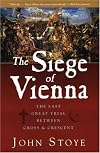
The Siege of Vienna: The Last Great Trial Between Cross & Crescent
by John Stoye
On This Page
Description
The Siege of Vienna in 1683 was one of the turning points in European history. It was the last serious threat to Western Christendom and so great was its impact that countries normally jealous and hostile sank their differences to throw back the armies of Islam and their savage Tartar allies. The consequences of defeat were momentous: the Ottomans lost half their European territories and began the long decline which led to the final collapse of the Empire, and the Hapsburgs turned their show more attention from France and the Rhine frontier to the rich pickings of the Balkans. The hot September day that witnesses the last great trial of strength between Cross and Crescent opened an epoch in European history that lasted until the cataclysm of the First World War in 1914. show lessTags
Recommendations




















Member Reviews
Siege of Vienna by John Stoye is a detailed historica description of the great siege of 1683 that ended Ottoman expansion in Europe. Stoye's work is a densely written and extensively researched exploration of the build-up to the siege and the events of that year. It was the first modern English language historical description of the siege. It has since faced competition, most notably The Enemy at the Gate which is a much easier and more interesting read.
Siege of Vienna is not an especially easy read, it was seemingly never really written with a reader in mind. It is much more the bringing of historical evidence together. The start of the book is one of the most glaring examples, it reads like a report of the sources Stoye has found show more rather than historical analysis. Stoye also seems to downplay every exciting moment as if fighting too hard against the trend to simplify by describing particular moments as critical. However, reading Stoye's description of the great charge of the Winged Hussars as 'the Poiish then deployed their cavalry' really fails to capture the essence of what happens in favour or a simple recitation of limited facts.
Stoye's work also gives undue weight to minor and un-interesting details while underplaying key figures like Jan Sobieski. Occasionally skirmishes that change the balance of power in the siege are referred to only in retrospect as having happened rather than being part of the narrative. The impact of the Ottomans on the lands immediately outside Vienna score only a minor reference right at the end of the book. The de-population of much of Niederösterreich is an event so significant it still impacts international politics but Stoye's detailed work makes practically no mention of it.
When analysing the impact of the siege, the reader is treated to an analysis of the relationship between Louis XIV of France and his wife. A complete tangent. On the other hand far too little time or attention is devoted to Jan Sobieski. No doubt it is right to spend more time on the Emperor and on the Duke of Lorraine but surely Sobieski would be a prominent figure in a narrative surrounding the Siege of Vienna.
Despite these limitations, Siege of Vienna is still a remarkable work. It is a detailed if not sufficiently thorough description of that pivotal year. The Siege exists in its context, Stoye provides it admirably. Given the disparity in the existence of sources there is of course more emphasis on the Habsburg side than the Ottoman but the painstaking research is obvious. The descriptions of the various diplomatic efforts the Habsburgs put in to build an alliance capable of repulsing the Ottomans is fascinating. The tension bewteen various Austrians, the circumstances of those living through the siege, the campaign in its totality are all present..
The full year's description is what makes Siege of Vienna a worthy inclusion in a collection of history books. The competing Magyar factions, the failed efforts to bulwark against Ottoman advance, the preparations to defend Vienna itself are all part of the Siege's story. Stoye has compiled so much from the extant historical record.
There is so much here that the actual siege begins only about half way through the work. The description of the siege is quite technical, providing enough information for a modern reader to begin to grasp some of the siege tactics used by both sides. The absence of artwork of the various pieces Stoye describes makes it a bit hard to picture with the dense writing style but for those with some knowledge of the technical language used it is a thorough description of the competing efforts.
Perhaps the strongest area of Stoye's work is his description of the various groups operating within Vienna itself. The description of the layers of Viennese society is terrific. From the top down, a series of rigid structures had clearly embedded themselves into every aspect of Viennese life. Not all that much has changed in the time since then. Great historical analysis requires an understanding of the factions and incentives within a group rather than just analysis of heroes and leaders. Stoye offers quite some detail on the complex governance structures and the power struggles across strata.
This work is not great historical analysis, there is too little analysis for that to be the case. It is mostly reporting which is in itself useful if not gripping. The weakness of this approach is that it distances the author and the reader from the times. A simple re-telling of facts is not enough. What is here though is interesting and useful, compulsory reading for those interested in the period but somewhat lacking depiction of the drama involved. show less
Siege of Vienna is not an especially easy read, it was seemingly never really written with a reader in mind. It is much more the bringing of historical evidence together. The start of the book is one of the most glaring examples, it reads like a report of the sources Stoye has found show more rather than historical analysis. Stoye also seems to downplay every exciting moment as if fighting too hard against the trend to simplify by describing particular moments as critical. However, reading Stoye's description of the great charge of the Winged Hussars as 'the Poiish then deployed their cavalry' really fails to capture the essence of what happens in favour or a simple recitation of limited facts.
Stoye's work also gives undue weight to minor and un-interesting details while underplaying key figures like Jan Sobieski. Occasionally skirmishes that change the balance of power in the siege are referred to only in retrospect as having happened rather than being part of the narrative. The impact of the Ottomans on the lands immediately outside Vienna score only a minor reference right at the end of the book. The de-population of much of Niederösterreich is an event so significant it still impacts international politics but Stoye's detailed work makes practically no mention of it.
When analysing the impact of the siege, the reader is treated to an analysis of the relationship between Louis XIV of France and his wife. A complete tangent. On the other hand far too little time or attention is devoted to Jan Sobieski. No doubt it is right to spend more time on the Emperor and on the Duke of Lorraine but surely Sobieski would be a prominent figure in a narrative surrounding the Siege of Vienna.
Despite these limitations, Siege of Vienna is still a remarkable work. It is a detailed if not sufficiently thorough description of that pivotal year. The Siege exists in its context, Stoye provides it admirably. Given the disparity in the existence of sources there is of course more emphasis on the Habsburg side than the Ottoman but the painstaking research is obvious. The descriptions of the various diplomatic efforts the Habsburgs put in to build an alliance capable of repulsing the Ottomans is fascinating. The tension bewteen various Austrians, the circumstances of those living through the siege, the campaign in its totality are all present..
The full year's description is what makes Siege of Vienna a worthy inclusion in a collection of history books. The competing Magyar factions, the failed efforts to bulwark against Ottoman advance, the preparations to defend Vienna itself are all part of the Siege's story. Stoye has compiled so much from the extant historical record.
There is so much here that the actual siege begins only about half way through the work. The description of the siege is quite technical, providing enough information for a modern reader to begin to grasp some of the siege tactics used by both sides. The absence of artwork of the various pieces Stoye describes makes it a bit hard to picture with the dense writing style but for those with some knowledge of the technical language used it is a thorough description of the competing efforts.
Perhaps the strongest area of Stoye's work is his description of the various groups operating within Vienna itself. The description of the layers of Viennese society is terrific. From the top down, a series of rigid structures had clearly embedded themselves into every aspect of Viennese life. Not all that much has changed in the time since then. Great historical analysis requires an understanding of the factions and incentives within a group rather than just analysis of heroes and leaders. Stoye offers quite some detail on the complex governance structures and the power struggles across strata.
This work is not great historical analysis, there is too little analysis for that to be the case. It is mostly reporting which is in itself useful if not gripping. The weakness of this approach is that it distances the author and the reader from the times. A simple re-telling of facts is not enough. What is here though is interesting and useful, compulsory reading for those interested in the period but somewhat lacking depiction of the drama involved. show less
I began reading “The Siege of Vienna” expecting to learn about siege as warfare. This book used the siege of Vienna by the Turks as a catalyst to run through all the political entanglements and intrigues of late 17th century Europe. In that scope this volume was much too short to make clear this very complicated subject. Descriptions of life under siege, the works of those laying siege and the climactic battle were much too short.
This is not a bad work if one has prior knowledge of the Hapsburg Empire, the reign of Louis XIV, The Germans, or the northern Spanish holdings. If your interest is simply in the mechanics of a siege, look elsewhere
This is not a bad work if one has prior knowledge of the Hapsburg Empire, the reign of Louis XIV, The Germans, or the northern Spanish holdings. If your interest is simply in the mechanics of a siege, look elsewhere
1161 The Siege of Vienna, by John Stoye (read 6 May 1972) This is a very scholarly and competent account of the 1683 event. But I did not really enjoy it. I suppose it wasn't popularized enough. The siege began in July and was lifted Sept 12.
Ratings
Members
- Recently Added By
Published Reviews
ThingScore 75
"A solid, if staid, narrative of events once well-known throughout Europe, and now the province of a few specialists."
added by bookfitz
Author Information

6 Works 373 Members
John Stoye was formerly a Fellow and Tutor of Magdalen College, Oxford
Common Knowledge
- Canonical title
- The Siege of Vienna: The Last Great Trial Between Cross & Crescent
- Original title
- The Siege of Vienna: The Last Great Trial Between Cross & Crescent
- Alternate titles
- The Siege of Vienna: The Last Great Trial Between Cross and Crescent
- Original publication date
- 2000
- People/Characters
- Louis XIV, 1638-1715; Leopold I, Holy Roman Emperor; Pope Innocent XI; Sultan Mehmed IV
- Important places
- Vienna; Istanbul, Turkey; Ottoman Empire; Vienna, Austria
- Important events
- Siege of Vienna
- Dedication
- To Catherine for withstanding the seige
- First words
- On 6 August 1682, an important meeting took place in Sultan Mehmed IV's great palace in Istanbul.
- Last words
- (Click to show. Warning: May contain spoilers.)In size and in the magnificence of its best buildings, it at last became worthy of the expanded Habsburg empire, which had partly sprung from that bitter fighting across the ground where now the traffic roars in the Ring and in the suburbs.
- Blurbers
- von Habsburg, Otto
- Original language
- English
Classifications
- Genres
- History, Nonfiction, General Nonfiction, Religion & Spirituality
- DDC/MDS
- 943 — History & geography History of Europe Central Europe: Germany, Austria, Switzerland, Czech, Poland, Hungary
- LCC
- DR536 .S74 — History of Europe, Asia, Africa and Oceania Balkan Peninsula History of Balkan Peninsula Turkey History By period 1281/1453-1789. Fall of Constantinople, 1453 1640-1789
- BISAC
Statistics
- Members
- 205
- Popularity
- 158,871
- Reviews
- 3
- Rating
- (3.44)
- Languages
- English, Italian
- Media
- Paper, Audiobook, Ebook
- ISBNs
- 10
- ASINs
- 7