Landscape of Farewell
by Alex Miller
On This Page
Description
Haunting, meaningful and deeply moving, "Landscape of Farewellʺ is the story of Max Otto, an elderly German academic. After the death of his much-loved wife and his realisation that he will never write the great study of history that he always thought would be his life's crowning work, Max is comtemplating putting an end to his life. Yet when he travels to Australia he forms an unlikely freiendship with Dougald Gnapun, an Aboriginal elder. A friendship that not only saves his life and show more gives him new meaning and purpose, but teaches him of the profound importance of truth-telling in his reconciliation with his past, and country's past. show lessTags
Recommendations



















Member Reviews
A poignant meditation on loss and secrets that can alienate families. This is the story of history professor Max Otto, who was a child in Germany during the second World War and whose life has been deeply affected by the subsequent guilt, most especially by the fact that he never knew exactly what his own father did during the war. As the book opens, he's grieving for his recently dead wife and planning on killing himself as soon as he's finished giving a paper at a local history conference. There he meets a young Australian academic, Professor Vita McLelland, and rediscovers his passion for life.
The rest of the book takes place in outback Queensland as Max spends a few weeks with Vita's Uncle Dougald. Max and Dougald get along very show more well, although - or perhaps because - they are both taciturn men, and the time they spend together ends up being far more profound and dramatic than they were expecting.
One of the interesting themes of this book was that of massacres. Max, although an innocent to World War Two's atrocities, feels deep guilt for them. And Dougald's ancestor was a powerful man in his Aboriginal community, another group of people who know all too well about massacres. And Max always yearned to write about such things as a historian, but was never able to because of his own guilt and took the easier path academically into medieval history.
I found this overall a bit too slow and stately, it focussed very much on the characters' inner lives, and I generally enjoy books that are less psychologically introspective. But the characters were interesting (although I never did quite understand Vita), and it was beautifully written. show less
The rest of the book takes place in outback Queensland as Max spends a few weeks with Vita's Uncle Dougald. Max and Dougald get along very show more well, although - or perhaps because - they are both taciturn men, and the time they spend together ends up being far more profound and dramatic than they were expecting.
One of the interesting themes of this book was that of massacres. Max, although an innocent to World War Two's atrocities, feels deep guilt for them. And Dougald's ancestor was a powerful man in his Aboriginal community, another group of people who know all too well about massacres. And Max always yearned to write about such things as a historian, but was never able to because of his own guilt and took the easier path academically into medieval history.
I found this overall a bit too slow and stately, it focussed very much on the characters' inner lives, and I generally enjoy books that are less psychologically introspective. But the characters were interesting (although I never did quite understand Vita), and it was beautifully written. show less
It pains me to say it, but the best thing about this book as far as I am concerned is that it’s short. I read it in a day.
In the first couple of pages, it seemed to hit wrong note after wrong note. Just two examples, tiny in themselves, but part of a cumulative effect that left me simply not believing in the characters: an elderly German professor, meditating on the notion of honour, remembers that somewhere in the bible, probably in the New Testament, we are told to honour our father and our mother; a young Australian History professor asks that same man what his father did in the war, and when he reacts with shock says it was just a piece of Australian humour. Just what planet do you have to be an academic on not to know the Ten show more Commandments, or that Germans of a certain age might not like to be asked by complete strangers about their family’s relationship to Nazism.
In spite of encountering some fine prose and being invited to confront difficult realities, I never recovered from the blow my trust received in those first pages. The book’s centrepiece is a powerful account of a meticulously planned massacre of white settlers in North Queensland by Aboriginal men in reprisal for the unwitting violation of a sacred site. Everything else seems to be there to justify this piece of writing. It didn’t work for this little white duck. I was left with an uneasy feeling that some kind of equivalence was being proposed between the Aboriginal action and unnamed actions taken by German operatives during the Second World War. I’m sorry, but my response, in a word, is ‘Ewww!’ show less
In the first couple of pages, it seemed to hit wrong note after wrong note. Just two examples, tiny in themselves, but part of a cumulative effect that left me simply not believing in the characters: an elderly German professor, meditating on the notion of honour, remembers that somewhere in the bible, probably in the New Testament, we are told to honour our father and our mother; a young Australian History professor asks that same man what his father did in the war, and when he reacts with shock says it was just a piece of Australian humour. Just what planet do you have to be an academic on not to know the Ten show more Commandments, or that Germans of a certain age might not like to be asked by complete strangers about their family’s relationship to Nazism.
In spite of encountering some fine prose and being invited to confront difficult realities, I never recovered from the blow my trust received in those first pages. The book’s centrepiece is a powerful account of a meticulously planned massacre of white settlers in North Queensland by Aboriginal men in reprisal for the unwitting violation of a sacred site. Everything else seems to be there to justify this piece of writing. It didn’t work for this little white duck. I was left with an uneasy feeling that some kind of equivalence was being proposed between the Aboriginal action and unnamed actions taken by German operatives during the Second World War. I’m sorry, but my response, in a word, is ‘Ewww!’ show less
"Is it history that tells us who we are? Or is it the story we tell ourselves - humanity's great sagas, myths and legends, songs and poems and tales of battles over blood and soil - that defines who we are? As Miller [shows], it is a conundrum with profound consequences - he leaves the answer to us."
A fascinating book, about which anything I say won't do justice to it, or else I'll leave things that I meant to say unsaid. I do think it's a fairly improbable story, but contrived so well that I'm prepared to overlook the unlikeliness of it.
A fascinating book, about which anything I say won't do justice to it, or else I'll leave things that I meant to say unsaid. I do think it's a fairly improbable story, but contrived so well that I'm prepared to overlook the unlikeliness of it.
This book didn't pass my 'page 73 test' (if a book hasn't grabbed my attention in some way by page 73 then we both accept it never will and we part company). I gave up on page 66 and, if I am being totally honest, I'd have given up earlier were it not for the fact that a respected friend had recommened the book to me.
I found the detail excrutiating. I found the core event and subsequent relationship that drives the story utterly improbable. I found Max to be a melodramatic yawn of a character. And I found that I don't enjoy being led by the hand like a 6-year old through a predictable story where I'm told what to think and how to feel at every step.
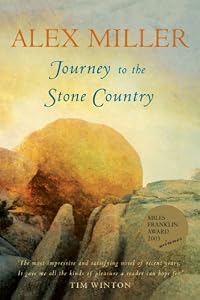
Journey to the Stone Country was a far better book.
I found the detail excrutiating. I found the core event and subsequent relationship that drives the story utterly improbable. I found Max to be a melodramatic yawn of a character. And I found that I don't enjoy being led by the hand like a 6-year old through a predictable story where I'm told what to think and how to feel at every step.
Journey to the Stone Country was a far better book.
"Landscape of Farewell" is a metaphor for images in memory, of the irretrievable past. I found it an easy read because the prose is relaxed and contemplative.
A German academic is retired, defeated by grief and the loss of his wife. He meets a vibrant, angry young Aboriginal academic, Vita who is the means by which he arrives in Australia to visit with her uncle Dougald Gnapun. Together they revisit memories and family stories to reconcile and record the past.
I liked the way Dugald's story that is the culmination of the book was written with a spiritual, dreamlike quality.
A German academic is retired, defeated by grief and the loss of his wife. He meets a vibrant, angry young Aboriginal academic, Vita who is the means by which he arrives in Australia to visit with her uncle Dougald Gnapun. Together they revisit memories and family stories to reconcile and record the past.
I liked the way Dugald's story that is the culmination of the book was written with a spiritual, dreamlike quality.
Excellent portrayal of a man at the end of an academic career who has lost his wife and will to live. A meeting with a Sydney academic at his farewell speech changes his future
Beautifully written novel about friendship and searching through the past to enhance the present. The trip takes Max, a retired German professor to Australia's outback and a young Australian friend's uncle. Lovely!
Members
- Recently Added By
Lists

Best Australian Books of the 21st Century
88 works; 2 members
Author Information

16+ Works 1,537 Members
Alexander McPhee Miller was born on December 27, 1936 in London. He is an Australian novelist. He won the Miles Franklin Award twice, once in 1993 for the Ancestor Game and again in 2003 for Journey to the Stone Country. He also won the overall award for the Commonwealth Writer's Prize for The Ancestor Game in 1993. Miller's first novel, Watching show more the Climbers on the Mountain, was published in 1988 and republished by Allen & Unwin in 2012. Major national and international recognition came with the publication of The Ancestor Game, his third novel and the winner of both the Miles Franklin Award and overall winner of the Commonwealth Writers' Prize in 1993. Since then Miller has published on average a major novel every two years, his tenth being Autumn Laing published in 2011. His title Coal Creek, made the finalists for the $30,000 Best Writing Award, presented for `a piece of published or produced work of outstanding clarity, originality and creativity by a Victorian writer. (Bowker Author Biography) show less
Awards and Honors
Awards
Common Knowledge
- Original publication date
- 2007
- People/Characters
- Max Otto; Winifred Otto; Professor Vita McLelland; Dougald Gnapun
- Important places
- Hamburg, Germany; Mt. Nebo, Queensland, Australia; Expedition Range, Queensland, Australia
Classifications
Statistics
- Members
- 126
- Popularity
- 258,098
- Reviews
- 8
- Rating
- (3.73)
- Languages
- English
- Media
- Paper, Ebook
- ISBNs
- 9
- ASINs
- 1