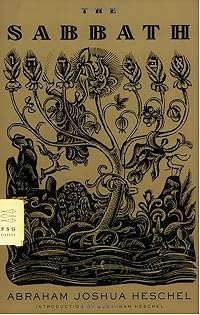
The Sabbath
by Abraham Joshua Heschel
On This Page
Description
Elegant, passionate, and filled with the love of God's creation, Abraham Joshua Heschel's The Sabbath has been hailed as a classic of Jewish spirituality ever since its original publication-and has been read by thousands of people seeking meaning in modern life. In this brief yet profound meditation on the meaning of the Seventh Day, Heschel introduced the idea of an "architecture of holiness" that appears not in space but in time. Judaism, he argues, is a religion of time: it finds meaning show more not in space and the material things that fill it but in time and the eternity that imbues it, so that "the Sabbaths are our great cathedrals." show lessTags
Recommendations









Member Reviews
I'm not religious and don't believe in a literal god, heaven, or hell. I am curious about Judaism (and other spiritual paths) because of the traditions and philosophies. Some books help with this journey and some derail it, but rarely does a book feel holy (not in that way). This book, short as it was, feels like one that I'll read many times, each time gleaning something new
This was probably one of the most inspiring books I've read. A short book, it is full of rich, deep truths and insights. Heschel talks at length about time and space, and leads the reader into some philosophical worlds which are exciting and new. The meaning of the Sabbath- rest, holiness, sanctuary and peace- is explored and delved into here, like no other book I've read on the subject. The only parts where I got a bit lost were when Heschel would quote from works by other rabbis- texts I was unfamiliar with. But this didn't hinder my understanding. I highly recommend this book to anyone who longs for rest, for a meaningful Sabbath, for a break from the busyness, corruption and weariness of the world, especially during this election show more season! show less
This is a short, rather interesting reflection on the institution of the Sabbath, as in "remember the Sabbath Day to keep it holy". It was written by a Jewish scholar, so is specifically related to the Sabbath as celebrated by Jewish people. But, it has some interesting ideas and concepts that people of other faiths might find helpful as they try to understand and relate to their Creator.
The lives of men, according to Heschel, are primarily lived on a structural (physical) plane, i.e. we build things, we manage things, we fix things, we sew and reap crops, we write/plan/calculate, and so forth. All we create, even our mightiest structures, e.g. the pyramids, or our most elevated ideas, eventually decay back to nothingness. Time is show more different. Time is eternal. The structural is consumed by time, but time never changes, it just goes on...eternally. Something like that.
So, although we work in the structural world for six days of the week, we can escape to the temporal when we celebrate the Sabbath. Creation was done and continues to be done in time. So the Sabbath becomes a day of re-creation, a day of holiness ("...and on the seventh day, God rested...and called it holy"), and also a day, because we are living it in time and in holiness, where we deepen our relationship to and celebrate our relationship with our Creator. In so doing, we attain glimpses of eternity.
I am, of course, missing a lot, and perhaps making some stuff up (and didn't have a clue what he was talking about when he likened the Sabbath to a Bride to be celebrated at the wedding feast). Properly read, this book would be studied, i.e. re-read, notes taken and so forth. I won't be doing that, in part because the book is due back at the library muy pronto. But it is interesting to contemplate how the world might differ if we all took off one day from our normal pursuits—many of us, one day off from being assholes—and considered our relationships with our Creator, and consequently with each other, since we are each of us a little piece of our Creator's work—all many parts, but just one body kind of stuff. That's not going to happen any time soon, of course, because the love of money—allegedly the root of all evil, or so Paul would have it—has pretty much trumped everything else in our modern world. But just think, if each of us reduced our personal assholism by just one seventh, how much better a world we would share with each other. show less
The lives of men, according to Heschel, are primarily lived on a structural (physical) plane, i.e. we build things, we manage things, we fix things, we sew and reap crops, we write/plan/calculate, and so forth. All we create, even our mightiest structures, e.g. the pyramids, or our most elevated ideas, eventually decay back to nothingness. Time is show more different. Time is eternal. The structural is consumed by time, but time never changes, it just goes on...eternally. Something like that.
So, although we work in the structural world for six days of the week, we can escape to the temporal when we celebrate the Sabbath. Creation was done and continues to be done in time. So the Sabbath becomes a day of re-creation, a day of holiness ("...and on the seventh day, God rested...and called it holy"), and also a day, because we are living it in time and in holiness, where we deepen our relationship to and celebrate our relationship with our Creator. In so doing, we attain glimpses of eternity.
I am, of course, missing a lot, and perhaps making some stuff up (and didn't have a clue what he was talking about when he likened the Sabbath to a Bride to be celebrated at the wedding feast). Properly read, this book would be studied, i.e. re-read, notes taken and so forth. I won't be doing that, in part because the book is due back at the library muy pronto. But it is interesting to contemplate how the world might differ if we all took off one day from our normal pursuits—many of us, one day off from being assholes—and considered our relationships with our Creator, and consequently with each other, since we are each of us a little piece of our Creator's work—all many parts, but just one body kind of stuff. That's not going to happen any time soon, of course, because the love of money—allegedly the root of all evil, or so Paul would have it—has pretty much trumped everything else in our modern world. But just think, if each of us reduced our personal assholism by just one seventh, how much better a world we would share with each other. show less
Overall, this was a wonderful book, and I must thank Rabbi for recommending it to me. R. Heschel makes this book, and the idea of Shabbat, accessible for those of all faiths (or even none). On page 14 he cites Philo's excellent use of terms that the ancient Greeks already understood, those of athletics, to explain his concept, but points out on page 18 that even in Rome, bread and circuses were not enough. Mankind needs sacred time as well. I love the idea of 6-winged angels, and the ideas of paradise, spirit as our mates, and time to re-ensoul ourselves through contemplation.
I had a real Wow moment on page 89 at his comment that "Nothing is as hard to surpress as the will to be a slave to one's own pettiness... man must fight for inner show more liberty ... depends on being exempt from domination of things as well."
And I see the return to the idea that life is like a spiral. Very very nice! show less
I had a real Wow moment on page 89 at his comment that "Nothing is as hard to surpress as the will to be a slave to one's own pettiness... man must fight for inner show more liberty ... depends on being exempt from domination of things as well."
And I see the return to the idea that life is like a spiral. Very very nice! show less
Absolutely beautiful book about the concept of "sacred time" as opposed to "sacred space." It resonated a lot with me, even as an atheist, because it was focused on how we choose to perceive the reality of time around us. Whether you think sacred time is blessed by a supernatural being, or if, like me, you believe that is a gift we give ourselves, this book has something in it for you. Gorgeously written.
I'm not going to hazard a rating for this book, a beloved 20th century Jewish philosophical work about the Sabbath- "A palace in time". The book is short, but dense, loaded with thought-provoking turns of phrase like "Our world is a world of space moving through time" and "What is the Sabbath? Spirit in the form of time".
I think the thesis, as I understand it, is that what makes the Sabbath special is that it is wholly about TIME, while the profane world is about the conquering of space.
Concepts here are tough to grasp, and I'm not at all sure I get it. It's a classic work, though, and a short read.
I think the thesis, as I understand it, is that what makes the Sabbath special is that it is wholly about TIME, while the profane world is about the conquering of space.
Concepts here are tough to grasp, and I'm not at all sure I get it. It's a classic work, though, and a short read.
Members
- Recently Added By
Lists

Tom's Bookstore
346 works; 2 members

Mo's Reading List
218 works; 1 member

Mo's Reading List (Abridged)
75 works; 1 member
Author Information

55+ Works 9,187 Members
Heschel received his doctorate at the Hochschule fur die Wissenschaft des Judentums in Berlin but was deported to Poland by the Nazis in 1938. He went to London in 1940 and after the war accepted a professorship in ethics and mysticism at the Jewish Theological Seminary in New York. Heschel articulated a depth theology, arguing that the show more divine-human encounter takes place at a deeper level than is attainable by the rational mind. Reaching out to skeptical Jews and seeking to make Judaism accessible and meaningful in the modern world, Heschel stressed the interdependence of God and humanity, and maintained that God recognizes and supports ethical human action and that humans express their faith through their actions. Heschel lived according to his word and played an active role in social change, including the civil rights movement. (Bowker Author Biography) show less
Some Editions
Awards and Honors
Series
Belongs to Publisher Series
Common Knowledge
- Original title
- The Sabbath, its meaning for modern man
- Alternate titles
- 安息日的真諦:在時間中打造永恆建築的猶太生命智慧
- Original publication date
- 1951
- First words
- Technical civilization is a man's conquest of space.
- Quotations
- The meaning of the Sabbath is to celebrate thime rather than space. Six days a week we live under the tyranny of things of space; on the Sabbath we try to become attuned to holiness in time. It is a day on which we are called... (show all) upon to share in what is eternal in time, to turn from the results of creation to the mystery of creation; from the world of creation to the creation of the world. (p. 10)
This is our constant problem--how to live with people and remain free, how to live with things and remain independent P.89 - Last words
- (Click to show. Warning: May contain spoilers.)Eternity utters a day
- Canonical LCC
- 95-61629
Classifications
Statistics
- Members
- 2,009
- Popularity
- 10,431
- Reviews
- 23
- Rating
- (4.35)
- Languages
- 7 — Chinese, Czech, Dutch, English, German, Italian, Portuguese
- Media
- Paper, Ebook
- ISBNs
- 15
- ASINs
- 12