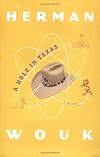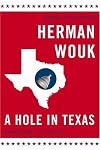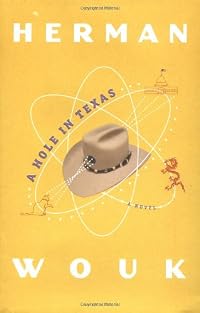
A Hole in Texas: A Novel
by Herman Wouk
On This Page
Description
With this rollicking novel hailed equally for its satiric bite, its lightly borne scientific savvy, and its tender compassion for foible-prone humanity, one of America's preeminent storytellers returns to fiction. Guy Carpenter is a regular guy, a family man, an obscure NASA scientist, when he is jolted out of his quiet life and summoned to the corridors of power in Washington, D.C. Through a turn of events as unlikely as it is inevitable, Guy finds himself compromised by scandal and show more romance, hounded by Hollywood, and agonizingly alone at the white-hot center of a firestorm ignited as three potent forces of American culture -- politics, big science, and the media -- spectacularly collide. show lessTags
Recommendations

















Member Reviews
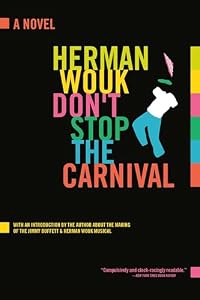
Prior to reading this book, I had only read two of Wouk's novels. I was very impressed. The first – The Caine Mutiny - is well known, if for nothing else, because of the movie it is based on. But the novel surpasses the movie (as so often happens.) It is a straight ahead narrative of a mutiny and the misconceived perceptions people have about other people. Serious and compelling, I greatly enjoyed it. Because of that experience, the second book was a surprise. Don't Stop the Carnival was humorous look at a man who attempts to run away from his nasty life in the big city. Funny, acerbic, touching, lovable off-beat characters – again, a book I enjoyed. Two novels by one author as different in temperament as could be. Yet both showed show more the Wouk's skills as a storyteller who also had the skill to bring very different kinds of people to life.
Two books that indicate Wouk is at home in many different milieus and equally successful. And the setting of a stage for my expectations of continued great things.
A Hole in Texas falls into the same category as Don't Stop the Carnival. It is intended to be a wry look at the collision between politics and science. The "hole" alluded to is the super collider that was almost completed in Texas. The book's primary focus is Guy Carpenter – a physicist who worked on that collider. Events transpire (recent events over which he has no control and past events for which he must bear the blame) which cause him to be brought back to the project. It seems the Chinese have made a significant discovery in that arena. The US reacts in a way very reminiscent to the 60's-space-race paranoia that followed Sputnik. However, it is the 21st Century, so now throw in the power of the media and a little Hollywood megabillion dollar mania, and you have the environment in which the novel functions. We are told the story of how this all goes strangely, while showing us more about Guy and the people around him – their strengths and foibles – and we learn that craziness is not the purview of any one group or any one individual.
I am tempted to add the phrase "and hilarity ensues" because I think that is part of the point. Unfortunately, while Wouk makes several attempts, what ensures is less hilarity and more a shrug of the shoulders and, occasionally, a minor titter. You may have noted that I previously used the phrase "intended to be a wry look". The road to so-so books is paved with such intentions.
You can see this book trying. It is trying to be satirical. It is trying to be funny. It is trying (as it says on the back cover blurb) to be rollicking. But it never gets above try. Part of the problem is that this attempt relies too much on clichés we have all seen. The crazed Hollywood people, the bickering Washington lawmakers, the buried-in-their-studies scientists. Even the infidelities feel contrived. None rise above the clichés to become something more, nor are the clichés used to effectively evoke humor, wryness, the ability to "rollick".
And (giving nothing away) the end seems far too pat and, in today's political environment, implausible. (And the book is from 2004 – it was just as implausible then.) Somewhat happy times for all.
I just didn't buy it.
This is a pleasant enough novel. And Wouk is a good writer – his skills are the only thing that saves the novel. But, shy of a quick read when nothing else peaks your interest, it is a novel that really hasn't got that much worth going after. There is definitely worse out there, but there is also better. show less
Two books that indicate Wouk is at home in many different milieus and equally successful. And the setting of a stage for my expectations of continued great things.
A Hole in Texas falls into the same category as Don't Stop the Carnival. It is intended to be a wry look at the collision between politics and science. The "hole" alluded to is the super collider that was almost completed in Texas. The book's primary focus is Guy Carpenter – a physicist who worked on that collider. Events transpire (recent events over which he has no control and past events for which he must bear the blame) which cause him to be brought back to the project. It seems the Chinese have made a significant discovery in that arena. The US reacts in a way very reminiscent to the 60's-space-race paranoia that followed Sputnik. However, it is the 21st Century, so now throw in the power of the media and a little Hollywood megabillion dollar mania, and you have the environment in which the novel functions. We are told the story of how this all goes strangely, while showing us more about Guy and the people around him – their strengths and foibles – and we learn that craziness is not the purview of any one group or any one individual.
I am tempted to add the phrase "and hilarity ensues" because I think that is part of the point. Unfortunately, while Wouk makes several attempts, what ensures is less hilarity and more a shrug of the shoulders and, occasionally, a minor titter. You may have noted that I previously used the phrase "intended to be a wry look". The road to so-so books is paved with such intentions.
You can see this book trying. It is trying to be satirical. It is trying to be funny. It is trying (as it says on the back cover blurb) to be rollicking. But it never gets above try. Part of the problem is that this attempt relies too much on clichés we have all seen. The crazed Hollywood people, the bickering Washington lawmakers, the buried-in-their-studies scientists. Even the infidelities feel contrived. None rise above the clichés to become something more, nor are the clichés used to effectively evoke humor, wryness, the ability to "rollick".
And (giving nothing away) the end seems far too pat and, in today's political environment, implausible. (And the book is from 2004 – it was just as implausible then.) Somewhat happy times for all.
I just didn't buy it.
This is a pleasant enough novel. And Wouk is a good writer – his skills are the only thing that saves the novel. But, shy of a quick read when nothing else peaks your interest, it is a novel that really hasn't got that much worth going after. There is definitely worse out there, but there is also better. show less
Very entertaining satire of Congress, Hollywood, nosy and malicious reporters, and dog-eat-dog Academia which also teaches particle physics in a surprisingly understandable way. I loved it!
What, me reading mundane (non-SF) fiction? Not exactly, since the title's "hole" is the one left by the Superconducting SuperCollider (SSC) project infamously killed by Congress in 1993. The SSC might have found the Higgs boson, the still-missing piece of the Standard Model of particle physics. Now, Wouk's plot asks, what if the present-day Chinese were to discover the Higgs and develop a Boson Bomb?
2026 book #14. 2004. In 1993 Congress defunded the Superconducting Super Collider in Texas. This book picks up the story in 2003, when the Chinese claim to have found the Higgs Boson. Mostly a satire on how the government does big science, mainly in panic. A bit dated but OK.
About 300 pages. I read it in 3 days. Well developed, interesting characters. I liked the technical physics talk. Some good humor and great drama. Perhaps too many attractions of a romantic nature and too much alcohol drinking made main character a bit unbelieveable. I mean could you be a high level physicist in NASA and drink and romance that much and still have time for work?
Herman is Pulitzer Prize winner. He certainly didn’t win it for this book. It seemed like it was written following a model. Combine 3 popular things which each appeal to a diverse range of people to increase book sales. In this case the book combines American politics, quantum physics and an orange cat. The Chinese have discovered the Higgs bosum particle and the Americans are afraid they’re going to make a bomb. The orange cat contributes little to the story line.
Don't waste your time. Go read a good book.
Don't waste your time. Go read a good book.
Fiction
Members
- Recently Added By
Author Information

83+ Works 19,191 Members
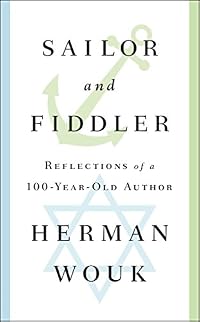
Herman Wouk was born in the Bronx, New York on May 27, 1915. He received a bachelor's degree in comparative literature and philosophy from Columbia University. In 1936, he became a staff writer for the radio comedian Fred Allen. He enlisted in the Navy immediately after Pearl Harbor and was posted as a radio officer in the South Pacific. His debut show more novel, Aurora Dawn, was published in 1947. His other novels included The City Boy, Marjorie Morningstar, Youngblood Hawke, Don't Stop the Carnival, The Winds of War, War and Remembrance, The Hope, The Gift, A Hole in Texas, and The Lawgiver. He received the Pulitzer Prize for fiction in 1952 for The Caine Mutiny. He received the first Library of Congress Lifetime Achievement Award for the Writing of Fiction in 2008. His nonfiction books included This Is My God, The Language God Talks, and Sailor and Fiddler: Reflections of a 100-Year-Old Author. Several of his books were adapted into movies including The Caine Mutiny and Marjorie Morningstar. He adapted the courtroom sections of The Caine Mutiny into the Broadway play The Caine Mutiny Court-Martial. His other Broadway shows included The Traitor and Nature's Way. He died on May 17, 2019 at the age of 103. (Bowker Author Biography) show less
Common Knowledge
- Original publication date
- 2004 (Little, Brown & Co) (Little, Brown & Co)
- Epigraph
- It could probably be shown by facts and figures that there is no distinctly native American criminal class except Congress.
- Mark Twain - Dedication
- To my brother
Victor Wouk, PhD,
California Institute of Technology '42
with admiration and love - First words
- We all have bad days, and Dr. Guy Carpenter awoke to rain drumming on gray windows, with a qualm in his gut about what this drab day might bring.
- Last words
- (Click to show. Warning: May contain spoilers.)"Good enough." She wrapped her arms powerfully around him, and the Deep Throat Physicist was home.
Classifications
Statistics
- Members
- 338
- Popularity
- 93,398
- Reviews
- 7
- Rating
- (3.19)
- Languages
- English
- Media
- Paper, Audiobook, Ebook
- ISBNs
- 12
- ASINs
- 5