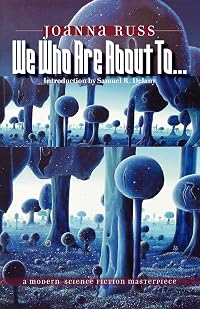
We Who Are About To...
by Joanna Russ
On This Page
Description
In this stunning and boldly imagined novel, an explosion leaves the passengers of a starship marooned on a barren alien planet. Despite only a slim chance for survival, most of the strangers are determined to colonize their new home. But the civilization they hoped for rapidly descends into a harsh microcosm of a male-dominated society, with the females in the group relegated to the subservient position of baby-makers. One holdout wants to accept her fate realistically and prepare for death. show more But her desperate fellow survivors have no intention of honoring her individual right to choose. They're prepared to force her to submit to their plan for reproduction-which will prove to be a grave mistake . . . In Hugo and Nebula Award-winning author Joanna Russ's trailblazing body of work. show lessTags
Recommendations
























Member Recommendations

lquilter Both Russ's We Who Are About To ... and Leiber's "The Night of the Long Knives" have characters confronting death in a bleak and hopeless landscape. Russ admired Leiber's work, and it shows very much in these two works, which work in some ways on the same issues.
marietherese While Harpmann's book is likely an allegory of the soul as much as an exploration of gender relations, survivalism and dystopia, the two books share strong, singular (in every sense of the word) female narrators and similarly bleak but moving endings.
Member Reviews
This is one of those rare science fiction novels that really make you think about right and wrong, the world around you, and what it means to be human.
Russ gives us a story about a small group of space travelers stranded on an uninhabited planet, a story that initially feels like a familiar "Robinson Crusoe in Space" tale, but very quickly proceeds to crush irretrievably each and every trope we’ve come to expect from this subgenre.
This novel can certainly stand as feminist scifi, a rejection of the all too typical “when the going gets rough, the men should be men and the women should revert to their natural role” premise. But I think it has much more to say than that: an effective indictment of the tyranny of the majority, an show more argument against group think, a rejection of the swaggering leader who says to the entire world “either you agree with us, or you are against us.”
We Who Are About To... is a fairly quick read, but it is by no means an easy read. show less
Russ gives us a story about a small group of space travelers stranded on an uninhabited planet, a story that initially feels like a familiar "Robinson Crusoe in Space" tale, but very quickly proceeds to crush irretrievably each and every trope we’ve come to expect from this subgenre.
This novel can certainly stand as feminist scifi, a rejection of the all too typical “when the going gets rough, the men should be men and the women should revert to their natural role” premise. But I think it has much more to say than that: an effective indictment of the tyranny of the majority, an show more argument against group think, a rejection of the swaggering leader who says to the entire world “either you agree with us, or you are against us.”
We Who Are About To... is a fairly quick read, but it is by no means an easy read. show less
Womb Raider
Caution: minor spoilers ahead. Also, trigger warning for rape and violence.
The year’s 2120 (roughly), and an unlucky group of space travelers find themselves stranded on an barren alien planet devoid of animal life. Hurled there by a multi-dimensional explosion, they have little hope of being rescued, the nature of space travel being what it is: in essence, the folding of spacetime. Do it wrong and you can end up “God knows where, maybe entirely out of [y]our galaxy, which is that dust you see in the sky on clear nights when you’re away from cities.” (page1)
Though the planet is “tagged” – meaning that, at some time in the distant past, a team of scientists surveyed a square mile of the planet’s surface and show more found nothing in the atmosphere that’s immediately lethal to humans – it’s far from hospitable; the narrator variously describes it as the Sahara, a tundra, the Mojave desert. They have few supplies – a water filter, enough dried food to last six months, a pharmacopeia of drugs stashed on the narrator’s person, and the ship itself – none of which present a solution to their precarious situation, the book’s futuristic sci-fi setting notwithstanding. With no way to call for rescue (assuming that rescuers could even reach them during their natural lives!) the survivors are left to their own devices. They are five women and three men.
Most of the group resolves not just to survive, but thrive: almost immediately, they set about colonizing the planet. Within days this new society devolves into an Upper Paleolithic patriarchy, the women of which are reduced to little more than baby makers, walking wombs. With the middle-aged Mrs. Graham luckily excused from service, and her daughter Lori a few years too young to bear children, that leaves three women: Nathalie, a young adult who was on her way to begin military training when the ship crashed; Cassie, a thirty-something ex-waitress; and the narrator, a 42-year-old musicologist with medical issues. Whereas Nathalie and Cassie somewhat reluctantly agree to “do their duty,” the narrator (cynically but realistically) scoffs at their plans. In an especially amusing exchange, one of the men insists that it’s their responsibility to rebuild civilization. “But civilization still exists,” the narrator points out. “We just aren’t a part of it anymore.” (I paraphrase, but you get the gist.) Humans, always the center of their own little worlds!
Naturally, the narrator’s fatalistic observations do not go over well.
Despite the obvious difficulties of starting over with nothing, the women are initially disallowed from doing manual labor (though this policy changes rather quickly), and just four days in the seemingly affable Alan savagely beats Nathalie for “disrespecting” him. (I guess he didn’t get the memo that womb-bearers are to be protected.) When the narrator gets especially “uppity” and starts to talk of suicide, she’s put on 24-hour watch so that her precious uterus is not compromised. Eventually the narrator – who’s recording these events after the fact on a “pocket vocoder” – escapes on a “broomstick” (a small hovercraft), finding refuge in a cave several day’s travel from the group’s camp. Instead of letting this “troublemaker” go her own way, the group chases her down and attempts to drag her back “home,” where she’s to be tied to a tree, raped, forcibly impregnated, and made to carry and birth a child against her will. Barbaric, right?
And yet many reviewers seem to blame the narrator for her own predicament. She’s nihilistic, narcissistic, a feminist harpy shrew. Indeed, by story’s end the narrator comes to believe that she deliberately provoked her fellow survivors into a confrontation because she wanted an excuse to lash out at them physically. And perhaps this is true. But they still took the bait. Even after she removed herself from the situation, leaving them to do as they pleased, they hunted her down, with the intention of violating her in the most intimate and traumatic of ways. She (and the other women) was dehumanized and objectified; treated as little more than a means to an end. I fail to see how a little extra politeness on the narrator’s part would have altered the men’s plans.
Suicidal throughout the story – likely even before the crash – in the narrator I see not misanthropic feminazi, but rather a burned out and disillusioned activist (Communist, neo-Christian) who, when suddenly and unexpectedly confronted with death, is overcome with a sense of tired resignation. In life, she was unable to change history; and now, she will die outside of it. “I’m nobody, who are you? Are you a nobody, too?” (page 33; lower-case mine.)
We Who Are About To... is dark with a capital “D” – definitely not for everyone, as evidenced by the book’s polarized ratings on Amazon. I found it compulsively readable – kind of like Margaret Atwood’s dystopias (The Handmaid's Tale, Oryx and Crake, The Year of the Flood), but minus her tentative sense of hope. I’m a newcomer to Joanna Russ – I think I accidentally stumbled upon this book via a BookMooch recommendation, perhaps because Atwood, Octavia Butler, and Ursula Le Guine are heavily represented on my list – and have already added most of the rest of her oeuvre to my wishlist. A must for fans of feminist science fiction.
http://www.easyvegan.info/2013/07/12/we-who-are-about-to-by-joanna-russ/ show less
Caution: minor spoilers ahead. Also, trigger warning for rape and violence.
The year’s 2120 (roughly), and an unlucky group of space travelers find themselves stranded on an barren alien planet devoid of animal life. Hurled there by a multi-dimensional explosion, they have little hope of being rescued, the nature of space travel being what it is: in essence, the folding of spacetime. Do it wrong and you can end up “God knows where, maybe entirely out of [y]our galaxy, which is that dust you see in the sky on clear nights when you’re away from cities.” (page1)
Though the planet is “tagged” – meaning that, at some time in the distant past, a team of scientists surveyed a square mile of the planet’s surface and show more found nothing in the atmosphere that’s immediately lethal to humans – it’s far from hospitable; the narrator variously describes it as the Sahara, a tundra, the Mojave desert. They have few supplies – a water filter, enough dried food to last six months, a pharmacopeia of drugs stashed on the narrator’s person, and the ship itself – none of which present a solution to their precarious situation, the book’s futuristic sci-fi setting notwithstanding. With no way to call for rescue (assuming that rescuers could even reach them during their natural lives!) the survivors are left to their own devices. They are five women and three men.
Most of the group resolves not just to survive, but thrive: almost immediately, they set about colonizing the planet. Within days this new society devolves into an Upper Paleolithic patriarchy, the women of which are reduced to little more than baby makers, walking wombs. With the middle-aged Mrs. Graham luckily excused from service, and her daughter Lori a few years too young to bear children, that leaves three women: Nathalie, a young adult who was on her way to begin military training when the ship crashed; Cassie, a thirty-something ex-waitress; and the narrator, a 42-year-old musicologist with medical issues. Whereas Nathalie and Cassie somewhat reluctantly agree to “do their duty,” the narrator (cynically but realistically) scoffs at their plans. In an especially amusing exchange, one of the men insists that it’s their responsibility to rebuild civilization. “But civilization still exists,” the narrator points out. “We just aren’t a part of it anymore.” (I paraphrase, but you get the gist.) Humans, always the center of their own little worlds!
Naturally, the narrator’s fatalistic observations do not go over well.
Despite the obvious difficulties of starting over with nothing, the women are initially disallowed from doing manual labor (though this policy changes rather quickly), and just four days in the seemingly affable Alan savagely beats Nathalie for “disrespecting” him. (I guess he didn’t get the memo that womb-bearers are to be protected.) When the narrator gets especially “uppity” and starts to talk of suicide, she’s put on 24-hour watch so that her precious uterus is not compromised. Eventually the narrator – who’s recording these events after the fact on a “pocket vocoder” – escapes on a “broomstick” (a small hovercraft), finding refuge in a cave several day’s travel from the group’s camp. Instead of letting this “troublemaker” go her own way, the group chases her down and attempts to drag her back “home,” where she’s to be tied to a tree, raped, forcibly impregnated, and made to carry and birth a child against her will. Barbaric, right?
And yet many reviewers seem to blame the narrator for her own predicament. She’s nihilistic, narcissistic, a feminist harpy shrew. Indeed, by story’s end the narrator comes to believe that she deliberately provoked her fellow survivors into a confrontation because she wanted an excuse to lash out at them physically. And perhaps this is true. But they still took the bait. Even after she removed herself from the situation, leaving them to do as they pleased, they hunted her down, with the intention of violating her in the most intimate and traumatic of ways. She (and the other women) was dehumanized and objectified; treated as little more than a means to an end. I fail to see how a little extra politeness on the narrator’s part would have altered the men’s plans.
Suicidal throughout the story – likely even before the crash – in the narrator I see not misanthropic feminazi, but rather a burned out and disillusioned activist (Communist, neo-Christian) who, when suddenly and unexpectedly confronted with death, is overcome with a sense of tired resignation. In life, she was unable to change history; and now, she will die outside of it. “I’m nobody, who are you? Are you a nobody, too?” (page 33; lower-case mine.)
We Who Are About To... is dark with a capital “D” – definitely not for everyone, as evidenced by the book’s polarized ratings on Amazon. I found it compulsively readable – kind of like Margaret Atwood’s dystopias (The Handmaid's Tale, Oryx and Crake, The Year of the Flood), but minus her tentative sense of hope. I’m a newcomer to Joanna Russ – I think I accidentally stumbled upon this book via a BookMooch recommendation, perhaps because Atwood, Octavia Butler, and Ursula Le Guine are heavily represented on my list – and have already added most of the rest of her oeuvre to my wishlist. A must for fans of feminist science fiction.
http://www.easyvegan.info/2013/07/12/we-who-are-about-to-by-joanna-russ/ show less
This was difficult to read and is difficult to talk about. I think any “plot” synopsis fails to do it justice. Yes, it starts out as a story about a small group of survivors on a desert/deserted planet and the almost immediate resurgence of patriarchy. But that’s maybe the first half of the book. It’s told as the recorded monologue of one of the survivors, who wants nothing to do with the others’ plan to reestablish patriarchal civilization. And after the first half, most of the rest is the narrator’s unflinching ruminations on her life, and society, and right and wrong, and really the purpose of human existence.
Just before exploding, a lost starship ejects its passenger compartment on a planet with a breathable atmosphere. There are three men and five women, food and water for six months, and no idea where they are. It may be, as the narrator puts it, “We’re nowhere. We’ll die alone.” The other survivors do not favor her point of view, and begin planning how to live on this unknown planet and how to populate and subdue it. But as the days wear on, friction among the group builds, tempers flare and violence erupts.
This is a superbly written gritty tale of survival and extinction.
This is a superbly written gritty tale of survival and extinction.
Knowing that Joanna Russ is generally considered part of science fiction's New Wave movement, it might seem odd that the setup of this 1977 novel uses only ingredients that could be found in earlier space adventure stories: colonization ships, surprisingly hospitable planets, a super-competent individualist narrator, and a group of castaways that includes a nuclear family and an athlete and a government agent and a professor and a showgirl. The difference is just in the plot, the characterizations, the philosophy, the prose style, and everything else.
The word that follows the title is of course "die", and right away our narrator (I'll call her ON, she never says her name) figures out that their situation is totally hopeless, and tells show more everyone so. She can't stop them from trying to carry on Robinson Crusoe projects anyway, but there's no chance that they'll be rescued, and their idea of populating the planet with their descendants (another classic SF notion) almost certainly won't work—if it's even desirable. So she just wants to be left in peace. That's basically the entire plot. If you think this sounds like kind of a bummer scenario, you are correct.
You may expect some kind of power struggle to develop, and it does, but not necessarily in the way you'd think. You may also expect, given ON's immediate hostility to everyone and her high level of general crankiness, that eventually she'll soften up and come to see their point of view, since that's a familiar kind of character arc; that doesn't exactly happen (although we do find out some interesting things about the other people), and Russ plays with our sympathies quite a bit, making all of ON's harsh judgments seem right so you can't just say "this person is too angry", but then letting her second-guess herself in ways that also seem possibly right. The flashbacks we eventually get to her past don't exactly explain things, but they're very moving. The point of view is strongly feminist in a way that lets no one off the hook; the first time there's violence between a man and a woman, the way they each deal with it is both disturbing and totally believable for those characters.
At one point something happens that may make you think "Wow, holy shit... well, if that’s where this was going, I guess the book must be almost over"—when in fact you're only a little past the halfway mark; Russ is gambling that if you've made it this far, you'll stick around for what follows, if only to see what more she could possibly do with the premise. The way the last section unfolds sometimes feels a little arbitrary, various things just come and go, but I suspect there's more shape to it than I noticed because I was still really engrossed. The actual end hit me like a brick wall.
There are many difficult things about the book, but the only one that slightly bothered me and felt like it wasn't on purpose was the prose style: it's supposed to be spoken dictation but it doesn't read like that at all, and the dialogue is compressed and choppy in a way that I found a little hard to follow at times (although that may not be specific to Russ; I've noticed it with other writers of that period too). Anyway, it's worth sticking with it even though you will need a hug afterward.
(PS: I'm looking at the 1977 Dell paperback edition and—while I usually don't bother complaining about SF book covers because they're so often terrible, and I sure don't blame publishers for having no idea how to market such a merciless and experimental novel—this has one of the least appropriate covers I've ever seen. There's a little open-top vehicle flying through interplanetary space, piloted by a grey-faced kind of goblin person with glowing red eyes. Needless to say this is not a thing from the book. However, the person who designed the cover so as to make it seem like some other kind of story clearly wasn't talking to the person who designed everything else, because immediately inside the front cover is an excerpt that contains not just a spoiler, but the single most shocking sentence in the book. I'm picturing a bunch of unsuspecting SF fans in 1977 picking this up and going "Oh cool, space! I wonder what it's—[opens cover] AIEEE!") show less
The word that follows the title is of course "die", and right away our narrator (I'll call her ON, she never says her name) figures out that their situation is totally hopeless, and tells show more everyone so. She can't stop them from trying to carry on Robinson Crusoe projects anyway, but there's no chance that they'll be rescued, and their idea of populating the planet with their descendants (another classic SF notion) almost certainly won't work—if it's even desirable. So she just wants to be left in peace. That's basically the entire plot. If you think this sounds like kind of a bummer scenario, you are correct.
You may expect some kind of power struggle to develop, and it does, but not necessarily in the way you'd think. You may also expect, given ON's immediate hostility to everyone and her high level of general crankiness, that eventually she'll soften up and come to see their point of view, since that's a familiar kind of character arc; that doesn't exactly happen (although we do find out some interesting things about the other people), and Russ plays with our sympathies quite a bit, making all of ON's harsh judgments seem right so you can't just say "this person is too angry", but then letting her second-guess herself in ways that also seem possibly right. The flashbacks we eventually get to her past don't exactly explain things, but they're very moving. The point of view is strongly feminist in a way that lets no one off the hook; the first time there's violence between a man and a woman, the way they each deal with it is both disturbing and totally believable for those characters.
At one point something happens that may make you think "Wow, holy shit... well, if that’s where this was going, I guess the book must be almost over"—when in fact you're only a little past the halfway mark; Russ is gambling that if you've made it this far, you'll stick around for what follows, if only to see what more she could possibly do with the premise. The way the last section unfolds sometimes feels a little arbitrary, various things just come and go, but I suspect there's more shape to it than I noticed because I was still really engrossed. The actual end hit me like a brick wall.
There are many difficult things about the book, but the only one that slightly bothered me and felt like it wasn't on purpose was the prose style: it's supposed to be spoken dictation but it doesn't read like that at all, and the dialogue is compressed and choppy in a way that I found a little hard to follow at times (although that may not be specific to Russ; I've noticed it with other writers of that period too). Anyway, it's worth sticking with it even though you will need a hug afterward.
(PS: I'm looking at the 1977 Dell paperback edition and—while I usually don't bother complaining about SF book covers because they're so often terrible, and I sure don't blame publishers for having no idea how to market such a merciless and experimental novel—this has one of the least appropriate covers I've ever seen. There's a little open-top vehicle flying through interplanetary space, piloted by a grey-faced kind of goblin person with glowing red eyes. Needless to say this is not a thing from the book. However, the person who designed the cover so as to make it seem like some other kind of story clearly wasn't talking to the person who designed everything else, because immediately inside the front cover is an excerpt that contains not just a spoiler, but the single most shocking sentence in the book. I'm picturing a bunch of unsuspecting SF fans in 1977 picking this up and going "Oh cool, space! I wonder what it's—[opens cover] AIEEE!") show less
While SF is a literature of ideas at its best, more frequently, it takes an idea and creates some escapist fun with it. Here Russ takes one of the oldest ideas in literature -- the Robinsonade -- and uses the science fictional setting to turn the story up a notch and rip it inside out. Not an easy read but worth reading, and reading again, every few years. Russ's language is diamond-hard; her characterization unsparing; her world-building spare but intense and perfectly-realized. This is a novel that will stay with you a long time.
Difficult to rate... I think if it was any longer I would have found it unbearable. As it is, it's quite difficult. Sort of a more depressing version of Russ' Picnic on Paradise in tone. This all sounds really negative, but I thought it was a genius and well-crafted story. Written in an incredibly distinct voice, it really turns the "spaceship crashed on an alien planet" plot inside out.
I need to keep reading more Joanna Russ!
I need to keep reading more Joanna Russ!
Members
- Recently Added By
Lists

Best Science Fiction Novels
816 works; 426 members

Favorite Science Fiction by Women Authors
737 works; 202 members

Short and Sweet
245 works; 23 members

Unshelved Book Clubs
579 works; 5 members

Books Read in 2017
4,249 works; 130 members

University Presses
155 works; 1 member

Otherland Book Club
36 works; 2 members
Favorite Science Fiction
456 works; 218 members
Author Information

94+ Works 7,647 Members
Joanna Russ was born in New York City on February 22, 1937. She received a degree in English from Cornell University in 1957 and a MFA in playwriting from the Yale Drama School in 1960. She taught at various colleges and universities during her lifetime including a long stint at the University of Washington in Seattle. She was a critic and science show more fiction writer best known for books of criticism such as The Female Man (1975) and How to Suppress Women's Writing (1984) as well as the novel And Chaos Died (1970). She died on April 29, 2011 at the age of 74. (Bowker Author Biography) show less
Some Editions
Series
Belongs to Publisher Series
Work Relationships
Common Knowledge
- Canonical title*
- Wir, die wir geweiht sind ...
- Original title
- We Who Are About To . . .
- Alternate titles*
- Wir, die wir sehr bald …; Die Todgeweihten ...
- Original publication date
- 1976 (in Galaxy Magazine) (in Galaxy Magazine)
- People/Characters
- Valeria Graham; Nathalie; Victor Graham; Cassie; Alan-Bobby Whitehouse; John Ude (show all 10); Lori Graham; L. B.; Marilyn; Kennedy
- First words
- About to die. And so on.
- Quotations
- Either you limit what you think about and who you think about (the commonest method) or you start raising a ruckus about being outside and wanting to get inside (then they try to kill you) or you say piously that God puts eve... (show all)rybody on the inside (then they love you) or you become crazed in some way. Not insane but flawed deep down somehow, like a badly-fire pot that breaks when you take it out of the kiln and the cold air hits it. Desperate. (p.118, 1977 Dell paperback edition)
The neo-Christian theory of love is this:
There is little of it. Use it where it's effective.
It's a bore, a dreadful bore, being outside history. - Last words
- (Click to show. Warning: May contain spoilers.)well it's time.
- Blurbers
- Delany, Samuel R.
*Some information comes from Common Knowledge in other languages. Click "Edit" for more information.
Classifications
Statistics
- Members
- 687
- Popularity
- 41,555
- Reviews
- 22
- Rating
- (3.68)
- Languages
- English, French, German, Swedish
- Media
- Paper, Ebook
- ISBNs
- 11
- ASINs
- 7