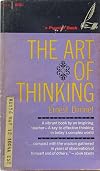
The Art of Thinking
by Ernest Dimnet
On This Page
Description
Dimnet's classic on the art of thinking provides the most useful tips and advice on how to improve one's mind, improve concentration and thinking better, and even answers some timeless and all-important questions such as "how do I be myself" and "how do I find myself." Finding an answer to these questions, Dimnet explains, is crucial to the production of any original thought. We must know ourselves in order to think for ourselves. This book is the key to effective thinking in today's complex show more world. Learn how the way we think can greatly improve the way we live. show lessTags
Recommendations
















Member Reviews
No one will read this book without many times closing it, keeping a finger in the place, while his own mind, infected by the activity of the Abbé's, goes off on some excursion. It does not give rules for thinking but it does give many rules for avoiding thoughtlessness and, by delightful example, makes its readers think. Too wise to try to teach what cannot be taught, the lecturer is himself thinking all the time. It is a pleasure and a stimulus to agree or to disagree with him and he is one of those writers who compel his readers to do one or other. For example, he complains that our world is populated by a majority of minors and that our education is unsufficiently serious and too long postponed. Is it? Is it desirable that a man of show more twenty should 'know the essentials of even the encyclopaedic knowledge of to-day?' Can he learn so young and so fast without sacrificing things more important than knowledge? But how admirable is Mr. Dimnet's indignation at the indifference of parents to the quality of the stuff their children cram into their omnivorous mental stomachs. No parent who can help it gives his child second-best food. And 'no book ought to be left in the nursery that is inferior to Robinson Crusoe, The Arabian Nights, or Perrault's Fairy Tales'. As for grown-ups, 'Never read a book for the style', 'Only read what gives the greatest pleasure', and, finally, 'Do not read good books - only read the best'. His mind plays over one aspect of though after another, the processes of thinking, the tidying up of minds, the right way of reading newspapers, solitude, the persistent ghosts that gibber in the thinker's face, the elusive moths of thought that must be either caught or lost forever.
Arthur Ransome, 'The art of thinking', Now and Then, no. 33 (Autumn 1929), pp. 20-21. show less
Arthur Ransome, 'The art of thinking', Now and Then, no. 33 (Autumn 1929), pp. 20-21. show less
A classic book on the way we think and how to think about the subject. Is it an art? That is what is explored in this slight volume.
Helpful
Louise Morgan Sill
Ratings
Members
- Recently Added By
Lists

Best Books of 1926-1935
403 works; 10 members

Publisher's Weekly NON-Fiction list - 1912 - 1975
486 works; 4 members
Author Information

11 Works 335 Members
Some Editions
Awards and Honors
Distinctions
Common Knowledge
- Canonical title*
- Die Kunst des Denkens
- Original title
- Die Kunst des Denkens
- Original publication date
- 1928
- First words
- A familiar scene.
- Last words
- (Click to show. Warning: May contain spoilers.)The writer has had no other ambition and he cherishes no greater hope than that of being useful.
- Original language*
- Englisch
*Some information comes from Common Knowledge in other languages. Click "Edit" for more information.
Classifications
Statistics
- Members
- 276
- Popularity
- 117,579
- Reviews
- 4
- Rating
- (3.62)
- Languages
- 6 — English, Finnish, German, Portuguese (Portugal), Spanish, Swedish
- Media
- Paper, Ebook
- ISBNs
- 10
- UPCs
- 1
- ASINs
- 20