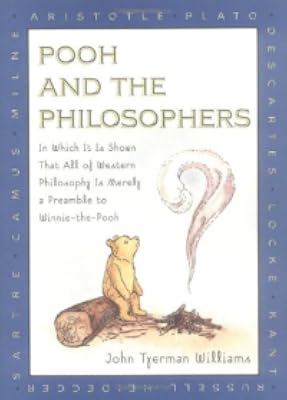
Pooh and the Philosophers : In Which It Is Shown That All of Western Philosophy Is Merely a Preamble to Winnie-The-Pooh
by John Tyerman Williams
On This Page
Description
In this splendidly preposterous volume, John Tyerman Williams sets out to prove beyond all reasonable doubt that the whole of Western philosophy - from the ancient Greeks to the existentialists of this century - may be found in the works of A. A. Milne. Williams shows how Pooh - referred to here as "the Great Bear" - explains and illuminates the most profound ideas of the great thinkers, from Aristotle and Plato to Sartre and Camus.Tags
Recommendations










Member Reviews
Pooh and the Philosophers: In-Which-It-Is-Shown-That-A-Fool-Is-Born-Every-Minute.
Sigh.
I admit I was curious.
I admit to liking Benjamin Hoff's Tao of Pooh very much. As an antidote to sadness, or downheartedness, or just a vague bluesy feeling, it is exactly what works for me. There is no doubt in my mind that Winnie The Pooh is a Zen Master. My tongue is only a teeny bit in my cheek, for I can certainly embrace all the Zen qualities of Pooh when I tuck the book under my arm, stroll down the garden path to the pond, and spend a few pleasant hours, intermittently reading, and listening to the bees buzzing.
Then along comes a brick like this.
I never suspected for a moment that the author might be serious. Then I read,
So when Pooh Bear show more experienced the burning pain of a bee sting, this symbolized the pain of discarding a cherished hypothesis. We note the unhesitating courage with which he performed the painful duty.
We also see how great his anguish was when we go on to read, "his arms were so stiff from holding on to the string of the balloon all that time that they stayed up straight in the air for more than a week." What a brilliant picture of the way in which habit and emotion may cling to a belief that evidence and reason have rejected!
I myself was in danger of my arms staying straight up for a week: I was desperately clinging to emotions that evidence and reason were rejecting, for I actually continued to read after this, despite my soul screaming out for mercy.
Later, I encountered that blasted balloon again:
The familiar phrase "the World of Pooh" itself signals a strong connection with Heidegger. ... Pooh's use of a balloon as a tool to get honey is obviously the key to Heidegger's emphasis on the use of tools and equipment to deal with the world outside. Even Heidegger's favorite phrase "ready to hand" to indicate equipment clearly derives from Pooh's phrase "about you" when he asks, "I wonder if you've got such a thing as a balloon about you?"
Oh, clearly that is what Pooh meant. Obviously. So many absolutes. Coelholy. (My newly-minted word for being at one with the universe.)
This is a sad little book in which Poor Pooh Has Been Made To Go Head-to-Head With All The Philosophers, From Aristotle to The Existentialists, And Emerges Exhausted And Traumatized.
Pooh will be in therapy for the rest of his life. Or until I rescue him again and take him down to the pond, on a summer's day, to hear the bees buzzing -- but not feel those pesky (western) philosophers stinging.
"My arms ache." show less
Sigh.
I admit I was curious.
I admit to liking Benjamin Hoff's Tao of Pooh very much. As an antidote to sadness, or downheartedness, or just a vague bluesy feeling, it is exactly what works for me. There is no doubt in my mind that Winnie The Pooh is a Zen Master. My tongue is only a teeny bit in my cheek, for I can certainly embrace all the Zen qualities of Pooh when I tuck the book under my arm, stroll down the garden path to the pond, and spend a few pleasant hours, intermittently reading, and listening to the bees buzzing.
Then along comes a brick like this.
I never suspected for a moment that the author might be serious. Then I read,
So when Pooh Bear show more experienced the burning pain of a bee sting, this symbolized the pain of discarding a cherished hypothesis. We note the unhesitating courage with which he performed the painful duty.
We also see how great his anguish was when we go on to read, "his arms were so stiff from holding on to the string of the balloon all that time that they stayed up straight in the air for more than a week." What a brilliant picture of the way in which habit and emotion may cling to a belief that evidence and reason have rejected!
I myself was in danger of my arms staying straight up for a week: I was desperately clinging to emotions that evidence and reason were rejecting, for I actually continued to read after this, despite my soul screaming out for mercy.
Later, I encountered that blasted balloon again:
The familiar phrase "the World of Pooh" itself signals a strong connection with Heidegger. ... Pooh's use of a balloon as a tool to get honey is obviously the key to Heidegger's emphasis on the use of tools and equipment to deal with the world outside. Even Heidegger's favorite phrase "ready to hand" to indicate equipment clearly derives from Pooh's phrase "about you" when he asks, "I wonder if you've got such a thing as a balloon about you?"
Oh, clearly that is what Pooh meant. Obviously. So many absolutes. Coelholy. (My newly-minted word for being at one with the universe.)
This is a sad little book in which Poor Pooh Has Been Made To Go Head-to-Head With All The Philosophers, From Aristotle to The Existentialists, And Emerges Exhausted And Traumatized.
Pooh will be in therapy for the rest of his life. Or until I rescue him again and take him down to the pond, on a summer's day, to hear the bees buzzing -- but not feel those pesky (western) philosophers stinging.
"My arms ache." show less
Having read The Tao of Pooh, I came across this book by accident in a bookshop and bought it on impulse. The premise of the book is that the stories of Winnie the Pooh and the House at Pooh Corner contain the whole of western philosophy.
The book examines how key ideas from the thinking of Plato through to the existentialists is described through these two stories. Indeed given the these stories were published in 1926 and 1928 a number of more recent philosophers are shown to have provided either footnotes to the Pooh stories or have expounded on them.
The first thing to say is that this is an enjoyable, fun and eminently readable book. I initially approached it with some scepticism and for the first part of the book harboured the fear show more that I may be the subject of a joke on the basis that given enough analysis the London tube timetable can probably be shown to have the key thoughts of Karl Marx or be shown to predict the date of the apocalypse. As I read through the book however I became more and more drawn into the underpinning ideas of what I had previously seen as children’s stories and to my surprise found that through them I was adding considerably to my understanding of the philosophers thinking.
As I began to accept the argument of a philosophical basis to the stories my intrigue switched to the nature of communicating ideas. A.A. Milne it appears had taken the extremely dry and largely inaccessible topic of philosophy and packaged it up in the most accessible of children’s stories. If this is what he has done, then maybe he was just too clever since most readers of Winnie the Pooh have no idea that they are reading about philosophy. Of course this is probably a virtue since many readers would run a mile if they thought they were invited to read a philosophy book. For other readers who want to have the philosophy pointed out to them perhaps Milne set out to sow a seed which has taken 75 years to germinate and now be revealed in this book.
The book establishes a convincing case that the thinking of western philosophy is contained in these apparently simple stories. Interesting though this is, more importantly it has revealed a great deal of insight about the nature of communicating ideas.
The ability to achieve improvement is in large part determined by the way in which we think. Understanding how to communicate ideas and change thinking is thus critically important. This book provides an insightful glimpse into the use of stories to communicate complex ideas. More importantly just as the Winnie the Pooh stories do, it does so in a way that you learn almost by accident without feeling you had to try.
If you want to learn about thinking without having to feel that you have to think, or would like to understand philosophy without the need to read a philosophy book then this is the book for you. show less
The book examines how key ideas from the thinking of Plato through to the existentialists is described through these two stories. Indeed given the these stories were published in 1926 and 1928 a number of more recent philosophers are shown to have provided either footnotes to the Pooh stories or have expounded on them.
The first thing to say is that this is an enjoyable, fun and eminently readable book. I initially approached it with some scepticism and for the first part of the book harboured the fear show more that I may be the subject of a joke on the basis that given enough analysis the London tube timetable can probably be shown to have the key thoughts of Karl Marx or be shown to predict the date of the apocalypse. As I read through the book however I became more and more drawn into the underpinning ideas of what I had previously seen as children’s stories and to my surprise found that through them I was adding considerably to my understanding of the philosophers thinking.
As I began to accept the argument of a philosophical basis to the stories my intrigue switched to the nature of communicating ideas. A.A. Milne it appears had taken the extremely dry and largely inaccessible topic of philosophy and packaged it up in the most accessible of children’s stories. If this is what he has done, then maybe he was just too clever since most readers of Winnie the Pooh have no idea that they are reading about philosophy. Of course this is probably a virtue since many readers would run a mile if they thought they were invited to read a philosophy book. For other readers who want to have the philosophy pointed out to them perhaps Milne set out to sow a seed which has taken 75 years to germinate and now be revealed in this book.
The book establishes a convincing case that the thinking of western philosophy is contained in these apparently simple stories. Interesting though this is, more importantly it has revealed a great deal of insight about the nature of communicating ideas.
The ability to achieve improvement is in large part determined by the way in which we think. Understanding how to communicate ideas and change thinking is thus critically important. This book provides an insightful glimpse into the use of stories to communicate complex ideas. More importantly just as the Winnie the Pooh stories do, it does so in a way that you learn almost by accident without feeling you had to try.
If you want to learn about thinking without having to feel that you have to think, or would like to understand philosophy without the need to read a philosophy book then this is the book for you. show less
Upon reading the Pooh books, I did observe the philosophical and thouhtful touch of the writing, so I find this kind of an homage very appropriate. But this shouldn't be taken too seriously, since with enough effort, one can find any hidden meanings in just about anything. Also, the original thoughts of the chosen philosophers aren't made that clear, so some background in the history of philosophy is needed to fully appreciate this.
The most interesting parts to me were Wittgenstein's and Heidegger's thoughts on language. On the other hand, I don't understand any of Hegel's work, so I couldn't enjoy his part here either.
The most interesting parts to me were Wittgenstein's and Heidegger's thoughts on language. On the other hand, I don't understand any of Hegel's work, so I couldn't enjoy his part here either.
Cute and worth a read, but not as good as the Tao of Pooh, which does a much better job with the Milne characters or Sophie's World which does the philosophy part better.
Shepard, Ernest H. (Illustrator)
Ratings
Members
- Recently Added By
Author Information

4 Works 1,287 Members
All Editions
Some Editions
Common Knowledge
- Original title
- Pooh and the Philosophers
- Original publication date
- 1995
Classifications
- DDC/MDS
- 828.91209 — Literature & rhetoric English & Old English literatures English miscellaneous writings English miscellaneous writings 1900- English miscellaneous writings 1900-1999 English miscellaneous writings 1900-1945 Individual authors not limited to or chiefly identified with one specific form.
- LCC
- PR6025 .I65 .Z976 — Language and Literature English English Literature 1900-1960
- BISAC
Statistics
- Members
- 917
- Popularity
- 29,088
- Reviews
- 5
- Rating
- (3.21)
- Languages
- 12 — Czech, Danish, Dutch, English, Estonian, Finnish, German, Italian, Japanese, Norwegian (Bokmål), Polish, Swedish
- Media
- Paper, Audiobook
- ISBNs
- 22
- ASINs
- 6