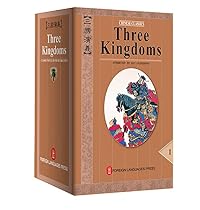
The Romance of the Three Kingdoms
by Guanzhong Luo
On This Page
Description
Updated with a new foreword by Moss Roberts for this fifteenth anniversary edition, Three Kingdoms tells the story of the fateful last reign of the Han dynasty (206 B.C.-A.D. 220), when the Chinese empire was divided into three warring kingdoms. Writing some twelve hundred years later, the Ming author Luo Guanzhong drew on histories, dramas, and poems portraying the crisis to fashion a sophisticated, compelling narrative that has become the Chinese national epic. This abridged edition show more captures the novel's intimate and unsparing view of how power is wielded, how diplomacy is conducted, a show lessTags
Recommendations





Member Reviews
This was one of the first books I've ever read, where I became so morally disgusted that I almost decided to not finish it. A certain vignette involving cannibalism brought to the fore just how dramatically different cultural mindsets can be. After a helpful exchange with an old school acquaintance from China I decided to keep going, and I'm glad I did. The rest of the book (both volumes/parts) was a fascinating and exciting read. So much of it reminded me other great classics of western literature (from the Illiad to the Gallic Wars) -- and yet there was so much different. And that similarity really provided a great basis to appreciate the differences. While the "orientalists" of the past certainly went to far in decrying the values of show more the "far east" -- reading this book helped me appreciate that the east and west are separated by a greater gulf than many modern folks want to admit.
(2024 Review #4) show less
(2024 Review #4) show less
Luo Guanzhong's 三国演义 (Romance of the Three Kingdoms) is a cornerstone of Chinese literature and a compelling historical novel that delves into the turbulent period of the Three Kingdoms era. This edition, published in the Classical Masterworks Popular Library series, presents the story in an accessible format ideal for casual readers and serious scholars.
Suitable for Studying:
三国演义 offers a profound exploration of strategy, leadership, and interpersonal dynamics, making it an invaluable text for students of history and literature. The novel's rich portrayal of historical figures and events provides deep insights into the socio-political complexities of ancient China. The strategic understanding of characters like Liu Bei, show more Cao Cao, and Sun Quan can be studied to understand historical military tactics and governance.
Inspiration for Fantasy Novels:
For fantasy novelists, 三国演义 serves as a wellspring of inspiration. Its intricate plotlines, vivid characterizations, and dramatic conflicts offer fertile ground for creating fantasy worlds. The novel's themes of heroism, betrayal, and ambition can be reimagined in fantastical settings, while its detailed descriptions of battles and politics provide a blueprint for developing complex fantasy narratives. Luo Guanzhong's work, thus, bridges historical depth with creative storytelling possibilities. show less
Suitable for Studying:
三国演义 offers a profound exploration of strategy, leadership, and interpersonal dynamics, making it an invaluable text for students of history and literature. The novel's rich portrayal of historical figures and events provides deep insights into the socio-political complexities of ancient China. The strategic understanding of characters like Liu Bei, show more Cao Cao, and Sun Quan can be studied to understand historical military tactics and governance.
Inspiration for Fantasy Novels:
For fantasy novelists, 三国演义 serves as a wellspring of inspiration. Its intricate plotlines, vivid characterizations, and dramatic conflicts offer fertile ground for creating fantasy worlds. The novel's themes of heroism, betrayal, and ambition can be reimagined in fantastical settings, while its detailed descriptions of battles and politics provide a blueprint for developing complex fantasy narratives. Luo Guanzhong's work, thus, bridges historical depth with creative storytelling possibilities. show less
Three Kingdoms, also known as Romance of the Three Kingdoms, is basically a novelization of the century of Chinese history between 180 and 280 AD. By focusing on this period Luo Guanzhong is able to provide a story encompassing a complete cycle of division and reunification in ancient China. As the opening chapter and the closing chapter state, "[t]he empire, long divided, must unite; long united, must divide. Thus it has ever been." For better or worse, to capture the entire cycle in this epic takes over 2,000 pages, and while the central goal of portraying this period of history is achieved, there are some serious flaws with the work. Luo Guanzhong accomplished what he was trying to accomplish, but little else. Whether that makes this show more work worth reading depends on what you're looking to get out of it.
Starting in a period of rebellion and turmoil, the first volume of this four-volume (at least the Moss edition is four volumes) epic establishes most of the important characters of the piece. We are first introduced to Liu Bei (Xuande), a minor member of the royal family and a virtuous warrior and leader- at times perhaps too virtuous. Alongside him are his two sworn brothers Guan Yu (a fierce warrior whose skill in battle is almost without peer) and Zhang Fei (a hotheaded warrior who attacks without thinking, but still a formidable warrior). These are painted as the protagonists for much of this long tale, and for the first few volumes their exploits receive the most attention in the narrative. Fighting with them at first, and later opposing them, is Cao Cao. Cao Cao is a villain or antihero depending on how you interpret the story. He's clever but stubborn at times, willing to do anything to advance his position, but petty and brutal once he gets to be in charge. His vision of a unified empire is what drives Three Kingdoms more than any other factor. Volume 1 also introduces us to the characters of the Southland (Wu), though none of them last as long or have as strong an influence on the story as the characters I just mentioned. With Liu Bei and his kingdom of Shu being the heroes and Cao Cao and his kingdom of Wei being the villains, Wu and its leaders (the Sun family) often seem like the third wheel of this story, and at times they are not even mentioned for long spans of the book. Nevertheless their kingdom is a key player in many of the most important battles of the epic, making them an essential element of the tale.
Despite the fact that I outlined the three main kingdoms above, and the fact that this massive tome is called Three Kingdoms, these three nations don't coalesce until well into the second volume. Most of the first volume is spent with Liu Bei wandering from place to place with a growing band of followers and with Cao Cao playing warlord-whack-a-mole. By the end of the first volume most of the minor players have been cleared away, but some key characters haven't even made an appearance yet (like Zhuge Liang [Kongming], Liu Bei's chief strategist, is only introduced at around page 650).
The second volume sees the introduction of Zhuge Liang and the Battle of Red Cliffs, the major battle of the period that cemented the tripolar balance of power. The Battle of Red Cliffs makes a good central set piece to volume two, as all three nations and every major character still alive at that point are involved, and the preparations and strategies for the battle are more fully developed than usual (the Battle of Red Cliffs takes about one hundred pages, whereas most battles take about two). By the tail end of the second volume ancient China is divided in the way that you typically picture when you think of the Three Kingdoms period.
Volume three continues the struggle between the three kingdoms, with many battles fought but little change in the dynamic between countries. One nation attacks another, and then that second nation uses the threat of the third nation to make the first nation back off. This happens many times. Over a 100-150 page segment in the middle of volume three nearly every character of interest is killed off, some given deaths in battle, others written off with a sentence. With the loss of so many big names you might expect a major change in the story, but largely everything keeps going as it did before, except with new characters. The end of volume three and most of volume four covers attempts by Shu to strike at the heartland of Wei, I believe there are a total of 14 military campaigns conducted.
Volume four, besides dealing with the Shu-Wei battles, covers Wei court politics extensively, giving you a chance to get to know the Wei characters far better than characters from the other two kingdoms. Eventually, after 14 failed campaigns by Shu, Wei strikes back. The two kingdoms of Shu and Wu fall to Wei, not because of any especially brave or brilliant Wei commander, but because of the internal corruption of the other two kingdoms. With the victory of Wei China is once again unified, and the Three Kingdoms period comes to a close.
Obviously a whole lot more happens over the course of the books, but that's a brief outline. Tracing all the major players of the day, Luo Guanzhong gives us an entire era of Chinese history in a single epic. The problem is that, while Three Kingdoms serves as a decent novelization of history, it isn't as impressive a work of literature. First, a few minor complaints: as I already discussed above, Wu gets less focus than the other two kingdoms by a fair margin, which results in less investment in those characters. Even Wu's defeat is wrapped up in 25 pages or so, making it feel as though Wu was the also-ran of the epic. Another minor complaint is the length: while it was inevitable that a book trying to do what this one does would be long, there are parts that could have been cut to slim down the epic a bit. There are 4 chapters devoted almost entirely to Zhuge Liang's seven captures of the tribal leader Meng Huo, for instance, that could have been cut. The chapters reestablish for the umpteenth time that Zhuge Liang is a brilliant strategist, but outside of a more exotic locale the chapters do nothing new, and it feels like an aside from the main action between the three kingdoms. A cut here and a cut there could have streamlined the book at the cost of some anecdotes, and while you may disagree I think that the tradeoff would have been beneficial to the book overall.
Speaking of anecdotes, my first major complaint with this book is that it has very, very few actual characters. It has plenty of named characters, but almost none of them are distinct. Even among major characters who last an entire volume you are lucky to get a single anecdote to establish characterization. Xiahou Dun gets shot in the eye with an arrow and eats the eye, Dian Wei uses the corpses of men he's killed as clubs to kill even more enemies, and those scenes are great, but ultimately they are anecdotes that establish only a single character trait. Most characters don't even get an anecdote: looking at the glossary of major characters there are over a hundred, and most don't have an identifying characteristic. Besides who they fight for, what is one thing that distinguishes Han Dang from Liao Hua? Or Jian Yong from Lu Fan? Almost all the characters in this book can be reduced to "brave warrior" or "clever commander" or "leader of X army" and nothing distinguishes them from all the other characters in that position. Even major characters are often given only a single character trait. Besides Xiahou Dun being loyal and fierce, or Dian Wei being strong, as the above anecdotes indicate, they have no other characteristics. Dian Wei is entirely "strong bodyguard" and Xiahou Dun is almost always "loyal battlefield commander." Of characters that get more than one trait, their character is sometimes not even consistent. Zhuge Liang is a master at reading the heavens- except when he ignores them and calls people who talk of them silly. Cao Cao is the most dynamic character in the epic, and he actually seems to lose depth as the story progresses, becoming more of a mere petty tyrant as the story goes on. Most characters have no depth. The few exceptions are relatively shallow. This makes it difficult to care about their battles, or to invest in the success of their kingdoms. "Oh no, Xu Sheng died! Wait, who was Xu Sheng again?" It wouldn't have been feasible to give every single character depth, as there are more than a hundred characters of importance and probably a couple thousand named characters in all, but this really just begs the question of why introduce the minor characters at all? Why spend the space saying "A rode out with his advisor B to the city of X, where he faced off against C and cut off his head in one pass, then D surrendered the city" instead of saying "city X was taken?" The historical nature of the book might weigh in favor of naming all these minor characters, but the history is fictionalized enough that such details seem pointless: this isn't where you go to get accurate information about every minor battle. The detailing of the identities of these extremely minor characters comes at the cost of the more important characters, as the space would have been better spent making those characters less shallow.
Another major complaint is that this epic is incredibly repetitive, both in terms of events and in terms of writing. The number of times that a commander clashes with an enemy commander, then feigns defeat, gets chased a certain number of li, then bombards sound and the enemy commander is caught in an ambush is ridiculously high. It happens at least a hundred times. All of the battles quickly become repetitive, the court intrigue becomes repetitive, even the clever strategies used by the smart commanders become repetitive. On a page by page basis this is a monotonous book. The writing is equally repetitive. Here's a drinking game: take a shot every time the word "delighted" is used. Except don't actually do that, because you'll die. Every time an enemy surrenders, the commander is delighted. Any time someone volunteers, the commander is delighted. Most of the time when someone offers advice, the commander is delighted, followed by the commander saying some variant of "that's just what I was thinking!" While it is possible that this is a translation issue, I'm almost certain that it's not, because Moss Roberts would have to have been insane to take a varied selection of words and translate them all as "delighted." It's pretty clearly the original text that is repetitively written.
Finally, this epic lacks all subtlety. This is a book full of betrayals and surprise attacks, but largely devoid of excitement. That's because any time there is going to be a betrayal or a surprise attack the book tells you about it beforehand. And not in a way that's open to interpretation. Kongming will say "watch out for that guy, he's going to betray you someday!" and then in a few chapters that guy betrays them. Or the astronomers will look to the stars and say "watch out, a commander will die tomorrow," and then that will happen. Or a commander will whisper a plan into another commander's ear, and then in the battle immediately following they will use that plan to defeat the enemy, and then they explain what the plan was afterward even though you've already seen how it has played out. The book could just as easily have had subtlety or some dramatic tension in these scenes, but instead deliberately undermines it. One example stands out in particular:
When Guan Yu is killed his sworn brothers hunger for revenge. The loss hits Zhang Fei especially hard, his temper is shorter than ever, and he is drinking heavily. It is established earlier in the story that when he drinks he beats his men. He is finally assigned to go fight the southland and take revenge, but when he gets drunk he beats his men and treats them terrible, finally threatening to have a couple of them killed the next day. The men decide it's better to assassinate Zhang Fei than die themselves, and so they kill him. This would be a perfectly fine course of events, but Luo Guanzhong feels the need to have Liu Bei tell Zhang Fei right before this happens "hey Zhang Fei, you probably shouldn't get drunk and beat your men. That's a good way to get yourself killed!"
Thanks, Luo Guanzhong, for stripping all surprise from the situation and making the events feel completely inorganic. There's a line between foreshadowing and undermining the impact of the narrative, and Luo Guanzhong consistently crosses it in Three Kingdoms. The reader is never trusted to understand things on their own, nor to experience things without being forewarned. The story is weaker for all the coddling, and at times the condescending nature of the text was downright annoying.
I would much rather read Three Kingdoms' partially-fictionalized account of the period than a textbook on Chinese history, but the "fictionalized" aspect of the book isn't particularly impressive. The book is overlong, the vast majority of characters either have no characterization or the most shallow characterization imaginable, the language used and the events described are all extremely repetitive, and there is no subtlety even where there could have been. If you are interested in the period, or want a war epic that really focuses on war, or are just trying to read all the Chinese classics, then go ahead and give this one a read. Really, though, there's only the novelized history here. If you are expecting anything else, I fear you'll be left disappointed. show less
Starting in a period of rebellion and turmoil, the first volume of this four-volume (at least the Moss edition is four volumes) epic establishes most of the important characters of the piece. We are first introduced to Liu Bei (Xuande), a minor member of the royal family and a virtuous warrior and leader- at times perhaps too virtuous. Alongside him are his two sworn brothers Guan Yu (a fierce warrior whose skill in battle is almost without peer) and Zhang Fei (a hotheaded warrior who attacks without thinking, but still a formidable warrior). These are painted as the protagonists for much of this long tale, and for the first few volumes their exploits receive the most attention in the narrative. Fighting with them at first, and later opposing them, is Cao Cao. Cao Cao is a villain or antihero depending on how you interpret the story. He's clever but stubborn at times, willing to do anything to advance his position, but petty and brutal once he gets to be in charge. His vision of a unified empire is what drives Three Kingdoms more than any other factor. Volume 1 also introduces us to the characters of the Southland (Wu), though none of them last as long or have as strong an influence on the story as the characters I just mentioned. With Liu Bei and his kingdom of Shu being the heroes and Cao Cao and his kingdom of Wei being the villains, Wu and its leaders (the Sun family) often seem like the third wheel of this story, and at times they are not even mentioned for long spans of the book. Nevertheless their kingdom is a key player in many of the most important battles of the epic, making them an essential element of the tale.
Despite the fact that I outlined the three main kingdoms above, and the fact that this massive tome is called Three Kingdoms, these three nations don't coalesce until well into the second volume. Most of the first volume is spent with Liu Bei wandering from place to place with a growing band of followers and with Cao Cao playing warlord-whack-a-mole. By the end of the first volume most of the minor players have been cleared away, but some key characters haven't even made an appearance yet (like Zhuge Liang [Kongming], Liu Bei's chief strategist, is only introduced at around page 650).
The second volume sees the introduction of Zhuge Liang and the Battle of Red Cliffs, the major battle of the period that cemented the tripolar balance of power. The Battle of Red Cliffs makes a good central set piece to volume two, as all three nations and every major character still alive at that point are involved, and the preparations and strategies for the battle are more fully developed than usual (the Battle of Red Cliffs takes about one hundred pages, whereas most battles take about two). By the tail end of the second volume ancient China is divided in the way that you typically picture when you think of the Three Kingdoms period.
Volume three continues the struggle between the three kingdoms, with many battles fought but little change in the dynamic between countries. One nation attacks another, and then that second nation uses the threat of the third nation to make the first nation back off. This happens many times. Over a 100-150 page segment in the middle of volume three nearly every character of interest is killed off, some given deaths in battle, others written off with a sentence. With the loss of so many big names you might expect a major change in the story, but largely everything keeps going as it did before, except with new characters. The end of volume three and most of volume four covers attempts by Shu to strike at the heartland of Wei, I believe there are a total of 14 military campaigns conducted.
Volume four, besides dealing with the Shu-Wei battles, covers Wei court politics extensively, giving you a chance to get to know the Wei characters far better than characters from the other two kingdoms. Eventually, after 14 failed campaigns by Shu, Wei strikes back. The two kingdoms of Shu and Wu fall to Wei, not because of any especially brave or brilliant Wei commander, but because of the internal corruption of the other two kingdoms. With the victory of Wei China is once again unified, and the Three Kingdoms period comes to a close.
Obviously a whole lot more happens over the course of the books, but that's a brief outline. Tracing all the major players of the day, Luo Guanzhong gives us an entire era of Chinese history in a single epic. The problem is that, while Three Kingdoms serves as a decent novelization of history, it isn't as impressive a work of literature. First, a few minor complaints: as I already discussed above, Wu gets less focus than the other two kingdoms by a fair margin, which results in less investment in those characters. Even Wu's defeat is wrapped up in 25 pages or so, making it feel as though Wu was the also-ran of the epic. Another minor complaint is the length: while it was inevitable that a book trying to do what this one does would be long, there are parts that could have been cut to slim down the epic a bit. There are 4 chapters devoted almost entirely to Zhuge Liang's seven captures of the tribal leader Meng Huo, for instance, that could have been cut. The chapters reestablish for the umpteenth time that Zhuge Liang is a brilliant strategist, but outside of a more exotic locale the chapters do nothing new, and it feels like an aside from the main action between the three kingdoms. A cut here and a cut there could have streamlined the book at the cost of some anecdotes, and while you may disagree I think that the tradeoff would have been beneficial to the book overall.
Speaking of anecdotes, my first major complaint with this book is that it has very, very few actual characters. It has plenty of named characters, but almost none of them are distinct. Even among major characters who last an entire volume you are lucky to get a single anecdote to establish characterization. Xiahou Dun gets shot in the eye with an arrow and eats the eye, Dian Wei uses the corpses of men he's killed as clubs to kill even more enemies, and those scenes are great, but ultimately they are anecdotes that establish only a single character trait. Most characters don't even get an anecdote: looking at the glossary of major characters there are over a hundred, and most don't have an identifying characteristic. Besides who they fight for, what is one thing that distinguishes Han Dang from Liao Hua? Or Jian Yong from Lu Fan? Almost all the characters in this book can be reduced to "brave warrior" or "clever commander" or "leader of X army" and nothing distinguishes them from all the other characters in that position. Even major characters are often given only a single character trait. Besides Xiahou Dun being loyal and fierce, or Dian Wei being strong, as the above anecdotes indicate, they have no other characteristics. Dian Wei is entirely "strong bodyguard" and Xiahou Dun is almost always "loyal battlefield commander." Of characters that get more than one trait, their character is sometimes not even consistent. Zhuge Liang is a master at reading the heavens- except when he ignores them and calls people who talk of them silly. Cao Cao is the most dynamic character in the epic, and he actually seems to lose depth as the story progresses, becoming more of a mere petty tyrant as the story goes on. Most characters have no depth. The few exceptions are relatively shallow. This makes it difficult to care about their battles, or to invest in the success of their kingdoms. "Oh no, Xu Sheng died! Wait, who was Xu Sheng again?" It wouldn't have been feasible to give every single character depth, as there are more than a hundred characters of importance and probably a couple thousand named characters in all, but this really just begs the question of why introduce the minor characters at all? Why spend the space saying "A rode out with his advisor B to the city of X, where he faced off against C and cut off his head in one pass, then D surrendered the city" instead of saying "city X was taken?" The historical nature of the book might weigh in favor of naming all these minor characters, but the history is fictionalized enough that such details seem pointless: this isn't where you go to get accurate information about every minor battle. The detailing of the identities of these extremely minor characters comes at the cost of the more important characters, as the space would have been better spent making those characters less shallow.
Another major complaint is that this epic is incredibly repetitive, both in terms of events and in terms of writing. The number of times that a commander clashes with an enemy commander, then feigns defeat, gets chased a certain number of li, then bombards sound and the enemy commander is caught in an ambush is ridiculously high. It happens at least a hundred times. All of the battles quickly become repetitive, the court intrigue becomes repetitive, even the clever strategies used by the smart commanders become repetitive. On a page by page basis this is a monotonous book. The writing is equally repetitive. Here's a drinking game: take a shot every time the word "delighted" is used. Except don't actually do that, because you'll die. Every time an enemy surrenders, the commander is delighted. Any time someone volunteers, the commander is delighted. Most of the time when someone offers advice, the commander is delighted, followed by the commander saying some variant of "that's just what I was thinking!" While it is possible that this is a translation issue, I'm almost certain that it's not, because Moss Roberts would have to have been insane to take a varied selection of words and translate them all as "delighted." It's pretty clearly the original text that is repetitively written.
Finally, this epic lacks all subtlety. This is a book full of betrayals and surprise attacks, but largely devoid of excitement. That's because any time there is going to be a betrayal or a surprise attack the book tells you about it beforehand. And not in a way that's open to interpretation. Kongming will say "watch out for that guy, he's going to betray you someday!" and then in a few chapters that guy betrays them. Or the astronomers will look to the stars and say "watch out, a commander will die tomorrow," and then that will happen. Or a commander will whisper a plan into another commander's ear, and then in the battle immediately following they will use that plan to defeat the enemy, and then they explain what the plan was afterward even though you've already seen how it has played out. The book could just as easily have had subtlety or some dramatic tension in these scenes, but instead deliberately undermines it. One example stands out in particular:
Thanks, Luo Guanzhong, for stripping all surprise from the situation and making the events feel completely inorganic. There's a line between foreshadowing and undermining the impact of the narrative, and Luo Guanzhong consistently crosses it in Three Kingdoms. The reader is never trusted to understand things on their own, nor to experience things without being forewarned. The story is weaker for all the coddling, and at times the condescending nature of the text was downright annoying.
I would much rather read Three Kingdoms' partially-fictionalized account of the period than a textbook on Chinese history, but the "fictionalized" aspect of the book isn't particularly impressive. The book is overlong, the vast majority of characters either have no characterization or the most shallow characterization imaginable, the language used and the events described are all extremely repetitive, and there is no subtlety even where there could have been. If you are interested in the period, or want a war epic that really focuses on war, or are just trying to read all the Chinese classics, then go ahead and give this one a read. Really, though, there's only the novelized history here. If you are expecting anything else, I fear you'll be left disappointed. show less
I’m tempted to call this an epic but vast I think fits this better. I got this book a few years back on a whim, because flicking through it it looked interesting but then it just stayed in my eBook library, as I had no idea how to read this. Before this I knew close to nothing about Ancient and Imperial China, I’m just amazed by it. From reading this I have so many questions, but I know I need to park this for now as I explore other books and subjects and get ready for 2026.
The last third did drag, and it was good that I took a break, during it I went through my other books to get a bit more sense of this world, this helped to get me to the finish line. The first two-thirds I enjoyed with a 4* rating, here there was many moments of show more comedy and drama compared to the sombre tone of the last third. The last third is harder for me to gauge but I also enjoyed this in a different way; for giving me a better insight into this world.
To read this has been a surprise and a really nice way to finish 2025 for me. show less
The last third did drag, and it was good that I took a break, during it I went through my other books to get a bit more sense of this world, this helped to get me to the finish line. The first two-thirds I enjoyed with a 4* rating, here there was many moments of show more comedy and drama compared to the sombre tone of the last third. The last third is harder for me to gauge but I also enjoyed this in a different way; for giving me a better insight into this world.
To read this has been a surprise and a really nice way to finish 2025 for me. show less
As a newcomer to Chinese literature, I am ignorant of so many cultural nuance and references -- the things that a mature reader would just know, but that a child wouldn't. So, I thought this series of children's volumes would help me get my feet wet with these classics the way that so many others did with western classics when I was an actual child. And it did help!
As a bonus: my three kids (9, 11, 14 at this time), have all picked these up too!
(2024 Review #5)
As a bonus: my three kids (9, 11, 14 at this time), have all picked these up too!
(2024 Review #5)
At four volumes, this is a lot of book. I decided to read it around the time that Beijing was making news for their Olympic preparations, as Three Kingdoms is a beloved classic there and reputedly informs much of Chinese culture. After making my way through this epic, I can certainly see why, though I personally felt that it was a little more military history than novel.
Trying to pay attention to the particulars of Three Kingdoms can be a daunting task; there are literally hundreds of characters, many with similar names, and a majority of the novel is dedicated to descriptions of battles and their outcomes. Between the multitude of characters and the multiple repetitions of specific military stratagems, many parts of the story began to show more blur together for me. During the third and fourth volumes, I had to resist the temptation to skip forward and just read the chapter names in order to get a summation of events, passing over all of the lengthy battles and strategic discussions between generals and their subordinates. The translation doesn’t make things easier; though Roberts’ translation is heralded as the best, it is still rife with errors, and it feels like there is some specific cultural significance lost reading it in English, making certain scenes and actions seem somewhat incomprehensible to me as a Western reader.
The beauty in Three Kingdoms, though, is in the big picture. I often struggled to understand what was going on in a specific chapter, but the more I ruminated on the myriad power shifts, alliances, betrayals, ascents to power, and tragic falls that link together throughout the course of the book, the more fascinated I became with the entire story. The characters, too, are impressive; despite their numbers, each character is distinctly defined, with their own mannerisms, motivations, and personalities. At first, I was somewhat disturbed by the fact that almost everyone seems to be a scheming bastard who is not above compromising their own ethics and committing reprehensible acts, including the “good guys” (the only standout exception in my mind is Zhao Zilong). However, in context with the whole story of the fall of the Han and warring of the three kingdoms, this only serves to highlight both the complexity of the characters themselves and the harsh realities of their situation.
Even though I struggled at times to finish this dense, complicated book, I think anybody who is a fan of Asian culture or military history should give it a read. Especially if they have been exposed to and were intrigued by the multiple references to Three Kingdoms in modern movies, comics, and video games. show less
Trying to pay attention to the particulars of Three Kingdoms can be a daunting task; there are literally hundreds of characters, many with similar names, and a majority of the novel is dedicated to descriptions of battles and their outcomes. Between the multitude of characters and the multiple repetitions of specific military stratagems, many parts of the story began to show more blur together for me. During the third and fourth volumes, I had to resist the temptation to skip forward and just read the chapter names in order to get a summation of events, passing over all of the lengthy battles and strategic discussions between generals and their subordinates. The translation doesn’t make things easier; though Roberts’ translation is heralded as the best, it is still rife with errors, and it feels like there is some specific cultural significance lost reading it in English, making certain scenes and actions seem somewhat incomprehensible to me as a Western reader.
The beauty in Three Kingdoms, though, is in the big picture. I often struggled to understand what was going on in a specific chapter, but the more I ruminated on the myriad power shifts, alliances, betrayals, ascents to power, and tragic falls that link together throughout the course of the book, the more fascinated I became with the entire story. The characters, too, are impressive; despite their numbers, each character is distinctly defined, with their own mannerisms, motivations, and personalities. At first, I was somewhat disturbed by the fact that almost everyone seems to be a scheming bastard who is not above compromising their own ethics and committing reprehensible acts, including the “good guys” (the only standout exception in my mind is Zhao Zilong). However, in context with the whole story of the fall of the Han and warring of the three kingdoms, this only serves to highlight both the complexity of the characters themselves and the harsh realities of their situation.
Even though I struggled at times to finish this dense, complicated book, I think anybody who is a fan of Asian culture or military history should give it a read. Especially if they have been exposed to and were intrigued by the multiple references to Three Kingdoms in modern movies, comics, and video games. show less
Romance of the Three Kingdoms is a 15th-century novelization of the events of China's 3rd-century Three Kingdoms period. The novel revolves around Liu "Xuande" Bei and his chief minister Zhuge "Kongming" Liang as they combat Cao Cao, a Chinese prime minister who has made the Imperial family his puppet rulers. Mixed into this is the sometimes-ally sometimes-enemy Sun clan, whose Southland has declared independence from the declining Imperial court. While much of the book revolves around military tactics (which here is often outright trickery), the later stages of the book pit Xuande's loyalty to his two oath-brothers against his desire for good strategy and administration (the latter of which is almost always backed by Kongming). As show more historical novelizations do, this account attributes conversations and emotions to characters that could not possibly be known, but the author stays pretty true to historical events and timelines. Unlike in many modern novels, all of the main characters in this story grow feeble and die--not just in physical stature, but also in mental acuity, which is a little heartbreaking to read. While I generally gravitate toward more modern works, I definitely appreciated this book in its context as one of the great works of Chinese literature. show less
Members
- Recently Added By
Lists

1001 Books You Must Read Before You Die
1,448 works; 1,131 members

100 Books to Read in a Lifetime (That Are Older Than 200 Years)
415 works; 175 members
Books That Changed Me
157 works; 47 members

Favourite Books
1,817 works; 309 members

New Lifetime Reading Plan by Fadiman and Major
225 works; 5 members

The China Project Book List
100 works; 2 members

DigitalDreamDoor top 300
300 works; 4 members

Books We'd Want on a Desert Island
203 works; 131 members
Talk Discussions
Past Discussions
****Romance of the Three Kingdoms - Year long group read in 2021 Category Challenge (October 2021)
Romance of the Three Kingdoms in 1001 Books to read before you die (August 2011)
Three Kingdoms - Read along in Ancient China (September 2008)
Author Information

128+ Works 4,042 Members
Very little is known about Lo the man, and even the extent of his participation in the works bearing his name is in some doubt. All we can say for certain is that he lived during the transition from Yuan to Ming dynasties, hailed from T'ai-yuan (in Shansi Province), and spent at least part of his adult life in Hangchow. There, he authored three show more dramas, one of which survives, and worked on two historical narratives that eventually became the famous fiction masterpieces "Outlaws of the Marsh" and "Romance of the Three Kingdoms". Traditionally, Lo is given as the first author of the "Romance of the Three Kingdoms", whereas he is listed as secondary author after Shih Nai-an for "Outlaws of the Marsh". However, it seems probable that he was actually the primary writer of both. He based the first on the historical work "Account of the Three Kingdoms", about events following the breakup of the Han empire (168--265), and based the second on storyteller's material compiled by Shih about a legendary band of outlaws active during the reign of Hui-tsung in the Northern Sung (1101-1125). Nevertheless, in deference to tradition, "Outlaws of the Marsh" will be discussed under the entry for Shih Nai-an. Lo's main contribution to Chinese literature in the Three Kingdoms epic is in taking incidents recorded in history and long borrowed by the storytelling tradition, and molding them into a coherent chronological narrative. In the process, he attempts to sift out the patently false or exaggerated elements while maintaining liveliness and artistic interest. His goal seems to have been to reach a wide reading audience with his lessons, while not pandering to vulgar cravings for Taoist magicians' stunts or Buddhist popular proofs of retribution in the workings of history. Instead, he invites his readers to reflect on how ambition affects different human characters at a time when the stakes are very high---a dynastic title is the prize. Lo's is a complex vision of reality; his heroes are not rigidly black or white, and virtue is not necessarily rewarded. But his universe is not without laws, and his portrayal of events illustrates the Confucian belief that one's actions determine the outcome of events. According to a younger contemporary, Lo was a shy and retiring man. Perhaps his personal modesty is mirrored by the style of his great narrative, which is generally lacking in rhetorical flourish, but yet not highly colloquial---a kind of simplified classical Chinese. With his plain style and sober attention to historical fact, the result could have been a dry chronicle; but such was Lo's passion for his subject, and his ability to achieve character that generations of Chinese readers have seen the Three Kingdoms period through his eyes and even today admire his heroes and hate his villains. (Bowker Author Biography) show less
Some Editions
Awards and Honors
Notable Lists
Series
Belongs to Publisher Series
Work Relationships
Has the adaptation
Is abridged in
Inspired
Common Knowledge
- Canonical title
- The Romance of the Three Kingdoms
- Original title
- 三国演义 [San Guo Yan Yi]; 三國演義 [San Guo Yan Yi]
- Alternate titles
- Romance of the Three Kingdoms
- Original publication date
- 1300's
- People/Characters
- Liu Bei; Cao Cao; Lü Bu; Sun Quan; Yuan Shu; Guan Yu (show all 12); Yuan Shao; Zhuge Liang; Sun Ce; Zhang Fei; Zhao Yun; Lord Guan
- Important places
- Imperial China; China
- Important events
- 3rd century; Han Dynasty; Fall of the Later Han; Three Kingdoms Era
- Epigraph
- On and on the Great River rolls, racing east.
Of proud and gallant heroes its white-tops leave no trace,
As right and wrong, pride and fall turn all at once unreal.
Yet ever the green hills stay,
To blaze in the ... (show all)west-waning day.
Fishers and woodsmen comb the river isles.
White-crowned, they've seen enough of spring and autumn tide
To make good company over the wine jar,
Where many a famed event
Provides their merriment.
From Ershiwu shi tanci - First words
- Here begins our tale. The empire, long divided, must unite; long united, must divide. Thus it has ever been.
- Original language
- Chinese
Classifications
- Genres
- Fiction and Literature, General Fiction, Historical Fiction
- DDC/MDS
- 895.1 — Literature & rhetoric Asian Literature Literatures of East and Southeast Asia Chinese
- LCC
- PL2690 .S3 .E53 — Language and Literature Languages and literatures of Eastern Asia, Africa, Oceania Languages of Eastern Asia, Africa, Oceania Chinese language and literature Chinese literature Individual authors and works
- BISAC
Statistics
- Members
- 1,450
- Popularity
- 16,090
- Reviews
- 22
- Rating
- (4.04)
- Languages
- 10 — English, French, German, Indonesian, Italian, Korean, Polish, Russian, Thai, Chinese, traditional
- Media
- Paper, Audiobook, Ebook
- ISBNs
- 165
- UPCs
- 2
- ASINs
- 19