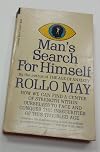
Man's Search for Himself
by Rollo May
On This Page
Description
Loneliness, boredom, emptiness: These are the complaints that Rollo May encountered over and over from his patients. In response, he probes the hidden layers of personality to reveal the core of man's integration-a basic and inborn sense of value. Man's Search for Himself is an illuminating view of our predicament in an age of overwhelming anxieties and gives guidance on how to choose, judge, and act during such times.Tags
Recommendations














Member Reviews
May begins by identifying the common threads of modern men who possess attitudes of passivity, apathy, and boredom. These “hollow men” who are strangers to themselves, feel largely insignificant, harbor resentment towards the monotonous treadmills of life, fear abandon and isolation, suffer from directionless and despondency, and have little to look forward to. At the core is a loneliness and a floating, ubiquitous anxiety whose sources appear nebulous. But with psychological acumen, May attempts to shed light on these sources. An individual may be bereft of adequate stability, the progeny of worried parents, or the victim of cruel life events. But often individual difficulties are symptomatic of epidemics at large. May points out show more that we are in a transition age. In the twilight of religion, we inherit our values from long anonymous men while the vitality of their traditions is lost to us. The products of an industrial age, we lead vacuous lives of routine, while competitive rewards are few and far between and emptiness springs from powerlessness in a world at scale. And while the latter-day influence of science and reason is both momentous and pervasive, in expelling such “absurdities” as witchcraft, we also expelled our connection with imagination, wonder, and mystery, throwing the baby out with the bathwater.
Still more discomforting is our tendency to combat such problems with maladaptive strategies: buttressing ourselves with authoritarian institutions that cater to our desires to be led by the absolutes of “authority and miracle” but only perpetuate our problem of dependence; averting inner confrontation with campaigns of busyness, self-pity, or intellectualization; and suspending our attentions from illuminating revelations to concerns of immediacy. We are raised to control our “uncivilized” emotions, to suppress our unconscious desires as bestial and barbaric, and to puritanically compartmentalize our now taboo sexual lives. In our Cartesian dichotomy of mind and body, we are understandably detached from our feelings. But under Freudian influence we realize the ego is less in control than we’d like to admit and possess occasional contempt for a consciousness regarded as weak but demanding with its many thou-shalt’s and thou-shalt-not’s.
While this does paint a bleak diagnosis, it does not imply a bleak prognosis. Anxiety implies conflict, and conflict (which in this age is often between Self and Society, or between different internalizations) can be harmonized. At present, our task is to learn how to live vibrantly, to learn how to embrace the “pregnant moment” by living each one with freedom, honesty, and responsibility. The starting place is self-awareness. In genuinely understanding and honoring our inward motives, we achieve a greater integrity of self, which is needed to move from dependence towards integration and freedom. Consciousness can help be our guide here, tapping into the deeper wisdoms of the self and the past. Learning how to attune to the unconscious is equally important. Inevitably, a leap is required. As we attempt to develop a deeper intimacy with ourselves, replacing dependency with individual values and choices is required, but naturally comes with doubt, imperfect acuity, and sometimes regret. Meeting anxiety with courage is the “will to live”.
If it is any consolation, an unsettled world is a world in which man will certainly be forced to confront himself. Loss of innocence can be seen as the birth of spiritual man (see Adam and Prometheus) as opposed to a bitter end, loneliness or illness can be opportunities to cultivate inner resources and centers of strength (which we may have neglected to develop), anxiety can be perceived as a signal of conflict calling one’s attention rather than a burden to bear, and fear of moving ahead into the unknown can be grounds for wonder, friendship, and love. In this era, the Socratic decree to “know thyself” becomes the most difficult task of all, but also the most important. This creative (and daily) process of transcendence demonstrates, to quote Miller, the “indestructible will of man to achieve his humanity”. show less
Still more discomforting is our tendency to combat such problems with maladaptive strategies: buttressing ourselves with authoritarian institutions that cater to our desires to be led by the absolutes of “authority and miracle” but only perpetuate our problem of dependence; averting inner confrontation with campaigns of busyness, self-pity, or intellectualization; and suspending our attentions from illuminating revelations to concerns of immediacy. We are raised to control our “uncivilized” emotions, to suppress our unconscious desires as bestial and barbaric, and to puritanically compartmentalize our now taboo sexual lives. In our Cartesian dichotomy of mind and body, we are understandably detached from our feelings. But under Freudian influence we realize the ego is less in control than we’d like to admit and possess occasional contempt for a consciousness regarded as weak but demanding with its many thou-shalt’s and thou-shalt-not’s.
While this does paint a bleak diagnosis, it does not imply a bleak prognosis. Anxiety implies conflict, and conflict (which in this age is often between Self and Society, or between different internalizations) can be harmonized. At present, our task is to learn how to live vibrantly, to learn how to embrace the “pregnant moment” by living each one with freedom, honesty, and responsibility. The starting place is self-awareness. In genuinely understanding and honoring our inward motives, we achieve a greater integrity of self, which is needed to move from dependence towards integration and freedom. Consciousness can help be our guide here, tapping into the deeper wisdoms of the self and the past. Learning how to attune to the unconscious is equally important. Inevitably, a leap is required. As we attempt to develop a deeper intimacy with ourselves, replacing dependency with individual values and choices is required, but naturally comes with doubt, imperfect acuity, and sometimes regret. Meeting anxiety with courage is the “will to live”.
If it is any consolation, an unsettled world is a world in which man will certainly be forced to confront himself. Loss of innocence can be seen as the birth of spiritual man (see Adam and Prometheus) as opposed to a bitter end, loneliness or illness can be opportunities to cultivate inner resources and centers of strength (which we may have neglected to develop), anxiety can be perceived as a signal of conflict calling one’s attention rather than a burden to bear, and fear of moving ahead into the unknown can be grounds for wonder, friendship, and love. In this era, the Socratic decree to “know thyself” becomes the most difficult task of all, but also the most important. This creative (and daily) process of transcendence demonstrates, to quote Miller, the “indestructible will of man to achieve his humanity”. show less
I forced myself through this up until this point, because it was a recommendation. The whole thing is shallow and inane, he makes some very silly unfalsifiable claims, but when he does say something falsifiable he doesn't seem to think there's any value in actually finding out whether it's true (so just like Eric Fromm, who he quotes repeatedly). But when he got to the point of saying homosexuality is a "confusion" and gave a case where he said it was caused by bad parenting I just flung it across the room. I wouldn't even curse a second hand book shop with this crap. And don't tell me he's a child of his time, there were plenty of contemporary dissenting voices, including Carl Rogers.
Utter crap that I can't believe people are still show more falling for in 2019. show less
Utter crap that I can't believe people are still show more falling for in 2019. show less
A good companion for a couple of days, as I'm living the struggle of "what do I like/want to do in life" it made me feel at least that it's not so strange not to know the answer as we seldom experience and assert ourselves.
One: Our Predicament
1. Loneliness and Anxiety of Modern Man
2. Roots of Malady
Two: Rediscovering Selfhood
3. Becoming a Person
4. Struggle to Be
Three: Goals of Integration
5. Freedom and inner strength
6. Creative Conscience
7. Courage and Virtue of Maturity
8. Man, Transcender of Time
1. Loneliness and Anxiety of Modern Man
2. Roots of Malady
Two: Rediscovering Selfhood
3. Becoming a Person
4. Struggle to Be
Three: Goals of Integration
5. Freedom and inner strength
6. Creative Conscience
7. Courage and Virtue of Maturity
8. Man, Transcender of Time
Ratings
Members
- Recently Added By
Author Information

36+ Works 4,260 Members
"The development of an existential psychology in America is in good part the work of Rollo May. He helped bring existentialism to psychology some fifteen years ago, and since then his impact has increased each year. As he says here, he isn't an existentialist in a cultist sense. In American psychology, the existential approach is part of a wider show more trend which includes many views" (Eugene T. Gendlin, Psychology Today). May's psychology is sometimes referred to as humanistic. He is one of the affirmative, "third force" American psychologists who are also critical of the society in which we live. Gendlin writes further: "In. . . Psychology and the Human Dilemma [1966], May offers a wealth of valid and stimulating ideas in a totally engaging and readable fashion. [The human dilemma is that] man is always both an active subject and a passive object ". . . May [says]: "Only in knowing ourselves as the determined ones are we free. This last sentence and his many similar discussions seem to mean that we can't help what happens, but only what attitude we take toward what happens. In fact, he means more than this---in taking an attitude toward what happens we change what happens." In late 1968, May was the subject of an article in the New York Times in which he was said to feel that "one sign that the modern age is dying is that its myths are dying." We are at present in a "limbo" between myths---the situation in which people become disoriented and "alienated." "In the new myths," he said, "I would think that racial variation will be seen as a positive value, that emphasis on one world will replace fragmented nationalism, and that things will be valued more for their intrinsic worth rather than in use---what they can be banked for." As a young man, May taught for a period at the American College in Saloniki, Greece. An ordained Congregational minister, May received his Ph.D. at Columbia University in 1949. He worked as supervisory and training analyst at the William Alanson White Institute in New York City and adjunct professor of clinical psychology at the New York University Graduate School of Arts and Sciences for many years. May was instrumental in establishing the Rollo May Center for Humanistic Studies at Saybrook Institute in San Francisco. (Bowker Author Biography) show less
Awards and Honors
Distinctions
Classifications
Statistics
- Members
- 514
- Popularity
- 57,822
- Reviews
- 5
- Rating
- (3.93)
- Languages
- English, Portuguese, Turkish
- Media
- Paper, Audiobook, Ebook
- ISBNs
- 15
- ASINs
- 18