On This Page
Description
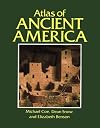
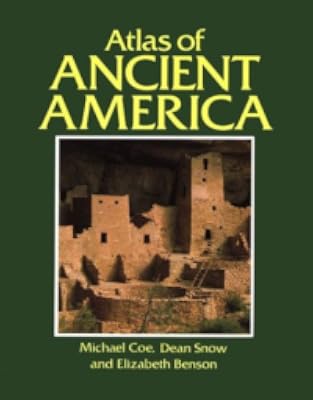
Contains 56 maps, 329 illustrations, and accompanying text describing ancient American art, history, and archaeology.Tags
Recommendations




















Member Reviews
The science of archeology was initiated by Thomas Jefferson around 1782. [25] A century before stratigraphic excavation was practiced anywhere else in the world, Jefferson directed the trenching of a burial mound on his Virginia estate, noting four superimposed layers and the practice of group burial.
This Atlas is a scholarly work with maps, gazeteer, biobiography, and index.
NATIVE LOSSES. The collapse of population brought about by indigenous factors is documented. [60, the vacant quarter in the heartland/Mississippi delta], 15 Nazca] well before 1300 AD.
The leyenda negra is exploded, but so is the encomiendas system. "As Las Casas tirelessly pointed out, Spaniards tended to ignore the duties imposed upon them by the system--the show more preservation and protection of the Indians, the provision of priests and schools--while imposing tribute and labor demands of such intensity that they distorted and destroyed native communities." [22]
DEMOGRAPHICS -- Epidemics often preceded the first attempts to reconstruct demographic data. Best estimates are that people were scarce in the Arctic, Subarctic, Plains and Great Basin. Medium densities of 1-100 per 100 kilometers in Southern Canada, Plateau and Northeastern Mexico. High densities, of more than 100/100, probably characterized the rest of the continent. [21] The authors seem to acknowledge the drastic declines caused by post-1600 epidemics of smallpox, measles, influenza and other pathogens.[21]
In Peru, the native population is estimated to have fallen from 9 million in 1533 to 500,000 by the 17th century. [22] Mexico, with an estimated 11-25 million on the eve of Spanish conquest, fell to 1.25 million by 1625.[23] Other regions are difficult to estimate.
CODEX. The great enterprise, and expense, of locating and preserving the manuscripts of the New World, was undertaken by Edward King, born 1795. He died bankrupt in a debtor's prison, but without his quixotic efforts we would have few of the most important manuscripts -- for example, the Maya Dresden Codex. [24] Humboldt's contributions to the archeology of the Americas are modest. [26]
ART. The first art to appear in Mesoamerica is the Olmec [96]
BALL GAME. By the Classic period, masonry courts with sloping sides were found throughout Mesoamerica. Not a mere athletic contest. The court was a cosmological diagram, with the large solid rubber ball symbolizing the sun. The game was imbued with imagery of death and sacrifice. [108]
TEOTIHUACAN. While the state fell in flames at the end of the 7th century, it left a legacy of its gods/ideology in terms of a religious system and pantheon adopted by the Aztecs. [109] The untold amounts of lime plaster that went into building the city required the burning of staggering amounts of wood.
TBD show less
This Atlas is a scholarly work with maps, gazeteer, biobiography, and index.
NATIVE LOSSES. The collapse of population brought about by indigenous factors is documented. [60, the vacant quarter in the heartland/Mississippi delta], 15 Nazca] well before 1300 AD.
The leyenda negra is exploded, but so is the encomiendas system. "As Las Casas tirelessly pointed out, Spaniards tended to ignore the duties imposed upon them by the system--the show more preservation and protection of the Indians, the provision of priests and schools--while imposing tribute and labor demands of such intensity that they distorted and destroyed native communities." [22]
DEMOGRAPHICS -- Epidemics often preceded the first attempts to reconstruct demographic data. Best estimates are that people were scarce in the Arctic, Subarctic, Plains and Great Basin. Medium densities of 1-100 per 100 kilometers in Southern Canada, Plateau and Northeastern Mexico. High densities, of more than 100/100, probably characterized the rest of the continent. [21] The authors seem to acknowledge the drastic declines caused by post-1600 epidemics of smallpox, measles, influenza and other pathogens.[21]
In Peru, the native population is estimated to have fallen from 9 million in 1533 to 500,000 by the 17th century. [22] Mexico, with an estimated 11-25 million on the eve of Spanish conquest, fell to 1.25 million by 1625.[23] Other regions are difficult to estimate.
CODEX. The great enterprise, and expense, of locating and preserving the manuscripts of the New World, was undertaken by Edward King, born 1795. He died bankrupt in a debtor's prison, but without his quixotic efforts we would have few of the most important manuscripts -- for example, the Maya Dresden Codex. [24] Humboldt's contributions to the archeology of the Americas are modest. [26]
ART. The first art to appear in Mesoamerica is the Olmec [96]
BALL GAME. By the Classic period, masonry courts with sloping sides were found throughout Mesoamerica. Not a mere athletic contest. The court was a cosmological diagram, with the large solid rubber ball symbolizing the sun. The game was imbued with imagery of death and sacrifice. [108]
TEOTIHUACAN. While the state fell in flames at the end of the 7th century, it left a legacy of its gods/ideology in terms of a religious system and pantheon adopted by the Aztecs. [109] The untold amounts of lime plaster that went into building the city required the burning of staggering amounts of wood.
TBD show less
Ratings
Members
- Recently Added By
Author Information
Series

Belongs to Publisher Series
Work Relationships
Common Knowledge
- Canonical title
- Atlas of Ancient America
- Original publication date
- 1986
- Important places
- Americas
- Original language
- English
Classifications
Statistics
- Members
- 255
- Popularity
- 127,692
- Reviews
- 1
- Rating
- (3.71)
- Languages
- 7 — Czech, English, German, Hungarian, Italian, Polish, Spanish
- Media
- Paper
- ISBNs
- 11
- ASINs
- 4