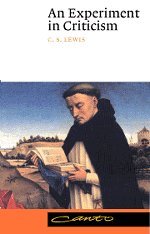
An Experiment in Criticism
by C. S. Lewis
On This Page
Description
Why do we read literature and how do we judge it? C. S. Lewis's classic An Experiment in Criticism springs from the conviction that literature exists for the joy of the reader and that books should be judged by the kind of reading they invite. He argues that 'good reading', like moral action or religious experience, involves surrender to the work in hand and a process of entering fully into the opinions of others: 'in reading great literature I become a thousand men and yet remain myself'. show more Crucial to his notion of judging literature is a commitment to laying aside expectations and values extraneous to the work, in order to approach it with an open mind. Amid the complex welter of current critical theories, C. S. Lewis's wisdom is valuably down-to-earth, refreshing and stimulating in the questions it raises about the experience of reading. show lessTags
Recommendations









Member Reviews
If you can get past Lewis's snooty attitude here (LW3 called him a "pompous poot" in the margin in the copy I just read), he has some rather interesting and important things to say about how we judge books. In a nutshell, he thinks that considering how a book is read would be a much better endeavor than trying to use taste to judge a book good or bad. If a book invites readers to read it in a "literary" way, the book is good. (Much of Lewis's book is taken up in discussing what he means by "literary"; one part of his definition is that literary readers experience or "receive" while reading rather than "using" what they read). A complex text very well worth reading and which resists easy summary. Perhaps the best summary is to say that show more Lewis spends the book trying to prove the statement he makes to close his argument: "But in reading great literature I become a thousand men and yet remain myself. Like the night sky in the Greek poem, I see with a myriad eyes, but it is still I who see. Here, as in worship, in love, in moral action, and in knowing, I transcend myself; and am never more myself than when I do." show less
Brilliant stuff. Lewis doesn't criticize books on themselves, but readers (literary and non-literary) and thier reading. Thus he tell us that a book is good if it permits, invites, or compels good reading, and bad if it isn't possible for that book to do so, because a good book can be badly read, etc. But a book that's deem as bad and is loved by many could have hidden virtues that can't be discovered. But someone that reads bad books doesn't need to be denigrated, but be taught to enjoy better works. He then goes to argue what criticism is, if it has value, and what good analysis is. Also what is literature for in a beautifully written epilogue: "The nearest I have got to an answer is that we seek an enlargment of our being. We want to show more be more than ourselves."
This is a very open minded argument, written with great precision and wit. show less
This is a very open minded argument, written with great precision and wit. show less
C. S. Lewis and I don't agree on everything. But we both love words, books, and beauty. We're "kindred spirits" that way, to borrow L. M. Montgomery's phrase. I loved his musings on why we read, why we critique, and why art, specifically literature, is necessary in life. His words, particularly on how literature and art connects us, made me think about the amazing writers that have expanded my life, helped me see, fear, suffer, love, and rejoice with others who are not like me and, yet, are, like me, human. The list is long, but not long enough, and so I still read.
I really quite enjoyed this long essay / short book. I particularly enjoyed Lewis’s early descriptions of the reading experience; I don’t think I’ve run across a more apt description of the pleasure of reading stories. In classic Lewis-fashion, the various distinctions he draws between the types of reading both ring true and prove enlightening. Additionally, Lewis’s approach seems a refreshing alternative to contemporary literary criticism, even if he is reacting to something quite different in his own times. (More on this below) For all the value of literary criticism (and I for one think there is some value), there’s something to be said for the more basic questions we should bring to a book: How and why does this story move show more us the way it moves us? If it works well, how does it work well?
Despite my absolute appreciation for much of what Lewis is doing here, I do have two criticisms. First, Lewis (unknowingly, I suppose) speaks very condescendingly toward non-literary readers. While I am tempted to agree with him on certain levels, I think my propensity is rooted in a rather subjective and prideful understanding of how much literary works are related to my own identity and how I see the world. I’d be quite hesitant to say all non-literary readers are lacking in something essential. Here is Lewis in his own words: “Those of us who have been true readers all our life seldom realize the enormous extension of our being which we owe to authors.” Cool up to this point. “We realize it best when we talk with an unliterary friend.” Possibly condescending turn. “He may be full of goodness and good sense but he inhabits a tiny world.” Ouch. Can he get more condescending? The answer is yes. “In it, we should be suffocated.”
Second, in attempting to free literature from the shackles of “evaluative criticism” and the bore of academia, I feel like Lewis actually removes some of the potential social value of literature, as it existed in the past and present. Lewis dismisses all readings that attempt to find in the literature a “philosophy of life.” Lewis essentially denies the artist the ability to be communicating something about his view of life or what it means to be a human person; or he at least says that a reader’s job isn’t about doing this, and discussing books in this way is in poor taste. I grant part of Lewis’s point: we shouldn’t take a story that is essentially a comic romp—even a comic romp done with wonderful artistry—and wring it out to find out what it’s “saying about life.” Not all, or perhaps even most, stories are attempts to demonstrate something about life or society. However, artists have historically engaged the world and society through their art, contemplating or exploring perspectives on important matters through their art—and some of the joy of reading these texts is the vicarious exploration of exactly these perspectives. I’m not speaking of didactic texts, which are rarely good art. I’m speaking of artistic forays into social issues, texts whose values are rooted both in their aesthetic qualities paired with their social values. Huck Finn, The Divine Comedy, and numerous other classic texts clearly engage the society they exist within. To tell the reader that they shouldn’t attempt to perceive the texts' social meaning (which isn’t the same as social “message,” i.e. a boiled down ideological statement) is to deny one of the great values of art, which is to engage the present culture in a meaningful way. There is a strong chance I misinterpreted Lewis’s section on this topic; and perhaps he was responding to a different sort of “reading” than I’m defending, a type of reading I don’t have immediate access to in 2017.
Lewis’s most important target for this “experiment in criticism” is the “evaluative critic,” the interpreter of texts who tells us which texts are good, which are great, and which should be avoided at all costs. Interestingly, this type of criticism doesn’t exist anymore—unfortunately this isn’t because we have taken Lewis’s challenges to heart. Whereas Lewis rejected evaluation is favor of understanding how to read and enjoy and engage meaningfully in texts, the contemporary literary world has rejected evaluation because of its claim to objectivity. We can’t judge a text because there are no objective standards. The cool bit (at least I think it’s cool) is that Lewis’s antidote—his “experiment”—would also help the contemporary literary world. Yes, we don’t proclaim texts objectively good or objectively bad anymore; but we’ve replaced this with a literary analysis that reduces all texts to ideological statements or material products of ideology. We don’t care about the beauty of the text or how it moves us; we care about it as a demonstration of market forces, or political ideology, or social naivetés, or social progressiveness. We could do well beginning with the fact that we human persons, or at least some of us, just really freakin’ like to read a good story. show less
Despite my absolute appreciation for much of what Lewis is doing here, I do have two criticisms. First, Lewis (unknowingly, I suppose) speaks very condescendingly toward non-literary readers. While I am tempted to agree with him on certain levels, I think my propensity is rooted in a rather subjective and prideful understanding of how much literary works are related to my own identity and how I see the world. I’d be quite hesitant to say all non-literary readers are lacking in something essential. Here is Lewis in his own words: “Those of us who have been true readers all our life seldom realize the enormous extension of our being which we owe to authors.” Cool up to this point. “We realize it best when we talk with an unliterary friend.” Possibly condescending turn. “He may be full of goodness and good sense but he inhabits a tiny world.” Ouch. Can he get more condescending? The answer is yes. “In it, we should be suffocated.”
Second, in attempting to free literature from the shackles of “evaluative criticism” and the bore of academia, I feel like Lewis actually removes some of the potential social value of literature, as it existed in the past and present. Lewis dismisses all readings that attempt to find in the literature a “philosophy of life.” Lewis essentially denies the artist the ability to be communicating something about his view of life or what it means to be a human person; or he at least says that a reader’s job isn’t about doing this, and discussing books in this way is in poor taste. I grant part of Lewis’s point: we shouldn’t take a story that is essentially a comic romp—even a comic romp done with wonderful artistry—and wring it out to find out what it’s “saying about life.” Not all, or perhaps even most, stories are attempts to demonstrate something about life or society. However, artists have historically engaged the world and society through their art, contemplating or exploring perspectives on important matters through their art—and some of the joy of reading these texts is the vicarious exploration of exactly these perspectives. I’m not speaking of didactic texts, which are rarely good art. I’m speaking of artistic forays into social issues, texts whose values are rooted both in their aesthetic qualities paired with their social values. Huck Finn, The Divine Comedy, and numerous other classic texts clearly engage the society they exist within. To tell the reader that they shouldn’t attempt to perceive the texts' social meaning (which isn’t the same as social “message,” i.e. a boiled down ideological statement) is to deny one of the great values of art, which is to engage the present culture in a meaningful way. There is a strong chance I misinterpreted Lewis’s section on this topic; and perhaps he was responding to a different sort of “reading” than I’m defending, a type of reading I don’t have immediate access to in 2017.
Lewis’s most important target for this “experiment in criticism” is the “evaluative critic,” the interpreter of texts who tells us which texts are good, which are great, and which should be avoided at all costs. Interestingly, this type of criticism doesn’t exist anymore—unfortunately this isn’t because we have taken Lewis’s challenges to heart. Whereas Lewis rejected evaluation is favor of understanding how to read and enjoy and engage meaningfully in texts, the contemporary literary world has rejected evaluation because of its claim to objectivity. We can’t judge a text because there are no objective standards. The cool bit (at least I think it’s cool) is that Lewis’s antidote—his “experiment”—would also help the contemporary literary world. Yes, we don’t proclaim texts objectively good or objectively bad anymore; but we’ve replaced this with a literary analysis that reduces all texts to ideological statements or material products of ideology. We don’t care about the beauty of the text or how it moves us; we care about it as a demonstration of market forces, or political ideology, or social naivetés, or social progressiveness. We could do well beginning with the fact that we human persons, or at least some of us, just really freakin’ like to read a good story. show less
C.S. Lewis and I are not the best match. I'm even in the small minority who don't appreciate the beloved Narnia books. He has a loopy excessive style which was very prevalent in this book. To me, it seems like the writing equivalent of thinking aloud. However in all that word salad, he did catch my attention a few times. I quite enjoyed his essay on Poetry. I also liked his thoughts on critical reading and the way certain books and authors come in and out of vogue over time. He asks the question, do we judge a book by the quality of it's reader, or a reader by the quality of the book? It's topsy turvey thinking but I've always been interested in what people are reading and why they love or hate it so these notions of what makes a good show more book are interesting to me. All said - I managed to take something away from this book despite struggling through much of it. show less
“(I)n reading great literature I become a thousand men and yet remain myself.”
I have often said that I majored in English in spite of literary criticism and not because of it. This little volume has helped me articulate my feelings about what English professors do to literature as well as given me food for thought on what makes a good reader.
I have often said that I majored in English in spite of literary criticism and not because of it. This little volume has helped me articulate my feelings about what English professors do to literature as well as given me food for thought on what makes a good reader.
This is a fantastic short book on the purpose and value of criticism. I had read chapters from it previously, but this is my first read all the way through. This read through is prompted by my preliminary work on developing my thesis for the MA program at Mythgard Institute.
Not only does Lewis make a strong case for looking at literary criticism from a different perspective — that of how readers read, as opposed to what they read — but it ends strongly, stating what I think is at least a similar sentiment to my own about what literature does, and something that I strongly suspect is a universal experience for what Lewis calls "literary readers," even if not all of them acknowledge it.
As I've done before, rather than trying to sum up show more my thoughts, I'm going to note passages that I enjoyed while reading this:
p. 91-92: "In characterising the two sorts of reading [good and bad] I have deliberately avoided the word 'entertainment'. Even when fortified by the adjective mere, it is too equivocal. If entertainment means light and playful pleasure, then I think it is exactly what we ought to get from some literary work…. If it means those things which 'grip' the reader of popular romance—suspense, excitement and so forth—then I would say that every book should be entertaining. A good book will be more; it must not be less."
p. 106: "Observation of how men read is a strong basis for judgements on what they read; but judgements on what they read is a flimsy, even a momentary, basis for judgements on their way of reading. For the accepted valuation of literary works varies with every change of fashion, but the distinction between attentive and inattentive, obedient and wilful, disinterested and egoistic, modes of reading is permanent; if ever valid, everywhere and always."
p. 120: "The question is about the criticism which pronounces on the merits of books; about evaluations, and devaluations. Such criticism was once held to be of use to authors. But that claim has on the whole been abandoned. It is now valued for its supposed use to readers…. For me it stands or falls by its power to multiply, safeguard, or prolong those moments when a good reader is reading well a good book and the value of literature thus exists in actu."
p. 130: "Are you and I especially obliged or especially qualified to discuss what, precisely, the good of literature consists in? To explain the value of any activity, still more to place it in a hierarchy of values, is not generally the work of the activity itself."
p. 132: "A work of literary art can be considered in two lights. It both means and is. It is both Logos (something said) and Poiema (something made). As Logos it tells a story, or expresses an emotion, or exhorts or pleads or describes or revokes or excites laughter. As Poiema, by its aural beauties and also by the balance and contrast and the unified multiplicity of its successive parts, it is an objet d'art, a thing shaped so as to give great satisfaction."
p. 140: "Literary experience heals the wound, without undermining the privilege, of individuality…. But in reading literature I become a thousand men and yet remain myself. Like the night sky in the Greek poem, I see with myriad eyes, but it is still I who see." show less
Not only does Lewis make a strong case for looking at literary criticism from a different perspective — that of how readers read, as opposed to what they read — but it ends strongly, stating what I think is at least a similar sentiment to my own about what literature does, and something that I strongly suspect is a universal experience for what Lewis calls "literary readers," even if not all of them acknowledge it.
As I've done before, rather than trying to sum up show more my thoughts, I'm going to note passages that I enjoyed while reading this:
p. 91-92: "In characterising the two sorts of reading [good and bad] I have deliberately avoided the word 'entertainment'. Even when fortified by the adjective mere, it is too equivocal. If entertainment means light and playful pleasure, then I think it is exactly what we ought to get from some literary work…. If it means those things which 'grip' the reader of popular romance—suspense, excitement and so forth—then I would say that every book should be entertaining. A good book will be more; it must not be less."
p. 106: "Observation of how men read is a strong basis for judgements on what they read; but judgements on what they read is a flimsy, even a momentary, basis for judgements on their way of reading. For the accepted valuation of literary works varies with every change of fashion, but the distinction between attentive and inattentive, obedient and wilful, disinterested and egoistic, modes of reading is permanent; if ever valid, everywhere and always."
p. 120: "The question is about the criticism which pronounces on the merits of books; about evaluations, and devaluations. Such criticism was once held to be of use to authors. But that claim has on the whole been abandoned. It is now valued for its supposed use to readers…. For me it stands or falls by its power to multiply, safeguard, or prolong those moments when a good reader is reading well a good book and the value of literature thus exists in actu."
p. 130: "Are you and I especially obliged or especially qualified to discuss what, precisely, the good of literature consists in? To explain the value of any activity, still more to place it in a hierarchy of values, is not generally the work of the activity itself."
p. 132: "A work of literary art can be considered in two lights. It both means and is. It is both Logos (something said) and Poiema (something made). As Logos it tells a story, or expresses an emotion, or exhorts or pleads or describes or revokes or excites laughter. As Poiema, by its aural beauties and also by the balance and contrast and the unified multiplicity of its successive parts, it is an objet d'art, a thing shaped so as to give great satisfaction."
p. 140: "Literary experience heals the wound, without undermining the privilege, of individuality…. But in reading literature I become a thousand men and yet remain myself. Like the night sky in the Greek poem, I see with myriad eyes, but it is still I who see." show less
Members
- Recently Added By
Lists

Literary Theory and Criticism: What Happens and Why
37 works; 5 members

CCE 100 Great Books List
145 works; 8 members

Books Read in 2025
4,090 works; 97 members

The Five Books That Represent Us
390 works; 147 members
Author Information

528+ Works 522,307 Members
C. S. (Clive Staples) Lewis, "Jack" to his intimates, was born on November 29, 1898 in Belfast, Ireland. His mother died when he was 10 years old and his lawyer father allowed Lewis and his brother Warren extensive freedom. The pair were extremely close and they took full advantage of this freedom, learning on their own and frequently enjoying show more games of make-believe. These early activities led to Lewis's lifelong attraction to fantasy and mythology, often reflected in his writing. He enjoyed writing about, and reading, literature of the past, publishing such works as the award-winning The Allegory of Love (1936), about the period of history known as the Middle Ages. Although at one time Lewis considered himself an atheist, he soon became fascinated with religion. He is probably best known for his books for young adults, such as his Chronicles of Narnia series. This fantasy series, as well as such works as The Screwtape Letters (a collection of letters written by the devil), is typical of the author's interest in mixing religion and mythology, evident in both his fictional works and nonfiction articles. Lewis served with the Somerset Light Infantry in World War I; for nearly 30 years he served as Fellow and tutor of Magdalen College at Oxford University. Later, he became Professor of Medieval and Renaissance English at Cambridge University. C.S. Lewis married late in life, in 1957, and his wife, writer Joy Davidman, died of cancer in 1960. He remained at Cambridge until his death on November 22, 1963. (Bowker Author Biography) show less
Some Editions
Awards and Honors
Notable Lists
Series
Belongs to Publisher Series
Assaig minor (13)
Work Relationships
Is abridged in
Common Knowledge
- Canonical title
- An Experiment in Criticism
- Original title
- An experiment in criticism
- Original publication date
- 1961
- First words
- In this essay I propose to try an experiment.
- Last words
- (Click to show. Warning: May contain spoilers.)Here, in worship, in love, in moral action, and in knowing, I transcend myself; and am never more myself then when I do.
- Original language
- English
Classifications
- Genres
- Literature Studies and Criticism, Nonfiction, Religion & Spirituality
- DDC/MDS
- 801.95 — Literature & rhetoric Literature, rhetoric & criticism Philosophy and theory Nature and character Literary theory and criticism
- LCC
- PN85 .L49 — Language and Literature Literature (General) Literature (General) Criticism
- BISAC
Statistics
- Members
- 1,406
- Popularity
- 16,740
- Reviews
- 18
- Rating
- (4.21)
- Languages
- 9 — Catalan, Chinese, English, Finnish, German, Italian, Spanish, Portuguese (Portugal), Portuguese (Brazil)
- Media
- Paper, Audiobook, Ebook
- ISBNs
- 20
- ASINs
- 19