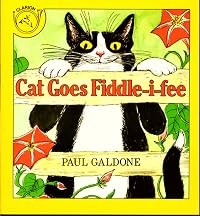
Cat Goes Fiddle-I-Fee
by Paul Galdone
On This Page
Description
An old English rhyme names all the animals a farm boy feeds on his daily rounds.Tags
Recommendations







Member Reviews
9:25 am 26 April 2025
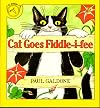
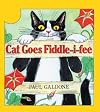
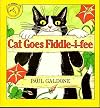
This is one of five books with black and white cats on the cover that I spotted scattered around the children's section which I picked up in loving memory of Calder Eno, who was enormous and affectionate and funny.
Given that context, maybe it was bound to disappoint? I didn't care for it: the limited palette didn't work well with the style of the art, nor did I like either. I was not familiar with the traditional poem? song? that the text is pulled from, which has some very odd noises for the cat, hen, and goose, as indicated in the title. There are a lot of close ups and open mouths and the whole thing felt vaguely threatening to me. Maybe if I look at a different version this one will bother me less?
Well, I'll show more have a go at the other four and see if they feel less like a disturbing montage in Rosemary's Baby or A Clockwork Orange. On the off chance anyone is reading this in real time, I invite you to stick around for comments on the others. Maybe I am just weird this morning, who knows?
Library copy show less
This is one of five books with black and white cats on the cover that I spotted scattered around the children's section which I picked up in loving memory of Calder Eno, who was enormous and affectionate and funny.
Given that context, maybe it was bound to disappoint? I didn't care for it: the limited palette didn't work well with the style of the art, nor did I like either. I was not familiar with the traditional poem? song? that the text is pulled from, which has some very odd noises for the cat, hen, and goose, as indicated in the title. There are a lot of close ups and open mouths and the whole thing felt vaguely threatening to me. Maybe if I look at a different version this one will bother me less?
Well, I'll show more have a go at the other four and see if they feel less like a disturbing montage in Rosemary's Baby or A Clockwork Orange. On the off chance anyone is reading this in real time, I invite you to stick around for comments on the others. Maybe I am just weird this morning, who knows?
Library copy show less
This book is really repetitive for the whole entire book and can get really boring. It needs to be paired with other activities to make it more entertaining.
This book is more of a poem than a story, so I would use it for fluency work. The narrator, a little boy, talks about all his different animals and the sounds they make. This book repeats the same phrases over and over, so it might be beneficial for struggling readers.
The illustrations are beautiful and fun--I love singing this one to my daughter. When we get to the end, she ALWAYS says, "I want to read it again!" So we do.
A little boy had a bunch of animals (cat, pig, cow, horse, dog, goose, and duck) and he fed them all under a tree. The story goes through all of the animals and tell what they say. With each new animal, he repeats the old ones. It ends with just the cat going "Fiddle-i-fee".
Ratings
Members
- Recently Added By
Author Information

88+ Works 20,126 Members
Paul Galdone was born in Budapest, Hungary in 1907 and immigrated to the United States in 1928. Though he was also a painter and sculptor, he is best known as a writer and illustrator of children's books. During his early career Galdone worked in the art department at Doubleday where he designed a successful book jacket. The experience led him to show more believe that he could make a living as a freelance illustrator. He left behind the working world of New York City when he and his wife moved to rural Rockland County, New York. Many of Galdone's works are adaptations of fairy tales and folktales. Some of these are The House that Jack Built (1961), Cinderella (1978), and Three Aesop Fox Fables (1971). He illustrated the well-known Miss Pickerell Goes to Mars and sequels written by Ellen MacGregor. He has illustrated works by John Greenleaf Whittier, Oliver Wendell Holmes, Edward Lear, and Nathaniel Hawthorne. During his career he illustrated over 100 books and wrote and illustrated several dozen others. Galdone was twice runner up for the Caldecott Medal, in 1957 and 1958. Paul Galdone died in 1986. (Bowker Author Biography) show less
Classifications
Statistics
- Members
- 412
- Popularity
- 74,959
- Reviews
- 5
- Rating
- (3.47)
- Languages
- English
- Media
- Paper, Ebook
- ISBNs
- 11
- UPCs
- 1
- ASINs
- 4