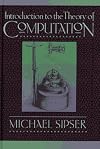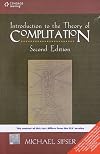
Introduction to the Theory of Computation
by Michael Sipser
On This Page
Description
Gain a clear understanding of even the most complex, highly theoretical computational theory topics in the approachable presentation found only in the market-leading INTRODUCTION TO THE THEORY OF COMPUTATION, 3E. The number one choice for today's computational theory course, this revision continues the book's well-know, approachable style with timely revisions, additional practice, and more memorable examples in key areas. A new first-of-its-kind theoretical treatment of deterministic show more context-free languages is ideal for a better understanding of parsing and LR(k) grammars. You gain a solid understanding of the fundamental mathematical properties of computer hardware, software, and applications with a blend of practical and philosophical coverage and mathematical treatments, including advanced theorems and proofs. INTRODUCTION TO THE THEORY OF COMPUTATION, 3E's comprehensive coverage makes this a valuable reference for your continued studies in theoretical computing. show lessTags
Recommendations

Member Reviews
This book is a real gem. A coherent focus is maintained throughout, subjects are introduced in a rational order, and not a word or paragraph is wasted. The assignments at the end of the chapter are excellently selected to enhance understanding or to encourage investigation of topics which the book does not cover.
This was one of the better textbooks I had to use, in terms of aesthetics, design, layout, and materials, but I was always frustrated by its use of animistic metaphor for rigorous algorithmic processes -- a Turing machine no more "wants" or "expects" something than a rock does. At the same time, the examples were usually more illuminating than in other texts, so I can't complain too much.
Sipser starts from a treatment of basic set theory and proofs. He moves from there through regular languages & finite automata, context-free languages & pushdown automata, and on to Turing machines & the associated complexity theory (that P and NP jazz), and more. He thus builds a rigorous and pretty complete theory of computation course from the ground up, accessible to any determined reader with a little aptitude for finite math.
The end of each chapter features dozens of general "exercises" and more rigorous "problems". Answers are provided for a few. When an exercise or problem makes reference to the chapter text, it's always easy to locate, as "figures", "theorems", "definitions", and so on are counted in the same series -- e.g. show more Figure 1.4 is found just before Definition 1.5. It's a small but refreshing design choice, one of many nice design choices in this beautiful volume.
The new edition is quite expensive indeed, especially considering how small the book is. The new content since the second edition consists of some corrections and minor changes, and a new section on deterministic context-free languages. If you are buying this book for a course that won't cover deterministic CFL's -- a very challenging topic -- you might ask your instructor for permission to use the second edition. The new material does have some relevance to compilers, though, so you might like to have it handy if you plan to study compilers later. show less
The end of each chapter features dozens of general "exercises" and more rigorous "problems". Answers are provided for a few. When an exercise or problem makes reference to the chapter text, it's always easy to locate, as "figures", "theorems", "definitions", and so on are counted in the same series -- e.g. show more Figure 1.4 is found just before Definition 1.5. It's a small but refreshing design choice, one of many nice design choices in this beautiful volume.
The new edition is quite expensive indeed, especially considering how small the book is. The new content since the second edition consists of some corrections and minor changes, and a new section on deterministic context-free languages. If you are buying this book for a course that won't cover deterministic CFL's -- a very challenging topic -- you might ask your instructor for permission to use the second edition. The new material does have some relevance to compilers, though, so you might like to have it handy if you plan to study compilers later. show less
This is quite possibly one of the most terse, clearly-written CS theory books that there is.
I read this for a class in the Theory of Computation. The book was very clear and as easy to read as any other theoretical math textbook.
first glance: 2022-02-21---2022-02-27
Ratings
Members
- Recently Added By
Lists

Dan Luu's Programming book list
46 works; 1 member
Author Information

5 Works 902 Members
Michael Sipser has taught theoretical computer science and other mathematical subjects at the Massachusetts Institute of Technology for the past 32 years. He is the Head of the Mathematics Department and a member of the Computer Science and Artificial Intelligence Laboratory (CSAIL). He enjoys teaching and pondering the many mysteries of show more complexity theory. show less
Common Knowledge
- Canonical title
- Introduction to the Theory of Computation
- Canonical DDC/MDS
- 511.3
Classifications
Statistics
- Members
- 852
- Popularity
- 32,106
- Reviews
- 6
- Rating
- (4.01)
- Languages
- English, German, Greek, Portuguese
- Media
- Paper, Ebook
- ISBNs
- 17
- ASINs
- 3