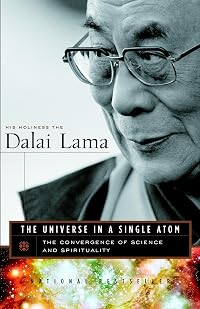
The Universe in a Single Atom: The Convergence of Science and Spirituality
by Dalai Lama
On This Page
Description
Gallileo, Copernicus, Newton, Niels Bohr, Einstein. Their insights shook our perception of who we are and where we stand in the world and in their wake have left an uneasy co-existence: science vs. religion, faith vs. empirical enquiry. Which is the keeper of truth? Which is the true path to understanding reality? After forty years of study with some of the greatest scientific minds as well as a lifetime of meditative, spiritual and philosophical study, the Dalai Lama presents a brilliant show more analysis of why both disciplines must be pursued in order to arrive at a complete picture of the truth. Science shows us ways of interpreting the physical world, while spirituality helps us cope with reality. But the extreme of either is impoverishing. The belief that all is reducible to matter and energy leaves out a huge range of human experience: emotions, yearnings, compassion, culture. At the same time, holding unexamined spiritual beliefs–beliefs that are contradicted by evidence, logic, and experience–can lock us into fundamentalist cages. Through an examination of Darwinism and karma, quantum mechanics and philosophical insight into the nature of reality, neurobiology and the study of consciousness, the Dalai Lama draws significant parallels between contemplative and scientific examination of reality. “I believe that spirituality and science are complementary but different investigative approaches with the same goal of seeking the truth,” His Holiness writes. “In this, there is much each may learn from the other, and together they may contribute to expanding the horizon of human knowledge and wisdom.” This breathtakingly personal examination is a tribute to the Dalai Lama’s teachers–both of science and spirituality. The legacy of this book is a vision of the world in which our different approaches to understanding ourselves, our universe and one another can be brought together in the service of humanity. show lessTags
Recommendations










Member Reviews
The 14th Dalai Lama is a very intelligent man. This is even more clear with this book. He is, however, inhibited by significant biases. That's not a slight - we all have biases - but his objective suffers considerable obstacles because of his particular biases (well, the ones I perceive through his writing...he likely has many more, as do I.) In his prologue, he says, "This book is not an attempt to unite science and spirituality...Rather, I believe that spirituality and science are different but complementary investigative approaches with the same greater goal, of seeking the truth." Yes, he said that. Given his position, what else could he say? I made a lot of notes while reading this short book, but in the interest of pseudo-brevity, show more I'll shotgun only a few points here.
He asks, "Do ethics have a place in science? I believe they do." I respond, that's a rather nonsensical rhetorical question - of course they do. But he diverges into presumption quite quickly: "There is, however, a general assumption that ethics are relevant to only the application of science, not the actual pursuit of science." What? 1) how is that a "general assumption", and 2) more importantly, I maintain we have a moral obligation to pursue science, as it is the only way to truly understand anything. He errs further in saying "Science and technology are powerful tools, but we must decide how best to use them." No. I concur with the assessment and judgment with respect to technology, but you use science to learn. He almost lost me when he said "...many aspects of human existence, including values, creativity, and spirituality, as well as deeper metaphysical questions, lie outside the scope of scientific inquiry." No. Nothing lies outside the scope of scientific inquiry.
Here he nearly fails...were it not for the qualifier "current", he might as well have stoppped right there. James Morrow said in his fictional story Only Begotten Daughter,
To which I always append "...yet."
I am not wholly ignorant of Buddhism, but not have studied it in depth, I learned a bit reading this book. He says, "...strictly speaking, in Buddhism scriptural authority cannot outweigh an understanding based on reason and experience." This is refreshing in light of Western religious traditions. The emphasis placed on reason is important, but he undermines scientific reason by placing limits on it that he claims are not so in his religion:
Making his case for the inferiority of science? - oh, not overt, but a pervasive subtext throughout. While metaphysics is usually framed as addressing a priori knowledge and non-empirical, and science clearly "a posteriori" and empirical, metaphysics also clearly cannot be empirical-less as it relies on empircal data to analyze! And anything that can be analyzed, science can study. The domain of inquiry is not limited in science...this is not a contrast. What is acceptable evidence is, though, limited in science.
With respect to a perception of science having disproved many claims of religion...
...he really misses the mark. Science does not set out to disprove. Confirmation of a theory only increases the probability of its correctness. Obviously, disproof negates any position and renders the theory, or portion of the theory, invalid. Of course, the disproof must itself be analyzed and confirmed. Validation is crucial. Not proving does not disconfirm...merely, it does not confirm. And his concluding sentence of Chapter Two: Encounter with Science, "Reality, including our own existence, is so much more complex than objective scientific materialism allows." is a non sequitur.
It's not all nits to be picked...he says "One of the most inspiring things about science is the change our understanding of the world undergoes in the light of new findings." Yes! Concur wholeheartedly! However...then there's this:
Does not follow...how can he rationalize that conclusion? I'm not even going to spend time here addressing his "theory of emptiness", but when he says "I have the conviction that the great discoveries in physics going back as far as Copernicus give rise to the insight that reality is not as it appears to us.", well... That's a common argument, and yet no less irrelevant even if he says it. We can only interact with how it appears to us, therefore reality is how it appears to us. Science may determine how and why what is not our perceived reality presents itself to us as we perceive it, or it may be as I said, irrelevant. Imagining other universes, or dimensions, if we cannot interact with them is a thought experiment only. What we can interact with is our perceived reality.
One subtle snipe throughout the book is the Dalai Lama's use of the term "open-minded scientists". He is quite obviously in the context of use referring to scientists who accept religion in some degree. Am I being sensitive? No...for when he describes scientists who are evidence founded only (at least in the descriptions), he does not use the term "open minded." The reality is, all true scientists are open minded. They are also human, while human failings, and sometimes close their minds to that which disproves their work. Another subtle snipe, perhaps not intended as such, but he's far too intelligent for the subtlety to be accidental, is the use of the word "story" to undermine scientific theories he talks about
Of the various scientific theories he discusses, he is comes off weakest with respect to evolution. (Many references to "story" an not theory...) He claims that "From the Buddhist perspective, the idea of these mutations being purely random events is deeply unsettling for a theory that purports to explain the origin of life." (Emphasis mine.) Not true. Evolutionary biologists would love to be able to explain the origin, but most accurately, the study attempts to explain the speciation of life. Don't put words into their published papers, Mr. Lama...no one not from religious intent have claimed an origin theory. (Note, when he has a negative to say about something, it's a "theory", not a "story".) His understanding of altruism and evolution are flawed, making claims that altruism can't be supported according to the theory as the passing of genes for altruism is in opposition to the selfish nature of genes. But he gives himself an out "As it stands, the current biological model does not allow for the possibility of real altruism." true. the current model doesn't. But then, we don't have all the science ...yet.
Wrong! In the story of Western religion maybe, not science! (Note again..."story" of evolution...)
I admit I was taken aback in the last chapter with his stories of mystical nonsense. I can sidestep his rationalization of his belief in rebirth though a misunderstanding of instinct, but when he talked about
I can't help it...
Complete loss of credibility claiming someone was in a meditative state 13 days after death! And another for 17!!
It's unfair to end on that note, so I'll share one of his parting thoughts
Wise. Overall, a very good book given the author's position in the world of religion. Admirable. And he can be forgiven for his biases. I suspect he'd forgive me mine. show less
He asks, "Do ethics have a place in science? I believe they do." I respond, that's a rather nonsensical rhetorical question - of course they do. But he diverges into presumption quite quickly: "There is, however, a general assumption that ethics are relevant to only the application of science, not the actual pursuit of science." What? 1) how is that a "general assumption", and 2) more importantly, I maintain we have a moral obligation to pursue science, as it is the only way to truly understand anything. He errs further in saying "Science and technology are powerful tools, but we must decide how best to use them." No. I concur with the assessment and judgment with respect to technology, but you use science to learn. He almost lost me when he said "...many aspects of human existence, including values, creativity, and spirituality, as well as deeper metaphysical questions, lie outside the scope of scientific inquiry." No. Nothing lies outside the scope of scientific inquiry.
There is more to human existence and to reality itself than current science can ever give us access to.
Here he nearly fails...were it not for the qualifier "current", he might as well have stoppped right there. James Morrow said in his fictional story Only Begotten Daughter,
“Science does have all the answers,” ...“The problem is that we don’t have all the science.”
To which I always append "...yet."
I am not wholly ignorant of Buddhism, but not have studied it in depth, I learned a bit reading this book. He says, "...strictly speaking, in Buddhism scriptural authority cannot outweigh an understanding based on reason and experience." This is refreshing in light of Western religious traditions. The emphasis placed on reason is important, but he undermines scientific reason by placing limits on it that he claims are not so in his religion:
If we take this criterion [the Popperian falsifiability thesis] seriously, then many questions that pertain to our human existence, such as ethics, aesthetics, and spirituality, remain outside the domain of science. By contrast, the domain of inquiry in Buddhism is not limited to the objective. It also encompasses the subjective world of experience as well as the question of values. In other words, science deals with empirical facts but not with metaphysics and ethics, whereas for Buddhism, critical inquiry into all three is essential.
Making his case for the inferiority of science? - oh, not overt, but a pervasive subtext throughout. While metaphysics is usually framed as addressing a priori knowledge and non-empirical, and science clearly "a posteriori" and empirical, metaphysics also clearly cannot be empirical-less as it relies on empircal data to analyze! And anything that can be analyzed, science can study. The domain of inquiry is not limited in science...this is not a contrast. What is acceptable evidence is, though, limited in science.
With respect to a perception of science having disproved many claims of religion...
And within this conceptual framework, anything that is not proven or affirmed by science is somehow either false or insignificant. Such views are effectively philosophical assumptions that reflect their holders’ metaphysical prejudices. Just as we must avoid dogmatism in science, we must ensure that spirituality is free from the same limitations.
...he really misses the mark. Science does not set out to disprove. Confirmation of a theory only increases the probability of its correctness. Obviously, disproof negates any position and renders the theory, or portion of the theory, invalid. Of course, the disproof must itself be analyzed and confirmed. Validation is crucial. Not proving does not disconfirm...merely, it does not confirm. And his concluding sentence of Chapter Two: Encounter with Science, "Reality, including our own existence, is so much more complex than objective scientific materialism allows." is a non sequitur.
It's not all nits to be picked...he says "One of the most inspiring things about science is the change our understanding of the world undergoes in the light of new findings." Yes! Concur wholeheartedly! However...then there's this:
For instance, if we examine our own conception of selfhood, we will find that we tend to believe in the presence of an essential core to our being, which characterizes our individuality and identity as a discrete ego, independent of the physical and mental elements that constitute our existence.
Does not follow...how can he rationalize that conclusion? I'm not even going to spend time here addressing his "theory of emptiness", but when he says "I have the conviction that the great discoveries in physics going back as far as Copernicus give rise to the insight that reality is not as it appears to us.", well... That's a common argument, and yet no less irrelevant even if he says it. We can only interact with how it appears to us, therefore reality is how it appears to us. Science may determine how and why what is not our perceived reality presents itself to us as we perceive it, or it may be as I said, irrelevant. Imagining other universes, or dimensions, if we cannot interact with them is a thought experiment only. What we can interact with is our perceived reality.
One subtle snipe throughout the book is the Dalai Lama's use of the term "open-minded scientists". He is quite obviously in the context of use referring to scientists who accept religion in some degree. Am I being sensitive? No...for when he describes scientists who are evidence founded only (at least in the descriptions), he does not use the term "open minded." The reality is, all true scientists are open minded. They are also human, while human failings, and sometimes close their minds to that which disproves their work. Another subtle snipe, perhaps not intended as such, but he's far too intelligent for the subtlety to be accidental, is the use of the word "story" to undermine scientific theories he talks about
Of the various scientific theories he discusses, he is comes off weakest with respect to evolution. (Many references to "story" an not theory...) He claims that "From the Buddhist perspective, the idea of these mutations being purely random events is deeply unsettling for a theory that purports to explain the origin of life." (Emphasis mine.) Not true. Evolutionary biologists would love to be able to explain the origin, but most accurately, the study attempts to explain the speciation of life. Don't put words into their published papers, Mr. Lama...no one not from religious intent have claimed an origin theory. (Note, when he has a negative to say about something, it's a "theory", not a "story".) His understanding of altruism and evolution are flawed, making claims that altruism can't be supported according to the theory as the passing of genes for altruism is in opposition to the selfish nature of genes. But he gives himself an out "As it stands, the current biological model does not allow for the possibility of real altruism." true. the current model doesn't. But then, we don't have all the science ...yet.
One Implicit assumption I have sometimes found in Western thought is that, in the story of evolution, human beings enjoy a unique existential status.
Wrong! In the story of Western religion maybe, not science! (Note again..."story" of evolution...)
I admit I was taken aback in the last chapter with his stories of mystical nonsense. I can sidestep his rationalization of his belief in rebirth though a misunderstanding of instinct, but when he talked about
One area of possible research on meditation could be what the Tibetan tradition describes as the experience of the clear light state. This is a state of consciousness understood to be extremely subtle that manifests briefly in all human beings at the moment of death.
[...]
My own teacher Ling Rinpoche remained in the clear light of death for thirteen days; although he was clinically dead and had stopped breathing, he stayed in the meditation posture and his body showed no sign of decomposition.
I can't help it...
Complete loss of credibility claiming someone was in a meditative state 13 days after death! And another for 17!!
It's unfair to end on that note, so I'll share one of his parting thoughts
I suppose my fascination for science still rests in an innocent amazement at the wonders of what it can achieve. From these beginnings my journey into science has led me into issues of great complexity, such as science’s impact on our understanding of the world, its power to transform human lives and the very earth we live on, and the awesome moral dilemmas which its new findings have posed. Yet one cannot and should not forget the wonder and the beauty of what has been made possible.
Wise. Overall, a very good book given the author's position in the world of religion. Admirable. And he can be forgiven for his biases. I suspect he'd forgive me mine. show less
I am not quite sure what the Dalai Lama wanted to achieve here. If I take him to his own words in the introduction:
'(...) spirituality and science are different but complementary investigative approaches with the same greater goal, of seeking the truth. In this, there is much each may learn from the other, and together they may contribute to expanding the horizon of human knowledge and wisdom. Moreover, through a dialogue between the two disciplines, I hope both science and spirituality may develop to be of better service to the needs and well-being of humanity.'
Well, so far so good but, it quite of fall short on several fronts!
First of all, let's acknowledge his remarkable attitude of wanting to put Buddhism under the scrutiny of show more scientific inquiry, so as to discard any tenets that are wrong. Not only is this highly unusual coming from a religious leader of his importance (I mean, we got so used to dogmatic and superstitious bigots that...!) but, also and above all, because it allows him to discuss here some parallels between Buddhist's understanding of the world and ourselves, and modern scientific discoveries, in very engaging chapters.
Learning thus how quantum physics meets the notion of impermanence of things, how the goal of meditative practice accords with the plasticity of the brain as understood by neuroscience and psychology or, again, how genetics, proving our shared connectedness with all living things, could call for an all embracing compassion is very interesting. At least, it will surely be reassuring for Buddhists to know that, some of their set of beliefs can be rooted in science! However, I don't see how, in turn, such similarities could benefit science itself.
Besides, Buddhism embodies so many various schools that, obviously, under such scrutiny some will fare better that others so, he just have to pick the ones that suit... Which, coincidentally, he does (how convenient!)!
But, where I have lost the plot is when he wishes science to learn from Buddhism -both in its approach and its practice. I found him here loosing ground for at least two reasons.
First, because he annoyingly falls victim of a few prejudices commonly attributed to science by those coming from a purely religious/spiritual perspective:
-no, a purely scientific world view doesn't lead to nihilism and/ or reductionism;
-no, feelings, emotions and thoughts do not fall outside the realm of scientific inquiries;
-no, altruism and compassion are not ignored by Darwinian evolutionary theory.
I understand his point but, I always find it tiring to read such misconceptions again and again!
Then because, as he calls for Buddhist meditative practice to be applied in our attempts to understand consciousness, I found him a bit confusing, even contradictory considering where he is coming from. Sure, contemplative meditation has been shown to help change the working of the mind -or at least alleviate suffering- and, here's indeed an open field for scientific inquiries (and the findings so far are really interesting). However, I am not sure that, as he claims, introspection as practiced by Buddhists can help shed light on 'the psychological and phenomenological aspects of our cognitive and emotional states.' Not that it wouldn't be useful but, no matter how disciplined and trained a mind can be, it still could fall prey of subjectivism -and, as with science indeed, is it not what Buddhism's core belief warns us against? Again, I don't really know what he was trying to achieve with such an argument.
Now, maybe, what could be integrated within science as it is practiced is a Buddhist ethics with its strong emphasis on compassion and altruism (and not aesthetics or profits or else). He actually hints at such a point in the last chapters -even though, being humble and open-minded as he is, he doesn't see such ethics as solely Buddhist but, naturally human. Such a stance would have been, I think, more insightful and relevant. Actually, I understand that this is what he has done in another book -'Ancient Wisdom, Modern World -Ethics for a New Millennium'... Maybe, then, that's the book I should have picked in the first place?
All in all, it was a quick and interesting read. Unfortunately, I didn't find it as fascinating as I wished it could have been. Having said that, I have added 'Ancient Wisdom, Modern World' in my 'to read' list ;-) show less
'(...) spirituality and science are different but complementary investigative approaches with the same greater goal, of seeking the truth. In this, there is much each may learn from the other, and together they may contribute to expanding the horizon of human knowledge and wisdom. Moreover, through a dialogue between the two disciplines, I hope both science and spirituality may develop to be of better service to the needs and well-being of humanity.'
Well, so far so good but, it quite of fall short on several fronts!
First of all, let's acknowledge his remarkable attitude of wanting to put Buddhism under the scrutiny of show more scientific inquiry, so as to discard any tenets that are wrong. Not only is this highly unusual coming from a religious leader of his importance (I mean, we got so used to dogmatic and superstitious bigots that...!) but, also and above all, because it allows him to discuss here some parallels between Buddhist's understanding of the world and ourselves, and modern scientific discoveries, in very engaging chapters.
Learning thus how quantum physics meets the notion of impermanence of things, how the goal of meditative practice accords with the plasticity of the brain as understood by neuroscience and psychology or, again, how genetics, proving our shared connectedness with all living things, could call for an all embracing compassion is very interesting. At least, it will surely be reassuring for Buddhists to know that, some of their set of beliefs can be rooted in science! However, I don't see how, in turn, such similarities could benefit science itself.
Besides, Buddhism embodies so many various schools that, obviously, under such scrutiny some will fare better that others so, he just have to pick the ones that suit... Which, coincidentally, he does (how convenient!)!
But, where I have lost the plot is when he wishes science to learn from Buddhism -both in its approach and its practice. I found him here loosing ground for at least two reasons.
First, because he annoyingly falls victim of a few prejudices commonly attributed to science by those coming from a purely religious/spiritual perspective:
-no, a purely scientific world view doesn't lead to nihilism and/ or reductionism;
-no, feelings, emotions and thoughts do not fall outside the realm of scientific inquiries;
-no, altruism and compassion are not ignored by Darwinian evolutionary theory.
I understand his point but, I always find it tiring to read such misconceptions again and again!
Then because, as he calls for Buddhist meditative practice to be applied in our attempts to understand consciousness, I found him a bit confusing, even contradictory considering where he is coming from. Sure, contemplative meditation has been shown to help change the working of the mind -or at least alleviate suffering- and, here's indeed an open field for scientific inquiries (and the findings so far are really interesting). However, I am not sure that, as he claims, introspection as practiced by Buddhists can help shed light on 'the psychological and phenomenological aspects of our cognitive and emotional states.' Not that it wouldn't be useful but, no matter how disciplined and trained a mind can be, it still could fall prey of subjectivism -and, as with science indeed, is it not what Buddhism's core belief warns us against? Again, I don't really know what he was trying to achieve with such an argument.
Now, maybe, what could be integrated within science as it is practiced is a Buddhist ethics with its strong emphasis on compassion and altruism (and not aesthetics or profits or else). He actually hints at such a point in the last chapters -even though, being humble and open-minded as he is, he doesn't see such ethics as solely Buddhist but, naturally human. Such a stance would have been, I think, more insightful and relevant. Actually, I understand that this is what he has done in another book -'Ancient Wisdom, Modern World -Ethics for a New Millennium'... Maybe, then, that's the book I should have picked in the first place?
All in all, it was a quick and interesting read. Unfortunately, I didn't find it as fascinating as I wished it could have been. Having said that, I have added 'Ancient Wisdom, Modern World' in my 'to read' list ;-) show less
I'm not sure why I wanted to read this, tbh. ?áIf I'd seen what is apparently an alternate subtitle: The Universe in a Single Atom: How Science and Spirituality Can Serve Our World, I might have realized without even picking it up that it's not for me. ?áIt is short and easy to read, so maybe spiritual people can get more out of it than I did. ?á
But I got to p. 37 when I met this line: Reality, including our own existence, is so much more complex than objective scientific materialism allows." ?áOk, so it is the same old dogma that I know from Christians, the same old claim that we should 'give up and let god.' ?áI disagree. ?áThe scientific method is the only valid way to get to know the world. ?áIt's the only thing show more that leads to real advances in medicine, psychology, technology, sociology. ?á If only more politicians and economists applied the scientific method, the world would be a better place. ?á(Studies of history, respect for the traditions of historical precedence, can get us only so far, too, imo. ?áWe must strive to overcome the baser aspects of human nature. ?áWe must, for example, admire the works of Shakespeare for their revelation of the follies that humans have in the past exhibited, and be proud that we no longer [for example] think it's funny to 'Tame the Shrew.')
?áReligion is about faith. ?áIt's just as much of a myth or fairy-tale or hallucinogenic high experience as any of those things more accurately labeled. ?áNo amount of prayer or ritual or service to a god or pope or?ámeditation is going to increase our knowledge of how the world works. ?áThe only real ways that spirituality could 'serve our world' is by serving as a palliative to the fearful and an admonition to the wicked. ?áAnd, since the wicked twist the words of the holy texts to suit their ambitions anyway, and since the fearful would actually be better off if they worked to become?ásmarter and stronger, I can't even allow for that. ?áI'm sure the man means well, but imo it's time for the human race to grow up, to free ourselves from the shackles of tradition." show less
But I got to p. 37 when I met this line: Reality, including our own existence, is so much more complex than objective scientific materialism allows." ?áOk, so it is the same old dogma that I know from Christians, the same old claim that we should 'give up and let god.' ?áI disagree. ?áThe scientific method is the only valid way to get to know the world. ?áIt's the only thing show more that leads to real advances in medicine, psychology, technology, sociology. ?á If only more politicians and economists applied the scientific method, the world would be a better place. ?á(Studies of history, respect for the traditions of historical precedence, can get us only so far, too, imo. ?áWe must strive to overcome the baser aspects of human nature. ?áWe must, for example, admire the works of Shakespeare for their revelation of the follies that humans have in the past exhibited, and be proud that we no longer [for example] think it's funny to 'Tame the Shrew.')
?áReligion is about faith. ?áIt's just as much of a myth or fairy-tale or hallucinogenic high experience as any of those things more accurately labeled. ?áNo amount of prayer or ritual or service to a god or pope or?ámeditation is going to increase our knowledge of how the world works. ?áThe only real ways that spirituality could 'serve our world' is by serving as a palliative to the fearful and an admonition to the wicked. ?áAnd, since the wicked twist the words of the holy texts to suit their ambitions anyway, and since the fearful would actually be better off if they worked to become?ásmarter and stronger, I can't even allow for that. ?áI'm sure the man means well, but imo it's time for the human race to grow up, to free ourselves from the shackles of tradition." show less
The Dalai Lama attempts in this book to discuss the relationship between several fields of modern day science and Tibetan Buddhist cosmology and philosophy. Unfortunately, he never delves very deeply into either of these subjects, perhaps because the book is geared toward laymen in both fields. The effect, however, is to make his arguments appear somewhat tenuous at best and ungrounded at worst. I thus found myself enjoying the author's personal reminiscences the most. A good read, but definitely a library lender.
This, like "The Four Noble Truths" is a book I'll be thinking about and reacting to for a long time. While I still don't buy into the argument for the Buddhist theory of reincarnation, it's made more coherently than I've read before and that was really the only area I felt religion might be getting in the way of reason. This is one of those books I'd have no hesitation recommending to anyone asking for suggestions of something to read.
Nicely written; enjoyed the discussion of a potential crossover of Buddhism (subjective 1st person experiences) and science (objective 3rd person observations).
Other spiritual leaders need to open their minds and hearts as the Dalai Lama does here in this profound exploration. How refreshing to see this truly enlightened soul say that some of tenets of his ancient tradition need to change because of truths discovered in the scientific world! I would read anything this great soul writes.
Members
- Recently Added By
Lists

Vote: Science, Religion, and History Group Reads
30 works; 17 members
Author Information

1,143+ Works 42,717 Members
The exiled 14th Dalai Lama was born on July 6, 1935 to a peasant family living in a former Tibetan village. He was recognized as the reincarnation of the previous spiritual leader of his nation at the age of two and enthroned on February 22, 1940. In 1959 he and 100,000 followers fled the country following a failed revolt against the Communist show more Chinese forces that had occupied Tibet for almost a decade. Since that time, the Dalai Lama has met with numerous world leaders and U. N. officials in a tireless effort to free his country and preserve the traditional Tibetan way of life. He received the Nobel Peace Prize in 1989 and has been awarded honorary citizenships by many international cities and countries, as well as multiple honorary degrees and human rights awards. In 2007 the Dalai Lama received the United States Congressional Gold Medal. He has written many books and lectures around the world. His book, My Spiritual Journey, made the iBooks bestseller list in 2016. He is the author of the best seller, The Book of Joy: Lasting Happiness in a Changing World, with the Desmond Tutu and Douglas Carlton Abrams. (Bowker Author Biography) show less
Common Knowledge
- Original title
- The Universe in a Single Atom: The Convergence of Science and Spirituality
- Original publication date
- 2005
- People/Characters
- Dalai Lama
- First words
- I was never myself trained in science.
- Quotations
- There are no subjects without objects by which they are defined.
- Last words
- (Click to show. Warning: May contain spoilers.)This is my heartfelt plea.
- Original language
- English
- Canonical LCC
- BQ7935.B774 U56 2005
Classifications
- Genres
- Religion & Spirituality, Nonfiction, General Nonfiction, Philosophy
- DDC/MDS
- 294.3365 — Religion Other religions Dharmic religions Buddhism Buddhism - social aspects Philosophy
- LCC
- BQ7935 .B774 .U56 — Philosophy, Psychology and Religion Buddhism Buddhism Modifications, schools, etc. Tibetan Buddhism (Lamaism)
- BISAC
Statistics
- Members
- 1,645
- Popularity
- 13,698
- Reviews
- 30
- Rating
- (4.09)
- Languages
- 8 — Danish, Dutch, English, Finnish, French, German, Portuguese, Spanish
- Media
- Paper, Audiobook, Ebook
- ISBNs
- 27
- ASINs
- 11