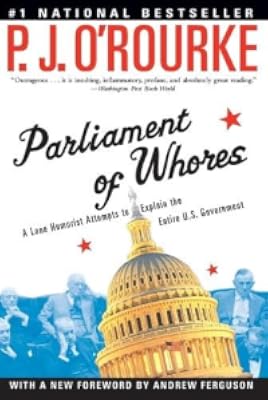
Parliament of Whores: A Lone Humorist Attempts to Explain the Entire U.S. Government
by P. J. O'Rourke
On This Page
Description
P. J. O'Rourke's savagely funny and national best-seller Parliament of Whores has become a classic in understanding the workings of the American political system. Originally written at the end of the Reagan era, this new edition includes an extensive foreword by the renowned political writer Andrew Ferguson - showing us that although the names and the players have changed, the game is still the same. Parliament of Whores is an exuberant, broken-field run through the ethical foibles, show more pork-barrel flimflam, and bureaucratic bullrorfle inside the Beltway that leaves no sacred cow unskewered and no politically correct sensitivities unscorched. show lessTags
Recommendations




















Member Reviews
I read this before in book form, but this time enjoyed it narrated by Christopher Hurt.
I find the whole thing entertaining, it is at its most enlightening when P.J. does a deep dive, such as when he melded his interest with automobiles to investigate how the National Highway Traffic Safety Administration (NHTSA) investigated the reported sudden unintended acceleration in Audi 5000 models during model years 1983–1987. Audi's U.S. sales fell after several recalls of, and what apparently was rooted in operator error had outsized effect on the manufacturer similar to what apparently happened to Toyota: The Toyota Way to Lean Leadership: Achieving and Sustaining Excellence Through Leadership Development.
There is also his embedding with show more target="_top">Guardian Angels as they go "slammin' and jammin'" to directly confront a drug den.
Finally, there is the introspective final chapter "At Home in the Parliament of Whores", where P.J. reflects on the practice of typical choice to use the tools of democracy to block others' freedoms. Most of the book is at the federal level, but the last chapter about “Blatherboro” (a name for the New Hampshire town where O’Rourke), is about locals killing the golf-course-and-condominium project through municipal sewer regulation, because they could.
I find the whole thing entertaining, it is at its most enlightening when P.J. does a deep dive, such as when he melded his interest with automobiles to investigate how the National Highway Traffic Safety Administration (NHTSA) investigated the reported sudden unintended acceleration in Audi 5000 models during model years 1983–1987. Audi's U.S. sales fell after several recalls of, and what apparently was rooted in operator error had outsized effect on the manufacturer similar to what apparently happened to Toyota: The Toyota Way to Lean Leadership: Achieving and Sustaining Excellence Through Leadership Development.
There is also his embedding with show more target="_top">Guardian Angels as they go "slammin' and jammin'" to directly confront a drug den.
Finally, there is the introspective final chapter "At Home in the Parliament of Whores", where P.J. reflects on the practice of typical choice to use the tools of democracy to block others' freedoms. Most of the book is at the federal level, but the last chapter about “Blatherboro” (a name for the New Hampshire town where O’Rourke), is about locals killing the golf-course-and-condominium project through municipal sewer regulation, because they could.
I hold private-property rights to be sacred in theory, but in practice I had thrown in with the anti-golf-course faction.show less
...
Theory is important, sure, but it shouldn't get between a man and his wallet. You can't serve theory for dinner. People have a theoretical right to do what they want with their property, and people have a theoretical right to move into my town. But ...
It was at this moment, in the middle of the Blatherboro sewer debate, that I achieved enlightenment about government...
It wasn't mere disillusionment that I experienced. Government isn't a good way to solve problems; I already knew that. And I'd been to Washington and seen for myself that government is concerned mostly with self-perpetuation and is subject to fantastic ideas about its own capabilities, I understood that government is wasteful of the nation's resources, immune to common sense and subject to pressure from every half-organized bouquet of assholes, I had observed, in person, government solemnity in debate of ridiculous issues and frivolity in execution of serious duties. I was fully aware that government is distrustful of and disrespectful toward average Americans while being easily gulled by Americans with money, influence or fame. What I hadn't realized was government is morally wrong .
Now, it should go without saying that government is about more than dollars and cents. It is also about arrogance, stupidity, vanity, and the corruption of good intentions. (xxi - from the Foreword to the 2003 edition by Andy Ferguson)
I'm not sure I learned anything except that giving money and power to government is like giving whiskey and car keys to teenage boys. (xxiv - from the Preface)
I would be hard pressed not to enjoy a book with section headings such as, "OUR GOVERNMENT: What the Fuck Do They Do All Day And Why Does It Cost So Goddamned Much Money?"
I'm not sure I learned anything except that giving money and power to government is like giving whiskey and car keys to teenage boys. (xxiv - from the Preface)
I would be hard pressed not to enjoy a book with section headings such as, "OUR GOVERNMENT: What the Fuck Do They Do All Day And Why Does It Cost So Goddamned Much Money?"
I picked up this book, published in 1992, at the 2012 Gaithersburg Maryland Book Festival because it was FREE. It was well worth the price. Although I probably never would have bought it, it was a delightful read.
O’Rourke’s trenchant and acid observations about the American government, with a few exceptions, are at least as true today as they were in 1991. His descriptions of the conventions that nominated Bush I and Michael Dukakis are hilarious. For example, his description of the process of choosing a Democratic vice presidential candidate:
“Dukakis was considering Danny Ortega [the head of the Nicaraguan Contras, for those of you too young to remember] as a running mate, but Ortega’s Central American peace plan proved too show more similar to Ronald Reagan’s. So Mike went with the high-concept ticket-balancing choice of Lloyd Bentsen, who was two hundred fifty years old and a little to the right of Albert Speer. Actually, Dukakis wanted a Texan who was slightly more liberal, but George Bush was busy.”
O’Rourke considered himself a conservative in 1991, although today’s Tea Party might call him a lefty. He is critical of most aspects of government spending but he is willing to give credit where it is due. He commends the National Transportation Safety Board (NTSB) for its careful study of “unintended acceleration” supposedly experienced by owners of Audi 5000’s. He found that the professionals at the NTSB were not mere bureaucrats, but were sincere professionals who knew a lot about cars. They spent a lot of money to conclude that the unintended acceleration was almost surely caused by pushing on the gas pedal rather than the brakes, but they knew that a lot people who thought they could recover lots of money from Audi did not want to hear that.
Another form of governmental expenditure he approved of was the development and purchase of Aegis class missile cruisers, the operation of which he describes as follows:
“I couldn’t talk the captain into firing a missile for me, but he gave me a videotape of a test firing….Even in slow motion there was nothing slow about the missile launching. The flip lid whips open, and for a moment you see a bald top of something emerging in light and smoke, a high burlesque of a jack-in-the-box; then the ship’s deck is covered by a tower of blast and dazzle blanketing one bright, rising, white, fiery column—hell’s own hard-on. This (emphasis in original) is the way to waste government money.”
His principle message, however, is that a great deal if not most government expenditures are wasted. His description of the farm price support program should make your blood boil…and yet these ridiculous payments to rich farmers to refrain from growing crops and make the rest of us pay more for a food continue!
The biggest problem of government is that citizens all seem to want payouts of some kind, the biggest of which is social security, but no one seems to be willing to pay for them. He concludes:
“ All through history mankind has been bullied by scum. Those who lord over their fellows and toss commands in every direction…are the most depraved kind of prostitutes. They will submit to any indignity, perform any vile act, do anything to achieve power. The worst off-sloughings of the planet are the ingredients of sovereignty. Every government is a parliament of whores. The trouble is, in a democracy the whores are us.”
I can’t wait to read his description of the campaign for the Republican nomination of 2012, a book I sincerely hope he writes.
(JAB) show less
O’Rourke’s trenchant and acid observations about the American government, with a few exceptions, are at least as true today as they were in 1991. His descriptions of the conventions that nominated Bush I and Michael Dukakis are hilarious. For example, his description of the process of choosing a Democratic vice presidential candidate:
“Dukakis was considering Danny Ortega [the head of the Nicaraguan Contras, for those of you too young to remember] as a running mate, but Ortega’s Central American peace plan proved too show more similar to Ronald Reagan’s. So Mike went with the high-concept ticket-balancing choice of Lloyd Bentsen, who was two hundred fifty years old and a little to the right of Albert Speer. Actually, Dukakis wanted a Texan who was slightly more liberal, but George Bush was busy.”
O’Rourke considered himself a conservative in 1991, although today’s Tea Party might call him a lefty. He is critical of most aspects of government spending but he is willing to give credit where it is due. He commends the National Transportation Safety Board (NTSB) for its careful study of “unintended acceleration” supposedly experienced by owners of Audi 5000’s. He found that the professionals at the NTSB were not mere bureaucrats, but were sincere professionals who knew a lot about cars. They spent a lot of money to conclude that the unintended acceleration was almost surely caused by pushing on the gas pedal rather than the brakes, but they knew that a lot people who thought they could recover lots of money from Audi did not want to hear that.
Another form of governmental expenditure he approved of was the development and purchase of Aegis class missile cruisers, the operation of which he describes as follows:
“I couldn’t talk the captain into firing a missile for me, but he gave me a videotape of a test firing….Even in slow motion there was nothing slow about the missile launching. The flip lid whips open, and for a moment you see a bald top of something emerging in light and smoke, a high burlesque of a jack-in-the-box; then the ship’s deck is covered by a tower of blast and dazzle blanketing one bright, rising, white, fiery column—hell’s own hard-on. This (emphasis in original) is the way to waste government money.”
His principle message, however, is that a great deal if not most government expenditures are wasted. His description of the farm price support program should make your blood boil…and yet these ridiculous payments to rich farmers to refrain from growing crops and make the rest of us pay more for a food continue!
The biggest problem of government is that citizens all seem to want payouts of some kind, the biggest of which is social security, but no one seems to be willing to pay for them. He concludes:
“ All through history mankind has been bullied by scum. Those who lord over their fellows and toss commands in every direction…are the most depraved kind of prostitutes. They will submit to any indignity, perform any vile act, do anything to achieve power. The worst off-sloughings of the planet are the ingredients of sovereignty. Every government is a parliament of whores. The trouble is, in a democracy the whores are us.”
I can’t wait to read his description of the campaign for the Republican nomination of 2012, a book I sincerely hope he writes.
(JAB) show less
P J O'Rourke is a brilliant satirist, and a sneakily smart commentator on all manner of subjects. But he has never been better than in Parliament of Whores, his takedown of the US Government.
You may fear that taking aim at a target so big, so bloated, so unmissable will lead to puffery, but P J attacks with enraged, spittle-flecked, venomous joy, never missing the opportunity to clamp down on the telling details, to skewer the vulnerable gaps in the great sheets of protective blubber that insulate politicians, bureaucrats and government departments from ordinary taxpayers' assaults.
It's all good, but my favorite chapter is the truly surreal report from the 1989 Housing Now! March on Washington DC. The chapter on the USA's agricultural show more policy is also spectacular.
And don't worry about the book's age: government never gets better, it just gets bigger, so Parliament of Whores is never more apposite than it is today. show less
You may fear that taking aim at a target so big, so bloated, so unmissable will lead to puffery, but P J attacks with enraged, spittle-flecked, venomous joy, never missing the opportunity to clamp down on the telling details, to skewer the vulnerable gaps in the great sheets of protective blubber that insulate politicians, bureaucrats and government departments from ordinary taxpayers' assaults.
It's all good, but my favorite chapter is the truly surreal report from the 1989 Housing Now! March on Washington DC. The chapter on the USA's agricultural show more policy is also spectacular.
And don't worry about the book's age: government never gets better, it just gets bigger, so Parliament of Whores is never more apposite than it is today. show less
Even though this book was written over ten years ago, it is still an up-to-date indictment of the American way of doing government, with lessons for those both in the USA and those of us who live in other (though similar) systems. What i thought summed up the brilliance of O'Rourke is that i would read sections that i didn't agree with, but could still not help myself from laughing out loud. And it is dispiriting yet insightful to read about his views on Afghanistan a decade ago, and how so little has changed!
I have loved everything that i have read so far that has been written by O'Rourke, and i am guessing that he is a love-it or hate-it style for most. But if you are in the love-it camp, you are in for a treat. As usual, his satire show more and wit has managed to combine insight with humour - a bloody good read for all. show less
I have loved everything that i have read so far that has been written by O'Rourke, and i am guessing that he is a love-it or hate-it style for most. But if you are in the love-it camp, you are in for a treat. As usual, his satire show more and wit has managed to combine insight with humour - a bloody good read for all. show less
This is the most devastating critique of government since H.L. Mencken, although O'Rourke is short on constructive solutions to most of the problems he exposes.
O'Rourke spent considerable time following around an unnamed congressman. O'Rourke, quite correctly, argues we get a bargain for our money. The average congressman has a budget of around $550,000 for staff, salaries, and expenses. That works out to only about $1.00 per taxpayer in his district. That's pretty cheap considering all the gripes and whining he/she has to listen to for a living. The congressman has a staff of 9 employees. There aren't many businesses serving 600,000 that could survive with that small a staff, and the congressman makes far less than a "shortstop show more hitting .197."
A few more O'Rourkisms: "The Graham-Hollings bill [deficit reduction act was like trying to stop smoking by hiding cigarettes from yourself and then leaving a note in your pocket telling you where they are." His description of journalism: "Trying to find hair in a bowl of dough." He leaves us with the reflection that government may be a parliament of whores, but "in a democracy the whores are us. show less
O'Rourke spent considerable time following around an unnamed congressman. O'Rourke, quite correctly, argues we get a bargain for our money. The average congressman has a budget of around $550,000 for staff, salaries, and expenses. That works out to only about $1.00 per taxpayer in his district. That's pretty cheap considering all the gripes and whining he/she has to listen to for a living. The congressman has a staff of 9 employees. There aren't many businesses serving 600,000 that could survive with that small a staff, and the congressman makes far less than a "shortstop show more hitting .197."
A few more O'Rourkisms: "The Graham-Hollings bill [deficit reduction act was like trying to stop smoking by hiding cigarettes from yourself and then leaving a note in your pocket telling you where they are." His description of journalism: "Trying to find hair in a bowl of dough." He leaves us with the reflection that government may be a parliament of whores, but "in a democracy the whores are us. show less
My reactions to reading this book in 1991.
O'Rourke communicates a great deal of information about U.S. government. You find out exactly what the truly hard-working congressmen do all day. They work hard at giving short, frivilous speeches; at devoting time to serious and complicated issues -- for an hour or two at a committee hearing; at raising money, passing silly, expensive legislation; and reading cheat sheets on legislation prepared by staffers. And, last but not least, here the whines and complaints, and "give-mes" of thousands of people. He tells you exactly what's wrong with farm legislation , what went wrong with the Savings and Loans, why our war on drugs isn't serious, how the President does little, and the general show more whorishness of the American public in voting themselves benefits.
He cites the source of the remark about democracies only lasting until the majority of voters discover they can vote themeselves largess out of the public trough -- 18th century Scot historian Alexander Tytle. AARP, to O'Rourke, represents the ultimate special interst -- and we can, or will, all belong to. O'Rourke shows us the effects (all negative) of a war on poverty (and offers an interesting mathematical proof from the government's own figures -- that poverty doesn't exist). He talks about the hoax that is the federal budget.
O'Rourke is willing, amongst the hyperbole, to look at things in a new, valueable (even if at times deliberately absurd way) that is effective satire. He seems to be mostly libertarian but likes defense). However, he curiously complains about lack of regulation under Reagan. I think he sees the need for regulation in industries, like the S&L, that already operate under regulations but thinks most regulation counter-productive. To him, the world is often an unfair, miserable place -- and goverment intervention will only make it worse. show less
O'Rourke communicates a great deal of information about U.S. government. You find out exactly what the truly hard-working congressmen do all day. They work hard at giving short, frivilous speeches; at devoting time to serious and complicated issues -- for an hour or two at a committee hearing; at raising money, passing silly, expensive legislation; and reading cheat sheets on legislation prepared by staffers. And, last but not least, here the whines and complaints, and "give-mes" of thousands of people. He tells you exactly what's wrong with farm legislation , what went wrong with the Savings and Loans, why our war on drugs isn't serious, how the President does little, and the general show more whorishness of the American public in voting themselves benefits.
He cites the source of the remark about democracies only lasting until the majority of voters discover they can vote themeselves largess out of the public trough -- 18th century Scot historian Alexander Tytle. AARP, to O'Rourke, represents the ultimate special interst -- and we can, or will, all belong to. O'Rourke shows us the effects (all negative) of a war on poverty (and offers an interesting mathematical proof from the government's own figures -- that poverty doesn't exist). He talks about the hoax that is the federal budget.
O'Rourke is willing, amongst the hyperbole, to look at things in a new, valueable (even if at times deliberately absurd way) that is effective satire. He seems to be mostly libertarian but likes defense). However, he curiously complains about lack of regulation under Reagan. I think he sees the need for regulation in industries, like the S&L, that already operate under regulations but thinks most regulation counter-productive. To him, the world is often an unfair, miserable place -- and goverment intervention will only make it worse. show less
Members
- Recently Added By
Lists

Libertarian Books
102 works; 19 members
Author Information

46+ Works 12,036 Members
P. J. O'Rourke was born in Toledo, Ohio on November 14, 1947. He received a B. A. from Miami University in Oxford, Ohio and a M.A. in English from Johns Hopkins University. He worked for the magazine National Lampoon, eventually becoming editor-in-chief. He received a writing credit for National Lampoon's Lemmings which helped launch the careers show more of John Belushi and Chevy Chase. In 1981, he left the magazine to write screenplays including Rodney Dangerfield's Easy Money. He contributes regularly to several magazines including Playboy, Esquire, Vanity Fair, The American Spectator, The New Republic, The Atlantic Monthly, The Weekly Standard, and Rolling Stone. He is the author of 20 books including Parliament of Whores, Give War a Chance, All the Troubles in the World, Don't Vote! - It Just Encourages the Bastards, and How It Got That Way (And It Wasn't My Fault) (And I'll Never Do It Again). (Bowker Author Biography) show less
Some Editions
Awards and Honors
Distinctions
Notable Lists
Work Relationships
Has as a student's study guide
Common Knowledge
- Canonical title
- Parliament of Whores: A Lone Humorist Attempts to Explain the Entire U.S. Government
- Original publication date
- 1991
- Important places
- USA
- Epigraph
- What stops a man who can laugh from speaking the truth?
--Horace - Dedication
- To Amy
- First words
- Preface
The subject of the book is goverment because I don't have to do anything about it.
What is this oozing behemoth, this fibrous tumor, this monster of power and expense hatched form the simple human desire for civic order? - Quotations
- There's a whiff of the lynch mob or the lemming migration about any overlarge concentration of like-thinking individuals, no matter how virtuous their cause.
Feeling good about government is like looking on the bright side of any catastrophe. When you quit looking on the bright side, the catastrophe is still there.
Politics are a lousy way for a free man to get things done. Politics are, like God's infinite mercy, a last resort. - Last words
- (Click to show. Warning: May contain spoilers.)The trouble is, in a democracy the whores are us.
- Canonical DDC/MDS
- 320.973
- Canonical LCC
- JK34 .O74
Classifications
- Genres
- General Nonfiction, Nonfiction, Politics and Government
- DDC/MDS
- 320.973 — Society, government, & culture Political science Types of Government Political situation and conditions North America United States
- LCC
- JK34 .O74 — Political Science Political institutions and public administration (United States) Political institutions and public administration United States
- BISAC
Statistics
- Members
- 1,652
- Popularity
- 13,607
- Reviews
- 21
- Rating
- (3.76)
- Languages
- English
- Media
- Paper, Audiobook, Ebook
- ISBNs
- 11
- ASINs
- 17