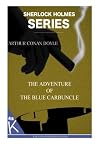
The Adventure of the Blue Carbuncle [short story]
by Arthur Conan Doyle 
On This Page
Description
Originally published in a 1892 edition of Strand Magazine, The Adventure of the Blue Carbuncle was one of twelve short stories to be included in the first Sherlock Holmes collection, the 1892 The Adventures of Sherlock Holmes. In this tale, Holmes and Watson investigate two cases-one involving a Christmas goose and a hat and the other, the theft of the Blue Carbuncle, a priceless jewel. The cases are quickly revealed to be intertwined, and the spirit of the holidays influences the tale's show more end. This recording of The Adventures of the Blue Carbuncle was recorded as part of Dreamscape's Classic Christmas Stories: A Collection of Timeless Holiday Tales. show lessTags
Recommendations






















Member Reviews
The Adventure of the Blue Carbuncle, narrated by Alan Cumming, is a fun romp and kept a smile plastered on my face throughout.
I didn’t read much Sherlock Holmes growing up – probably because I was scared out of my wits as a child watching Basil Rathbone in The Hounds of Baskerville (parents of yore were less vigilant about TV content for toddlers than today’s parents). Scary movies are even scarier in black and white and the distant howling of hounds against a gray foggy backdrop was truly terrifying! Because of this early horrific memory, I clearly must have missed out on a lot of fun because this story was an absolute hoot. I read the Purloined Letter earlier this year (because I read Proust’s Mysterious Correspondent before show more that). SH totally reminded me of Poe’s Dupin, but even better I think. The icing on the cake, however, was the narration by Alan Cumming.
Watson comes to visit his friend Holmes, who is preoccupied studying a hat. It transpires that Peterson, the commissionaire, bumped into a man who appeared to be arguing with two brutes accosting him. The man raised his walking stick to protect himself, broke a shop window and fled the scene, afraid of what appeared to be a policeman approaching. The man’s hat had flown off in one direction and the goose he was carrying fell in a different direction. Peterson tried to help by retrieving the items but the man, who was that much poorer at having lost both his hat and his goose, was nowhere to be found. Not knowing how to find the owner of the lost items, Peterson solicited Holmes’ advice. Holmes suggested that Peterson take home the goose for his Christmas dinner, since it would not keep and could be easily replaced, and he would try to find the owner to return the hat. While inspecting the goose, Holmes discovered and retrieved a large blue stone lodged in its gullet. To make a long story short, it turned out to be the most valuable diamond in the world, none other than (drum roll, please) the Blue Carbuncle, recently stolen from the Countess of Morcar’s hotel room. Although a reformed thief had already been arrested for the crime the diamond had never been found. Holmes proceeded to glean every bit of information you would never have guessed from that hat, then he advertised in all the next edition papers with a clue to the owner, who remarkably showed up on Holmes’ doorstep later in the day to retrieve his hat. The goose was, sadly, already cooked but the owner was pleased to accept a substitute goose for his dinner. Next the plan comes together, Holmes learned how the owner came upon the goose and traces his leads back to the culprit who had stolen the stone. Every part of this story is fun…what Holmes learns from the hat, how he develops his leads, dupes his foils into giving up information, and his eventual interrogation of the true thief, whose proverbial goose was cooked (okay okay, keep those raspberries to yourselves, please).
If you have Audible+ look for this. When I saw that Cumming was the narrator, I knew I was going to have fun.
If you don’t have audible+ you can enjoy this story on East of the Web
here or in the full collection (VII) of The Adventures of Sherlock Holmes, at Project Gutenberg here show less
I didn’t read much Sherlock Holmes growing up – probably because I was scared out of my wits as a child watching Basil Rathbone in The Hounds of Baskerville (parents of yore were less vigilant about TV content for toddlers than today’s parents). Scary movies are even scarier in black and white and the distant howling of hounds against a gray foggy backdrop was truly terrifying! Because of this early horrific memory, I clearly must have missed out on a lot of fun because this story was an absolute hoot. I read the Purloined Letter earlier this year (because I read Proust’s Mysterious Correspondent before show more that). SH totally reminded me of Poe’s Dupin, but even better I think. The icing on the cake, however, was the narration by Alan Cumming.
Watson comes to visit his friend Holmes, who is preoccupied studying a hat. It transpires that Peterson, the commissionaire, bumped into a man who appeared to be arguing with two brutes accosting him. The man raised his walking stick to protect himself, broke a shop window and fled the scene, afraid of what appeared to be a policeman approaching. The man’s hat had flown off in one direction and the goose he was carrying fell in a different direction. Peterson tried to help by retrieving the items but the man, who was that much poorer at having lost both his hat and his goose, was nowhere to be found. Not knowing how to find the owner of the lost items, Peterson solicited Holmes’ advice. Holmes suggested that Peterson take home the goose for his Christmas dinner, since it would not keep and could be easily replaced, and he would try to find the owner to return the hat. While inspecting the goose, Holmes discovered and retrieved a large blue stone lodged in its gullet. To make a long story short, it turned out to be the most valuable diamond in the world, none other than (drum roll, please) the Blue Carbuncle, recently stolen from the Countess of Morcar’s hotel room. Although a reformed thief had already been arrested for the crime the diamond had never been found. Holmes proceeded to glean every bit of information you would never have guessed from that hat, then he advertised in all the next edition papers with a clue to the owner, who remarkably showed up on Holmes’ doorstep later in the day to retrieve his hat. The goose was, sadly, already cooked but the owner was pleased to accept a substitute goose for his dinner. Next the plan comes together, Holmes learned how the owner came upon the goose and traces his leads back to the culprit who had stolen the stone. Every part of this story is fun…what Holmes learns from the hat, how he develops his leads, dupes his foils into giving up information, and his eventual interrogation of the true thief, whose proverbial goose was cooked (okay okay, keep those raspberries to yourselves, please).
If you have Audible+ look for this. When I saw that Cumming was the narrator, I knew I was going to have fun.
If you don’t have audible+ you can enjoy this story on East of the Web
here or in the full collection (VII) of The Adventures of Sherlock Holmes, at Project Gutenberg here show less
This was a free audiobook from Audible for the holiday season, and the fact that Alan Cumming was the narrator is the only reason I downloaded it. I am not a huge fan of the Sherlock Holmes canon, but I adore Alan Cumming and thought he would be an excellent test to see how deep my dislike of Holmes runs. Even with Mr. Cumming’s wonderful performance - always energetic and delightful - Sherlock Holmes is not for me. Everything others love about him – his curiosity, his bombast, his superiority complex - do nothing to make him a fascinating character for me, and I felt all three negative character attributes were on full display in this particular adventure. The mystery of the Blue Carbuncle is interesting if only because the strange show more events that oblige Holmes to get involved are so unusual and widely circumstantial. Because it takes less than an hour to listen to the entire mystery, it was not a complete waste of time, and Holmes’ fans will enjoy Mr. Cummings’ enthusiastic performance. For me, it was a good test that the Sherlock Holmes stories are ones I would do well to avoid. show less
I rarely stray into fiction, but this yuletide gift from Aubible makes me think tales of Sherlock Holmes may have something to offer me. I thoroughly enjoyed Holmes' exagerrated but supported hyper-deduction and Watson, playing banana to the great detective. Still, I couldn't get the picture of Robert Downey, Jr. as Holmes out of my head!
At Christmastime, Sherlock Holmes is tasked with returning a lost goose to its rightful owner, whose identity Holmes deduces from the hat he lost with the goose. The case gains a new urgency when the goose is discovered to hold a valuable secret. This is one of the more familiar Holmes stories since it’s often included in anthologies of Christmas mysteries. It’s a good entry point to the Holmes canon. Holmes gives a magical performance as he extracts a man from his hat!
This is Conan Doyle's Christmas Sherlock Holmes story, about a lost jewel concealed within the crop of a Christmas goose. It's a good story that manages to combine Christmas humour with a serious backdrop of a man wrongly accused with the theft of the jewel. Not one of Conan Doyle's very best, but always comes up well.
A very entertaining mystery short story from the Sherlock Holmes short stories collection. The plot is quite simple and intelligent: Watson visits his friend Holmes at Christmas time and finds him contemplating a battered old hat, brought to him by the commissionaire Peterson after the hat and a Christmas goose had been dropped by a man in a scuffle with some street ruffians. Peterson takes the goose home to eat, but later returns to Holmes with a blue carbuncle his wife had found in the bird's crop (throat). Holmes makes some interesting deductions concerning the owner of the hat from simple observations of its condition, conclusions amply confirmed when an advertisement for the owner produces the man himself: Henry Baker.
Holmes cannot show more resist such an intriguing mystery, and he and Watson set out across the city to determine exactly how the jewel, stolen from the Countess of Morcar during her stay at a hotel, wound up in a goose's crop. The man who dropped the goose, Mr. Henry Baker, comes to reclaim his hat in response to Holmes' advertisement. Holmes drops hints about how he saved the "innards" of the goose, but Baker fails to respond to them, simply saying that he is afraid goose remains are not much use. He does, however, give Holmes valuable information, eventually leading him to the conclusive stage of his investigation, at Covent Garden. Holmes offers a fresh goose to Henry Baker, who responds with gladness and departs, whereupon Holmes tells Watson that Baker is eliminated from the suspect list as he obviously knows nothing about the carbuncle. At Covent Garden, a salesman named Breckinridge gets angry with Holmes, complaining about all the people who have pestered him about geese sold recently to the landlord of the Alpha Inn. Clearly, someone else knows that the carbuncle was in a goose and is looking for the bird.
Holmes expects that he will have to visit the goose supplier in Brixton, but it proves unnecessary: the other "pesterer" that the salesman mentioned shows up right then, a cringing little man named James Ryder whom Holmes prevails upon to tell the whole sordid story, by first mentioning that Ryder is probably looking for a goose with a black bar on its tail, a remarkable bird that "[laid] an egg after it was dead". Of course, Holmes has already deduced most of it.
Ryder, believing he was being pursued for the theft, fed the carbuncle to a goose being bred by his sister Maggie Oakshott. He was to have had that goose as a gift, but lost track of which one it was.
When Ryder cut open the goose and found no gem, he went back to his sister, who had provided the Alpha Inn geese, and asked if there was more than one goose with a black bar on its tail. She said there were two, but he was too late: she had sold it to Breckinridge at Covent Garden. Breckinridge had already sold the geese to the Alpha Inn, and the other goose with a black bar on its tail had found its way to Henry Baker as his Christmas fowl. Ryder and his accomplice — the countess's maid, Catherine Cusack — contrived to frame John Horner, a plumber who worked at the same hotel as Ryder and had previously been imprisoned for robbery, for the crime.
Holmes, however, does not take the standard action against the man, it being Christmas, concluding that arresting the clearly anguished Ryder will only make him into a more hardened criminal later. Ryder flees to the continent and Horner will be freed as the case against him will collapse without Ryder's perjured testimony. Holmes remarks that he is not retained by the police to remedy their deficiencies.
I recommend this book to all readers that love a good mystery story, mainly those who enjoy Sherlock Holmes mystery stories. show less
Holmes cannot show more resist such an intriguing mystery, and he and Watson set out across the city to determine exactly how the jewel, stolen from the Countess of Morcar during her stay at a hotel, wound up in a goose's crop. The man who dropped the goose, Mr. Henry Baker, comes to reclaim his hat in response to Holmes' advertisement. Holmes drops hints about how he saved the "innards" of the goose, but Baker fails to respond to them, simply saying that he is afraid goose remains are not much use. He does, however, give Holmes valuable information, eventually leading him to the conclusive stage of his investigation, at Covent Garden. Holmes offers a fresh goose to Henry Baker, who responds with gladness and departs, whereupon Holmes tells Watson that Baker is eliminated from the suspect list as he obviously knows nothing about the carbuncle. At Covent Garden, a salesman named Breckinridge gets angry with Holmes, complaining about all the people who have pestered him about geese sold recently to the landlord of the Alpha Inn. Clearly, someone else knows that the carbuncle was in a goose and is looking for the bird.
Holmes expects that he will have to visit the goose supplier in Brixton, but it proves unnecessary: the other "pesterer" that the salesman mentioned shows up right then, a cringing little man named James Ryder whom Holmes prevails upon to tell the whole sordid story, by first mentioning that Ryder is probably looking for a goose with a black bar on its tail, a remarkable bird that "[laid] an egg after it was dead". Of course, Holmes has already deduced most of it.
Ryder, believing he was being pursued for the theft, fed the carbuncle to a goose being bred by his sister Maggie Oakshott. He was to have had that goose as a gift, but lost track of which one it was.
When Ryder cut open the goose and found no gem, he went back to his sister, who had provided the Alpha Inn geese, and asked if there was more than one goose with a black bar on its tail. She said there were two, but he was too late: she had sold it to Breckinridge at Covent Garden. Breckinridge had already sold the geese to the Alpha Inn, and the other goose with a black bar on its tail had found its way to Henry Baker as his Christmas fowl. Ryder and his accomplice — the countess's maid, Catherine Cusack — contrived to frame John Horner, a plumber who worked at the same hotel as Ryder and had previously been imprisoned for robbery, for the crime.
Holmes, however, does not take the standard action against the man, it being Christmas, concluding that arresting the clearly anguished Ryder will only make him into a more hardened criminal later. Ryder flees to the continent and Horner will be freed as the case against him will collapse without Ryder's perjured testimony. Holmes remarks that he is not retained by the police to remedy their deficiencies.
I recommend this book to all readers that love a good mystery story, mainly those who enjoy Sherlock Holmes mystery stories. show less
This is a short Sherlock Holmes Christmas mystery involving a Christmas goose and a missing gem. Holmes's classic deductive reasonings are demonstrated and there is a nice holiday message. Alan Cummings as the narrator was excellent. A fun listen and a nice free Christmas gift from Audible.
Members
- Recently Added By
Lists

Christmas Reading
142 works; 5 members

Books with Colourful Titles
171 works; 8 members

A Rainbow of Books: Colors in the Title
570 works; 24 members

Books Read in 2021
5,361 works; 113 members

Books Read in 2023
5,547 works; 145 members

Books Read in 2015
3,299 works; 129 members
Author Information

3,989+ Works 169,292 Members
The most famous fictional detective in the world is Arthur Conan Doyle's Sherlock Holmes. However, Doyle was, at best, ambivalent about his immensely successful literary creation and, at worst, resentful that his more "serious" fiction was relatively ignored. Born in Edinburgh, Doyle studied medicine from 1876 to 1881 and received his M.D. in show more 1885. He worked as a military physician in South Africa during the Boer War and was knighted in 1902 for his exceptional service. Doyle was drawn to writing at an early age. Although he attempted to enter private practice in Southsea, Portsmouth, in 1882, he soon turned to writing in his spare time; it eventually became his profession. As a Liberal Unionist, Doyle ran, unsuccessfully, for Parliament in 1903. During his later years, Doyle became an avowed spiritualist. Doyle sold his first story, "The Mystery of the Sasassa Valley," to Chambers' Journal in 1879. When Doyle published the novel, A Study in Scarlet in 1887, Sherlock Holmes was introduced to an avid public. Doyle is reputed to have used one of his medical professors, Dr. Joseph Bell, as a model for Holmes's character. Eventually, Doyle wrote three additional Holmes novels and five collections of Holmes short stories. A brilliant, though somewhat eccentric, detective, Holmes employs scientific methods of observation and deduction to solve the mysteries that he investigates. Although an "amateur" private detective, he is frequently called upon by Scotland Yard for assistance. Holmes's assistant, the faithful Dr. Watson, provides a striking contrast to Holmes's brilliant intellect and, in Doyle's day at least, serves as a character with whom the reader can readily identify. Having tired of Holmes's popularity, Doyle even tried to kill the great detective in "The Final Problem" but was forced by an outraged public to resurrect him in 1903. Although Holmes remained Doyle's most popular literary creation, Doyle wrote prolifically in other genres, including historical adventure, science fiction, and supernatural fiction. Despite Doyle's sometimes careless writing, he was a superb storyteller. His great skill as a popular author lay in his technique of involving readers in his highly entertaining adventures. (Bowker Author Biography) show less
Arthur Conan Doyle has a Legacy Library. Legacy libraries are the personal libraries of famous readers, entered by LibraryThing members from the Legacy Libraries group.
Some Editions
Series
Belongs to Publisher Series
Work Relationships
Is contained in
Sherlock Holmes: The Complete Novels and Stories, Vol. 1 (Bantam Classics 1/2) by Arthur Conan Doyle (indirect)
Sherlock Holmes: The Complete Novels and Stories, Vol. 1 and 2 (Bantam) by Arthur Conan Doyle (indirect)
The New Annotated Sherlock Holmes: The Short Stories, Volume 1 of 2 (The Adventures of Sherlock Holmes + The Memoirs of Sherlock Holmes) by Arthur Conan Doyle (indirect)
The Adventures of Sherlock Holmes [and] The Hound of the Baskervilles by Sir Arthur Conan Doyle (indirect)
Las Aventuras de Sherlock Holmes ; Sherlock Holmes sigue en pie ; El archivo de Sherlock Holmes by Sir Arthur Conan Doyle (indirect)
A Study in Scarlet / The Adventures of Sherlock Holmes / The Hound of the Baskervilles / Sign of Four by Arthur Conan Doyle (indirect)
The Sherlock Holmes illustrated omnibus : The adventures of Sherlock Holmes, The memoirs of Sherlock Holmes, The hound of the Baskervilles, The return of Sherlock Holmes : a facsimile of the stories and the adventure as they were first published in the Strand magazine, London by Sir Arthur Conan Doyle (indirect)
A Study In Scarlet, The Sign of the Four, The Adventures of Sherlock Holmes, The Memoirs of Sherlock Holmes, The Return of Sherlock Holmes (Sherlock Holmes - Bouquin Complete works - volume 1/2) by Arthur Conan Doyle (indirect)
The Adventures of Sherlock Holmes, The Memoirs of Sherlock Holmes, The Return of Sherlock Holmes (Classics Omnibus) by Arthur Conan Doyle (indirect)
The adventures of Sherlock Holmes ; The memoirs of Sherlock Holmes ; The return of Sherlock Holmes ; The hound of the Baskervilles ; A study in ... the Bruce-Partington plans (Masters Library) by Arthur Conan Doyle (indirect)
A Study in Scarlet / The Sign of the Four / The Adventures of Sherlock Holmes / The Memoirs of Sherlock Holmes by Arthur C. Doyle (indirect)
Adventures of Sherlock Holmes / Memoirs of Sherlock Holmes / The Sign Of Four by Arthur Conan Doyle (indirect)
A Study in Scarlet / The Sign of Four / The Adventures of Sherlock Holmes / The Memoirs of Sherlock Holmes / The Hound of the Baskervilles (B&N Classics 1/2) by Arthur Conan Doyle (indirect)
As Aventuras de Sherlock Holmes - Um Escândalo na Boémia, O Mistério do Vale Boscombe, O Carbúnculo Azul by Arthur Conan Doyle
Quatre aventures de Sherlock Holmes : La bande mouchetée ; L'association des hommes roux ; L'escarboule bleue ; Les cinq pépins d'orange by Arthur Conan Doyle
The Adventures of Sherlock Holmes III: The Adventure of the Cardboard Box/The Musgrave Ritual/The Man with the Twisted Lip/The Adventure of the Blue Carbuncle by Sir Arthur Conan Doyle
Common Knowledge
- Canonical title
- The Adventure of the Blue Carbuncle [short story]
- Original title
- The Adventure of the Blue Carbuncle
- Alternate titles
- The Blue Carbuncle; Sherlock Holmes and the Adventure of the Blue Carbuncle
- Original publication date
- 1892
- People/Characters
- Sherlock Holmes; John H. Watson (M.D.); Peterson (the commissionaire); Henry Baker; Countess of Morcar; John Horner (show all 12); James Ryder; Inspector Bradstreet; Windigate (the innkeeper); Breckenridge (the poulterer); Maggie Oakshott (the goose-rearer); Catherine Cusack
- Important places
- London, England, UK; Tottenham Court Road, London, England, UK; Goodge Street, London, England, UK; Alpha Inn, Bloomsbury, London, England, UK; Covent Garden Market, London, England, UK; 221B Baker Street, London, England, UK
- Important events
- Christmas
- Related movies
- "The Adventures of Sherlock Holmes" The Blue Carbuncle (1984 | IMDb)
- First words
- I had called upon my friend Sherlock Holmes upon the second morning after Christmas, with the intention of wishing him the compliments of the season.
- Quotations
- My name is Sherlock Holmes. It is my business to know what other people don't know.
- Original language
- English
- Canonical DDC/MDS
- 823.08721
Classifications
- Genres
- Fiction and Literature, Mystery
- DDC/MDS
- 823.08721 — Literature & rhetoric English & Old English literatures English fiction By type Genre fiction Adventure fiction Mystery fiction Detective fiction
- LCC
- PZ3 .D772 — Language and Literature Fiction and juvenile belles lettres Fiction and juvenile belles lettres Fiction in English
- BISAC
Statistics
- Members
- 464
- Popularity
- 65,414
- Reviews
- 22
- Rating
- (3.63)
- Languages
- 10 — Catalan, English, Finnish, French, German, Polish, Portuguese (Brazil), Serbian, Spanish, Swedish
- Media
- Paper, Audiobook, Ebook
- ISBNs
- 70
- ASINs
- 34