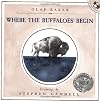
Where the Buffaloes Begin
by Olaf Baker
On This Page
Description
After hearing the legend retold by the tribe's oldest member, Little Wolf hopes to someday witness the beginning of the buffaloes at the sacred lake.Tags
Recommendations






Member Reviews
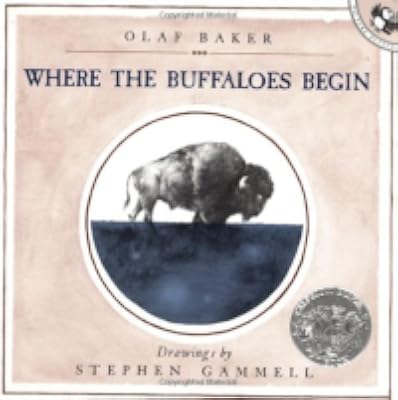
Originally published in 1915 in the St. Nicholas Magazine for children, this story by expatriate Englishman Olaf Baker was reprinted in 1981 with illustrations by Stephen Gammell. The result is a beautifully illustrated picture-book, awarded a Caldecott Honor in 1982. Where the Buffaloes Begin is the tale of Little Wolf, a young Indian boy who sets out to find the lake described by Nawa - his people's wise old storyteller - as the origin place of the buffalo. Little does he know that his triumphant return with a herd of buffalo will save his people from attack...
Described as a legend of the "Plains Indians," I think this must be taken from the traditions of either the Blackfeet or Gros Ventre peoples, as the Assiniboine are mentioned as show more enemies. Clearly the Assiniboine themselves wouldn't have related legends in which they themselves featured as the villains, so this cannot be a tale told by all the Plains nations, although I believe that many of them do have legends which tell of the underground origin of the buffalo.
Unfortunately, I don't know enough about either the folklore of the Blackfeet or Gros Ventre to judge the authenticity of this tale, but the deliberate vagueness of attribution makes me feel rather skeptical, especially given the well-documented history of European and Euro-American appropriation and misinterpretation of Native American cultures. The black and white illustrations by Stephen Gammell are lovely, but this is not one I would recommend for folklore study, unless its origin can be documented.
Addendum: Although I continue to think very poorly of the editor's choice here, to exclude any information as to specific cultural origin for this folktale, some new information, which I discovered reading the critical introduction to Where the Buffalos Begin in the anthology Adventures in the West: Stories for Young Readers, makes me think more kindly of the original author, Olaf Baker, and of his retelling. Apparently Baker spent some considerable time with the Blackfeet people, and it is from their tradition that this selection springs. I'm glad to see that my guess was partially correct, and to know the origin of the story, and have therefore increased my star rating from two to three. Hopefully future reprints of this picture-book will include more such information about the story's cultural origin and roots. show less
Described as a legend of the "Plains Indians," I think this must be taken from the traditions of either the Blackfeet or Gros Ventre peoples, as the Assiniboine are mentioned as show more enemies. Clearly the Assiniboine themselves wouldn't have related legends in which they themselves featured as the villains, so this cannot be a tale told by all the Plains nations, although I believe that many of them do have legends which tell of the underground origin of the buffalo.
Unfortunately, I don't know enough about either the folklore of the Blackfeet or Gros Ventre to judge the authenticity of this tale, but the deliberate vagueness of attribution makes me feel rather skeptical, especially given the well-documented history of European and Euro-American appropriation and misinterpretation of Native American cultures. The black and white illustrations by Stephen Gammell are lovely, but this is not one I would recommend for folklore study, unless its origin can be documented.
Addendum: Although I continue to think very poorly of the editor's choice here, to exclude any information as to specific cultural origin for this folktale, some new information, which I discovered reading the critical introduction to Where the Buffalos Begin in the anthology Adventures in the West: Stories for Young Readers, makes me think more kindly of the original author, Olaf Baker, and of his retelling. Apparently Baker spent some considerable time with the Blackfeet people, and it is from their tradition that this selection springs. I'm glad to see that my guess was partially correct, and to know the origin of the story, and have therefore increased my star rating from two to three. Hopefully future reprints of this picture-book will include more such information about the story's cultural origin and roots. show less
Where the Buffalos Begin is a book about an Indian boy named Little Wolf who saved the people in his tribe by stirring up the buffalos, and by accident had stopped an attack by another tribe on his people. The story is one of chance, but of great courage also.
I liked this book because it had a sense of excitement through every page. I thought that it was going to be a boy who helped his tribe find buffalo to kill and it was not anything like that. It was a legend, a folktale of a small curious boy who saved his people by more or less scaring the buffalo and making them run in a stampede killing the enemies of his tribe making him a hero.
This would be a good book when learning of some of the Indian culture and even about buffalo. It show more could raise the question of why the tribe had enemies and why was Little Wolf a here to his people. show less
I liked this book because it had a sense of excitement through every page. I thought that it was going to be a boy who helped his tribe find buffalo to kill and it was not anything like that. It was a legend, a folktale of a small curious boy who saved his people by more or less scaring the buffalo and making them run in a stampede killing the enemies of his tribe making him a hero.
This would be a good book when learning of some of the Indian culture and even about buffalo. It show more could raise the question of why the tribe had enemies and why was Little Wolf a here to his people. show less
I really enjoyed this book and I thought it was a great Native American myth. It begins with Nawa, an elder, telling a story about where the buffaloes begin. Little Wolf is the main character and he is a ten year old boy that is very brave and fearless. Once spring comes, Little Wolf leaves his camp and searches across the prairie to find the lake where the buffaloes begin. It takes him all day and along the way, he sees a shape in the distance that he dismisses as a herd of animals. At the time, he doesn’t realize it is a group of the enemy tribe heading towards his tribe, trying to attack them. He continues on and finds the lake. He waits all evening and falls asleep. He is woken by the sounds of the buffalo and sees that the legend show more is true. The buffalo rise up out of the lake in a huge herd and are standing there in on the water. Little Wolf gives a huge cry and waves his arms, trying to communicate with the buffalo. They see him and start galloping towards him. Little Wolf runs for his pony and they take off toward their camp. He doesn’t know what’s going to happen and wonders if the buffalo will trample them. He knows they can’t outrun them because his pony is tired from the trip out to the lake so they just keep going as fast as they can until they are surrounded by buffalo. They are running with the buffalo towards his tribe’s camp. That’s when they see the enemy. They are running away from the tribe’s camp. They heard the buffalo and are trying to escape and get to their ponies. They haven’t yet attacked the camp. The enemy is fleeing the scene and Little Wolf and his pony are galloping among the huge herd of buffalo toward his camp. The enemy is easily overtaken by the buffalo and they are trampled. Little Wolf has unknowingly saved his tribe by bringing the buffalo. show less
Where the Buffaloes Begin takes us on a journey alongside of Little Wolf, as he becomes victorious to his enemies. Illustrator, Stephen Gammell, completed phenomenal work! The illustrations were magnificent, and brought the story of Little Wolf to life. I particularly enjoyed how the author portrayed his audience to feel like Little Wolf himself. It was extraordinarily easy to get lost in Little Wolf’s adventure and relate to him throughout the picturebook. The introduction of Where the Buffaloes Begin provided background knowledge of the setting, teaching me more about Native American’s and their culture. After finishing this book, I truly learned more! This was a wonderful read, I would fully recommend this book as a teaching tool show more for Native American based units. This book was lengthy, so I would suggest reading it in segments to our younger audiences. show less
A Caldecott Honor picture book. Over the blazing campfires, where the wind moaned eerily through the thickets of juniper and fir, they spoke of it in the Indian tongue—the strange lake to the southward whose waters never rest. And Nawa, the medicine man, declared that if you arrived at the right time, on the right night, you would see the buffaloes rise out of the middle of the lake -- the sacred spot where the buffaloes began. Ten-year-old Little Wolf is determined to see this.
The drawings in this book are worth the price of the book. The story is an Indian legend first printed in 1915, and it is well written, better than many Caldecott winners.
Summary: This Caldecott honor book is based on an Indian boy who discovers where buffaloes begin. Down at the lake in the South, Little Wolf watches as the buffalo emerge out of the water and onto the prarie land. Little Wolf then leads the buffalo to victory against his people's enemy.
Personal Reaction: This book reminds me of Oklahoma history class I had to take whenever I moved to Oklahoma from Texas. There was a lot of Indian history that took place here in Oklahoma, where buffalo still roam.
Classroom Extension Ideas:
1. Have the children create a drawing of a buffalo.
2. Discuss what they know about buffalo.
Personal Reaction: This book reminds me of Oklahoma history class I had to take whenever I moved to Oklahoma from Texas. There was a lot of Indian history that took place here in Oklahoma, where buffalo still roam.
Classroom Extension Ideas:
1. Have the children create a drawing of a buffalo.
2. Discuss what they know about buffalo.
Members
- Recently Added By
Published Reviews
ThingScore 50
Little Wolf witnesses the origin of buffalo…. Little Wolf's tribe is not indicated, though the story relates that the enemy is Assiniboin. The author makes no claim that this retelling of a story… is based on an authentic Indian legend. The prose is poetic…; some lengthy sentences might daunt younger readers. The author's use of the name "Nawa" for the Great Spirit is purely fictional. show more Includes beautiful black-and-white illustrations. show less
added by CourtyardSchool
Lists

Caldecott Honor Books
296 works; 23 members

Books Read in 2023
5,547 works; 145 members
Author Information
10+ Works 876 Members
All Editions
Awards and Honors
Awards
Common Knowledge
- Canonical title
- Where the Buffaloes Begin
- Original publication date
- 1981
- People/Characters
- Little Wolf; Nawa
- Dedication
- To my friend Red Eagle
- First words
- Over the blazing camp-fires, when the wind moaned eerily through the thickets of juniper and fir, they spoke of it in the Indian tongue - of the strange lake to the south whose waters never rest.
- Last words
- (Click to show. Warning: May contain spoilers.)But now they always add the name of Little Wolf to the legend, for he is the boy who led the buffaloes and saved his people.
Classifications
Statistics
- Members
- 846
- Popularity
- 32,279
- Reviews
- 12
- Rating
- (3.80)
- Languages
- Chinese, English, Korean
- Media
- Paper, Ebook
- ISBNs
- 17
- UPCs
- 1
- ASINs
- 9