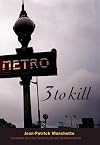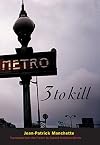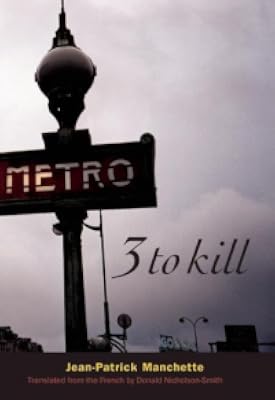
Three to Kill
by Jean-Patrick Manchette
On This Page
Description
First in English for Manchette, renovator of French noir; trenchant social critique laced with black humor.
Tags
Recommendations


























Member Reviews
This was my first exposure to Manchette and what a very pleasant surprise. The number of literate writers who venture into genre writing is small. You could count them on the fingers of both hands: maybe one hand. Ballard is one, Poe another. Manchette is one too. Credited with single handedly rescuing French crime fiction from the police procedural he writes in a spare, vicious language about men capable of extreme violence. Hardly a word seems wasted and once or twice an excess or a mis-step may be the fault of the translator. This is very good, very consistent, writing. Manchette's man, a high end hi-fi salesman, reluctantly stops to help a motorist who has been involved in an accident, or so he thinks but the man beside the citroen show more DS has been shot by professionals. The man takes the victim to hospital and abandons him to his fate while he himself goes off on holiday but his life has changed irrevocably. The killers soon come after him - and after his family - but the man is lucky. In a move never properly explained but not explained only because the man does not understand it himself he decoys the killers away from his family and the hunted becomes the hunter. Ten months later he returns to the bosom of his family, his task accomplished. Fast and insightful prose fills the gap I have left you here. Manchette fills up that gap much better than I could. Manchette elevates the crime novel to literature once more, bringing to mind Dostoevsky and Camus. In this slim volume he gives us psychological insight and social commentary spun in a tidy web of well chosen words. I did wonder whether he had read the great Derek Raymond but who cares? show less
Perfect. Not a word is wasted in this strange story of a man who becomes involved with killers and...well, it's a short book and to say more would just spoil it. This is even better than The Prone Gunman. It is as noir as it gets, but with an added weird sense of humor. Again, the word is perfect. Just read it.
A travelling salesman pulls over on the road very early one morning to help an apparent accident victim. Instead he finds a wounded victim of an attempted mob hit. He takes him to the nearest hospital (where the victim soon dies) not realizing he is being followed by the assassins who are now out to get him. They're coming to get him and anyone or anything associated with him--including pets. Watch him as he turns the table on his killers and the man who hires them. This a fast paced and very nasty thriller told in a very ironic and compelling manner. Manchette is quite the savvy social critic besides. I would like to see more of his work. A fun read and a great book.
In this re-print of a 1976 French title with a spare, vicious elegance, businessman Georges Gerfault stops to aid the victim of what seems to be a roadside accident but is in reality a failed hit job, and finds himself in the crosshairs of a pair of hired guns, Carlo and Bastien, who make their first attempt on his life while he vacations with his family at the sunny seaside, and chase him across the country and right out of his complacent bourgeois life. The swift, lean succession of unadorned brutality is related by a narrator not so much omniscient as insouciant, whose cool and clinical description of the desperate events unfolding before his impassive camera lens is leavened with Gallic shrugs and sly humor that is as reminiscent of show more Voltaire as Camus. The result is rather like being a passenger in a precision sportscar hurtling down the highway at insane speeds, wondering if the driver’s nonchalant demeanor and offhand remarks on the passing flora and fauna owe to his supreme expertise and confidence in German engineering, or to utter suicidal indifference. I swiftly gobbled up the only other Manchette currently available here — The Prone Gunman — and eagerly await the translation of his eight other crime novels. Imo, Americans don’t read (or have access to) nearly enough popular literature from other cultures — not that we’re obliged to be cosmopolitan in our tastes, but the rest of the world has so many refreshingly different stories to tell us. The current boom in Euro-mysteries is an encouraging sign. show less
review of
Jean-Patrick Manchette's 3 to Kill
by tENTATIVELY, a cONVENIENCE - October 16-17, 2020
I learned about this author by reading mention of him in Paco Ignacio Taibo II's Life Itself (my review: https://www.goodreads.com/review/show/3046523982 ). Since Taibo is one of my favorite crime fiction writers I respect his opinion & decided to check out Manchette. I comment on this in the review:
""Send me a package by Frontier Bus Lines, a bunch of black ribbons for the Olivetti portable, the cotton ones they sell at the shop on the corner, as well as the original, which is in a red briefcase with a lock, and a pile of novels by J. P. Ma"[n]"chette that I left on my side of the bed" - p 10
"For those of you who may be too young to show more remember, an "Olivetti" is a brand of typewriter, so he's asking for the things that provide the ink that the keys impress upon. As for "Machette"? I don't know his or her work so I look them up online & find nothing. BUT THAT'S BECAUSE THE NAME WAS MISSPELLED "Machette" instead of "Manchette". Later in this bk it was spelled correctly so I looked for books by him again & ordered 5 online.
""If you're going to divorce me, for God's sake send me the blue turtleneck sweater and the aspirins, Manchette's novels,""
This is the 1st Manchette I've read. The main character, Georges Gerfaut, is presented partially in terms of his musical tastes. That always interests me.
"a tape player is quietly diffusing West Coast-style jazz: Gerry Mulligan, Jimmy Giuffre, Bud Shank, Chico Hamilton. I know, for instance, that at one point it is Rube Bloom and Ted Koehler's "Truckin'" that is playing, as recorded by the Bob Brookmeyer Quintet." - pp 3-4
One of the killers has a highly specific sexual fetish.
"Women were attracted to him. After a while they would discover that the only thing he wanted from women was to be beaten. He did not beat them in return and had absolutely no wish to penetrate them. So women would break off with him, except for the perversely sadistic ones. But he got rid of the perversely sadistic ones the moment he realized they were getting pleasure from beating him. They disgusted him, he said." - p 6
Wouldn't you love to read his online dating profile? Then there's the other guy from the Dominican Republic.
"To San Isidro were regularly brought persons suspected of collusion with the class enemy, and the job of the SIM under Alonso's direction was to make them talk by beating them, raping them, slicing them up, electrocuting them, castrating them, drowning them in places ingeniously designed for that purpose, and cutting their heads off.
"On 30 May 1961, Trujillo the Benefactor of the Fatherland got himself riddled with bullets on a road by a commando group whose members, along with some accomplices, were later apprehended. For Alonso and Elias the halcyon days were over, or almost." - p 7
Yes, these 2 last characters are indeed as 'unsavory' as they seem. I, at least, wdn't eat them.
Alonso's musical tastes is different from George's.
"His LP collection fell into three categories. First, high classical: Bach, Mozart, Beethoven. Second, syrupy American popular singers: Mel Tormé or Billy May. Alonso never played anything from those two categories, however. What he played, from the moment he returned from his walk with Elizabeth, was Tchaikovsky, Mendelssohn, or Liszt." - pp10-11
What do you make of that? The torturer/murderer likes a gay composer & a Jewish one.
By page 16, a previous owner of the bk had apparently gotten lost in the not-really-very-labyrinthian-yet plot & 'corrected' the text incorrectly by changing "her" to "him" & "my doormat" to "the street".
""I don't know her," he was saying. "I found her lying on my doormat.["]"
Confusing, isn't it? Unless you too have read this bk you don't know what this means or who's correct: me or the anonymous marginaliaist (now, now, let's not quibble about whether that word's 'real' or not lest someone prove that YOU'RE NOT REAL).
There's all sorts of crossing paths with assassins w/o anything coming of it at the time.
"Up ahead a pair of taillights—the Italian sports car? was it perhaps a Lancia Beta?—had just been enveloped by the night." - p 13
It must've been a big envelope. Have you ever been enveloped by the night? Half the time they forget to lick the flap so it's easy to get out.
"So Gerfaut took the Mercedes and went to rent a television in Royan. On the return trip he overtook a Lancia Beta 1800 sedan." - p 34
As you may've surmised, Manchette goes for political detail to set the mood.
"He is one of those who were in the entrance to the Charonne metro station at a bad moment: 17 October 1961, when police cornered Algerian protestors there. He is also one of those who came out alive. The next year, six months after his release from the hospital, Liétard set upon a lone policeman late one night in Rue Brancion, beat the man savagely with his own baton and left him naked, two ribs and jaw broken, handcuffed to the iron railings around the Vaugirard slaughterhouses." - p 41
Well, well.. Did you know about that "bad moment"? I didn't, now I do. Isn't reading wonderful?
"The Paris massacre of 1961 occurred on 17 October 1961, during the Algerian War (1954–62). Under orders from the head of the Parisian police, Maurice Papon, the French National Police attacked a demonstration by 30,000 pro-National Liberation Front (FLN) Algerians. After 37 years of denial and censorship of the press, in 1998 the French government finally acknowledged 40 deaths, although there are estimates of 100 to 300 victims. Death was due to heavy-handed beating by the police, as well as mass drownings, as police officers threw demonstrators in the river Seine.
"The massacre was intentional, as substantiated by historian Jean-Luc Einaudi, who won a trial against Papon in 1999 (Papon had been convicted in 1998 of crimes against humanity for his role under the Vichy collaborationist regime during World War II). Official documentation and eyewitness accounts within the Paris police department suggest that Papon directed the massacre himself. Police records show that he called for officers in one station to be "subversive" in quelling the demonstrations, and assured them protection from prosecution if they participated."
- https://en.wikipedia.org/wiki/Paris_massacre_of_1961
Gerfaut goes thru quite an unexpected ordeal. On the way he's helped by some exploited immigrant workers.
"There were eight loggers, encamped beneath a canvas sheet held up by stakes. Their blankets were filthy, and they slept on bundled branches and leaves. They had stale bread, a little Algerian wine, cheese, bad coffee, big sacks of dried peas and beans, and three magazines filled with obscene photographs. Their professional equipment consisted of axes and saws and two Homelite chain saws. Their presence in France was illegal, they had no kind of social security, and they earned only slightly more than half the minimum wage for some sixty to seventy hours of work per week." - p 76
As far as the world knows, Gerfaut has disappeared. Unknown to them, he's been thrown upon his resources & is struggling to survive. After he's been missing for awhile, he finds a newspaper that mentions him. This is his 1st inkling of how his disappearance has been rc'vd.
"Still, the day after the couple's departure he had lit the fire with a copy of the evening France-Soir from the day before, which the pair had left behind. By chance, as he scrunched the newspaper up into loose airy balls, his eye had fallen upon a very short article—no more than filler—headed "Possible New Light Thrown on Disappearance of Paris Executive Georges Gerfaut After Massacre of Last Summer," which was a very long title for such a brief item." - p 94
We get to read about the musical tastes of these murderers, another killer enters the picture, Carlo, & we learn about what he's reading.
"In a metal suitcase on a baggage stand were a change of clothes, the S&W .45, the three knives and the steel, the garrote, the blackjack, and all the rest. Carlo's toilet bag was in the bathroom, and on the bedside table was a science-fiction novel by Jack Williamson in French translation." - p 100
Alonso the torturer/murderer is writing his memoirs. One wonders whether Manchette is mocking other such memoirs by people of highly suspect personal histories. Think about someone like Henry Kissinger, e.g., 'civilized' on the outside & brutal in his actual effect.
"The best way to end violence is to punish those who resort to it, whatever their position in society. Generally speaking, such individuals are not very numerous. And that is why, in principle, representative democracy has always seemed to me the best way to run a nation. Sadly, the countries of the free world are prevented from living according to their principles, because communist subversion insinuates itself into their organism and brings on recurrent and endemic attacks of decay." - p 125
I usually find the author's brief bios at the end to be illuminating. This one's no exception.
"Jean-Patrick Manchette (1942-1995) rescued the French crime novel from the grip of stodgy police procedurals—restoring the noir edge by virtue of his post-1968 leftism. Today, Manchette is a totem to the generation of French mystery writers who came in his wake. Jazz saxophonist, political activist, and screen writer, Manchette was influenced as much by Guy Debord as by Dashiell Hammett." - p 135
Indeed. This was a good thriller as well as good political commentary. I'll be reading more by him. show less
Jean-Patrick Manchette's 3 to Kill
by tENTATIVELY, a cONVENIENCE - October 16-17, 2020
I learned about this author by reading mention of him in Paco Ignacio Taibo II's Life Itself (my review: https://www.goodreads.com/review/show/3046523982 ). Since Taibo is one of my favorite crime fiction writers I respect his opinion & decided to check out Manchette. I comment on this in the review:
""Send me a package by Frontier Bus Lines, a bunch of black ribbons for the Olivetti portable, the cotton ones they sell at the shop on the corner, as well as the original, which is in a red briefcase with a lock, and a pile of novels by J. P. Ma"[n]"chette that I left on my side of the bed" - p 10
"For those of you who may be too young to show more remember, an "Olivetti" is a brand of typewriter, so he's asking for the things that provide the ink that the keys impress upon. As for "Machette"? I don't know his or her work so I look them up online & find nothing. BUT THAT'S BECAUSE THE NAME WAS MISSPELLED "Machette" instead of "Manchette". Later in this bk it was spelled correctly so I looked for books by him again & ordered 5 online.
""If you're going to divorce me, for God's sake send me the blue turtleneck sweater and the aspirins, Manchette's novels,""
This is the 1st Manchette I've read. The main character, Georges Gerfaut, is presented partially in terms of his musical tastes. That always interests me.
"a tape player is quietly diffusing West Coast-style jazz: Gerry Mulligan, Jimmy Giuffre, Bud Shank, Chico Hamilton. I know, for instance, that at one point it is Rube Bloom and Ted Koehler's "Truckin'" that is playing, as recorded by the Bob Brookmeyer Quintet." - pp 3-4
One of the killers has a highly specific sexual fetish.
"Women were attracted to him. After a while they would discover that the only thing he wanted from women was to be beaten. He did not beat them in return and had absolutely no wish to penetrate them. So women would break off with him, except for the perversely sadistic ones. But he got rid of the perversely sadistic ones the moment he realized they were getting pleasure from beating him. They disgusted him, he said." - p 6
Wouldn't you love to read his online dating profile? Then there's the other guy from the Dominican Republic.
"To San Isidro were regularly brought persons suspected of collusion with the class enemy, and the job of the SIM under Alonso's direction was to make them talk by beating them, raping them, slicing them up, electrocuting them, castrating them, drowning them in places ingeniously designed for that purpose, and cutting their heads off.
"On 30 May 1961, Trujillo the Benefactor of the Fatherland got himself riddled with bullets on a road by a commando group whose members, along with some accomplices, were later apprehended. For Alonso and Elias the halcyon days were over, or almost." - p 7
Yes, these 2 last characters are indeed as 'unsavory' as they seem. I, at least, wdn't eat them.
Alonso's musical tastes is different from George's.
"His LP collection fell into three categories. First, high classical: Bach, Mozart, Beethoven. Second, syrupy American popular singers: Mel Tormé or Billy May. Alonso never played anything from those two categories, however. What he played, from the moment he returned from his walk with Elizabeth, was Tchaikovsky, Mendelssohn, or Liszt." - pp10-11
What do you make of that? The torturer/murderer likes a gay composer & a Jewish one.
By page 16, a previous owner of the bk had apparently gotten lost in the not-really-very-labyrinthian-yet plot & 'corrected' the text incorrectly by changing "her" to "him" & "my doormat" to "the street".
""I don't know her," he was saying. "I found her lying on my doormat.["]"
Confusing, isn't it? Unless you too have read this bk you don't know what this means or who's correct: me or the anonymous marginaliaist (now, now, let's not quibble about whether that word's 'real' or not lest someone prove that YOU'RE NOT REAL).
There's all sorts of crossing paths with assassins w/o anything coming of it at the time.
"Up ahead a pair of taillights—the Italian sports car? was it perhaps a Lancia Beta?—had just been enveloped by the night." - p 13
It must've been a big envelope. Have you ever been enveloped by the night? Half the time they forget to lick the flap so it's easy to get out.
"So Gerfaut took the Mercedes and went to rent a television in Royan. On the return trip he overtook a Lancia Beta 1800 sedan." - p 34
As you may've surmised, Manchette goes for political detail to set the mood.
"He is one of those who were in the entrance to the Charonne metro station at a bad moment: 17 October 1961, when police cornered Algerian protestors there. He is also one of those who came out alive. The next year, six months after his release from the hospital, Liétard set upon a lone policeman late one night in Rue Brancion, beat the man savagely with his own baton and left him naked, two ribs and jaw broken, handcuffed to the iron railings around the Vaugirard slaughterhouses." - p 41
Well, well.. Did you know about that "bad moment"? I didn't, now I do. Isn't reading wonderful?
"The Paris massacre of 1961 occurred on 17 October 1961, during the Algerian War (1954–62). Under orders from the head of the Parisian police, Maurice Papon, the French National Police attacked a demonstration by 30,000 pro-National Liberation Front (FLN) Algerians. After 37 years of denial and censorship of the press, in 1998 the French government finally acknowledged 40 deaths, although there are estimates of 100 to 300 victims. Death was due to heavy-handed beating by the police, as well as mass drownings, as police officers threw demonstrators in the river Seine.
"The massacre was intentional, as substantiated by historian Jean-Luc Einaudi, who won a trial against Papon in 1999 (Papon had been convicted in 1998 of crimes against humanity for his role under the Vichy collaborationist regime during World War II). Official documentation and eyewitness accounts within the Paris police department suggest that Papon directed the massacre himself. Police records show that he called for officers in one station to be "subversive" in quelling the demonstrations, and assured them protection from prosecution if they participated."
- https://en.wikipedia.org/wiki/Paris_massacre_of_1961
Gerfaut goes thru quite an unexpected ordeal. On the way he's helped by some exploited immigrant workers.
"There were eight loggers, encamped beneath a canvas sheet held up by stakes. Their blankets were filthy, and they slept on bundled branches and leaves. They had stale bread, a little Algerian wine, cheese, bad coffee, big sacks of dried peas and beans, and three magazines filled with obscene photographs. Their professional equipment consisted of axes and saws and two Homelite chain saws. Their presence in France was illegal, they had no kind of social security, and they earned only slightly more than half the minimum wage for some sixty to seventy hours of work per week." - p 76
As far as the world knows, Gerfaut has disappeared. Unknown to them, he's been thrown upon his resources & is struggling to survive. After he's been missing for awhile, he finds a newspaper that mentions him. This is his 1st inkling of how his disappearance has been rc'vd.
"Still, the day after the couple's departure he had lit the fire with a copy of the evening France-Soir from the day before, which the pair had left behind. By chance, as he scrunched the newspaper up into loose airy balls, his eye had fallen upon a very short article—no more than filler—headed "Possible New Light Thrown on Disappearance of Paris Executive Georges Gerfaut After Massacre of Last Summer," which was a very long title for such a brief item." - p 94
We get to read about the musical tastes of these murderers, another killer enters the picture, Carlo, & we learn about what he's reading.
"In a metal suitcase on a baggage stand were a change of clothes, the S&W .45, the three knives and the steel, the garrote, the blackjack, and all the rest. Carlo's toilet bag was in the bathroom, and on the bedside table was a science-fiction novel by Jack Williamson in French translation." - p 100
Alonso the torturer/murderer is writing his memoirs. One wonders whether Manchette is mocking other such memoirs by people of highly suspect personal histories. Think about someone like Henry Kissinger, e.g., 'civilized' on the outside & brutal in his actual effect.
"The best way to end violence is to punish those who resort to it, whatever their position in society. Generally speaking, such individuals are not very numerous. And that is why, in principle, representative democracy has always seemed to me the best way to run a nation. Sadly, the countries of the free world are prevented from living according to their principles, because communist subversion insinuates itself into their organism and brings on recurrent and endemic attacks of decay." - p 125
I usually find the author's brief bios at the end to be illuminating. This one's no exception.
"Jean-Patrick Manchette (1942-1995) rescued the French crime novel from the grip of stodgy police procedurals—restoring the noir edge by virtue of his post-1968 leftism. Today, Manchette is a totem to the generation of French mystery writers who came in his wake. Jazz saxophonist, political activist, and screen writer, Manchette was influenced as much by Guy Debord as by Dashiell Hammett." - p 135
Indeed. This was a good thriller as well as good political commentary. I'll be reading more by him. show less
Late on night in France, traveling salesman Georges Gerfaut stops to help a motorist involved in what looks like a traffic accident. A few days later Georges is attacked by 2 men who try to kill him for reasons unknown to him. Georges goes on the run and tries to unravel why these men are trying to kill him. I had read one previous Manchette book which I really enjoyed so I jumped at the chance to read another. This one was just as good. His writing is tight and is pretty much perfect 70's French noir in style. I have already added his other books which have been translated into English in my wishlist.
Jean-Patrick Manchette (1942-1995) – French crime novelist who revived the genre in France beginning in the 1970s with his super-cool style of extreme violence mixed with caustic social and political commentary.
In Elmore Leonard’s novel Tishomingo Blues stunt diver Dennis Lenahan, an honest, straightlaced athlete, is practicing his stunt platform diving eighty feet above a pool of water behind a Tunica, Mississippi hotel when he witnesses a murder and is subsequently embroiled in the murky, deadly world of crime. It’s this clashing of two worlds that makes Leonard’s novel so compelling. Same thing for Three to Kill where Georges Gerfaut, an everyday kind of guy, a company manager, an engineer by education, through the simple act show more of providing aid to a victim of a car crash, becomes a prime target for two seasoned hit men.
I am not giving anything away here since right in the first chapters we come across an example of the author’s slick foreshadowing: “The attempt on Gerfaut’s life did not take place immediately, but it was not long in coming: just three days.” Through all the fast-paced action, think of films such as Pulp Fiction and Kill Bill, music blares on radios and stereos, jazz or popular singers like Leonard Cohen, no big surprise, since jazz and popular music are kings in this snazzy, hip world. And let’s recall Jean-Patrick Manchette was himself a jazz sax player.
Also, cars and guns are given a special call out, for such cool new crime fiction we have not just a red sedan but a Lancia Beta 1800; not just a target pistol but a SIG P210-5 9mm automatic. These souped-up objects pack the punch, provide the speed, add a dash of glamour and give the men and women in Manchette’s world an enhanced identity.
Even more than his jazz sax, let’s not forget Manchette was also involved in leftist Marxist politics prior to becoming a crime writer. His interest in politics, specifically the pitfalls and corrosiveness of capitalism comes through loud and clear, for example, one of the characters, a kingpin of killing from the Dominican Republic, was a leader in the military responsible for torturing and murdering peasants and poor people affiliated with revolutionary leftist, anti-capitalists. The lesson to be learned: how money and power corrupt and quickly lead to violence, a way of dealing with problems that spills over into the general society where anyone can be the victim of an eruption of violence in the least likely of places, swimming among a crown at a beach or pumping gas at a service station.
In such a modern world, life imitates art, men and women continually envision themselves as a character in a work of contemporary fiction, or more usually, an American action film. This is exactly the case when Georges Gerfaut finds himself in a life-threatening predicament that reminds him both of a crime novel and a American Western. Such is life in the late twentieth century - images and memories are linked not with classical literature or lessons learned in school but with popular culture and the crustiness of the here and now. Thus, these great lines: “From an aesthetic point of view, the landscape was highly romantic. From Gerfaut’s point of view, it was absolute shit.”
Fortunately, the world still contains people who are not all about greed and ego – an old man helps Gerfaut not to be paid but for that good old-time feeling: compassion for another human being. On the other end of the spectrum, Gerfaut encounters a young lady who tells him, “When I was nineteen I married a surgeon. He was crazily in love with me, the moron. It was only a civil marriage. We were divorced after five years, and I took him for every penny I could get.” We might think Manchette is making an observation about the older and younger generations but this would be short-sighted since there are other oldsters who exhibit a fair share of greed and ego and younger people who are kind. Perhaps this is the more accurate expression of the author’s philosophy: as powerful as social forces can be, we are still free to choose what type of people we become.
Life is rarely all black and white. Manchette captures the humanity of the two hit men, their squabbling, their fatigue, their suffering, even their tastes in food and reading material, the young one likes comics, especially Spiderman. And that kingpin of killing, Alonso, boss of the two hit men, has warm, fuzzy feelings for Elizabeth, his bull mastiff, occasionally giving her an extra helping of meat. Alonso also enjoys listening to Mendelssohn or Liszt and reads war novels by C.S. Forester when he isn’t looking at photos in Playboy and masturbating, mostly without success.
I can imagine many readers in France and elsewhere over the years have put themselves in Georges Gerfaut’s shoes. Even the meekest accountant-type has dreams of adventure and danger but, alas, the vast majority of middle-aged men (and women) are never attacked by hit men or take up automatic weapons to extract revenge against a killer. That’s the way it goes – at least they can read about Georges.
One last reflection. I read where critic Chris Morgan cites how Manchette would find today’s noir alien to his sensibilities since such as the films of David Lynch are voyeuristic rather than crusading, viewing depravity at a safe distance rather than confronting such degrading behavior directly. For Jean-Patrick Manchette morality is a key to building a good society and his cool, violent novels served as his vehicle to wake people up to this truth. And in such a cool, slick way.
Jean-Patrick Manchette (1942-1995) show less
Members
- Recently Added By
Author Information

42+ Works 3,050 Members
Series
Belongs to Publisher Series
Work Relationships
Is contained in
Has the adaptation
Common Knowledge
- Canonical title
- Three to Kill
- Original title
- Le petit bleu de la côte Ouest
- Original publication date
- 1977
- People/Characters
- Georges Gerfaut
- Important places
- Paris, France; France
- Original language
- French
- Disambiguation notice
- This is a novel. Please do not combine it with Tardi's graphic novel adaptation!
Classifications
- Genres
- Fiction and Literature, Mystery, General Fiction
- DDC/MDS
- 843.914 — Literature & rhetoric French Literature French fiction 1900- 20th Century 1945-1999
- LCC
- PQ2673 .A452 .P4713 — Language and Literature French, Italian, Spanish and Portuguese literatures French literature Modern literature 1961-2000
- BISAC
Statistics
- Members
- 290
- Popularity
- 111,462
- Reviews
- 10
- Rating
- (3.85)
- Languages
- 6 — English, French, German, Greek, Italian, Spanish
- Media
- Paper, Ebook
- ISBNs
- 14
- ASINs
- 5