
On This Page
Description
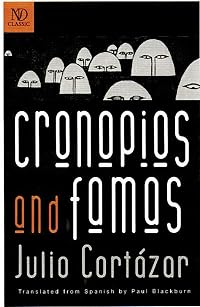
"The Instruction Manual," the first chapter, is an absurd assortment of tasks and items dissected in an instruction-manual format. "Unusual Occupations," the second chapter, describes the obsessions and predilections of the narrator's family, including the lodging of a tiger-just one tiger- "for the sole purpose of seeing the mechanism at work in all its complexity." Finally, the "Cronopios and Famas" section delightfully characterizes, in the words of Carlos Fuentes, "those enemies show more ofpomposity, academic rigor mortis and cardboard celebrity-a band of literary Marx Brothers." As theSaturday Review remarked: "Each page ofCronopios and Famas sparkles with vivid satire that goes to the heart of human character and, in the best pieces, to the essence of the human condition." show lessTags
Recommendations































Member Reviews
My piñata is overflowing! Julio, your Cronopios are driving me crazy!
Read Julio Cortázar! Transform the gray matter of your brain into a sparkling piñata, especially when reading Julio’s Cronopios and Famas, an assortment of dozens of the most micro of micro-fictions. And not only read, but let your piñata burst with streams of words, glittery, twinkling, flashing -- let your reading of each mini serve as a call to respond, yes, yes, you respond with your own shinny micro.
“Give us an example,” says a tiny Cronopio.
“Most certainly,” I reply, as I take the shape of a Fama. “Here are two plus two.”
INSTRUCTIONS ON HOW TO SING (Julio’s)
Begin by breaking all the mirrors of the house, let your arms fall to your side, gaze show more vacantly at the wall, forget yourself. Sing one singe note, listen to it from inside. If you hear (but this will happen much later) something like a landscape overwhelmed with dread, bonfires between the rocks with squatting half-naked silhouettes, I think you’ll be well on your way, and the same if you hear a river, boats painted yellow and black are coming down it, if you hear the smell of fresh bread, the shadow of a horse.
Afterwards, buy a manual of voice instruction and a dress jacket, and please, don’t sing through your nose and leave poor Schumann at peace.
THE SPEECH (mine)
I’m a guest speaker at a banquet. I start delivering my speech. Judging from the audience’s response, not a word of what I say is being understood. I try speaking louder. No luck. I try speaking slower. Once again, not a single word is being understood. I resort to simply moving my lips. The audience sits up and begins to understand. I stop moving my lips and start waving my arms. Everyone nods their head in approval. I stop waving my arms and simply stand there. I receive a round of applause. I remove my eyes, nose and mouth and tuck them in my pants pocket. The audience moves toward the podium – I can hear them – and each member takes a turn embracing me. “We’ve never seen such a speaker,” a deep voice intones. I wiggle my ears as a way of saying thank you. “Really, he utters, “you’ve said enough already.
STORY (Julio’s)
A small cronopto was looking for the key to the street door on the night table, the night table in the bedroom, the bedroom in the house, the house in the street. Here the cronopio pauses for to go into the street, he needed the key to the door.
HEAD GAMES (mine)
I woke up, head on the pillow but not anything else. I mean to say that there wasn’t any body attached; I was only head, nothing but head. I turned my head, my only me, and saw one of my arms, the left one, I think, on the bureau and my scrotum hanging on my clothes-tree. I turned my head the other way. My toes rested like ten pale Brazil nuts on the windowsill, the cheeks of my buttocks on the floor, a calf and knee poking out of the pants I threw over a chair last night. I looked up at the ceiling. More of the same: my neck, another leg, thumbs, and, yes, my penis, all dangle from the light cord.
By the time I gather myself together and I’m back in one piece, I’m really running late. I open my bedroom door and the rooms of my house and the rest of the neighborhood are scattered on a wide, grassy plain. Now I know I’m really going to be late.
THERAPIES ( Julio's)
A cronopio receives his medical degree and opens a practice in the calle Santiago del Estero. A patient arrives almost immediately and tells him how there are places that ache and how there are places that ache and how he doesn't sleep at night and eats nothing during the day.
--Buy a large bouquet of roses, the cronopio tells him.
The patient leaves, somewhat surprised, but he buys the bouquet and is instantly cured. Bursting with gratitude, he returns to the cronopio and not only plays him but, as a delicate testimonial, he presents him with the gift of a handsome bouquet of roses. He has hardly left the office when the cronopio falls ill, aches all over, can't sleep at night, and eats nothing during the day.
STRIKE UP THE BAND (mine)
Town doctors these days use band instruments for a surgical operation -- implanting brass from trombone, tuba and trumpet to replace stomach, liver and intestines.
In the recovery room, its time to strike up the band. Breakfast sounds like John Philip Sousa. Nurses wave flags, visitors toss confetti and the patient in the bed by the wall, who has been bedridden for over a month, gets up and starts marching around the room.
TURTLES AND CRONOPIOS (Julio’s)
Now it happens that turtles are great speed enthusiasts, which is natural.
The esperanzas know that and don’t bother about it.
The famas know it, and make fun of it.
The cronopios know it, and each time they meet a turtle, they haul out the box of colored chalks, and on the rounded blackboard of the turtle’s shell they draw a swallow.
FROG KITES (mine)
On sunny Sundays, Billy Boy fills his bullfrogs with helium and uses them for kites. The largest frogs he flies with a piece of cloth tied to one frog leg and string to the other.
For the smaller ones, he uses four pieces of balsa wood to stick two frogs together to make a box kite. The frogs can’t croak since Billy seals their mouths closed.
By passing gas, however, the frogs eventually run out of helium and glide back to earth slowly, trying to avoid tires of trucks and beaks of storks – and Billy, that naughty boy with his pathological knack for constructing frog kites. show less
A mais cortazariana das obras de Julio Cortázar Histórias de Cronópios e de Famas, escrito nos anos 50, em Roma e Paris, e publicado em 1962, um ano antes do já clássico O jogo da amarelinha, pode ser considerado uma boa “porta de entrada”, o melhor cartão de visita para o leitor ainda não familiarizado com o inventivo universo de Julio Cortázar. Nas quatro partes de Histórias de cronópios e de famas estão presentes o gosto pelo insólito, o humor levemente melancólico e a poesia de uma inocência quase infantil que caracterizam as principais obras de Cortázar. O autor lança um olhar puro sobre as coisas à sua volta, promovendo uma espécie de reinvenção do mundo. Os cronópios são criaturas verdes e úmidas, que show more gostam de cantar e recitar versos, mas muito distraídas, vivem perdendo o que têm nos bolsos, são atropeladas e choram. Muito diferentes são os famas, organizados e práticos, o que não impede que sejam os cronópios a sentirem por eles uma compaixão infinita. São narrativas curtas, mas um intenso exercício literário, e que reunem as principais características presentes em todas as suas obras. show less
I finally read this one. Perhaps because I've already read much of his work, but this one seemed underwhelming. There were brilliant bits but also bits that seemed formulaically Cortázarian. This would be a nice primer, because it presents his more playful side, which is the more photogenic side of Cortázar afterall. The thing is that you need this sillier side to enter the serious side, it is the portal through which one finds Cortázar's presumptions to be more stomachable, even appetizing (one must remember that Cortázar is the kind of guy who will go to unimaginable lengths just to laugh at himself).
I really liked the first piece (which I think was untitled), the one about the bear in the pipes, and many of the sillier show more Cronopios/Famas/Esperanza stuff in the last section.
I sometimes wonder why he is so obsessed with these playful categories--maybe he secretly fears that he is a Famas, or even, god-forbid, an Esperanza. The thing is that he is all these things, and more. Did Cortázar set out to have these correspond roughly with the id, the ego, and the superego? Cronopios is definitely the id, the other two I'm not sure. I see the ego as the esperanza and the superego as the famas, but these are not as clear-cut.
Cortázar's writing is, in itself, the prime example of the battle of these forces. He wants above all to be the instinctual writer, the one who circumambulates logic, who goes directly to the reader's baby-understanding. Naturally he achieves this as he is a born writer. One reads his sentences as if walking through the fecundity of continuous parks.
Yet at the same time he cannot overcome his tendency for logic and order, especially when it breaks down in structure, or when it seems paradoxical. This is a form of paring back that acts against his nature, i.e. to prose playfully and without restraint. Structure and play create slightly opposing armies and sometimes this is a self destructive battle, as in most of his short stories, in which I feel the balance goes towards the structure despite the great prose. But sometimes, as in most of his novels, the balance is just right, and the battle rages on. show less
I really liked the first piece (which I think was untitled), the one about the bear in the pipes, and many of the sillier show more Cronopios/Famas/Esperanza stuff in the last section.
I sometimes wonder why he is so obsessed with these playful categories--maybe he secretly fears that he is a Famas, or even, god-forbid, an Esperanza. The thing is that he is all these things, and more. Did Cortázar set out to have these correspond roughly with the id, the ego, and the superego? Cronopios is definitely the id, the other two I'm not sure. I see the ego as the esperanza and the superego as the famas, but these are not as clear-cut.
Cortázar's writing is, in itself, the prime example of the battle of these forces. He wants above all to be the instinctual writer, the one who circumambulates logic, who goes directly to the reader's baby-understanding. Naturally he achieves this as he is a born writer. One reads his sentences as if walking through the fecundity of continuous parks.
Yet at the same time he cannot overcome his tendency for logic and order, especially when it breaks down in structure, or when it seems paradoxical. This is a form of paring back that acts against his nature, i.e. to prose playfully and without restraint. Structure and play create slightly opposing armies and sometimes this is a self destructive battle, as in most of his short stories, in which I feel the balance goes towards the structure despite the great prose. But sometimes, as in most of his novels, the balance is just right, and the battle rages on. show less
E' come leggere un quadro di Picasso, poi passare a leggerne uno di Dali', poi uno di Mondrian... E' come leggere una galleria d'arte. E' passare da un universo e dalla sua rappresentazione ad un altro; poi fermarsi tra le Speranze, i Famas ed i Cronopios e trovarsi in una mitologia che se la Pixar la scoprisse ci farebbe uno dei migliori film del secolo. C. ha senz'altro un livello molto profondo, che grazie alla introduzione di Calvino si riesce a percepire, ma solo per un poco. A meno di non essere C. stesso e scrivere scivolando tra Ellington, Coleman e Mingus. Poi rileggere, ridere, e continuare a sognare.
My piñata is overflowing! Julio, your Cronopios are driving me crazy!
Reading Julio Cortázar? Transform the gray matter of your brain into a sparkling piñata, especially when reading Julio’s Cronopios and Famas, an assortment of dozens of the most micro of micro-fictions. And not only read, but let your piñata burst with streams of words, glittery, twinkling, flashing -- let your reading of each mini serve as a call to respond, yes, yes, you respond with your own shinny micro.
“Give us an example,” says a tiny Cronopio.
“Most certainly,” I reply, as I take the shape of a Fama. “Here are two plus two.”
INSTRUCTIONS ON HOW TO SING (Julio’s)
Begin by breaking all the mirrors of the house, let your arms fall to your side, show more gaze vacantly at the wall, forget yourself. Sing one singe note, listen to it from inside. If you hear (but this will happen much later) something like a landscape overwhelmed with dread, bonfires between the rocks with squatting half-naked silhouettes, I think you’ll be well on your way, and the same if you hear a river, boats painted yellow and black are coming down it, if you hear the smell of fresh bread, the shadow of a horse.
Afterwards, buy a manual of voice instruction and a dress jacket, and please, don’t sing through your nose and leave poor Schumann at peace.
THE SPEECH (mine)
I’m a guest speaker at a banquet. I start delivering my speech. Judging from the audience’s response, not a word of what I say is being understood. I try speaking louder. No luck. I try speaking slower. Once again, not a single word is being understood. I resort to simply moving my lips. The audience sits up and begins to understand. I stop moving my lips and start waving my arms. Everyone nods their head in approval. I stop waving my arms and simply stand there. I receive a round of applause. I remove my eyes, nose and mouth and tuck them in my pants pocket. The audience moves toward the podium – I can hear them – and each member takes a turn embracing me. “We’ve never seen such a speaker,” a deep voice intones. I wiggle my ears as a way of saying thank you. “Really, he utters, “you’ve said enough already.
STORY (Julio’s)
A small cronopto was looking for the key to the street door on the night table, the night table in the bedroom, the bedroom in the house, the house in the street. Here the cronopio pauses for to go into the street, he needed the key to the door.
HEAD GAMES (mine)
I woke up, head on the pillow but not anything else. I mean to say that there wasn’t any body attached; I was only head, nothing but head. I turned my head, my only me, and saw one of my arms, the left one, I think, on the bureau and my scrotum hanging on my clothes-tree. I turned my head the other way. My toes rested like ten pale Brazil nuts on the windowsill, the cheeks of my buttocks on the floor, a calf and knee poking out of the pants I threw over a chair last night. I looked up at the ceiling. More of the same: my neck, another leg, thumbs, and, yes, my penis, all dangle from the light cord.
By the time I gather myself together and I’m back in one piece, I’m really running late. I open my bedroom door and the rooms of my house and the rest of the neighborhood are scattered on a wide, grassy plain. Now I know I’m really going to be late.
THERAPIES ( Julio's)
A cronopio receives his medical degree and opens a practice in the calle Santiago del Estero. A patient arrives almost immediately and tells him how there are places that ache and how there are places that ache and how he doesn't sleep at night and eats nothing during the day.
--Buy a large bouquet of roses, the cronopio tells him.
The patient leaves, somewhat surprised, but he buys the bouquet and is instantly cured. Bursting with gratitude, he returns to the cronopio and not only plays him but, as a delicate testimonial, he presents him with the gift of a handsome bouquet of roses. He has hardly left the office when the cronopio falls ill, aches all over, can't sleep at night, and eats nothing during the day.
STRIKE UP THE BAND (mine)
Town doctors these days use band instruments for a surgical operation -- implanting brass from trombone, tuba and trumpet to replace stomach, liver and intestines.
In the recovery room, its time to strike up the band. Breakfast sounds like John Philip Sousa. Nurses wave flags, visitors toss confetti and the patient in the bed by the wall, who has been bedridden for over a month, gets up and starts marching around the room.
Turtles and Cronopios (Julio’s)
Now it happens that turtles are great speed enthusiasts, which is natural.
The esperanzas know that and don’t bother about it.
The famas know it, and make fun of it.
The cronopios know it, and each time they meet a turtle, they haul out the box of colored chalks, and on the rounded blackboard of the turtle’s shell they draw a swallow.
Frog Kites (mine)
On sunny Sundays, Billy Boy fills his bullfrogs with helium and uses them for kites. The largest frogs he flies with a piece of cloth tied to one frog leg and string to the other.
For the smaller ones, he uses four pieces of balsa wood to stick two frogs together to make a box kite. The frogs can’t croak since Billy seals their mouths closed.
By passing gas, however, the frogs eventually run out of helium and glide back to earth slowly, trying to avoid tires of trucks and beaks of storks – and Billy, that naughty boy with his pathological knack for constructing frog kites.
show less
Perhaps because of the title and a misleading summary, I was hoping for something along the lines of "Gargantua and Pantagruel." I was hoping, at least, for a character or two, since my version of "Cronopios and Famas" does not indicate anywhere that it is a collection of briefly explored ideas that could have become the seeds of short stories or could perhaps have been condensed into poems (prose or otherwise) with proper attention.This is more of a humorist's assembly than anything else. If you feel the need to read it, out of loyalty to Cortazar or for some other reason unconnected to its merits, keep it by the toilet. Reading it all at once can only be a disappointment.
But, my actual suggestion would be that you don't read this show more book, certainly that you don't read the section of the book that justifies the title. Check out Francis Ponge if you want thought-provoking, outsider prose poems, or Isadore Ducasse if you want absurd, poetic short stories. On the shear strength of "Autonauts of the Cosmoroute" I will continue to search for another Cortazar book that I like; but this stinker really lowered my hopes. show less
But, my actual suggestion would be that you don't read this show more book, certainly that you don't read the section of the book that justifies the title. Check out Francis Ponge if you want thought-provoking, outsider prose poems, or Isadore Ducasse if you want absurd, poetic short stories. On the shear strength of "Autonauts of the Cosmoroute" I will continue to search for another Cortazar book that I like; but this stinker really lowered my hopes. show less
A collection of short items, in 4 groups (Manual de instrucciones, Ocupaciones raras, Material plástico, and Historias de cronopios y de famas) - generally somewhat surreal and hilarious, and often profound as well. Fairly easy reading for an intermediate level learner of castellano.
Members
- Recently Added By
Lists

Latin America
26 works; 9 members

Very short stories
39 works; 2 members

Mustich's 1000 Books to Read Before You Die: A Life Changing List
1,001 works; 19 members
Author Information

403+ Works 21,916 Members
Julio Cortazar is an Argentine poet, short story writer, and translator, whose pseudonym is Julio Denis. He was born in Brussels, Belgium, in 1914. In 1918, he moved with his parents to their native Argentina. He taught high school and later French literature at the University of Cuyo, resigning after participating in demonstrations against show more Argentine President Juan Peron. He worked for a Buenos Aires publishing company and also earned a degree as a translator. Cortazar is part of the "boom" of excellence in Latin American letters in the 1950s and 1960s. He combines fantastic plots with commonplace events and characters, and looks for new ways for literature to represent life. His first novel, The Winners, tells the story of passengers on a luxury liner who are restricted to a certain area of the ship and forbidden to communicate with the crew. He explores the ways passengers react. Hopscotch has a complex narrative structure with 165 chapters that can be read in at least two logical sequences to create variations. A Change of Light and Other Stories is a short story collection dealing with themes ranging from political oppression to fantasy. We Love Glenda So Much is about a fan club murder of their favorite actress whose films do not meet their standards. A Certain Lucas is comprised of three sections of short observations, discussing the nature of reality, the exploration of literary form, and search for new ways to view the world. (Bowker Author Biography) show less
Some Editions
Awards and Honors
Notable Lists
Series

Belongs to Publisher Series
Work Relationships
Is contained in
Common Knowledge
- Canonical title*
- Cronopes et Fameux
- Original title
- Historias de cronopios y de famas
- Original publication date
- 1962
- Original language
- Spanish
*Some information comes from Common Knowledge in other languages. Click "Edit" for more information.
Classifications
Statistics
- Members
- 1,678
- Popularity
- 13,276
- Reviews
- 35
- Rating
- (4.11)
- Languages
- 16 — Czech, Danish, Dutch, English, Finnish, French, German, Greek, Hungarian, Italian, Lithuanian, Polish, Portuguese, Spanish, Swedish, Turkish
- Media
- Paper, Audiobook, Ebook
- ISBNs
- 77
- ASINs
- 15