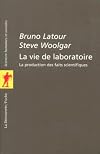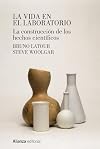
Laboratory Life
by Bruno Latour
On This Page
Description
This highly original work presents laboratory science in a deliberately skeptical way: as an anthropological approach to the culture of the scientist. Drawing on recent work in literary criticism, the authors study how the social world of the laboratory produces papers and other "texts,"' and how the scientific vision of reality becomes that set of statements considered, for the time being, too expensive to change. The book is based on field work done by Bruno Latour in Roger Guillemin's show more laboratory at the Salk Institute and provides an important link between the sociology of modern sciences and laboratory studies in the history of science. show lessTags
Recommendations

































Member Reviews
Latour manages a book that is both highly theoretical and intensely detailed. Written at one of the high points of the post-modern turn in STS, and deeply involved in the Strong Programme to explain successful and unsuccessful science in the same way, Laboratory Life shows how abstruse theory and ethnography can mutually support each other. Latour spent 21 months as a participant-observer in a neuro-endocrinology lab, and from his time develops a comprehensive picture of the scientific process as an act of rhetorical destruction--eliminating alternatives until only one is left, scientists as economic-strategic actors seeking to increase their stock of 'credit' in the community, and science as a difficult struggle to make Order out of show more Chaos.
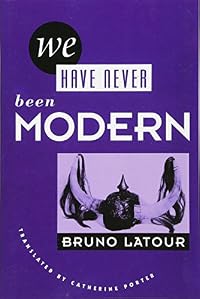
It's interesting seeing the evolution of Latour's thought from Laboratory Life to Science in Action to We Have Never Been Modern. You see facticity as an historical construct assembled out of a whole textus of inscriptions, but the later Latour dropped the idea of 'credit' as a reward (perhaps it is not analytic enough, but to me, it does describe the difference between a decent scholar and great one), and the whole notion of We Have Never Been Modern, that the Enlightenment goal of separating the world of science from the world of politics, and the world of humans from the world of nature is doomed to failure, is not yet evident. Though Latour still makes it very clear how contextual science is, in this book at least, he seems to believe that the work of science might yet succeed in making the entire world legible. show less
It's interesting seeing the evolution of Latour's thought from Laboratory Life to Science in Action to We Have Never Been Modern. You see facticity as an historical construct assembled out of a whole textus of inscriptions, but the later Latour dropped the idea of 'credit' as a reward (perhaps it is not analytic enough, but to me, it does describe the difference between a decent scholar and great one), and the whole notion of We Have Never Been Modern, that the Enlightenment goal of separating the world of science from the world of politics, and the world of humans from the world of nature is doomed to failure, is not yet evident. Though Latour still makes it very clear how contextual science is, in this book at least, he seems to believe that the work of science might yet succeed in making the entire world legible. show less
This anthropological study of scientists is at times thought-provoking and at times, it seems, intentionally obtuse. Latour and Woolgar's argument on the construction of facts (rather than their discovery) is well supported; their portrayal of the chaos of the daily life in a lab, in which "scientific reality is a pocket of order, created out of disorder by seizing on any signal which fits what has already been enclosed and by encolosing it, albeit at a cost", is useful and fair. But their dismissal of epistemologists that have addressed the same issues is unwarranted, their flirting with relativism is irresponsible, and their emphasis on literary inscriptions (scientific papers) and career advancement, paired with their dismissal of show more the meaning of those inscriptions and of any motivations of scientists beyond social recognition, are fundamentally misguided. show less
Intentionally provocative, but worth the stretch.
This book made me become a scientist, for better or for worse
Ratings
Members
- Recently Added By
Lists

Books in the Bibliography of The Mind in the Cave by David Lewis-Williams
257 works; 1 member
Author Information

112+ Works 4,925 Members
Bruno LaTour was born in the French province of Burgundy, where his family has been making wine for many generations. He was educated in Dijon, where he studied philosophy and Biblical exegesis. He then went to Africa, to complete his military service, working for a French organization similar to the American Peace Corps. While in Africa he became show more interested in the social sciences, particularly anthropology. LaTour believes that through his interests in philosophy, theology, and anthropology, he is actually pursuing a single goal, to understand the different ways that truth is built. Throughout the 1980s and 1990s, LaTour has written about the philosophy and sociology of science in an original, insightful, and sometimes quirky way. Works that have been translated to English include The Pasteurization of France; Laboratory Life; Science in Action: How to Follow Scientists and Engineers through Society; We Have Never Been Modern; and Aramis, or the Love of Technology. LaTour is a professor at the Center for the Sociology of Innovation, a division of the Ecole Nationale Superieure des Mines, in Paris. (Bowker Author Biography) show less
Awards and Honors
Common Knowledge
Classifications
Statistics
- Members
- 389
- Popularity
- 79,828
- Reviews
- 4
- Rating
- (3.84)
- Languages
- 5 — English, French, Polish, Portuguese, Spanish
- Media
- Paper, Ebook
- ISBNs
- 12
- ASINs
- 1