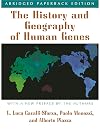
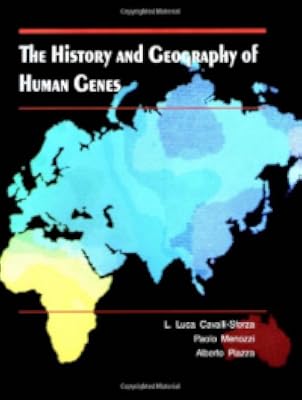
The History and Geography of Human Genes: (Abridged paperback edition)
by Luigi Luca Cavalli-Sforza, Paolo Menozzi (Author), Alberto Piazza (Author)
On This Page
Description
"Hailed as a breakthrough in the understanding of human evolution, The History and Geography of Human Genes offers the first full-scale reconstruction of where human populations originated and the paths by which they spread throughout the world. By mapping worldwide geographic distribution of genes for over 110 traits in over 1,800 primarily aboriginal populations, the authors charted migrations and devised a clock by which to date evolutionary history. Their innovative use of genetic data, show more when integrated with insights from geography, ecology, archaeology, physical anthropology, and linguistics, enables them to address a wide range of issues in human history that have long incited debate. This monumental work is now available in a more affordable paperback edition without the myriad illustrations and maps, but containing the full text of the authors' pathbreaking endeavor."--Jacket. show lessTags
Recommendations








































Member Reviews
Absolutely stunning. The result of over 30 years' work by hundreds of scientists. A must for any historian, anthropologist, linguist or paleontologist. Should be of great interest to any scientist.
The authors have applied sophisticated statistical analysis to the evidence from samples of blood taken from thousands of people around the world. It is amazing how much information is teased out. Huge amounts of computing time were required.
They look at dozens of alleles (minor mutations) which can be traced in populations over space and time. The primary mathematical method is identification of principal components by multivariate analysis. Most interesting is the resulting geographical mappings of gene flow. There are very many of great show more interest. For example, they show the three major migrations into North America from Beringia. They confirm that the dispersion of farming out of Anatolia 8,000 years ago was from migrations of farmers rather than merely the spread of a farming culture.
The authors freely draw from the fields of anthropoly, paleontology and linguistics (and occasionally written history) to supplement and complement the genetic data.
(The work shows clearly that race is not of genetic significance, never mind what you may possibly read elsewhere due to misunderstanding.) show less
The authors have applied sophisticated statistical analysis to the evidence from samples of blood taken from thousands of people around the world. It is amazing how much information is teased out. Huge amounts of computing time were required.
They look at dozens of alleles (minor mutations) which can be traced in populations over space and time. The primary mathematical method is identification of principal components by multivariate analysis. Most interesting is the resulting geographical mappings of gene flow. There are very many of great show more interest. For example, they show the three major migrations into North America from Beringia. They confirm that the dispersion of farming out of Anatolia 8,000 years ago was from migrations of farmers rather than merely the spread of a farming culture.
The authors freely draw from the fields of anthropoly, paleontology and linguistics (and occasionally written history) to supplement and complement the genetic data.
(The work shows clearly that race is not of genetic significance, never mind what you may possibly read elsewhere due to misunderstanding.) show less
Ratings
Members
- Recently Added By
Author Information
33+ Works 1,567 Members
Work Relationships
Is an abridged version of
Classifications
Statistics
- Members
- 90
- Popularity
- 357,079
- Reviews
- 1
- Rating
- (4.50)
- Languages
- English
- Media
- Paper, Ebook
- ISBNs
- 2
- ASINs
- 1