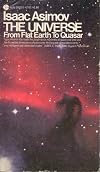
Universe from Flat Earth to Quasar
by Isaac Asimov
On This Page
Description
A readable introduction to the known scientific information regarding the earth, solar system, and the universe.Tags
Recommendations

















Member Reviews
Asimov's science writing is excellent. Clear, concise, relevant. As in this example. Far better than his SF where the ideas are good but his characters are cardboard and the plot dull.
Asimov does his usual science as a gradually-unfolding-series-of-more-reliable-answers-to-more-and-more-well-formulated-questions story, and as usual, he does it well.
Since this is astronomy not a whole lot of the early stuff is new to me. However I did learn a new phrase "equatorial horizontal parallax" and then I looked it up and didn't get a whole lot of good information online. Here's my try:
Inscribe an equilateral triangle within the earth. One point is at the very center of the earth and the other two are touching the surface of the (perfectly spherical) earth. There is an observer at each point. There is a point in the celestial sphere directly above each observer, and an arc that connects these two points. The thing to be show more observed, call it o, is observed by both observers to be situated on that arc. However, there is another thing, also observed on that arc, call it p, wrt. the angular distance between o and p differs, depending on which observer is doing the observing. When observing the moon in this way, the difference of arc is almost 1 degree. That's big! Since this is an equilateral triangle we're observing from, we know that the base of the triangle is one sixth the circumference of the earth, i.e., exactly it's radius and trigonometry automatically yields us the distance to the moon.
The ancient Greek astronomer Hipparchus calculated the distance to the moon using a variation based on a convenient solar eclipse. Knowing that at the Hellespont it was total and that in Alexandria the sun was only 1/5th obscured gave him a good measurement, and the rest followed.
Although attempted by an ancient Greek astronomer, using sound geometrical methods, the determination of the distance the sun could not be made with any accuracy until Kepler discovered his law relating the relative distances of the planets from the sun to their periods. Then, the telescope, and parallax of the nearest planets could be used to determine the AU. Cassini did it first, then the transit of Venus measurements resulted in a more accurate estimate, and then Eros, an asteroid with an orbit that brings it closer to the earth than either Venus or Mars ever gets was discovered was discovered in the 1930s, allowing even more accurate estimates. In the 1960s, bouncing microwaves off Venus made the estimates even more precise and accurate.
As one would expect for a 1960s book, Pluto is a planet, but even here Asimov doesn't give it too much importance. It is the comets, believed to have eccentric elliptic orbits by Edmond Halley, that while still captive to the sun's gravitational force, travel the farthest distance from it. It's calculated orbit far exceeded that of all the known planets at the time it was calculated. show less
Since this is astronomy not a whole lot of the early stuff is new to me. However I did learn a new phrase "equatorial horizontal parallax" and then I looked it up and didn't get a whole lot of good information online. Here's my try:
Inscribe an equilateral triangle within the earth. One point is at the very center of the earth and the other two are touching the surface of the (perfectly spherical) earth. There is an observer at each point. There is a point in the celestial sphere directly above each observer, and an arc that connects these two points. The thing to be show more observed, call it o, is observed by both observers to be situated on that arc. However, there is another thing, also observed on that arc, call it p, wrt. the angular distance between o and p differs, depending on which observer is doing the observing. When observing the moon in this way, the difference of arc is almost 1 degree. That's big! Since this is an equilateral triangle we're observing from, we know that the base of the triangle is one sixth the circumference of the earth, i.e., exactly it's radius and trigonometry automatically yields us the distance to the moon.
The ancient Greek astronomer Hipparchus calculated the distance to the moon using a variation based on a convenient solar eclipse. Knowing that at the Hellespont it was total and that in Alexandria the sun was only 1/5th obscured gave him a good measurement, and the rest followed.
Although attempted by an ancient Greek astronomer, using sound geometrical methods, the determination of the distance the sun could not be made with any accuracy until Kepler discovered his law relating the relative distances of the planets from the sun to their periods. Then, the telescope, and parallax of the nearest planets could be used to determine the AU. Cassini did it first, then the transit of Venus measurements resulted in a more accurate estimate, and then Eros, an asteroid with an orbit that brings it closer to the earth than either Venus or Mars ever gets was discovered was discovered in the 1930s, allowing even more accurate estimates. In the 1960s, bouncing microwaves off Venus made the estimates even more precise and accurate.
As one would expect for a 1960s book, Pluto is a planet, but even here Asimov doesn't give it too much importance. It is the comets, believed to have eccentric elliptic orbits by Edmond Halley, that while still captive to the sun's gravitational force, travel the farthest distance from it. It's calculated orbit far exceeded that of all the known planets at the time it was calculated. show less
For what is basically a text book, this volume is surprisingly readable, adn packed full of information.
I'll grant you that today most of it is OLD info - but it wasn't when the volume was published, now was it?
I'll grant you that today most of it is OLD info - but it wasn't when the volume was published, now was it?
8420692018
8420692050
Members
- Recently Added By
Author Information

2,404+ Works 291,813 Members
Isaac Asimov was born in Petrovichi, Russia, on January 2, 1920. His family emigrated to the United States in 1923 and settled in Brooklyn, New York, where they owned and operated a candy store. Asimov became a naturalized U.S. citizen at the age of eight. As a youngster he discovered his talent for writing, producing his first original fiction at show more the age of eleven. He went on to become one of the world's most prolific writers, publishing nearly 500 books in his lifetime. Asimov was not only a writer; he also was a biochemist and an educator. He studied chemistry at Columbia University, earning a B.S., M.A. and Ph.D. In 1951, Asimov accepted a position as an instructor of biochemistry at Boston University's School of Medicine even though he had no practical experience in the field. His exceptional intelligence enabled him to master new systems rapidly, and he soon became a successful and distinguished professor at Columbia and even co-authored a biochemistry textbook within a few years. Asimov won numerous awards and honors for his books and stories, and he is considered to be a leading writer of the Golden Age of science fiction. While he did not invent science fiction, he helped to legitimize it by adding the narrative structure that had been missing from the traditional science fiction books of the period. He also introduced several innovative concepts, including the thematic concern for technological progress and its impact on humanity. Asimov is probably best known for his Foundation series, which includes Foundation, Foundation and Empire, and Second Foundation. In 1966, this trilogy won the Hugo award for best all-time science fiction series. In 1983, Asimov wrote an additional Foundation novel, Foundation's Edge, which won the Hugo for best novel of that year. Asimov also wrote a series of robot books that included I, Robot, and eventually he tied the two series together. He won three additional Hugos, including one awarded posthumously for the best non-fiction book of 1995, I. Asimov. "Nightfall" was chosen the best science fiction story of all time by the Science Fiction Writers of America. In 1979, Asimov wrote his autobiography, In Memory Yet Green. He continued writing until just a few years before his death from heart and kidney failure on April 6, 1992. (Bowker Author Biography) show less
Series
Belongs to Publisher Series
Common Knowledge
- Original publication date
- 1968-02
- Dedication
- To Fred L Whipple and Carl Sagan
who know much more about it than I do - First words
- In the last few years, astronomers have excited themselves and the public enormously by the discoveries they have been making in unimaginably distant outer space.
- Last words
- (Click to show. Warning: May contain spoilers.)It is exciting to probe the unknown and shed light on what was dark before, then more and more excitement surely lies ahead of us.
- Blurbers
- Pickering, James S
Classifications
Statistics
- Members
- 680
- Popularity
- 41,798
- Reviews
- 11
- Rating
- (3.89)
- Languages
- English, German, Spanish
- Media
- Paper
- ISBNs
- 16
- ASINs
- 24