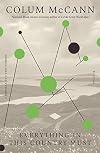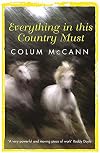
Everything in This Country Must: A Novella and Two Stories
by Colum McCann 
On This Page
Description
Colum McCann's Everything in This Country Must, a writer of fierce originality and haunting lyricism, turns to the troubles in Northern Ireland and reveals the reverberations of political tragedy in the most intimate lives of men and women, parents and children. In the title story, a teenage girl must choose between allegiance to her Catholic father and gratitude to the British soldiers who have saved the family's horse. The young hero of Hunger Strike, a novella, tries to replicate the show more experience of his uncle, an IRA prisoner on hunger strike. And in Wood, a small boy does his part for the Protestant marches, concealing his involvement from his blind father. Writing in a new form, but with the skill and force and sparkling poetry that have brought him international acclaim, Colum McCann has delivered masterful, memorable short fiction. show lessTags
Recommendations






Member Reviews
If "Hunger Strike" doesn't make you madder'n Hell's hottest rock, you're dead inside. "Everything in This Country Must" should make you weep buckets; LT @richardderus
Everything in this Country Must consists of two short stories and a novella:
Hunger Strike
The novella is a story of a young boy on the verge of adolescence during The Troubles in Ireland. His family is Catholic, IRA sympathizers. The boy and his mother have been forced to move to the Catholic South, fearing retaliation. His uncle is on hunger strike in jail in the North and the young boy is deeply influenced by this - so much so that he mimics the strike in his mind. He’s angry; everything about him rages against the Protestant north. He wants to be part of the action, to show more fight for an independent Ireland. He feels ineffectual and he hates it.
He hates the small place in the southern countryside where he and his mother are in hiding. He wants to be up north and he wants to fight. His adolescent urges are channeled into pure rage. He can’t even go to the next town to join in the protests. All he can do is to throw stones, and listen to the radio that gives update on how much weight his uncle has lost.
You don’t have to understand the history of “The Troubles” to understand what is so sad about the young boy. Any mother who has a young boy or who has had one, any grandmother of one, will cry watching the boy, his rage, his sorrow, and his love for his mother that keeps him there.
McCann is such a masterful writer. Every word, every sentence matters. I actually cried tears while reading the last pages.
A must read. show less
Everything in this Country Must consists of two short stories and a novella:
Hunger Strike
The novella is a story of a young boy on the verge of adolescence during The Troubles in Ireland. His family is Catholic, IRA sympathizers. The boy and his mother have been forced to move to the Catholic South, fearing retaliation. His uncle is on hunger strike in jail in the North and the young boy is deeply influenced by this - so much so that he mimics the strike in his mind. He’s angry; everything about him rages against the Protestant north. He wants to be part of the action, to show more fight for an independent Ireland. He feels ineffectual and he hates it.
He hates the small place in the southern countryside where he and his mother are in hiding. He wants to be up north and he wants to fight. His adolescent urges are channeled into pure rage. He can’t even go to the next town to join in the protests. All he can do is to throw stones, and listen to the radio that gives update on how much weight his uncle has lost.
You don’t have to understand the history of “The Troubles” to understand what is so sad about the young boy. Any mother who has a young boy or who has had one, any grandmother of one, will cry watching the boy, his rage, his sorrow, and his love for his mother that keeps him there.
McCann is such a masterful writer. Every word, every sentence matters. I actually cried tears while reading the last pages.
A must read. show less
These two stories and novella resonate particularly to me and bring back memories of my time in Northern Ireland from 1970-72, as the "Troubles" were heating up. I was among a small detachment of USN sailors operating a communication station. The thing about being an American in Derry was that the populace -- Catholics and Protestants -- viewed us as neutrals in their conflict. I have said that we Americans were the only people in the community who could enter any of the sharply segregated secterian neighborhoods. We had Catholic friends from Bogside and Protestant friends in the Waterside. (There was no mistaking which sect lived where by the graffiti, banners and curbstones painted the red, white and blue of Great Britain or the show more orange, green and white of Ireland). I arrived at the base (located right in the city) in November 1970. The Protestant assault against Catholic civil rights marchers at the Burntollent bridge outside Derry had happened in 1969. When the British army came shortly after to separate the fighting factions they were viewed at first by the Catholic community as protectors. This changed sharply in 1970 as the IRA adherents became actively violent. My wife and I rented a flat near the city center. Our landlords were partners in an auto dealership whose showrooms were on the ground floor. They were an unusual pair because one was Catholic and the other Protestant. In August 1971, the British rounded up suspected IRA militants and incarcerated them without charges in the prison at Long Kesh. This sparked a violent response across the province including stepping up bombing of civilian businesses. On the night of August 11, my wife and I were entertaining an Irish friend in our flat when, at about 10:00 pm, a bomb exploded outside the car showroom. We were not injured but the flat was no longer habitable. My sense is that whoever placed the bomb did not know that people were living above. My Navy bosses made arrangements with the British army for us to occupy a British army house outside the city adjacent to a weapons depot no longer in use. (The house was isolated so for obvious reasons they could not have their own soldiers living there.) Our neighbors in this rural setting were Protestant "Orangemen", but very nice people. I was invited by a civilian worker aquaintance at the base to attend the civil rights march on Sunday January 30, 1972 -- "it'll be a lark", he said. I declined. The march became the infamous "Bloody Sunday".
The first story -- "Everything in This Country Must" -- tells of a British army patrol that happens on a man and his daughter attempting to rescue their horse drowning in the river. The brave efforts of the soldiers, at no small risk to themselves, is appreciated by the girl, but not by her father who threatens them as they depart. His anger shows how the attitude of the people toward the presence of the British army had evolved.
The second story -- "Wood" -- refers to the annual parade of Protestant Orangemen through the streets of Derry, Belfast, and other cities. The paraders carry banners with anti-catholic slogans. It commerates the victory of Protestant King William over Catholic King James in 1691. The parades are perceived by the Catholic population as insulting and an arrogant symbol of Protestant supremacy. (I witnessed our Protestant neighbor proudly dressed in his parade regalia on the eve of the march.) The marchers needed wood poles to display their banners and called on a family of skillful workworkers to make them. The head of the household had been incapacitated by a stroke and, although a Protestant himself, loathed the annual parades for all they represented. His wife and young son surreptiously gathered the materials and made the poles for the income they would bring. He embodied the rejection of sectarianism felt by many, but his helplessness symbolized how the forces of hatred prevailed.
The novella -- "Hunger Strike -- is told from the perspective of a 13-year-old boy from Derry who is staying with his widowed mother in the Republic (somewhere it seems on the west coast near Galway). His uncle, who he has never met, is imprisoned in Prison Maze at Long Kesh for his suspected IRA activities. The uncle and others had begun a campaign of hunger strikes to protest the refusal of the British authorities to recognize them as prisoners of war as opposed to suspected common criminals. This resulted in a number of starvation deaths that received major media attention across the world. The boy is extremely obsessed his uncle's slow death, even to charting what he believes to the the steady weight loss. He seethes with anger, fantasizing about the actions he would take in response. He meets an elderly couple who introduce him to kayaking in the bay and repays their kindness in an unexpected way that speaks to his troubled state of mind. show less
The first story -- "Everything in This Country Must" -- tells of a British army patrol that happens on a man and his daughter attempting to rescue their horse drowning in the river. The brave efforts of the soldiers, at no small risk to themselves, is appreciated by the girl, but not by her father who threatens them as they depart. His anger shows how the attitude of the people toward the presence of the British army had evolved.
The second story -- "Wood" -- refers to the annual parade of Protestant Orangemen through the streets of Derry, Belfast, and other cities. The paraders carry banners with anti-catholic slogans. It commerates the victory of Protestant King William over Catholic King James in 1691. The parades are perceived by the Catholic population as insulting and an arrogant symbol of Protestant supremacy. (I witnessed our Protestant neighbor proudly dressed in his parade regalia on the eve of the march.) The marchers needed wood poles to display their banners and called on a family of skillful workworkers to make them. The head of the household had been incapacitated by a stroke and, although a Protestant himself, loathed the annual parades for all they represented. His wife and young son surreptiously gathered the materials and made the poles for the income they would bring. He embodied the rejection of sectarianism felt by many, but his helplessness symbolized how the forces of hatred prevailed.
The novella -- "Hunger Strike -- is told from the perspective of a 13-year-old boy from Derry who is staying with his widowed mother in the Republic (somewhere it seems on the west coast near Galway). His uncle, who he has never met, is imprisoned in Prison Maze at Long Kesh for his suspected IRA activities. The uncle and others had begun a campaign of hunger strikes to protest the refusal of the British authorities to recognize them as prisoners of war as opposed to suspected common criminals. This resulted in a number of starvation deaths that received major media attention across the world. The boy is extremely obsessed his uncle's slow death, even to charting what he believes to the the steady weight loss. He seethes with anger, fantasizing about the actions he would take in response. He meets an elderly couple who introduce him to kayaking in the bay and repays their kindness in an unexpected way that speaks to his troubled state of mind. show less
McCann writes beautifully and soulfully. Both the two stories and the novella are told from the viewpoint of children. In "Everything in This Country Must", a young girl is conflicted as she is torn between gratitude for the British soldier who risked his life to save his father's draft horse or allegiance to her Catholic father. In "Wood", a boy assists his mother as they covertly make banner poles for the Protestant marches in their mill under the nose of the husband/father disabled in bed. Although Protestant, he would disapprove, despite the fact that they sorely needed the money. I thought the ending on this latter story fell a little flat but both stories were powerful.
However, the price of the book was worth it for the 100 page show more novella "Hunger Strike." Set in early 1981 and against the 60+ day hunger strike of Irish Republican prisoners (remember Bobby Sands?), the novella captures the gut-wrenching struggle of a thirteen year old boy who is trying to parse out meaning behind his young uncle's hunger strike while mired in a complicated mess of feelings, the most powerful of which is anger. The fatherless boy (his father died years earlier in a road accident) never knew his uncle but struggles to make some connection to the event as the days of the strike click by and, much to the dismay of his mother, he becomes a bit obsessed with the hunger strike. The story also includes kayaking and chess pieces made out of bread, but I don't want to give everything away. The story is beautifully crafted, riveting and intense. show less
However, the price of the book was worth it for the 100 page show more novella "Hunger Strike." Set in early 1981 and against the 60+ day hunger strike of Irish Republican prisoners (remember Bobby Sands?), the novella captures the gut-wrenching struggle of a thirteen year old boy who is trying to parse out meaning behind his young uncle's hunger strike while mired in a complicated mess of feelings, the most powerful of which is anger. The fatherless boy (his father died years earlier in a road accident) never knew his uncle but struggles to make some connection to the event as the days of the strike click by and, much to the dismay of his mother, he becomes a bit obsessed with the hunger strike. The story also includes kayaking and chess pieces made out of bread, but I don't want to give everything away. The story is beautifully crafted, riveting and intense. show less
McCann has a terrible gift with the words, so he does. This collection of two short stories and a novella is powerful, disturbing, brilliant but ultimately unsatisfying for me. The title selection has a straightforward beginning, middle and end, which I confess to admiring. But the ending, which I certainly saw coming, does not make sense to me on an emotional level. I knew as soon as the soldiers succeeded in saving Father's favorite draft horse from drowning that Father would have to kill it. The story allows for no other outcome. But I will simply never understand a person destroying the thing he loves because it has been sullied in his mind by the actions of someone else. The second selection, "Wood", is beautifully crafted and I show more was sailing right along with it...right up to the moment McCann dropped me in mid-air. Beginning and middle...no end. Star off. The novella, "Hunger Strike', is the most difficult and heart-wrenching of the three. An Irish teen and his mother attempt to cope from a distance with his uncle's hunger strike during the troubles. Although the boy has never met his uncle, he feels a great connection to him and his struggle. I wished for a better grasp of the politics while reading this one; Irish history has always confused me a bit, and I need to get it clear in my head. I suspect this story of a subtlety I was not quite equipped to appreciate, but I still found it moving and enlightening. Recommended. show less
Okay, so, see, there's this place called Ireland? And it's really poor? Or, well, anyway, it used to be and stuff. So anyway, this Irish guy comes here, I mean to America, and he writes about these Irish people from when it was all poor and stuff? And so these stories are, like, really really sad and the people are all poor and kinda mean and they don't seem like they ever smile or anything? But they're all, like, really really trying to be good but something Irish just won't let em! Honest!
If "Hunger Strike" doesn't make you madder'n Hell's hottest rock, you're dead inside. "Everything in This Country Must" should make you weep buckets; "Wood" which is a lovely piece of writing, just doesn't fit in the emotional continuum of the other show more two, but what do I know.
I know I think you should read this collection tout suite. It's only 150pp, anyone here can polish that off in a day. show less
If "Hunger Strike" doesn't make you madder'n Hell's hottest rock, you're dead inside. "Everything in This Country Must" should make you weep buckets; "Wood" which is a lovely piece of writing, just doesn't fit in the emotional continuum of the other show more two, but what do I know.
I know I think you should read this collection tout suite. It's only 150pp, anyone here can polish that off in a day. show less
Colum McCann's book, 'Everything in this Country Must' consists of two short stories, the titular 'Everything in this Country Must' and 'Wood', and a novella, 'Hunger Strike'. All three are from the perspective of children, all three beautifully written and well worth the read. In 'Everything in this Country Must' an Irish man's horse gets his hoof stuck in a river during a flood. British soldiers help out, to his resistance. The daughter, who invites the soldiers in for tea after, sees her dad's grief, and her own gratitude to the soldiers, and sits between those two emotions. In 'Wood', a son helps his mother sell wooden poles to protesters, hiding this from his father, who lies sick at home. And finally, in 'Hunger Strike,' an IRA show more fighter succumbs to starvation while on strike in jail, while his nephew and sister flee for safety. The writing is very raw and declarative, and so powerful. show less
Everything in This Country Must consists of two short stories and a novella, which are set in Northern Ireland during the Troubles. The first short story, "Everything in This Country Must", is narrated by a farm girl whose mother and sister were killed by British army troops, who struggles vainly alongside her embittered father to rescue his beloved draft horse from a raging river, until British soldiers come to their aid. "Wood", the second short story, describes a poverty stricken boy and his mother, who secretly prepare wooden poles to sell to local Protestant marchers to make protest banners, unbeknownst to his disapproving and disabled father. Finally, "Hunger Strike" is a powerful novella about a teen-aged boy, who lives with his show more widowed mother as they follow the plight of his father's brother, an imprisoned IRA freedom fighter who is on a hunger strike. The stories are evocative and filled with repressed anger, fear and despair, but are not overly maudlin or partisan. show less
Members
- Recently Added By
Published Reviews
ThingScore 50
The two stories and novella that make up Colum McCann's very slim ''Everything in This Country Must'' seem to be a way of dealing with Ireland's sectarian conflict by coming at it sideways. That's not to say McCann has chosen the route of fable or metaphor. The battles between Protestant and Roman Catholic are alluded to in these three selections, but the characters seem to experience it all show more from a distance, or as part of a past that sits in the midst of their day-to-day experience like a lump of dry bread in the throat, impossible to digest or ignore. show less
added by kidzdoc
Author Information

23+ Works 14,331 Members
Irish writer Colum McCann was born near Dublin in 1965 and graduated from the University of Texas with a B.A. degree. He has worked as a newspaper journalist in Ireland and written several short stories and bestselling novels. The short film of Everything in this Country Must was nominated for an Academy Award in 2005. McCann's work has appeared show more in publications including The New York Times, The Atlantic Monthly, GQ, The Irish Times, La Repubblica, Die Zeit, Paris Match, the Guardian, and the Independent. He has won numerous awards, such as a Pushcart Prize, the Rooney Prize, the Irish Novel of the Year Award, and the 2002 Ireland Fund of Monaco Princess Grace Memorial Literary Award. In 2009 McCann was inducted into the Irish arts association Aosdana. He teaches in the Master of Fine Arts Creative Writing program at New York's Hunter College. (Bowker Author Biography) show less
Colum McCann is a LibraryThing Author, an author who lists their personal library on LibraryThing.
Work Relationships
Contains
Common Knowledge
- Canonical title*
- Come ogni cosa in questo paese
- Original title
- Everything in this country must
- Original publication date
- 2000-03
- Important places*
- Irlanda del Nord, Regno Unito
- Epigraph
- Horses buried for years
Under the foundations
Give their earthen floors
The ease of trampolines.
Paul Muldoon, Dancers at the Moy - Dedication
- For Isabella and John Michael
- First words
- A summer flood came and our draft horse got caught in the river.
- Quotations
- "...I was shivering and wet and cold and scared because Stevie and the draft horse were going to die since everything in this country must."
- Last words
- (Click to show. Warning: May contain spoilers.)When his sobs subsided the boy lifted his head from the boat, looked back over his shoulder, saw the light from the house of the Lithuanians, the front door open, the couple standing together, hands clasped, the old man's eyes squinting, the woman's large and tender.
- Original language*
- Inglese
*Some information comes from Common Knowledge in other languages. Click "Edit" for more information.
Classifications
Statistics
- Members
- 280
- Popularity
- 114,330
- Reviews
- 16
- Rating
- (3.80)
- Languages
- 6 — Dutch, English, French, German, Italian, Spanish
- Media
- Paper, Audiobook, Ebook
- ISBNs
- 21
- ASINs
- 6