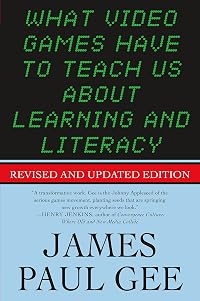
What Video Games Have to Teach Us About Learning and Literacy
by James Paul Gee
On This Page
Description
A controversial look at the positive things that can be learned from video games by a well known professor of education. James Paul Gee begins his new book with "I want to talk about video games-yes, even violent video games-and say some positive things about them." With this simple but explosive beginning, one of America's most well-respected professors of education looks seriously at the good that can come from playing video games. Gee is interested in the cognitive development that can show more occur when someone is trying to escape a maze, find a hidden treasure and, even, blasting away an enemy with a high-powered rifle. Talking about his own video-gaming experience learning and using games as diverse as Lara Croft and Arcanum, Gee looks at major specific cognitive activities: How individuals develop a sense of identity; How one grasps meaning; How one evaluates and follows a command; How one picks a role model; How one perceives the world. This is a ground-breaking book that takes up a new electronic method of education and shows the positive upside it has for learning. A controversial look at the positive things that can be learned from video games. show lessTags
Recommendations







Member Reviews
Interesting thesis: Gee identifies thirty-six principles of learning, and argues that playing video games helps to stimulate all thirty-six. The argument that follows is well-written and mostly convincing, although in order to complete this argument, Gee needs to expand out from simply playing video games to becoming a member of the "affinity group" of gamers, which dilutes the focus of the argument somewhat.
For instance, the book seems sharper to me when it discusses a skill like-- nonlinear exploration preceding movement towards a goal --a skill that Gee convincingly argues that video games develop, as well as one that has an obvious relevance in the classroom. To an educator (like myself) who teaches students who were raised on show more video games, this information is useful, and it gives me ideas on how I might tailor my assignments accordingly.
By contrast, we have something like learning the rules of a "semiotic domain" or "affinity group." Gee is right to say that gamers learn "to see themselves as the kind of person who can learn, use, and value [a] new semiotic domain" (in this case the "semiotic domain" of the gaming subculture). I also think that Gee is correct to say that a science teacher, for instance, is asking students to do similar work with reference to the semiotic domain of "science," and that students who have learned how to integrate themselves into a domain through gaming might be at a light advantage here. But it seems at this point like we're no longer dealing with "what video games have to teach us," and more dealing with a broader concept of subcultural orientation: certainly a student who belongs to the "affinity group" of, say, Honda aficionados would have had an identical experience and an identical advantage.
Other than this minor quibble (and some other quibbles about the way Gee thinks about narrative in video games) the book is an engaging read, one that I'd readily recommend to those interested on the topic. show less
For instance, the book seems sharper to me when it discusses a skill like-- nonlinear exploration preceding movement towards a goal --a skill that Gee convincingly argues that video games develop, as well as one that has an obvious relevance in the classroom. To an educator (like myself) who teaches students who were raised on show more video games, this information is useful, and it gives me ideas on how I might tailor my assignments accordingly.
By contrast, we have something like learning the rules of a "semiotic domain" or "affinity group." Gee is right to say that gamers learn "to see themselves as the kind of person who can learn, use, and value [a] new semiotic domain" (in this case the "semiotic domain" of the gaming subculture). I also think that Gee is correct to say that a science teacher, for instance, is asking students to do similar work with reference to the semiotic domain of "science," and that students who have learned how to integrate themselves into a domain through gaming might be at a light advantage here. But it seems at this point like we're no longer dealing with "what video games have to teach us," and more dealing with a broader concept of subcultural orientation: certainly a student who belongs to the "affinity group" of, say, Honda aficionados would have had an identical experience and an identical advantage.
Other than this minor quibble (and some other quibbles about the way Gee thinks about narrative in video games) the book is an engaging read, one that I'd readily recommend to those interested on the topic. show less
Very engaging; I felt like I learned quite a few useful things about teaching. The style is straight-forward and tailored to a mass audience, and the central conceit of the book makes for a palatable way to present educational theory. At the same time, none of the content comes across as dumbed-down. A few weird inaccuracies aside, Gee brings real video game knowledge rather than academic dabbling. This is a highly accessible and rewarding book.
Despite the first two sleep-inducing chapters, a fascinating and compelling book.
Gee presents a convincing argument that learning is essentially social, rather than mental, in nature; and that video and computer games - in contrast to skill-and-drill teaching oriented towards standardized testing - incorporate good learning principles that are relevant to today's world.
Gee presents a convincing argument that learning is essentially social, rather than mental, in nature; and that video and computer games - in contrast to skill-and-drill teaching oriented towards standardized testing - incorporate good learning principles that are relevant to today's world.
In What Video Games Have to Teach Us about Learning and Literacy, James Paul Gee argues that there is a reason that video games are popular and school is not: children learn from video games in ways that educators should understand as ways children should be learning: "video games are potentially particularly good places where people can learn to situate meanings through embodied experiences in a complex semiotic domain and mediate on the process" (26). Gee argues that the content of video games is their ability to "situate meaning in a multimodal space through embodied experiences to solve problems and reflect on the intricacies of the design of imagined worlds and the design of both real and imagined social relationships and show more identities in the modern world" (48). For Gee, learning is identity work, the testing of hypotheses in situated contexts, active, recursive, transferrable, and embodied. show less
I'm just reading this for an exam (I chose the book myself, i had bought it a few years back because I thought the topic interesting). I must say, as much as I wanted to like it, it it horribly written. Most parts are very dry and unnecessarily laden with scientific jargon. It is also overly wordy. The ideas themselves are excellent and interesting, but written in a way that exactly the people who could and should make use of them will probably never finish the book. It also lacks practical examples. Gee gives a string of 36 principles of learning (they are actually more observations and opinions than anything else) that he found in video games and that can be applied to learning in other areas (schools for example). But how to apply show more them practically is left for the reader to ponder. And that is almost impossible, considering the principles are also written in such convoluted terms that it is improbable that many people will understand what he has to say at all. Too bad, because I think there are a few hidden gems.
Another point is that the principles he found don't really have a backing in research. He bases them mostly on his own experience playing games and watching his little son play them. show less
Another point is that the principles he found don't really have a backing in research. He bases them mostly on his own experience playing games and watching his little son play them. show less
A dated attempt to put an idea that could have been said in a magazine article, in plain English, into academic language, to fill up a whole book.?á I read the Introduction, Conclusion, and Appendix, and could not persuade myself that he had anything more interesting to say there.?á
One thing that is still relevant, interesting, and true, is this:
Shooting is an easy form of social interaction (!) to program.?á As realistic forms of conversation become more computationally possible (a very hard task), I predict that shooting will be less important and talking more important in many games, even shooter games.""
One thing that is still relevant, interesting, and true, is this:
Shooting is an easy form of social interaction (!) to program.?á As realistic forms of conversation become more computationally possible (a very hard task), I predict that shooting will be less important and talking more important in many games, even shooter games.""
Good analysis of teaching and learning strategies embedded in video games. Focuses on first-person shooter (FPS) games.
Members
- Recently Added By
Author Information

22+ Works 1,128 Members
James Paul Gee is the Mary Lou Fulton Presidential Professor of Literacy Studies at Arizona State University. He is the author of many titles including An Introduction to Discourse Analysis, fourth edition (2014), Language and Learning in the Digital Age (2011) and co-editor of The Routledge Handbook of Discourse Analysis (2012).
Common Knowledge
- Original publication date
- 2003-05-16
Classifications
- Genres
- Nonfiction, General Nonfiction, Technology
- DDC/MDS
- 794.8019 — Arts & recreation Recreation, sports, and performing arts Indoor games of skill Electronic games Video Game History
- LCC
- GV1469.3 .G44 — Geography, Anthropology and Recreation Recreation. Leisure Recreation. Leisure Games and amusements Indoor games and amusements Board games. Move games
- BISAC
Statistics
- Members
- 533
- Popularity
- 56,128
- Reviews
- 9
- Rating
- (3.99)
- Languages
- English, German, Spanish
- Media
- Paper, Ebook
- ISBNs
- 6
- ASINs
- 4