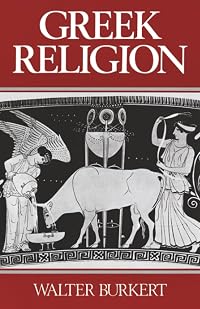
Greek Religion
by Walter Burkert
On This Page
Description
This is the first major synthesis of Greek religion to appear for a generation. A clearly structured and readable survey for classical scholars and students, it will also be generally welcomed as the best modern account of any polytheistic religious system. The text builds up an impressive and coherent picture of the current state of knowledge about the religion of the ancient Greeks.Tags
Recommendations








Member Reviews
Eine fleißige Sammlung an Fakten und übersichtlich gegliedert und systematisiert, aber zum Durchlesen weniger geeignet. Es setzt Vorwissen voraus und bietet sich an als ein Nachschlagewerk zum Vertiefen, auch dank der gründlichen Quellenverweise. Der Ton ist etwas altehrwürdig, und ich war erstaunt, dass es 1977 geschrieben worden ist. Es wäre toll, einen Begleitband zu haben, in dem die ganzen Abbildungen zugeordnet sind, von denen einige zwar vor dem geistigen Auge erscheinen, aber für einen Normalsterblichen das Aufsuchen und Nachschlagen von Bezügen viel Zeit in Anspruch nähme, würde man sich die Mühe machen. Diese Ausgabe ist überarbeitet. Ein Vergleich mit der Erstausgabe wäre vielleicht ein spannendes Forschungsthema, show more weil es vielleicht Aufschlüsse über wandelnden Zeitgeist verriete. Was den hervorgehobenen Hinweis auf die auf den "Orient" gewandte Aufmerksamkeit betrifft hätte ich davon mehr Spuren erwartet als gelegentliche streifende Blicke, aber das schreibe ich als Laie. show less
When talking about Ancient Greek Religion, people usually mean Mythology. This is because the myths are so well known, so complex and fascinating. And they are stories; and there is something inherently fascinating about stories. But mythologies do not exist in a vacuum. They come with rituals; and hardly anyone talks about the rituals of Ancient Greece. In part because it is trickier to find the traces.
This book came out in 1977, which is quite a while ago, but it has the status of a classic. It considers Greek religion, including its change over time from Minoan and Mycenean up through the Classic period (which is its focus). He looks at the individual gods in the main pantheon, but also smaller gods, as well as the connection to the show more religions of the Near East at the time. He shows how some cults are integrated with already established Greek deities, while others (like Dionysos) are given space of their own.
Burkert also sets up an opposition between the Olympian and the Chtonic gods, which I found terribly fascinating -- especially when he finds two gods with the same name and the same cultus (there is a Chtonic Zeus as well as an Olympian, for example). I am not sure how far this dichotomy is due to an antiquated academic style, or how much to an actual tendency in Greek culture to divide things into opposites. He does have a rather wonderful discussion of Dionysos as a deity spanning both; as well as an analysis of the Dioskouroi (the brothers of Helena and Klytaimnestra: Kastor and Polludeukes, one of which was mortal and the other immortal, but who did not want to be separated by death, and so shared both states ... it is really quite fascinating). Burkert's tendency to emphasise the many gods with the same name, however, is one of my favourite aspects of the book. He solves the problem of designation by assigning them epithets.
Having distinguished the various gods from each other, he is able to look more closely at the various cultses. He notes the importance of blood, sacrifice and fire in Greek ritual while all the while tying it to myths and literature. If you know your Greek myths, this is where it gets truly fascinating. He will first describe the rituals, and then he indicates the corresponding myth -- which is when you go "aha!".
Let me give you one (only one) example (and I had a hard time choosing). He writes a very intriguing chapter on the Eleusian mysteries; not to mention the really rather appealing Anthisteria, which is also known as the Old Dionysia (the new one being the one where theatre was central), which is a bona fide wine festival with all that entails. I think I'll go with the Thesmaphoria this time: a sinister, Chtonic women's festival dedicated to Demeter.
It is one of the key festivals of the Demeter cultus, and men and virgins are excluded. I am sure men found this rather disconcerting (and I remember reading somewhere that Aristophanes' Lysistrata may be based in part on the paranoia of what women were up to outside the control of manly reason. At any rate, it has been suggested that there were mysteries associated with it, and that is not an unreasonable supposition: Demeter was, after all, one of the key deities of the Eleusian mysteries, and as a fertility- and grain-goddess, she was closely associated with death and rebirth.
During the first day of the festival, piglets were sacrificed: they were thrown into a hole in the ground, and the remnants of the sacrifice from the preceeding year would be taken out of the hole (to be used in fertilising grain). This is a very clearly Chtonic cultus, of course (According to Burkert, Olympian sacrifices were conducted on a raised altar, Chtonic ones in a pit or hole in the ground). Allow me to quote Burkert (and keep in mind that Kore, "young girl", is a name often used for Persephone, the daughter of Demeter who was kidnapped and forced to marry Hades, the ruler of the dead):
The women thus enter into contact with the subterranean, with death and decay, while at the same time phalloi, snakes, and fir-cones, sexulaity and fertility are present. The myth explains the pig sacrifice by the rape of Kore: when Demeter's daughter sank into the earth, the pigs of the swineherd Euboleus were swallowed up as well. So Demeter on her search for her daughter instituted the Tesmophoria; the death marriage is recapitulated in the sacrifice. Demeter, Kore and Zeus Euboleus are worshipped together in connection with the Thesmophoria.
You can see how Burkert makes a clear distinction of one Zeus cultus, distinct from that of Olympian Zeus.
The second day of the festival was a day of fasting and sadness, commemorating the sorrow of Demeter at the loss of her daughter. Followed, on the third day, by a banquet.
I find it interesting to see how many of these rituals correspond (certainly in the larger lines -- possibly without the hurling of piglets into dark pits) to well-known rituals of our own day. And I confess I am a bit of a nut when it comes to Greek myths. But I think others might enjoy this as well. It may be a bit detailed for easy reading, but if you have the background knowledge I think you'll find it fascinating.
Caveat: my expertise on this topic is limited to undergraduate level, and so I may be fooled as to how good his method is (I suspect his descriptions of some of the rituals are in part, at least, derived from the myths in the first place, although he covers a great deal of scholarship). I don't care. It is a lovely book, one I will not part with easily. show less
This book came out in 1977, which is quite a while ago, but it has the status of a classic. It considers Greek religion, including its change over time from Minoan and Mycenean up through the Classic period (which is its focus). He looks at the individual gods in the main pantheon, but also smaller gods, as well as the connection to the show more religions of the Near East at the time. He shows how some cults are integrated with already established Greek deities, while others (like Dionysos) are given space of their own.
Burkert also sets up an opposition between the Olympian and the Chtonic gods, which I found terribly fascinating -- especially when he finds two gods with the same name and the same cultus (there is a Chtonic Zeus as well as an Olympian, for example). I am not sure how far this dichotomy is due to an antiquated academic style, or how much to an actual tendency in Greek culture to divide things into opposites. He does have a rather wonderful discussion of Dionysos as a deity spanning both; as well as an analysis of the Dioskouroi (the brothers of Helena and Klytaimnestra: Kastor and Polludeukes, one of which was mortal and the other immortal, but who did not want to be separated by death, and so shared both states ... it is really quite fascinating). Burkert's tendency to emphasise the many gods with the same name, however, is one of my favourite aspects of the book. He solves the problem of designation by assigning them epithets.
Having distinguished the various gods from each other, he is able to look more closely at the various cultses. He notes the importance of blood, sacrifice and fire in Greek ritual while all the while tying it to myths and literature. If you know your Greek myths, this is where it gets truly fascinating. He will first describe the rituals, and then he indicates the corresponding myth -- which is when you go "aha!".
Let me give you one (only one) example (and I had a hard time choosing). He writes a very intriguing chapter on the Eleusian mysteries; not to mention the really rather appealing Anthisteria, which is also known as the Old Dionysia (the new one being the one where theatre was central), which is a bona fide wine festival with all that entails. I think I'll go with the Thesmaphoria this time: a sinister, Chtonic women's festival dedicated to Demeter.
It is one of the key festivals of the Demeter cultus, and men and virgins are excluded. I am sure men found this rather disconcerting (and I remember reading somewhere that Aristophanes' Lysistrata may be based in part on the paranoia of what women were up to outside the control of manly reason. At any rate, it has been suggested that there were mysteries associated with it, and that is not an unreasonable supposition: Demeter was, after all, one of the key deities of the Eleusian mysteries, and as a fertility- and grain-goddess, she was closely associated with death and rebirth.
During the first day of the festival, piglets were sacrificed: they were thrown into a hole in the ground, and the remnants of the sacrifice from the preceeding year would be taken out of the hole (to be used in fertilising grain). This is a very clearly Chtonic cultus, of course (According to Burkert, Olympian sacrifices were conducted on a raised altar, Chtonic ones in a pit or hole in the ground). Allow me to quote Burkert (and keep in mind that Kore, "young girl", is a name often used for Persephone, the daughter of Demeter who was kidnapped and forced to marry Hades, the ruler of the dead):
The women thus enter into contact with the subterranean, with death and decay, while at the same time phalloi, snakes, and fir-cones, sexulaity and fertility are present. The myth explains the pig sacrifice by the rape of Kore: when Demeter's daughter sank into the earth, the pigs of the swineherd Euboleus were swallowed up as well. So Demeter on her search for her daughter instituted the Tesmophoria; the death marriage is recapitulated in the sacrifice. Demeter, Kore and Zeus Euboleus are worshipped together in connection with the Thesmophoria.
You can see how Burkert makes a clear distinction of one Zeus cultus, distinct from that of Olympian Zeus.
The second day of the festival was a day of fasting and sadness, commemorating the sorrow of Demeter at the loss of her daughter. Followed, on the third day, by a banquet.
I find it interesting to see how many of these rituals correspond (certainly in the larger lines -- possibly without the hurling of piglets into dark pits) to well-known rituals of our own day. And I confess I am a bit of a nut when it comes to Greek myths. But I think others might enjoy this as well. It may be a bit detailed for easy reading, but if you have the background knowledge I think you'll find it fascinating.
Caveat: my expertise on this topic is limited to undergraduate level, and so I may be fooled as to how good his method is (I suspect his descriptions of some of the rituals are in part, at least, derived from the myths in the first place, although he covers a great deal of scholarship). I don't care. It is a lovely book, one I will not part with easily. show less
This book was good in parts, but it was repetitive and wore out its welcome. For someone who has always loved to read and study Greek religions, I was disappointed. I did learn some interesting things, and perhaps could be said to have a better understanding, but I'm afraid by the end I was just ready to be done. The author writes in a scholarly style, which is not a bad thing, but when your specialty is not in that field, it can seem stilted and dry. He avoided jargon, which was good, not using the typical words currently used by too many philosophers of religion that seem more to obscure than to elucidate. I found it easy to understand, and perhaps would have done better to read it during a period when I don't get sleepy so soon. A show more good, thorough discussion for anyone interested in the origins of the Greek gods. show less
Average disinformative scholarly work written by a spiteful German "religious historian" somewhere in the middle of the 80s. The text is tediously padded with redundant lines dwelling on personal reflections and religious theories which reflect the author's materialistic and irreligious viewpoint, some of which are little more than wild guesses aimed at showing the insolence of the author in his patently ridiculous approach to the religious dimension of the ancients. While he doesn't shy away from making a mockery of his subject by defining the animal sacrifices as "burlesque" in the chapters that deal with the poorly explored ritualistic aspects, the blatant disservice to the Gods and to the ancient Greek cultural heritage throughout show more the volume is plainly illustrated by the failure to grasp the spiritual significance of the rituals. Avoid at all costs. show less
Scholarly, heavy going - perhaps most useful as a reference than as something to read through from start to finish. Still, belongs on the bookshelf of anyone serious about the subject, I should have thought...
"2012-10-26 12:00:00"
Ratings
Members
- Recently Added By
Lists

Vote: Science, Religion, and History Group Reads
30 works; 17 members

Books in the Bibliography of The History of Hell by Alice K. Turner
155 works; 1 member
Author Information

25+ Works 2,380 Members
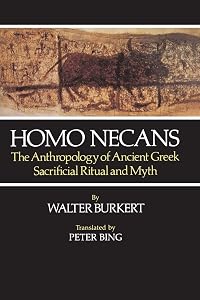
German-born scholar Walter Burkert currently teaches at the University of Zurich. He is the leading active scholar of the religion of early and classical Greece. Burkert's work proceeds through intense, meticulous historical and philological investigation, seeking to understand Greek religion in and of itself. His studies wed philology and history show more with methods drawn from anthropology and resemble the work of Jonathan Z. Smith. But, unlike Smith, who seems to rule out diachronic considerations categorically in favor of synchronic taxonomies or analogical comparisons, Burkert remains interested in questions of long-term historical evolution and cross-cultural influence. Burkert gives particular attention to psychological causation and the biological roots of human behavior as revealed by the science of ethology. For example, his study of Greek sacrifice, Homo necans, roots the practice of sacrifice in the biological necessity faced by prehistoric hunting groups that killed to survive. Burkert suggests that this necessary, aggressive behavior gave rise to anxiety, but through the practice of sacrifice the unavoidable aggression, which otherwise threatened to destroy society, was redirected to its promotion instead. In Structure and History Burkert's theoretical concerns are larger, including both myth and ritual. The precise relation between myth and ritual has been a vexing question for scholars of ancient religions; Burkert places them side by side and links them at a structural level. He thinks ritual is older than myth, because it is a form of behavior found even in animals. Nevertheless, ritual and myth share several important features: Both depend upon basic biological or cultural programs of action and detachment from pragmatic reality. Both serve communication. Because myth and ritual are related in this way, it is possible for them to be found together. Burkert's Greek Religion is the current, standard handbook on the religions of ancient Greece. His most recent work has been devoted to examining the influence of the ancient Near East on archaic Greek civilization. (Bowker Author Biography) show less
Some Editions
Common Knowledge
- Canonical title
- Greek Religion
- Original title
- Griechische Religion der archaischen und klassischen Epoche
- Original publication date
- 1977
- Important places
- Greece
- Original language
- English
Classifications
- Genres
- Religion & Spirituality, Nonfiction, History, General Nonfiction
- DDC/MDS
- 292.08 — Religion Other religions Greek & Roman Mythology Greek and Roman religion Greek religion
- LCC
- BL782 .B8313 — Philosophy, Psychology and Religion Religions. Mythology. Rationalism Religions. Mythology. Rationalism History and principles of religions European. Occidental Classical (Etruscan, Greek, Roman)
- BISAC
Statistics
- Members
- 849
- Popularity
- 32,314
- Reviews
- 6
- Rating
- (4.22)
- Languages
- 7 — English, German, Greek, Italian, Polish, Portuguese, Spanish
- Media
- Paper, Ebook
- ISBNs
- 19
- ASINs
- 4