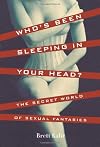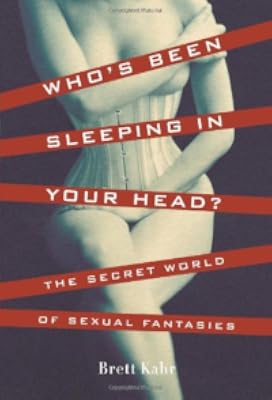
Who's Been Sleeping in Your Head: The Secret World of Sexual Fantasy
by Brett Kahr
On This Page
Description
In the largest study ever undertaken on sexual fantasy, world-renowned psychotherapist and researcher Brett Kahr reveals the astonishing truths behind secrecy, shame, and taboo in this groundbreaking book based on surveys of 23,000 men and women from eighteen to ninety years of age. The definitive account of what our fantasies tell us about ourselves, Who's Been Sleeping in Your Head? overturns conventional wisdom about sexuality today.Tags
Recommendations









































Member Reviews
This excellent book is a wonderful primer in the extraordinary range of sexual fantasies, as well as a fascinating exploration of where they come from and what purpose they serve in our wider lives.
Less titillating than Nancy Friday, Kahr approaches the subject from a clinical perspective, although he can sometimes seem a bit po-faced – his academic writing style, while clear and readable, often comes across as unintentionally funny next to the explicit interviews which make up part of the book.
The first half is essentially a thematic collection of fantasies drawn from a very extensive programme of clinical interviews. The second half is a detailed Freud-based analysis of their provenance and psychological significance.
The headline show more conclusion is that very many sexual fantasies, even tame ones, can be traced to traumatic childhood experiences. I would have been sceptical if not for the case studies, which illustrate his theory brilliantly, and which are calculated to have readers examining their own fantasies (and childhoods) with a new eye. show less
Less titillating than Nancy Friday, Kahr approaches the subject from a clinical perspective, although he can sometimes seem a bit po-faced – his academic writing style, while clear and readable, often comes across as unintentionally funny next to the explicit interviews which make up part of the book.
The first half is essentially a thematic collection of fantasies drawn from a very extensive programme of clinical interviews. The second half is a detailed Freud-based analysis of their provenance and psychological significance.
The headline show more conclusion is that very many sexual fantasies, even tame ones, can be traced to traumatic childhood experiences. I would have been sceptical if not for the case studies, which illustrate his theory brilliantly, and which are calculated to have readers examining their own fantasies (and childhoods) with a new eye. show less
Brett Kahr is a psychotherapist and a couples' counselor. During the course of his practice he became interested in things his clients had to say about their (sometimes troubling) sexual fantasies. and curious as to how normal such fantasies are and what kind of effect they have on people's lives. So he did a study on the subject, surveying many thousands of English and American adults via the internet and conducting extensive interviews with a small subset of individuals.
This is, I maintain, an intriguing and worthwhile topic. I'm always interested in the question of what makes human beings tick, and sex is, after all, a remarkably large part of our psychologies. And the way in which our sexual imaginations can incorporate so many odd show more elements that have little or nothing to do with the basic reproductive act is wonderfully bizarre. I also think there are some genuinely important questions in this area that it would be great if psychology could answer. For instance, are sexual fantasies which incorporate violent elements generally harmless, or do they indicate an increased likelihood of violent sexual behavior? And is it better. when attempting to treat someone with pedophilac tendencies, to encourage them to channel their impulses into fantasy scenarios in which no actual children are harmed, or is indulging those kinds of thoughts just more likely to result in them being acted on?
So I did find a lot of what this book as to say interesting. However, Kahr is a Freudian psychotherapist, a school of thought I am, to say the least, highly skeptical of, and his results are very much filtered through a Freudian lens. Which means that even his most reasonable and believable-sounding conclusions are almost all speculation, rather than science. Most particularly, his attempts to discover the origins and meaning of specific fantasies provided by his interviewees, while thoughtful and well-meaning, often display a logic that is extremely tenuous, sometimes to the point of ridiculousness. It does provide a very useful look at the Freudian mindset, though, and has given me a much clearer understanding of how it works and what people see in it.
And, yes, OK, I will admit to a certain amount of prurient as well as scientific interest. Come on, who isn't at least a little curious about the contents of other people's private sexual imaginations? It turns out, though, that reading other people's sexual fantasies can get boring surprisingly quickly. Well, except for the really disturbing and/or depressing ones, anyway. And speaking of surprising, I am deeply bemused by the fact that so many British people seem to have sexual fantasies about the Royal Family. I truly had no idea. show less
This is, I maintain, an intriguing and worthwhile topic. I'm always interested in the question of what makes human beings tick, and sex is, after all, a remarkably large part of our psychologies. And the way in which our sexual imaginations can incorporate so many odd show more elements that have little or nothing to do with the basic reproductive act is wonderfully bizarre. I also think there are some genuinely important questions in this area that it would be great if psychology could answer. For instance, are sexual fantasies which incorporate violent elements generally harmless, or do they indicate an increased likelihood of violent sexual behavior? And is it better. when attempting to treat someone with pedophilac tendencies, to encourage them to channel their impulses into fantasy scenarios in which no actual children are harmed, or is indulging those kinds of thoughts just more likely to result in them being acted on?
So I did find a lot of what this book as to say interesting. However, Kahr is a Freudian psychotherapist, a school of thought I am, to say the least, highly skeptical of, and his results are very much filtered through a Freudian lens. Which means that even his most reasonable and believable-sounding conclusions are almost all speculation, rather than science. Most particularly, his attempts to discover the origins and meaning of specific fantasies provided by his interviewees, while thoughtful and well-meaning, often display a logic that is extremely tenuous, sometimes to the point of ridiculousness. It does provide a very useful look at the Freudian mindset, though, and has given me a much clearer understanding of how it works and what people see in it.
And, yes, OK, I will admit to a certain amount of prurient as well as scientific interest. Come on, who isn't at least a little curious about the contents of other people's private sexual imaginations? It turns out, though, that reading other people's sexual fantasies can get boring surprisingly quickly. Well, except for the really disturbing and/or depressing ones, anyway. And speaking of surprising, I am deeply bemused by the fact that so many British people seem to have sexual fantasies about the Royal Family. I truly had no idea. show less
I was hoping for more psychology and fewer descriptions of people's fantasies. It reads more like "porn by way of science" than "why people have the fantasies they do and how the subconscious processes desires." I mean, there's some of that in the beginning, but then it's just fantasy descriptions.
Also, Kahr is a Freudian, and I am not into Freud at all. The guy's been thoroughly debunked, except for a couple of ideas. And seeing someone in modern times who actually falls for all the old ideas annoys the hell out of me. Oh well, another one for the discard pile...
Also, Kahr is a Freudian, and I am not into Freud at all. The guy's been thoroughly debunked, except for a couple of ideas. And seeing someone in modern times who actually falls for all the old ideas annoys the hell out of me. Oh well, another one for the discard pile...
The first half of this book was really interesting. The fantasies themselves, how the study was set up, etc....all fascinating. However, you get to the last third of the book and you get Freudian analysis of the fantasies. While he may have been able to reach back in time for some sort of trauma that people are eroticizing, it didn't always work. Some were such a stretch that I call bullshit. Sometimes a cigar is just a cigar dude.
The parts that were people listing their favourite fantasies were quite hot and interesting, but the parts that were Kahr laying Freudian analysis on them were pretty uniformly bullshit.
With this book, Bret Kahr has written something that i cant help but feel needed to be written. As a person living after the sexual revolution, i could not help but notice that people were still extraordinarily iffy about their fantasies. It felt to me as if it was one of those topics, like premarital sex before Kinsey, that everyone had a hand in but no one dared discuss. To see someone tackling the issue was wonderful.
The book had a large flaw, as i see it. While it is good to see that the author spent a large portion of the first part of the book discussing various types of fantasies and how many people share them, I think he could have done this in a more abridged manner. I have spoken with many people who, after revealing a show more perfectly common and perhaps normal fantasy, have said to me 'If anyone knew i thought that, they would...'. These are the people that need that section. But anyone who comes from that conservative a mindset will probably not read this book. What I felt the book need was more case studies, specifically at least one per genre of fantasy. I bough this book, foolishly perhaps, hoping that in his discussing of fantasies I would gleam something about myself. And while i did learn some very useful things, the book fell short of my hopes. Had he done more case studies in his book, with at least some resembling mine, it would have been more helpful. This is probably selfish and foolish. If there is one thing that i have taken away from reading this it is that fantasies are in there nature highly personal. Still, one can hope, right?
Brett Kahr certainly deserves a lot of credit on writing a book that is incredible accessible even to those of us who know very little about psychology. I never felt overwhelmed reading this. But ultimately, the most definitive thing he had to say about sexual fantasies is that they are common. Anyone who has ever cruised the internet for erotic literature already knows that anything they can think up has been thought up before by someone else. And this felt like a shame.
But i am certainly glad i read this. And will certainly tell others to read it. show less
The book had a large flaw, as i see it. While it is good to see that the author spent a large portion of the first part of the book discussing various types of fantasies and how many people share them, I think he could have done this in a more abridged manner. I have spoken with many people who, after revealing a show more perfectly common and perhaps normal fantasy, have said to me 'If anyone knew i thought that, they would...'. These are the people that need that section. But anyone who comes from that conservative a mindset will probably not read this book. What I felt the book need was more case studies, specifically at least one per genre of fantasy. I bough this book, foolishly perhaps, hoping that in his discussing of fantasies I would gleam something about myself. And while i did learn some very useful things, the book fell short of my hopes. Had he done more case studies in his book, with at least some resembling mine, it would have been more helpful. This is probably selfish and foolish. If there is one thing that i have taken away from reading this it is that fantasies are in there nature highly personal. Still, one can hope, right?
Brett Kahr certainly deserves a lot of credit on writing a book that is incredible accessible even to those of us who know very little about psychology. I never felt overwhelmed reading this. But ultimately, the most definitive thing he had to say about sexual fantasies is that they are common. Anyone who has ever cruised the internet for erotic literature already knows that anything they can think up has been thought up before by someone else. And this felt like a shame.
But i am certainly glad i read this. And will certainly tell others to read it. show less
Kahr is a British psychotherapist who researched sexual fantasy by surveying 23,000 men and women. In this book, he reports on the results of his research and discusses the subjects of the fantasies and how they become fantasies. This is a book for adults—the fantasies are sexually explicit. Kahr provides real life samples of different types of fantasies gleaned from his survey. He then provides a psychological discussion of the fantasies. His ultimate goal is to unmask the myths behind the fantasies and to help people accept their fantasies without guilt. He includes a chapter on possibly dangerous types of fantasies.
Members
- Recently Added By
Author Information

20 Works 296 Members
Professor Brett Kahr has worked in the mental health field for over forty years. He is Senior Fellow at the Tavistock Institute of Medical Psychology in London and Senior Clinical Research Fellow in Psychotherapy and Mental Health at the Centre for Child Mental Health in London. A Trustee of the Freud Museum London and of Freud Museum show more Publications, he has written or edited fourteen books, and he has served as series editor for more than fifty-five other titles. He is Consultant Psychotherapist at The Balint Consultancy and works full-time with individuals and couples in London. show less
Common Knowledge
- Canonical title
- Who's Been Sleeping in Your Head: The Secret World of Sexual Fantasy
- Original title
- Sex and the Psyche
- Original publication date
- 2007
- People/Characters
- Sigmund Freud; Theodor Reik; Alfred Kinsey; Richard von Krafft-Ebing
- Epigraph
- "Half a prayer, half a song" -nulli secundus.
- Dedication
- Dedicated to Kim
- First words
- For more than twenty years, I have worked as a psychotherapist.
- Last words
- (Click to show. Warning: May contain spoilers.)My favorite sexual fantasy? Wife turning into a 6-pack and pizza after sex.
Classifications
Statistics
- Members
- 152
- Popularity
- 216,372
- Reviews
- 9
- Rating
- (3.29)
- Languages
- Dutch, English, German
- Media
- Paper, Ebook
- ISBNs
- 8
- ASINs
- 3