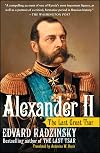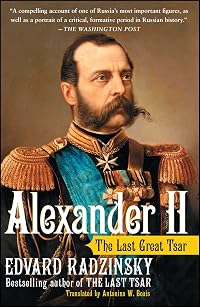
Alexander II: The Last Great Tsar
by Edvard Radzinsky
On This Page
Description
Profiles the Romanov Dynasty tsar as one of Russia's most forward-thinking rulers, documenting his efforts to redefine history by bringing freedom to his country, and describing the series of assassination attempts that eventually ended his life.Tags
Recommendations







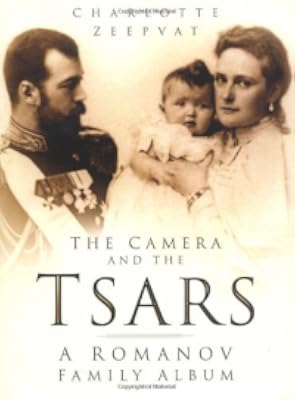
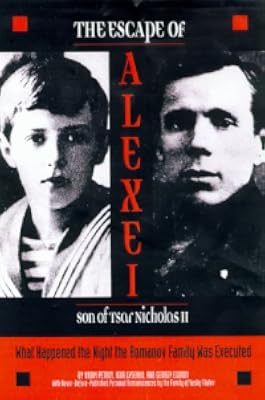


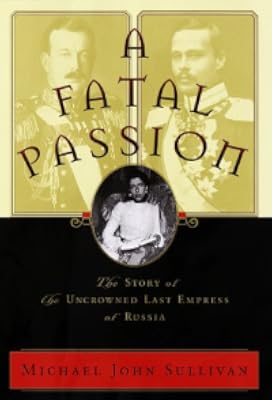
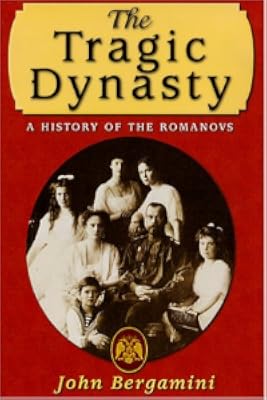



Member Recommendations
Member Reviews
Edvard Radzinsky has taken advantage of perestroika and glasnost to rummage around in previously secret Russian state files and come up with some pretty interesting aspects of the life of the man he calls “the last great Tsar”. He’s also a playwright; hence the book has a lot of dramatic, novelistic qualities. And he’s also a Russia, with an appreciation for the stereotypes of national character.
Either a lot of Russian history was suppressed by the Soviet Union or Radzinsky is consciously writing for a foreign audience, because the first third of the book is a primer on Russian history that I think a normal Russian reader would be expected to know. It a nice elementary introduction and explains a lot to me. When he finally gets show more to his subject, it’s almost as if his style changes; sentences and paragraphs become more sophisticated.
Alexander II was the one who freed the serfs. This had an opposite effect to what you might expect; conservatives hated him, of course, but the liberal faction didn’t like him very much either. (Radzinsky explains this by theorizing that Alexander II didn’t give the serfs enough freedom; I wonder if it were also a “Nixon in China” thing, where liberals got upset because someone had co-opted their program). At any rate, shortly after the serfs were freed Alexander II began to suffer assassination attempts, until the final successful one in 1881.
Conservatives and religious leaders were also scandalized by Alexander II’s sex life. The Tsar, of course, was expected to mess around with ladies-in-waiting and serving maids now and then, but Alexander’s critics felt he carried this to excess (especially since the Tsarina had the reputation of being a secular saint). The final straw was when the Tsarina died of tuberculosis, Alexander married his long-time mistress Ekaterina Dolgorukaya and legitimized their children. It was one thing to have a mistress, but it horribly offended the nobility to marry her. (One of the ironies here is that the Romanov dynasty, by this time, was almost 100% German due to the tradition of Tsars and Tsareviches marrying minor German princesses. Ekaterina Dolgorukaya, on the other hand, was the first Russia to marry a Tsar since the 15th century).
This is where Radzinsky begins to spin a conspiracy theory. His proposal is that the conservatives (Radzinsky usually calls them “retrogrades”) essentially cooperated with the radical assassins – not directly, but by deliberately ignoring evidence of assassination attempts. Radzinsky has just enough evidence here to be intriguing. It certainly looks like the radicals had some sort of inside information on the Tsar’s plans, and that the secret police, despite having immense powers, showed stunning incompetence in dealing with the plots. In December, 1879, assassins had exact information on the route of the Tsar’s train and the car he was in, tunneled under the tracks from a convenient house, and detonated a cache of dynamite as the train went by. (What saved the Tsar here was that there were two trains, a baggage train and a passenger train; the baggage train normally went first but a minor accident had delayed it slightly and the Tsar’s train was now ahead. The bomb was detonated under the correct car but the wrong train). A short time afterward the radicals managed to smuggle 250 pounds of dynamite into the Winter Palace, which turned out to be not quite enough to collapse the State Dining room when detonated in the cellar two floors below. The final attack involved a suicide bomber who managed to get close enough to the Tsar to detonate, while the Tsar was inspecting the damage done by yet another bombing a few minutes earlier that killed one of his guards.
This resulted in Tsar Alexander III, who corresponded to everybody’s idea of what a Tsar should be. He was 6’5” tall, strong enough to twist a horseshoe with his bare hands, had the brains of that same horseshoe, and was firmly under the control of the conservatives. Radzinsky makes the interesting point that the previously inefficient secret police sudden became very effective, quickly arresting all the surviving radicals.
Radzinsky draws attention to an interesting coincidence – and speculates it might not be a coincidence at all. For the final, successful plot, the radicals operated out of a small apartment building in Moscow. Their next-door neighbor was Fyodor Dostoyevsky. Dostoyevsky, off course, had been on the scaffold waiting to be hanged for belonging to a subversive group when his sentence was commuted (by Alexander II’s father, Tsar Nicholas I) to exile in Siberia (resulting in Notes from the Underground and Dostoyevsky’s religious conversion). Did Dostoyevsky have any contact with the plotters? He had a stroke, ostensibly while trying to move some heavy furniture, while police were searching the apartment next door. Radzinsky speculates perhaps Dostoyevsky was expecting his own apartment to be searched and the stroke was actually brought on by his possession of incriminating papers.
Well written and a nice introduction to the Russian history of the time, as well as the character of Alexander II. I forgive Radzinsky for a little Russian chauvinism (I never realized the Russians invented the electric light before). show less
Either a lot of Russian history was suppressed by the Soviet Union or Radzinsky is consciously writing for a foreign audience, because the first third of the book is a primer on Russian history that I think a normal Russian reader would be expected to know. It a nice elementary introduction and explains a lot to me. When he finally gets show more to his subject, it’s almost as if his style changes; sentences and paragraphs become more sophisticated.
Alexander II was the one who freed the serfs. This had an opposite effect to what you might expect; conservatives hated him, of course, but the liberal faction didn’t like him very much either. (Radzinsky explains this by theorizing that Alexander II didn’t give the serfs enough freedom; I wonder if it were also a “Nixon in China” thing, where liberals got upset because someone had co-opted their program). At any rate, shortly after the serfs were freed Alexander II began to suffer assassination attempts, until the final successful one in 1881.
Conservatives and religious leaders were also scandalized by Alexander II’s sex life. The Tsar, of course, was expected to mess around with ladies-in-waiting and serving maids now and then, but Alexander’s critics felt he carried this to excess (especially since the Tsarina had the reputation of being a secular saint). The final straw was when the Tsarina died of tuberculosis, Alexander married his long-time mistress Ekaterina Dolgorukaya and legitimized their children. It was one thing to have a mistress, but it horribly offended the nobility to marry her. (One of the ironies here is that the Romanov dynasty, by this time, was almost 100% German due to the tradition of Tsars and Tsareviches marrying minor German princesses. Ekaterina Dolgorukaya, on the other hand, was the first Russia to marry a Tsar since the 15th century).
This is where Radzinsky begins to spin a conspiracy theory. His proposal is that the conservatives (Radzinsky usually calls them “retrogrades”) essentially cooperated with the radical assassins – not directly, but by deliberately ignoring evidence of assassination attempts. Radzinsky has just enough evidence here to be intriguing. It certainly looks like the radicals had some sort of inside information on the Tsar’s plans, and that the secret police, despite having immense powers, showed stunning incompetence in dealing with the plots. In December, 1879, assassins had exact information on the route of the Tsar’s train and the car he was in, tunneled under the tracks from a convenient house, and detonated a cache of dynamite as the train went by. (What saved the Tsar here was that there were two trains, a baggage train and a passenger train; the baggage train normally went first but a minor accident had delayed it slightly and the Tsar’s train was now ahead. The bomb was detonated under the correct car but the wrong train). A short time afterward the radicals managed to smuggle 250 pounds of dynamite into the Winter Palace, which turned out to be not quite enough to collapse the State Dining room when detonated in the cellar two floors below. The final attack involved a suicide bomber who managed to get close enough to the Tsar to detonate, while the Tsar was inspecting the damage done by yet another bombing a few minutes earlier that killed one of his guards.
This resulted in Tsar Alexander III, who corresponded to everybody’s idea of what a Tsar should be. He was 6’5” tall, strong enough to twist a horseshoe with his bare hands, had the brains of that same horseshoe, and was firmly under the control of the conservatives. Radzinsky makes the interesting point that the previously inefficient secret police sudden became very effective, quickly arresting all the surviving radicals.
Radzinsky draws attention to an interesting coincidence – and speculates it might not be a coincidence at all. For the final, successful plot, the radicals operated out of a small apartment building in Moscow. Their next-door neighbor was Fyodor Dostoyevsky. Dostoyevsky, off course, had been on the scaffold waiting to be hanged for belonging to a subversive group when his sentence was commuted (by Alexander II’s father, Tsar Nicholas I) to exile in Siberia (resulting in Notes from the Underground and Dostoyevsky’s religious conversion). Did Dostoyevsky have any contact with the plotters? He had a stroke, ostensibly while trying to move some heavy furniture, while police were searching the apartment next door. Radzinsky speculates perhaps Dostoyevsky was expecting his own apartment to be searched and the stroke was actually brought on by his possession of incriminating papers.
Well written and a nice introduction to the Russian history of the time, as well as the character of Alexander II. I forgive Radzinsky for a little Russian chauvinism (I never realized the Russians invented the electric light before). show less
This is an excellent review of the life of one of the most intriguing figures in Russian history. Although the author is willing to gloss over many of the flaws of the Romanov's, he shows that it takes the Communists to make the Romanov's look good by comparison. A good primer for those who wish to rule. It doesn't show what should be done, but gives many ideas of what will get you killed.
Excellent! Covers both the life of the tzar and political environment of that time. Good coverage of Russia's underground movement, and People's Will in particular. I read other historical works by Radzinsky and seems that every subsequent work gets better.
4289 Alexander II The Last Great Tsar, by Edvard Radzinsky Translated by Antonina W. Bouis (read 24 Mar 2007) Tsar Alexander II was born in Moscow on 17 Apr 1818, succeeded his father Nicholas I in 1855, and was assassinated on 1 Mar 1881 (O.S.). The book has no footnotes, but has a 10-page bibliography--all Russian sources and books. It is not badly put together, but is a little patchy and jumpy. Alexander II was the Great Liberator in that he freed the serfs in 1861, but became quite reactionary till 1880 when he was looking toward granting a Constitution. 1880 is also the year he married his mistress--four months after his wife died. This book was OK but not as attention-holding as I expected.
After a few chapters, I'm just not enjoying it. I can't tell if it is the narrative style or the translation but it is hard to follow and rather rambling. My list to read is long so I'm letting this one go.
well done
This is an excellent book about Russian history and the Romanov family.
Members
- Recently Added By
Author Information

29+ Works 2,873 Members
Common Knowledge
- Canonical title*
- Alexandre II. La Russie entre espoir et terreur
- Original title
- Александр II: жизнь и смерть
- People/Characters
- Marie Feodorovna, Empress of Russia; Alexander II, Emperor of Russia; Alexander III, Emperor of Russia; Maria Alexandrovna, Empress of Russia; Ekaterina Dolgorukov
*Some information comes from Common Knowledge in other languages. Click "Edit" for more information.
Classifications
- Genres
- History, Nonfiction, Biography & Memoir, General Nonfiction
- DDC/MDS
- 920 — History & geography Biographies, Genealogy, Healdry Biographies
- LCC
- DK220 .R33 — History of Europe, Asia, Africa and Oceania Russia. Soviet Union. Former Soviet Republics – Poland History of Russia. Soviet Union. Former Soviet Republics History House of Romanov, 1613-1917
- BISAC
Statistics
- Members
- 369
- Popularity
- 85,264
- Reviews
- 8
- Rating
- (4.28)
- Languages
- 7 — Dutch, English, Estonian, Finnish, French, Russian, Swedish
- Media
- Paper, Ebook
- ISBNs
- 11
- ASINs
- 2