On This Page
Description
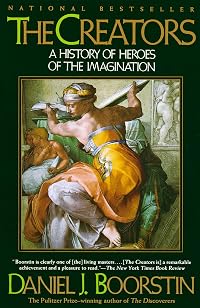
By piecing the lives of selected individuals into a grand mosaic, Pulitzer Prize-winning historian Daniel J. Boorstin explores the development of artistic innovation over 3,000 years. A hugely ambitious chronicle of the arts that Boorstin delivers with the scope that made his Discoverers a national bestseller. Even as he tells the stories of such individual creators as Homer, Joyce, Giotto, Picasso, Handel, Wagner, and Virginia Woolf, Boorstin assembles them into a grand mosaic of show more aesthetic and intellectual invention. In the process he tells us not only how great art (and great architecture and philosophy) is created, but where it comes from and how it has shaped and mirrored societies from Vedic India to the twentieth-century United States. show lessTags
Recommendations
















Member Recommendations

Member Reviews
Naše predstave o svetu u kome živimo i koje smo često skloni da bez rezerve prihvatimo, imaju svoju dugu i neretko burnu predistoriju. Zbog čega je taj svet kakav jeste, koji su to stavovi, dogme, izumi, otkrića, koje su istine ili zablude učinile da on za nas poprimi upravo onakav oblik, i da ga upravo na ovakav način opažamo i shvatamo, pitanja su na koja Borstinova knjiga pokušava najpre da nas navede, a zatim i da nam ponudi odgovore.
Uz živopisnu pozadinu koju čine biografije istraživača iz različitih epoha, upoznajemo se ne samo sa velikim i važnim otkrićima, već i sa tim kako je do njih došlo. Imena Kolumba, Balboe, Magelana i Kuka, Paracelzusa, Galena, Verzalija i Harvija nisu samo simboli za najznačajnija show more otkrića u istoriji sveta; oni na stranicama Borstinove knjige oživljavaju sa svim svojim vrlinama ali i manama, težnjama i strepnjama zbog kojih zauvek ostaju to što jesu. show less
Uz živopisnu pozadinu koju čine biografije istraživača iz različitih epoha, upoznajemo se ne samo sa velikim i važnim otkrićima, već i sa tim kako je do njih došlo. Imena Kolumba, Balboe, Magelana i Kuka, Paracelzusa, Galena, Verzalija i Harvija nisu samo simboli za najznačajnija show more otkrića u istoriji sveta; oni na stranicama Borstinove knjige oživljavaju sa svim svojim vrlinama ali i manama, težnjama i strepnjama zbog kojih zauvek ostaju to što jesu. show less
Aesthetic and intellectual innovations from great art to great architectural to philosophy have been a major part of the shaping of Western culture, but they didn’t appear out of nowhere and we have people thank for them. The Creators by Daniel J. Boorstin is a historic tale of the individuals that innovated in the styles of art, architecture, literature, music, and more from Vedic India to the 20th Century.
Boorstin over the course of almost 750 pages covers the development of various cultural aspects that have grown and evolved over the course of Western civilization. When possible, individuals are highlighted in biographical sketches as well as their contribution to the subject being discussed, though whenever the origins of the show more beginning of are murky or more communal in nature before individuals began to impact them Boorstin ready provides the information as such. Yet this approach of highlighting the Western tradition over the rest of the world through either ignoring it or simply writing off the rest of the world as disingenuous—his covering the Japanese long use of wood for architecture didn’t factor into the reality of how many earthquakes the nation dealt with and how quickly rebuilding homes were put back up with wood in comparison to stone. Also, some of Boorstin’s information was incorrect and he overlooked individual’s negative aspects in almost making them myths to illuminate. While some might believe Boorstin is being subjective in what he included, given wide range of time and the cultural aspects involved not everything could be included and so some selection is required in which an author’s personal preference will undoubtedly play a big role since they are writing the book. Overall, the volume is informative for someone looking for a general cultural history of the West, but if you want something more authoritative then this wouldn’t be the book.
The Creators is the middle volume of a trilogy by Daniel Boorstin on “Knowledge”, a hefty book that covers the development and evolution of Western cultural history. show less
Boorstin over the course of almost 750 pages covers the development of various cultural aspects that have grown and evolved over the course of Western civilization. When possible, individuals are highlighted in biographical sketches as well as their contribution to the subject being discussed, though whenever the origins of the show more beginning of are murky or more communal in nature before individuals began to impact them Boorstin ready provides the information as such. Yet this approach of highlighting the Western tradition over the rest of the world through either ignoring it or simply writing off the rest of the world as disingenuous—his covering the Japanese long use of wood for architecture didn’t factor into the reality of how many earthquakes the nation dealt with and how quickly rebuilding homes were put back up with wood in comparison to stone. Also, some of Boorstin’s information was incorrect and he overlooked individual’s negative aspects in almost making them myths to illuminate. While some might believe Boorstin is being subjective in what he included, given wide range of time and the cultural aspects involved not everything could be included and so some selection is required in which an author’s personal preference will undoubtedly play a big role since they are writing the book. Overall, the volume is informative for someone looking for a general cultural history of the West, but if you want something more authoritative then this wouldn’t be the book.
The Creators is the middle volume of a trilogy by Daniel Boorstin on “Knowledge”, a hefty book that covers the development and evolution of Western cultural history. show less
Daniel Boorstin wrote more serious books than most Americans read in a lifetime. He received the Pulitzer in 1974 for the third volume in his American history (The Democratic Experience, following The Colonial Experience, and The National Experience); then from 1975 to 1987 he was US Librarian of Congress. Somehow during that time and in the succeeding decade, he wrote a trilogy of world intellectual history, primarily of the West (The Discoverers, The Creators, and The Seekers). If I could plan my undergraduate education all over again, I would devote a year or so to the subject matter covered in each of these six books. I would have had a better background in the liberal arts and sciences than I did from those required courses I took show more in history, biology, and philosophy — better by far. Add to that a term devoted to the issues he addressed in The Image: A Guide to Pseudo-Events in America, and I would have been better prepared for my life and work in the 20th century.
Specialists, of course, find faults with Boorstin’s encyclopedic imagination. The problem with specialists in academia is that they rarely engage the attention, much less the abiding interest, of whole persons. Boorstin does. Specialists complain of his omissions, of the patterns that he discovers in (or imposes upon) his material, of his occasional glibness in the terms and titles he uses. What he always does for me, however, is to provoke my curiosity and model an appreciative mind. To be well educated, I would argue, is first of all to be curious and appreciative. Curiosity and appreciation, I suspect, always precede and qualify genuinely creative and critical thinking.
The Creators (Random House, c1992) exemplifies his versatility. As an example, let’s examine his section on primitive and classical forerunners of modern architecture. Called “The Power of Stone,” it demonstrates “man’s effort to outlive his life and make something that would endure forever.” The titles he assigns to his chapters and the topics they cover give evidence of Boorstin’s attempts to attract and inform the general reader: “The Mystery of Megaliths” (Stonehenge and the like), “The Castles of Eternity” (the Egyptian pyramids), “Temples of Community” (the Parthenon and other Greek structures), “Orders of Survival” (Doric, Ionian, and Corinthian architecture), “Artificial Stone” (the city of Rome), “Dome of the World” (the Pantheon), “The Great Church” (Hagia Sophia, first the Great Church, then the Great Mosque), and “A Road Not Taken” (Japanese shrines and gardens, a “triumph of wood”).
Let me share just a few of the passages I have marked in the chapter on Rome to illustrate Boorstin’s manner:
“For the beauties of classic Greece were revealed in the elegance of polished marble and survive with a charming patina. But the decisive new Roman material was concrete.”
“The shapes developed by the Romans — arches, vaults, and domes — have become so familiar and so essential to our architecture that we find it hard to believe they ever had to be created.”
“. . . the world of interiors that architects would make for man was transformed into a new curvesomeness. The classic Greeks had gathered out in the open air. Roman architecture brought people indoors . . . .”
“. . . the grandeur of Roman architecture began in the public baths.”
“The social latrine became standard in public baths. If bathing could be a pleasurable social occasion, why not defecating?”
“Nero must have had hidden strengths of character. For . . . at the age of seventeen, he opened his reign with five generous and constructive years.”
“The Great Fire of 64 [A.D.] gave him an opportunity . . . . Rome would be rebuilt in measured lines of streets with broad thoroughfares, buildings of restricted height, and open spaces, while porticoes were added as a protection to the front of the apartment-blocks. . . . He organized garbage removal . . . . He improved the water supply, required fire walls between buildings, and directed all householders to keep in the open their appliances for extinguishing fires.”
“Raphael imitated the style of the grotto walls . . . . This was called grottesche — in the style of the grottoes. ‘Grotesk’ . . . . the word became popular for distorted, exaggerated or humorous forms in painting or sculpture.”
And so it goes. For seventy chapters and an epilogue. He begins with religions “without a beginning” (Hinduosm, Confucianism, Buddhism, Homeric mythology) and with the creation stories of Judaism, Christianity, and Islam. Book One, “Creator Man,” starting with “The Power of Stone” (mentioned earlier), deals primarily with Graeco-Roman classicism. Book Two, “Re-creating the World,” goes on through the Renaissance and Reformation, concluding with the rise of the skyscraper in the architecture of Louis Sullivan, Le Corbusier, and Frank Lloyd Wright. Book Three, “Creating the Self,” emphasizes the psychological dimensions of modern creativity. Particularly interesting chapters are “The Art of Being Truthful: Confessions,” “The Art of Seeming Truthful: Autobiography,” “Songs of the Self” (from Wordsworth and Coleridge’s Lyrical Ballads to Walt Whitman’s Leaves of Grass), “The Filigreed Self” (James Joyce and his influence), and “Vistas from a Restless Self” (Picasso and his generation).
In a brief personal note to the reader at the very beginning, Boorstin clues us in to both his aims and his limitations. Calling it “a saga of Heroes of the Imagination,” he asserts, “We must find order in the random flexings of the imagination [his aim]. Here I have chosen creators who appeal to me [his self confessed limitation], who have brought something new into the arts.” What he is doing, however, is simply modeling what he advises us all to do: “. . . each of us alone must experience how the new adds to the old and how the old enriches the new, how Picasso enhances Leonardo and how Homer illuminates Joyce.”
As I said, what he does for me is to provoke my curiosity and model an appreciative mind. show less
Specialists, of course, find faults with Boorstin’s encyclopedic imagination. The problem with specialists in academia is that they rarely engage the attention, much less the abiding interest, of whole persons. Boorstin does. Specialists complain of his omissions, of the patterns that he discovers in (or imposes upon) his material, of his occasional glibness in the terms and titles he uses. What he always does for me, however, is to provoke my curiosity and model an appreciative mind. To be well educated, I would argue, is first of all to be curious and appreciative. Curiosity and appreciation, I suspect, always precede and qualify genuinely creative and critical thinking.
The Creators (Random House, c1992) exemplifies his versatility. As an example, let’s examine his section on primitive and classical forerunners of modern architecture. Called “The Power of Stone,” it demonstrates “man’s effort to outlive his life and make something that would endure forever.” The titles he assigns to his chapters and the topics they cover give evidence of Boorstin’s attempts to attract and inform the general reader: “The Mystery of Megaliths” (Stonehenge and the like), “The Castles of Eternity” (the Egyptian pyramids), “Temples of Community” (the Parthenon and other Greek structures), “Orders of Survival” (Doric, Ionian, and Corinthian architecture), “Artificial Stone” (the city of Rome), “Dome of the World” (the Pantheon), “The Great Church” (Hagia Sophia, first the Great Church, then the Great Mosque), and “A Road Not Taken” (Japanese shrines and gardens, a “triumph of wood”).
Let me share just a few of the passages I have marked in the chapter on Rome to illustrate Boorstin’s manner:
“For the beauties of classic Greece were revealed in the elegance of polished marble and survive with a charming patina. But the decisive new Roman material was concrete.”
“The shapes developed by the Romans — arches, vaults, and domes — have become so familiar and so essential to our architecture that we find it hard to believe they ever had to be created.”
“. . . the world of interiors that architects would make for man was transformed into a new curvesomeness. The classic Greeks had gathered out in the open air. Roman architecture brought people indoors . . . .”
“. . . the grandeur of Roman architecture began in the public baths.”
“The social latrine became standard in public baths. If bathing could be a pleasurable social occasion, why not defecating?”
“Nero must have had hidden strengths of character. For . . . at the age of seventeen, he opened his reign with five generous and constructive years.”
“The Great Fire of 64 [A.D.] gave him an opportunity . . . . Rome would be rebuilt in measured lines of streets with broad thoroughfares, buildings of restricted height, and open spaces, while porticoes were added as a protection to the front of the apartment-blocks. . . . He organized garbage removal . . . . He improved the water supply, required fire walls between buildings, and directed all householders to keep in the open their appliances for extinguishing fires.”
“Raphael imitated the style of the grotto walls . . . . This was called grottesche — in the style of the grottoes. ‘Grotesk’ . . . . the word became popular for distorted, exaggerated or humorous forms in painting or sculpture.”
And so it goes. For seventy chapters and an epilogue. He begins with religions “without a beginning” (Hinduosm, Confucianism, Buddhism, Homeric mythology) and with the creation stories of Judaism, Christianity, and Islam. Book One, “Creator Man,” starting with “The Power of Stone” (mentioned earlier), deals primarily with Graeco-Roman classicism. Book Two, “Re-creating the World,” goes on through the Renaissance and Reformation, concluding with the rise of the skyscraper in the architecture of Louis Sullivan, Le Corbusier, and Frank Lloyd Wright. Book Three, “Creating the Self,” emphasizes the psychological dimensions of modern creativity. Particularly interesting chapters are “The Art of Being Truthful: Confessions,” “The Art of Seeming Truthful: Autobiography,” “Songs of the Self” (from Wordsworth and Coleridge’s Lyrical Ballads to Walt Whitman’s Leaves of Grass), “The Filigreed Self” (James Joyce and his influence), and “Vistas from a Restless Self” (Picasso and his generation).
In a brief personal note to the reader at the very beginning, Boorstin clues us in to both his aims and his limitations. Calling it “a saga of Heroes of the Imagination,” he asserts, “We must find order in the random flexings of the imagination [his aim]. Here I have chosen creators who appeal to me [his self confessed limitation], who have brought something new into the arts.” What he is doing, however, is simply modeling what he advises us all to do: “. . . each of us alone must experience how the new adds to the old and how the old enriches the new, how Picasso enhances Leonardo and how Homer illuminates Joyce.”
As I said, what he does for me is to provoke my curiosity and model an appreciative mind. show less
In this hugely accomplished work, a companion volume to his monumental bestseller, the Pulitzer Prize-winning The Discoverers, Daniel Boorstin produces a panoramic yet minutely detailed history of the arts.
It is a saga of Heroes of the Imagination, creators who have brought something new into the arts - Homer, Joyce, Giotto, Picasso, Leonardo, Handel, Wagner - from the dazzling vision of the Hindus to the indifference of Confucius and the silence of Buddha to Herman Melville, Kakfka, Ruskin and a host of others. A magisterial work that finds order in the 'random flexings of the imagination' and reveals 'how the new adds to the old and how the old enriches the new, how Picasso enhances Leonardo and how Homer illuminates Joyce'. 'There show more are few writers who could tackle so vast a subject with as much verve or self-assurance or infectious enthusiasm as Boorstin. He combines lively opinion and a distinguished historian's erudition, with a first-class journalist's clarity and an eye for the revealing anecdote. show less
It is a saga of Heroes of the Imagination, creators who have brought something new into the arts - Homer, Joyce, Giotto, Picasso, Leonardo, Handel, Wagner - from the dazzling vision of the Hindus to the indifference of Confucius and the silence of Buddha to Herman Melville, Kakfka, Ruskin and a host of others. A magisterial work that finds order in the 'random flexings of the imagination' and reveals 'how the new adds to the old and how the old enriches the new, how Picasso enhances Leonardo and how Homer illuminates Joyce'. 'There show more are few writers who could tackle so vast a subject with as much verve or self-assurance or infectious enthusiasm as Boorstin. He combines lively opinion and a distinguished historian's erudition, with a first-class journalist's clarity and an eye for the revealing anecdote. show less
A very ambitious yet fascinating exploration of art history. Boorstin doesn't stop at the visual arts (painting, sculpture, architecture, photography, etc); he also covers literature, music, and dance. Although I wished for illustrations in a few places where specific artworks were discussed, the sheer deluge of wonderfully meticulous story-telling made up for it.
In this engrossing companion to his bestselling The Discoverers, Pulitzer Prize-winning historian Daniel J. Boorstin brings to life more that three thousand years of achievement in the arts. The Discoverers, which has been translated into twenty languages, gave us an epic of the quest to understand the world, from the heavens to the human heart. Now Boorstin puts flesh on the great figures who have created our cultural heritage, from the pyramid builders to Picasso, enriching our world with architectures, painting, sculpture, music, drama, dance, and literature. This is a surprising story from the very beginning. The ancient Hindus and the Buddhists were untroubled by the mystery of Creation. So, too, the Chinese saw history as a series show more of cycles without beginning or end. And Islam found the very notion of Creation unappealing. But our Judeo-Christian tradition--Moses and Saint Augustine among others--gave us a prophetic vision of Man the Creator in the image of a Creator-God. In this suspenseful narrative brimming with lively biographical incident, we see Dante, Chaucer, Rabelais, Cervantes, Shakespeare, and other great creators deftly placed in the unique circumstances of their times. For Boccaccio the plague offered a challenge to entertain with a hundred still-remembered tales. Brunelleschi designed the elegant dome of the cathedral in Florence to save his proud city the disgrace of an unfinished monument. And Michelangelo's commission to paint the curved, lunetted ceiling of the Sistine Chapel arose from his rivals' efforts to discredit an inexperienced painter with an impossible task. We see, too, how the challenge to Walt Whitman, Frank Lloyd Wright, Isadora Duncan, and others grew out of the experience of their age. Nor were the creators daunted by any obstacle--not the blindness of Milton, the impaired vision of a Prescott, Parkman, or Joyce, the deafness of a Beethoven, the asthma of a bedridden Proust, the dreariness of T. S. Eliot's life as a bank clerk, nor the confinement of female roles that made Virginia Woolf a unique explorer of the self. The familiar names become living heroes of the imagination as Boorstin captures their efforts to re-create the world in a composite Human Comedy--fashioned from the absurdities of Rabelais, the illusions of Don Quixote, Gibbon's view of ancient empires, Balzac's novels of love and money, Dickens's popular sagas of struggle and triumph. We see Western painting move from the craft tradition to the intuitions of Giotto, the science-enriched visions of Leonardo, the personal painted moments of Monet, and the ruthless visions of Picasso. Western music, once a domain of Gregorian chant, becomes the secular world of Haydn aiming to please his prince, which widens into the public-concert communities of Mozart and Beethoven, and the nation-shaping operas of Verdi and Wagner. Boorstin brings us to the modern climax--creating the self and probing the Wilderness Within, in Montaigne, Rousseau, and the tantalizing works of Melville, Dostoyevsky, and Kafka. Wonderful wide-ranging portraits inspire us with awe for the unpredictable artist--the Goethe, the Coleridge, the Sergei Eisenstein, the Martha Graham, the Stravinsky. The creators is epic history. It is also a mystery story of the restless, questing human spirit, written with all the excitement and authority Daniel J. Boorstin brought to The Discoverers. show less
Very long book. I liked it though. I think there was too much about books and not enough about painting and other visual arts. Made me more interested in classical life. Also I liked the parts about architecture. I learned that creative people don't every make much money or get recognized in their lifetimes. Very disheartening!
Members
- Recently Added By
Lists

Books Read in 2025
4,128 works; 98 members
Author Information

88+ Works 16,404 Members
A prolific writer, Daniel Boorstin is the author of numerous scholarly and popular works in American Studies. Born in Georgia and raised in Oklahoma, Boorstin received degrees from Harvard and Yale universities and was a Rhodes Scholar at Balliol College, Oxford. A member of the Massachusetts Bar, he has been visiting professor of American History show more at the Universities of Rome, Puerto Rico, Kyoto, and Geneva. He was the first incumbent of the chair of American History at the Sorbonne and Pitt Professor of American History and Institutions at Cambridge. He taught at the University of Chicago for 25 years. In 1959 Columbia University awarded him its Bancroft Prize for The Americans: The Colonial Experience (1958), the first volume of his trilogy titled The Americans. In 1966 he received the Francis Parkman Award for the second volume, The Americans: The National Experience (1965), and in 1974 he received the Pulitzer Prize for the third volume, The Americans: The Democratic Experience (1973). Many of Boorstin's books have been translated into Chinese, Japanese, and various European languages. In 1969 Boorstin became director of the National Museum of History and Technology of the Smithsonian Institution. In 1973 he became senior historian at the Smithsonian. Boorstin was appointed Librarian of Congress in 1975 and served in that position with distinction for 12 years, becoming Librarian Emeritus in 1987. (Publisher Provided) show less
Awards and Honors
Awards
Distinctions
Series

Belongs to Publisher Series
Work Relationships
Common Knowledge
- Original title
- The Creators
- Alternate titles
- The Creators: A History of Heroes of the Imagination
- Original publication date
- 1992
- Epigraph
- And, as imagination bodies forth,
The forms of things unknown, the poet's pen
Turns them to shapes, and gives to airy nothing
A local habitation and a name.
--Shakespeare, "A Midsummer Night's Dream, V, I" - Dedication
- For Ruth
- First words
- The Hindus have left an eloquent history of their efforts to answer the riddle of Creation.
- Last words
- (Click to show. Warning: May contain spoilers.)The creators of the newest art were in bondage to a spectral master.
- Blurbers
- Will, George F.
- Canonical DDC/MDS
- 909
- Canonical LCC
- CB69
Classifications
Statistics
- Members
- 2,550
- Popularity
- 7,534
- Reviews
- 25
- Rating
- (3.82)
- Languages
- 10 — Czech, Danish, Dutch, English, French, Polish, Portuguese, Serbian, Spanish, Turkish
- Media
- Paper, Audiobook, Ebook
- ISBNs
- 27
- ASINs
- 11