On This Page
Description
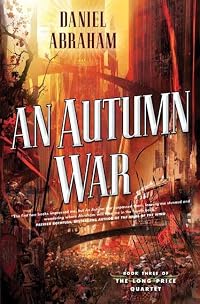
Otah Machi, ruler of the city of Machi, has tried for years to prepare his people for a future in which the magical andat, entities that support their commerce and intimidate all foes, can no longer be safely harnessed. But his efforts are too little, too late. The Galts, an expansionist empire from across the sea, have tired of games of political espionage and low-stakes sabotage. Their general, a ruthless veteran, has found a way to do what was thought impossible: neutralize the andat.As show more the Galtic army advances, the Poets who control the andat wage their own battle to save their loved ones and their nation. Failure seems inevitable, but success would end the Galtic threat. show lessTags
Recommendations





Member Reviews
What a joy to read. I can't honestly recall the last time a book created such tension, such a war between my interest and care for characters, and an irresistible sense of impending doom. I wanted to read it through in one sitting, but I hated to see these deep, breathing, living characters suffer at all.
I won't bother with a synopsis, there are a dozen out there. Suffice it to say, where the first two books in the quartet were engaging, well crafted fantasies, this is a work of deep, almost painful humanity. I honestly can't imagine how Abraham followed this, and I can't wait to find out.
I won't bother with a synopsis, there are a dozen out there. Suffice it to say, where the first two books in the quartet were engaging, well crafted fantasies, this is a work of deep, almost painful humanity. I honestly can't imagine how Abraham followed this, and I can't wait to find out.
This is such a good series. The writing is so good, the world of the empire so interesting, the magic of the andat original. Most fantasy war novels are all about the fighting and the heroism. This one is about the affect of war on the people. When leaders disagree, it is the people who suffer the most.
Casting the andat as weapons of mass destruction is brilliant. One sympathizes with the motives of the Galts, and yet the andats are used more as economic weapons rather than weapons of war. That is, until the war is brought to their doorsteps. All the motivations, and character choices, are understandable and real. This is really a novel, a whole series, about people caught up in events. It's so good.
I'm going to try to get the fourth show more book at the library, because I have been unable to find it, though I've looked for years and finally decided to read the series without it. Wish me luck! show less
Casting the andat as weapons of mass destruction is brilliant. One sympathizes with the motives of the Galts, and yet the andats are used more as economic weapons rather than weapons of war. That is, until the war is brought to their doorsteps. All the motivations, and character choices, are understandable and real. This is really a novel, a whole series, about people caught up in events. It's so good.
I'm going to try to get the fourth show more book at the library, because I have been unable to find it, though I've looked for years and finally decided to read the series without it. Wish me luck! show less
An Autumn War is the third in Daniel Abraham's Long Price Quartet. The story kicks things up a notch as the long awaited war between Galt and the Khaiem finally arrives. The result is nothing short of brilliant though I almost gave up on the story due to it's glacial pacing in the first half of the book. Reader be warned: this is not a happy tale. Abraham paints war in all it's horrifying and tragic glory.
Fourteen years have passed and Otah Matchi has settled into his role as Khai for the people of Machi, albeit in a non-traditional manner. He has only one wife, a single son and a single daughter, and has undertaken the training of a standing militia, something not seen in the Khaiem in ages. Most believe it unnecessary with the power show more of the andat at their side. After all, the Khaiem have used the threat of the andat to ensure peace and prosperity for their people for centuries. Why would this ever change? One Balasar Gice, general of Galt, is about to change everything.
Similar to the previous book, I'm fairly conflicted in my feelings. The first half of the book was a complete slog, taking me 10 days to complete. We spend even more time in the heads of the same characters, almost 30 years later, older but not necessarily wiser. If there was one character I felt truly drawn to this would have been OK. I still haven't connected with anyone in the cast so it makes reading these long sections more of a chore than it might be otherwise.
The second half of the book is completely different. Around chapter 16 plot takes off and I could not put the book down, finishing the remaining chapters in a few hours. The scale of the war is enormous, with an outcome I never saw coming, one that has changed the face of the world. Abraham's writing is elegant. He paints a tragedy that is almost Shakespearean in it's beauty and brilliant in its execution. I am in awe of what he pulled off.
I would be remiss if I didn't talk about Balasar Gice at least a little. He is a wonderfully drawn villain. Rather unimposing physically, Gice is incredibly charismatic, a scary-smart tactician, leads his men by example and is willing to start a war to acheive his goalof ending the threat of the andat, though really the andat are basically a sheathed sword as the Khaiem have no aspirations towards conquering . In the book's own words: “At heart, he was not a conqueror. Only a man who saw what needed doing and then did it.” There is nothing scarier than a true believer.
At this point I have no idea what is in store for this world next. I am looking forward to finding out. Just please give me a character to root for! show less
Fourteen years have passed and Otah Matchi has settled into his role as Khai for the people of Machi, albeit in a non-traditional manner. He has only one wife, a single son and a single daughter, and has undertaken the training of a standing militia, something not seen in the Khaiem in ages. Most believe it unnecessary with the power show more of the andat at their side. After all, the Khaiem have used the threat of the andat to ensure peace and prosperity for their people for centuries. Why would this ever change? One Balasar Gice, general of Galt, is about to change everything.
Similar to the previous book, I'm fairly conflicted in my feelings. The first half of the book was a complete slog, taking me 10 days to complete. We spend even more time in the heads of the same characters, almost 30 years later, older but not necessarily wiser. If there was one character I felt truly drawn to this would have been OK. I still haven't connected with anyone in the cast so it makes reading these long sections more of a chore than it might be otherwise.
The second half of the book is completely different. Around chapter 16 plot takes off and I could not put the book down, finishing the remaining chapters in a few hours. The scale of the war is enormous, with an outcome I never saw coming, one that has changed the face of the world. Abraham's writing is elegant. He paints a tragedy that is almost Shakespearean in it's beauty and brilliant in its execution. I am in awe of what he pulled off.
I would be remiss if I didn't talk about Balasar Gice at least a little. He is a wonderfully drawn villain. Rather unimposing physically, Gice is incredibly charismatic, a scary-smart tactician, leads his men by example and is willing to start a war to acheive his goal
At this point I have no idea what is in store for this world next. I am looking forward to finding out. Just please give me a character to root for! show less
Not quite as emotionally excoriating as the second in this series, but still a magnificently ruthless and implacable look at real, faceted, complex characters in personally (and, in this one, objectively) horrifying situations, all the more horrifying because the world is this shape, and these things must be.
The strength and depth and nuance of the world is part of the awesome scope of this series, and this one shifted the lens ever so slightly to bring the central detente into vivid intensity. I am tremendously impressed with how perfect a fantasy analogy for nuclear deterrence, brinksmanship, the whole cold-war shebang this is. I take off my honours-in-political-science hat to Mr Abraham.
The strength and depth and nuance of the world is part of the awesome scope of this series, and this one shifted the lens ever so slightly to bring the central detente into vivid intensity. I am tremendously impressed with how perfect a fantasy analogy for nuclear deterrence, brinksmanship, the whole cold-war shebang this is. I take off my honours-in-political-science hat to Mr Abraham.
There is something about these books that causes me to get stuck about halfway through, leave it be for a few days, and then pick it up and drive straight on to the end. I’m not sure if it’s a lull in the action or what, but this is the third time it’s happened. I am so glad I did pick it back up, though, because this book is easily the best in the series so far.
And a warning: we have reached the point where it is inevitable, there will be SPOILERS for the earlier books in the rest of this review.
Some fifteen years have passed since the events of A Betrayal in Winter. Otah is now Khai Machi, responsible for an entire city. He has, scandalously, only one wife, and his only son Danat is sickly. His daughter Eiah, being a teenager, show more is starting to act out, despite the careful guidance of her beloved Uncle Maati. Into this relatively blissful domestic scene comes Liat, the former lover of both Maati and Otah, with her grown son, who had been raised by Maati when he was small but who is now so visibly Otah’s son that his presence is likely to cause even more scandal. Not as much, though, as the news Liat brings with her: the Galts are going to attempt an invasion.
For centuries the andat, the incredibly powerful beings held by the poets of the great cities, have protected them from the technologically advanced, militaristic Galts, but Galtic General Balatar Gice has dedicated his whole life to destroying the andat. No one, he thinks, should be allowed to have that much power – control over a being who could pull down whole cities with a thought, or destroy the crops of an entire country, or cause ravaging floods and devastation. He has gone into the desert that used to be the old Empire, he has found a poet of his own, and he is going to first destroy the andat and then any possibility that they will ever return, even if that means destroying every one of the great cities on his way.
All of the cover blurbs on this book talk about the amazing ending, which usually puts me off because most of the time, knowing the twist is going to come, I can predict it well in advance. Not so much in this case. The climax of this story hits that perfect combination of exquisite foreshadowing and total surprise – Once you get there you realize there is no way it could have gone any differently, but it was so completely not what you were expecting that it feels like a punch in the gut. In a good way, of course.
Abraham’s characters are exquisite, and as the world becomes more familiar the deeper you get into the series, the characters take their places as the highlight of the book. Otah, Maati, and Liat have all changed so much since A Shadow in Summer, grown both in wisdom and in their flaws, but they’re still deeply recognizable as themselves. It’s the characters who make that ending what it is, because it’s the characters, their drives and disappointments, the whole history of their lives, that make it so inevitable. It’s a wonderful study in how good people can do horrible things in pursuit of good causes, and there is no one, from the Galtic general to the treacherous mercenary, who you can really blame. Everyone is doing the best they can with the options they have, they’re just terrible options. It is, in fact, very like a Greek tragedy; if they were different people it would have gone differently, but they aren’t, so how could it?
In any other series, this would be the end. This book ends with an earthshattering change, but there are possibilities for growth and rebirth still visible. Most writers would have left it there, but there is another book in this series, and I can’t wait to see what happens next. show less
And a warning: we have reached the point where it is inevitable, there will be SPOILERS for the earlier books in the rest of this review.
Some fifteen years have passed since the events of A Betrayal in Winter. Otah is now Khai Machi, responsible for an entire city. He has, scandalously, only one wife, and his only son Danat is sickly. His daughter Eiah, being a teenager, show more is starting to act out, despite the careful guidance of her beloved Uncle Maati. Into this relatively blissful domestic scene comes Liat, the former lover of both Maati and Otah, with her grown son, who had been raised by Maati when he was small but who is now so visibly Otah’s son that his presence is likely to cause even more scandal. Not as much, though, as the news Liat brings with her: the Galts are going to attempt an invasion.
For centuries the andat, the incredibly powerful beings held by the poets of the great cities, have protected them from the technologically advanced, militaristic Galts, but Galtic General Balatar Gice has dedicated his whole life to destroying the andat. No one, he thinks, should be allowed to have that much power – control over a being who could pull down whole cities with a thought, or destroy the crops of an entire country, or cause ravaging floods and devastation. He has gone into the desert that used to be the old Empire, he has found a poet of his own, and he is going to first destroy the andat and then any possibility that they will ever return, even if that means destroying every one of the great cities on his way.
All of the cover blurbs on this book talk about the amazing ending, which usually puts me off because most of the time, knowing the twist is going to come, I can predict it well in advance. Not so much in this case. The climax of this story hits that perfect combination of exquisite foreshadowing and total surprise – Once you get there you realize there is no way it could have gone any differently, but it was so completely not what you were expecting that it feels like a punch in the gut. In a good way, of course.
Abraham’s characters are exquisite, and as the world becomes more familiar the deeper you get into the series, the characters take their places as the highlight of the book. Otah, Maati, and Liat have all changed so much since A Shadow in Summer, grown both in wisdom and in their flaws, but they’re still deeply recognizable as themselves. It’s the characters who make that ending what it is, because it’s the characters, their drives and disappointments, the whole history of their lives, that make it so inevitable. It’s a wonderful study in how good people can do horrible things in pursuit of good causes, and there is no one, from the Galtic general to the treacherous mercenary, who you can really blame. Everyone is doing the best they can with the options they have, they’re just terrible options. It is, in fact, very like a Greek tragedy; if they were different people it would have gone differently, but they aren’t, so how could it?
In any other series, this would be the end. This book ends with an earthshattering change, but there are possibilities for growth and rebirth still visible. Most writers would have left it there, but there is another book in this series, and I can’t wait to see what happens next. show less
The third book of the Long Price quartet. This book has the distinction of making me stop a bit less than halfway through because I was too afraid of the horrible suffering ahead. As it turned out, the suffering was more told than shown, which was all to the good for my equilibrium. A clever plot by the enemy Galts succeeds in stripping the cities of the Khaiem of their andat, the physicalized spirits that had made them wealthy and untouchable. As the Galts roll through the land, characters from the previous books struggle to save themselves and their people, facing horrible choices and learning how to fight as they go. This is a book about the consequences of mistakes being inflicted on the innocent; for all it’s a well-constructed show more world, it’s a rough ride. show less
As with the previous two books in the series, this was a very enjoyable and fresh take on fantasy. As the series develops the depth of it becomes even greater and the twist at the end of the tale in this third of four parts made the entirety elevated beyond much of what else exists in the world of fantasy.
Daniel Abraham is a skilled craftsman. His use of the action of 'Posing' to add to verbal communication gives us another worldly feel, as well as sometimes the language that cuts out an essential verb, forcing the reader to use our minds to fill in the missing word.
We find additional details that make us think that some human emotions are lacking in the people that populate the tale, but they are all living within their motivations. show more There is evil but you see it more as a world that has generations of mistrust and animosity such as plagues the Middle East where it is something so ingrained that rising above will take extraordinary people. People that may never exist.
It is my understanding that it is hard now to find the fourth book alone, or expensive, but after such good storytelling for the first three books, I must pursue this fourth book. show less
Daniel Abraham is a skilled craftsman. His use of the action of 'Posing' to add to verbal communication gives us another worldly feel, as well as sometimes the language that cuts out an essential verb, forcing the reader to use our minds to fill in the missing word.
We find additional details that make us think that some human emotions are lacking in the people that populate the tale, but they are all living within their motivations. show more There is evil but you see it more as a world that has generations of mistrust and animosity such as plagues the Middle East where it is something so ingrained that rising above will take extraordinary people. People that may never exist.
It is my understanding that it is hard now to find the fourth book alone, or expensive, but after such good storytelling for the first three books, I must pursue this fourth book. show less
Members
- Recently Added By
Lists

Best Fantasy Novels
821 works; 361 members
Author Information

130+ Works 12,974 Members
Some Editions
Awards and Honors
Awards
Distinctions
Series

Work Relationships
Is contained in
Common Knowledge
- Canonical title
- An Autumn War
- Original title
- An Autumn War
- Original publication date
- 2008-07-22
- People/Characters
- Otah Machi; Maati Vaupathai
- Dedication
- To Jim and Allison,
without whom none of this would have been possible - First words
- Three men came out of the desert. Twenty had gone in.
- Publisher's editor
- Frenkel, James
- Blurbers
- Rothfuss, Patrick; Lake, Jay; Elliott, Kate; Willis, Connie; Williams, Walter Jon; Diaz, Junot
- Original language
- English
Classifications
Statistics
- Members
- 597
- Popularity
- 48,762
- Reviews
- 27
- Rating
- (4.06)
- Languages
- English, French, German
- Media
- Paper, Audiobook, Ebook
- ISBNs
- 8
- ASINs
- 4