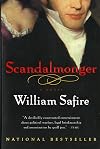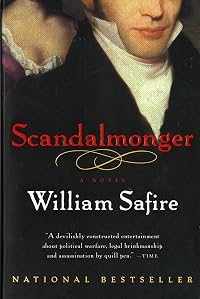
Scandalmonger
by William Safire
On This Page
Description
This volume unveils the story behind the nation's first great political scandals. James Thomson Callender, the "scandalmonger" of the title, is an ambitious gossip-peddling editor secretly hired by Thomas Jefferson as a political weapon. After carefully damaging Alexander Hamilton's reputation, thereby paving the way for Jefferson's success, Callender is shunned by the very politicians on whose behalf he was jailed for sedition. Broke and betrayed, Callender seeks revenge by exposing an show more illicit affair between Jefferson and his slave Sally Hemmings, an accusation that ultimately cost Callender his career and would not be authenticated for two centuries. By using actual letters, records, and notes to re-create dialog and events, this work embodies historical fiction at its best, politics at its most intriguing, and our Founding Fathers at their most notorious. For those who think that Washington sex scandals and lurid journalism are recent developments, this novel will be a revelation, for it shows how media intrusiveness into private lives-and politicians' cool manipulation of the press-are practices as old as the Constitution. show lessTags
Recommendations












Member Reviews
William Safire is an exquisite, exacting author whose prose rings with echoes of the 18th century. The book, according to Safire, is not historical fiction, but rather history told as a history. And what a story: political intrigue and manipulation along with the rise of the newspaper men. James Callender, who first revealed Jefferson's relationship with Sally Hemings, gets a better treatment than he often does and Safire admits to having some sympathy for the man. In the larger view, I came away from the book having a much better understanding of the differences between the federalists and republicans of both that time and our own time. Safire's underbook, with its extensive notes and stories about what happened to the main characters, show more added details and was interesting in its own right. A good read for both fiction and nonfiction fans of American history. show less
Having never read historical fiction before I wasn't sure if I'd like it or not. Having read about the events of James Callender, Thomas Jefferson, and Alexander Hamilton, however, helped me appreciate and enjoy the story.
In Scandalmonger, we get an up-close look at how Jefferson paid and encouraged Callender to investigate and humiliate not only his nemesis Hamilton but Washington, and Adams. Of course, others were using the press for the same purposes.
In Scandalmonger, we get an up-close look at how Jefferson paid and encouraged Callender to investigate and humiliate not only his nemesis Hamilton but Washington, and Adams. Of course, others were using the press for the same purposes.
Scandalmonger is an entertaining novel that portrays the important, and often dangerous, role that "newsmongers" played in the early part of our country's history. Safire does a fine job of letting the history expose the personal weaknesses of several Founding Fathers without harping on them. These individuals are humanized, but then also (rather unexpectedly) draw sympathy in the midst of their mistakes. In telling his tale, Safire seizes on the life of Mary Lewis Clement, a character that he portrays as taking hard abuse as her life careens between a number of important men near the turn of the century. Aside from telling an interesting story, Safire also explains well a number of very important disagreements that faced the leaders of show more the new government. For example, (at p. 161), he highlights the different views of Hamilton and Jefferson with respect to federalism issues. Jefferson is adamant that the states did not submit without limits to the federal government as they united; and in Jefferson's (portrayed) view, the federal government was not made, by the states, the final judge of the extent of the powers delegated to it. Contrasted with Hamilton's quite different view of federalism, these political philosophies drive much of the passion behind the Republican and Federalist camps.
Overall, this was an enjoyable read. Safire, of course, is very intentional with his words, and it is a joy to read and appreciate his skill in this regard. show less
Overall, this was an enjoyable read. Safire, of course, is very intentional with his words, and it is a joy to read and appreciate his skill in this regard. show less
Historical Fiction
Thomas Jefferson, government,
Ratings
Members
- Recently Added By
Published Reviews
ThingScore 88
"So, and with skill and considerable evidence, William Safire argues in this handsomely constructed and politically sophisticated novel, which articulates the Republic's early years by looking upward at our founding fathers, as it were, from the perspective of the ink-stained wretches who served them."
added by bookfitz
"Grammar maven, Pulitzer Prize-winner, novelist (Freedom) and erudite political columnist Safire delivers a sprawling, fact-based if somewhat stiffly written novel that will acquaint readers with several of the nation's first political scandals."
added by bookfitz
Lists

Historical Fiction Lovers
88 works; 4 members

Authors from the United States
245 works; 3 members
Author Information

39+ Works 5,082 Members
William Safire was born on Dec. 17, 1929. He attended Syracuse University, but dropped out after two years. He began his career as a reporter for The New York Herald Tribune. He had also been a radio and television producer and a U.S. Army correspondent. From 1955 to 1960, Safire was vice president of a public relations firm in New York City, and show more then became president of his own firm. He was responsible for bringing Nixon and Nikita Khrushchev together in 1959. In 1968, he joined the campaign of Richard Nixon as a senior White House speechwriter for Nixon. Safire joined The New York Times in 1973 as a political columnist. He also writes a Sunday column, On Language, which has appeared in The New York Times Magazine since 1979. This column on grammar, usage, and etymology has led to the publication of 10 books and made him the most widely read writer on the English language. William Safire was the winner of the 1978 Pulitzer Prize for distinguished commentary. He is a trustee for Syracuse University. Since 1995 he has served as a member of the Pulitzer Board. He is the author of Freedom (1987), a novel of Lincoln and the Civil War. His other novels include Full Disclosure (1977), Sleeper Spy (1995) and Scandalmonger (2000). His other titles include a dictionary, a history, anthologies and commentaries. (Bowker Author Biography) show less
Awards and Honors
Distinctions
Common Knowledge
- Canonical title
- Scandalmonger
- Original title
- Scandalmonger
- Original publication date
- 2000-02
- People/Characters
- Alexander Hamilton; Thomas Jefferson; John Beckley; Maria Reynolds; William Cobbett; Matthew Lynn (show all 12); James Monroe; George Washington; Aaron Burr; Sally Hemings; Benjamin Rush; James Thomas Callender
- Important places
- Philadelphia, Pennsylvania, USA; Richmond, Virginia, USA
- Important events
- Sedition Act of 1798
- Epigraph
- And there's a Luft in Man no Charm can tame,
Of loudly publifhing our Neighbour's Same;
On Eagles' Wings immortal Scandals fly,
While Virtuous Actions are but Born, and Dye.
--Juvenal, Satire IX (c. A.D. 12... (show all)0) - Dedication
- For Timothy Thunderproof and Peter Porcupine
- First words
- Prologue: "The man now in jail who got me into all this trouble says he has enough on the Treasury Secretary to hang him."
- Last words
- (Click to show. Warning: May contain spoilers.)"Then she and I will go home."
- Blurbers
- McCullough, David; Lehrer, Jim; Gawalt, Gerald W.; Beschloss, Michael; Davis, William C.
- Original language
- English
Classifications
Statistics
- Members
- 435
- Popularity
- 70,725
- Reviews
- 5
- Rating
- (3.70)
- Languages
- English
- Media
- Paper, Audiobook, Ebook
- ISBNs
- 6
- ASINs
- 3