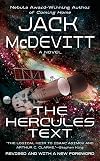
The Hercules Text
by Jack McDevitt
On This Page
Description
The classic first-contact science fiction novel that launched the career of Jack McDevitt, the nationally bestselling author of Coming Home—now revised from the original edition, and featuring a new foreword.From a remote corner of the galaxy a message is being sent. The continuous beats of a pulsar have become odd, irregular . . . artificial. It can only be a code.
Frantically, a research team struggles to decipher the alien communication. And what the scientists discover is destined to show more shake the foundations of empires around this world—from Wall Street to the Vatican . . . show less
Tags
Recommendations





















Member Reviews
Just when everyone got convinced that there is noone out there and that we are all alone in the universe, a signal is picked up - from a place that noone expected - the Hercules system. And the signal is weird - it looks as if someone manipulates pulsars - and then it stops. Of course, it is a USA laboratory that picks it up and of course, there is an administrator that needs explanations so the scientists need to explain in a plain language what happened. It is a good way to do that actually - and considering that the novel was written 30 years ago, it is a standard way.
Politicians get involved, careers almost get ruined due to the secrets and it looks like this initial transmission will be the only one. Until it starts again. And the show more team is assembled to try to understand what they are sending.
Most first contact novels end up with the aliens coming to Earth or humanity bumping into them somewhere among the stars. McDevitt went for the much more likely scenario - we get a transmission that had been sent millions of years ago - that reach us, with no possibility to actually meet them. And while dealing with the message is, the novel deals with how it influences the world - both the people that know what had happened and the ones that can only rely in rumors. I wish he had expanded the focus and looked more at the outer world but that would have made the novel unwieldy. Instead McDevitt uses a Monitor between the chapters - with articles and headlines from the newspapers of the time. It works - it takes a while to start connecting the dots and to get the novel going but once you get used to the style, it is a page turner.
At the end, it is a story of humanity - the Altheans (as they call them) and their message are just showing what we are. The scientists that did not look at a test because they knew what would see so missed to see that this star is not like any other; the president that is more concerned about defense than clean energy; the arrogant scientist that decides to experiment without understanding what he is doing; the pastor that causes a death because he does not realize what it will cause. And the human greed - the pure greed that had caused so many troubles in the past. McDevitt does not leave the church out of it as well - because such a message, the existence of aliens would influence the religions more than anything else. And his portrayal is sincere - both the parts that want to close their eyes and the ones that admit that they cannot do that anymore.
When McDevitt decided to have the book reissued in 2015, he decided to revise it. And that weakened the book - I am not sure how extensive were the changes outside of the political views (past presidents and the big bad of the times) but it is uneven - in parts it reads as a 1986 novel set in the start of the 21st century; in places it reads as a thriller set in the time of writing. And that is annoying. I am not going to track down the old version - it is the same story after all and I did not like it that much - but I suspect that even if it had dated references and motives, it was more coherent. Especially when you expected to read a 1986 novel. show less
Politicians get involved, careers almost get ruined due to the secrets and it looks like this initial transmission will be the only one. Until it starts again. And the show more team is assembled to try to understand what they are sending.
Most first contact novels end up with the aliens coming to Earth or humanity bumping into them somewhere among the stars. McDevitt went for the much more likely scenario - we get a transmission that had been sent millions of years ago - that reach us, with no possibility to actually meet them. And while dealing with the message is, the novel deals with how it influences the world - both the people that know what had happened and the ones that can only rely in rumors. I wish he had expanded the focus and looked more at the outer world but that would have made the novel unwieldy. Instead McDevitt uses a Monitor between the chapters - with articles and headlines from the newspapers of the time. It works - it takes a while to start connecting the dots and to get the novel going but once you get used to the style, it is a page turner.
At the end, it is a story of humanity - the Altheans (as they call them) and their message are just showing what we are. The scientists that did not look at a test because they knew what would see so missed to see that this star is not like any other; the president that is more concerned about defense than clean energy; the arrogant scientist that decides to experiment without understanding what he is doing; the pastor that causes a death because he does not realize what it will cause. And the human greed - the pure greed that had caused so many troubles in the past. McDevitt does not leave the church out of it as well - because such a message, the existence of aliens would influence the religions more than anything else. And his portrayal is sincere - both the parts that want to close their eyes and the ones that admit that they cannot do that anymore.
When McDevitt decided to have the book reissued in 2015, he decided to revise it. And that weakened the book - I am not sure how extensive were the changes outside of the political views (past presidents and the big bad of the times) but it is uneven - in parts it reads as a 1986 novel set in the start of the 21st century; in places it reads as a thriller set in the time of writing. And that is annoying. I am not going to track down the old version - it is the same story after all and I did not like it that much - but I suspect that even if it had dated references and motives, it was more coherent. Especially when you expected to read a 1986 novel. show less
An alien transmission opens a Pandora's box for the American researchers who decipher it. I was hoping this would be a first contact novel about the decipherment of a mysterious message, but it is actually about the personal lives of the researchers -- imagine Rendezvous with Rama if it was about the backstory of the ground crew with just brief glimpses of what was inside the cylinder. The characters spend a substantial amount of the book wondering what the implications of extraterrestrial intelligence are for Christianity, which I found tedious because I'm not Christian. As a social scientist who thinks a lot about society and politics, I didn't find the characters' speculations about a world transformed by alien tech very deep or show more compelling, and the characters themselves were pretty unlikable. I was disappointed by this novel. show less
The Hercules Text by Jack McDevitt
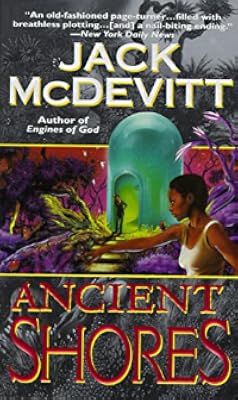
The Hercules Text, which was first published in 1986, was Jack McDevitt's first full-length book, and it is a fine debut novel. I found that it had some definite similarities to Ancient Shores, a work written by McDevitt some ten years later and another excellent example of speculative fiction. Both books ask 'What if...?' certain prodigious events took place, changing mankind's view of reality and the universe, and both examine the implications of certain discoveries for science, politics, military affairs, the economy, and the everyday lives of ordinary people. While Ancient Shores involves the discovery of alien technology, The Hercules Text is a first-contact story. The aliens, however, never make show more an appearance because the message which scientists intercept was sent in the distant past.
What I enjoy about many of Jack McDevitt's novels is that they occur in realistic settings and revolve around characters to whom we can easily relate. The people in the story have their own strengths and weaknesses, and react in believable ways to extraordinary situations. This gives the plot developments a pleasing mixture of both the unpredictable and the predictable. And although the scientists working on the decoding of the alien message are experts on recondite subjects which laymen would have difficulty comprehending, the necessary details are presented by the author in a way which is accessible to the average reader.
In my view, this is an example of speculative fiction at its best, since it not only asks ‘What if...?’ but also compels readers to ask themselves what decisions they would make if they found themselves in the positions of the people in the story. At the same time, we are encouraged to consider the greater implications and possibilities for the future of humanity. Readers who enjoy quieter and more thoughtful science fiction which focusses on the human aspects of newly-gained knowledge will likely appreciate this novel. show less
The Hercules Text, which was first published in 1986, was Jack McDevitt's first full-length book, and it is a fine debut novel. I found that it had some definite similarities to Ancient Shores, a work written by McDevitt some ten years later and another excellent example of speculative fiction. Both books ask 'What if...?' certain prodigious events took place, changing mankind's view of reality and the universe, and both examine the implications of certain discoveries for science, politics, military affairs, the economy, and the everyday lives of ordinary people. While Ancient Shores involves the discovery of alien technology, The Hercules Text is a first-contact story. The aliens, however, never make show more an appearance because the message which scientists intercept was sent in the distant past.
What I enjoy about many of Jack McDevitt's novels is that they occur in realistic settings and revolve around characters to whom we can easily relate. The people in the story have their own strengths and weaknesses, and react in believable ways to extraordinary situations. This gives the plot developments a pleasing mixture of both the unpredictable and the predictable. And although the scientists working on the decoding of the alien message are experts on recondite subjects which laymen would have difficulty comprehending, the necessary details are presented by the author in a way which is accessible to the average reader.
In my view, this is an example of speculative fiction at its best, since it not only asks ‘What if...?’ but also compels readers to ask themselves what decisions they would make if they found themselves in the positions of the people in the story. At the same time, we are encouraged to consider the greater implications and possibilities for the future of humanity. Readers who enjoy quieter and more thoughtful science fiction which focusses on the human aspects of newly-gained knowledge will likely appreciate this novel. show less
McDevitt, Jack. The Hercules Text. 1986. 2nd edition. Ace, 2015.
In revisiting his first novel, The Hercules Text, Jack McDevitt found it needed upgrades to its contemporary politics and technology. But even so, some details already seem dated—my favorite being the note that the Redskins are still refusing to change the team’s racist name. In the last couple of years, the team has thankfully changed its name twice and should probably change it again. The novel proposes an intriguing problem for the SETI folks: what should we do if we get a message from a very distant civilization with information containing the keys to immortality and dangerous new technologies, as well as philosophical texts that challenge traditional religious show more tenets? It is as if an advanced civilization invested a great deal of effort to broadcast its version of Wikipedia into the dark without hope of a response. We see the problem through the eyes of several scientists and a Catholic monk with a scientific education. McDevitt is not a great prose stylist, but he is a good storyteller, even early in his career, and his ideas have merit. 4 stars. show less
In revisiting his first novel, The Hercules Text, Jack McDevitt found it needed upgrades to its contemporary politics and technology. But even so, some details already seem dated—my favorite being the note that the Redskins are still refusing to change the team’s racist name. In the last couple of years, the team has thankfully changed its name twice and should probably change it again. The novel proposes an intriguing problem for the SETI folks: what should we do if we get a message from a very distant civilization with information containing the keys to immortality and dangerous new technologies, as well as philosophical texts that challenge traditional religious show more tenets? It is as if an advanced civilization invested a great deal of effort to broadcast its version of Wikipedia into the dark without hope of a response. We see the problem through the eyes of several scientists and a Catholic monk with a scientific education. McDevitt is not a great prose stylist, but he is a good storyteller, even early in his career, and his ideas have merit. 4 stars. show less
Remarkably less epic than I was anticipating but still did bring up some interesting questions about the morality of "first contact" and sharing information so that was nice. I can't help but to compare this to Carl Sagan's Contact, which I read recently. I thought Sagan was much too optimistic about humanity's ultimate response to the knowledge that we are not alone. This book, I felt, was much more realistic (or cynical, whichever you prefer) in that sense.
I was looking forward to reading this, as it had been billed as a rational but human story of first contact. I wasn't expecting what I found - almost a novelization of a tv mini-series. That's not to damn with faint praise, because the novel had all the immediacy of something I was watching on a tv screen, with all the pros and cons that come with that experience.
Indeed, if this were made into a tv mini-series, it would be hailed as something interesting and intelligent. It was a very strange feeling to get from reading a book, and to some extent I have kept reading McDevitt just to see if he carries on with the trick. (He does.)
Indeed, if this were made into a tv mini-series, it would be hailed as something interesting and intelligent. It was a very strange feeling to get from reading a book, and to some extent I have kept reading McDevitt just to see if he carries on with the trick. (He does.)
I ordinarily am OK with McDevitt in a 'crusty old guy is making an effort' kind of way. Hutch is tolerable. Alex is a run of the mill "lovable" egotist. Whatever.
But this book. I read it once before. It wasn't memorable. When I decided to re-read it, my love said, 'oh, no, not that', or words to that effect. I made it about halfway through before the vast and numerous irritants outweighed the minuscule enjoyment.
1. Harry is an idiot who stands in for the reader so McDevitt can wax poetic about physics and astronomy, presumably to us idiots. There is NO reason for *an administrator* to rush in to the office when he does. There's no reason for him to even find out about the message for at least 6 months.
2. Harry is an idiot. How did his show more wife get far enough to have a kid with him? He's a cardboard cut-out. The attempts at depicting gender relationships look like they were written in 1962. "The project heart-throb" very nearly had me pitch the book across the room. Gah! McDevitt did a whole lot better writing women later than in this mess.
3. The scientists are idiots. No way is this stuff timely enough that revealing the information a month or so into trying to interpret it (which happens insanely fast) would be "withholding". No way to prevent other countries from getting the info either. Science isn't a cauldron, it's a sieve.
4. The government agencies are idiots. Their attempt at suppressing *millions of years old* signals is like trying to seal the not-a-cauldron with window screen. Unfortunately, this part is not implausible.
5. The unlikelihood of life and intelligence is harped on to death which makes the fact that the timing in this is too pat even more glaring.
6. All the little things. Constant use of land lines? Magazines all over the place? And a Star Trek game? Seriously? The author might have been forgiven in 1986 when kids were playing with Turtle Graphics, but by the world of 2015, the whole thing is tone deaf. The revision could have fixed that, but didn't. That's OK. This mess isn't worth the effort. show less
But this book. I read it once before. It wasn't memorable. When I decided to re-read it, my love said, 'oh, no, not that', or words to that effect. I made it about halfway through before the vast and numerous irritants outweighed the minuscule enjoyment.
1. Harry is an idiot who stands in for the reader so McDevitt can wax poetic about physics and astronomy, presumably to us idiots. There is NO reason for *an administrator* to rush in to the office when he does. There's no reason for him to even find out about the message for at least 6 months.
2. Harry is an idiot. How did his show more wife get far enough to have a kid with him? He's a cardboard cut-out. The attempts at depicting gender relationships look like they were written in 1962. "The project heart-throb" very nearly had me pitch the book across the room. Gah! McDevitt did a whole lot better writing women later than in this mess.
3. The scientists are idiots. No way is this stuff timely enough that revealing the information a month or so into trying to interpret it (which happens insanely fast) would be "withholding". No way to prevent other countries from getting the info either. Science isn't a cauldron, it's a sieve.
4. The government agencies are idiots. Their attempt at suppressing *millions of years old* signals is like trying to seal the not-a-cauldron with window screen. Unfortunately, this part is not implausible.
5. The unlikelihood of life and intelligence is harped on to death which makes the fact that the timing in this is too pat even more glaring.
6. All the little things. Constant use of land lines? Magazines all over the place? And a Star Trek game? Seriously? The author might have been forgiven in 1986 when kids were playing with Turtle Graphics, but by the world of 2015, the whole thing is tone deaf. The revision could have fixed that, but didn't. That's OK. This mess isn't worth the effort. show less
Members
- Recently Added By
Lists

Null
30 works; 1 member
Author Information

124+ Works 20,872 Members
Jack McDevitt (born 1935) is an American science fiction author whose novels frequently deal with attempts to make contact with alien races, and with archaeology or xenoarchaeology. He attended La Salle University, where a short story of his won the annual Freshman Short Story Contest and was published in the school's literary magazine, Four show more Quarters. He received a Master's degree in literature from Wesleyan University in 1971. Before becoming a full-time author, he was an English teacher, naval officer, Philadelphia taxi driver, customs officer and motivational trainer. His first published story was The Emerson Effect in The Twilight Zone Magazine in 1981. Two years later, he published his first novel, The Hercules Text, which won the Philip K. Dick Special Award. He won the 2006 Nebula Award for Best Novel for Seeker, the UPC International Prize for his novella Ships in the Night in 1991, and the John W. Campbell Memorial Award for best SF novel for Omega in 2003. (Bowker Author Biography) show less
Some Editions
Awards and Honors
Awards
Series
Belongs to Publisher Series
Work Relationships
Is contained in
Common Knowledge
- Original publication date
- 1986
- Dedication
- For John and Elizabeth
McDevitt
with love - First words
- Harry Carmichael Sneezed.
- Last words
- (Click to show. Warning: May contain spoilers.)"Four Corners," he said. It was a pedestrian answer.
- Blurbers
- Benford, Gregory
Classifications
Statistics
- Members
- 406
- Popularity
- 76,246
- Reviews
- 11
- Rating
- (3.43)
- Languages
- English, German, Spanish
- Media
- Paper, Audiobook, Ebook
- ISBNs
- 7
- ASINs
- 3