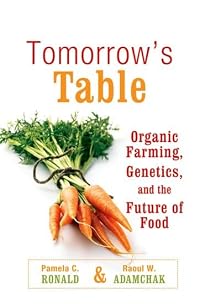
Tomorrow's Table: Organic Farming, Genetics, and the Future of Food
by Pamela C. Ronald, Raoul W. Adamchak (Author)
On This Page
Description
Science. Sociology. Technology. Nonfiction. "Tomorrow's Table" argues that a judicious blend of two important strands of agriculture—genetic engineering and organic farming—is key to helping feed the world's growing population in an ecologically balanced manner. Pamela Ronald, a geneticist, and her husband, Raoul Adamchak, an organic farmer, take the reader inside their lives for roughly a year, allowing us to look over their shoulders so that we can see what geneticists and organic show more farmers actually do. Readers see the problems that farmers face, trying to provide larger yields without resorting to expensive or environmentally hazardous chemicals—a problem that will loom larger and larger as the century progresses—and they learn how organic farmers and geneticists address these problems. The book is for consumers, farmers, and policy decision makers who want to make food choices and policy that will support ecologically responsible farming practices, and for anyone who wants accurate information about organic farming, genetic engineering, and their potential impacts on human health and the environment. The first edition was published in hardcover in 2008 and in paperback in 2009. This second edition reflects the many and varied changes the fields of farming and genetic engineering have seen since 2009. It includes a new preface and three new chapters-one on politics and food-related protests such as the Marin county anti-vaccine movement and the subsequent outbreak of whooping cough, one on farming and food security, and one containing various recipes. Existing chapters on the tools of genetic engineering, organic vs. conventional foods, the tools of organic agriculture, and food labeling and legislature have all been updated. show lessTags
Recommendations


Member Reviews
Ronald argues around the issues presented by the anti-GMO faction without really addressing anything head-on. It's as if she is blind to the real science. But how can that be? She IS a scientist. This is an excellent example of self-justification and blindness. This is the same glossing over tactic of the rest of the industry. Don't worry, this is all a continuum of the natural way of things. There will be a bitter reckoning.
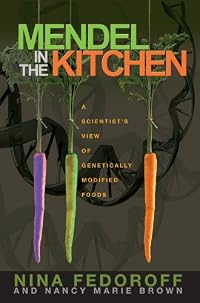
The material here is excellent - both sides, considered from a rational scientific viewpoint and also as part of conversations with non-experts with standard concerns about genetic engineering. The writing feels... stilted, at times (likely a result of transcribing and cleaning up conversations and experiences), but the pair of viewpoints is great. This replaces 'Mendel in the Kitchen' as my go-to for basic GE reading recommendation.
I think this is a good books in that it ties together the concerns that many people who "believe" in organics have with the concerns that many people who "believe" in GE have: reducing pesticide use, health, water use, etc. and highlights the concerns of GE proponents that (unfortunately, in my experience) are often second-tier concerns for organic-ists: feeding a growing population under the reality of climate change, soil depredation, dwindling water sources and quality, and preservation of remaining wild spaces.
It also highlights some of the *cough* naivete about breeding practices, genetic and biological science, and risk-vs-harm psychology of all people; and it does this while acknowledging the valid fears re: seed ownership, show more economic and power concentration in the hands of a few companies, etc. that are too often ignored by those who are not anti-GMO.
So why only three stars? For me, it was too conversational... no. Too "nice"...? Not exactly. Too I'm-not-sure-what. The book includes several recipes interspersed throughout that are part of the scenery as stories about mornings getting ready for work, minor confrontations with in-laws, etc. are used to, in part, narrate the book. Perhaps I am just too jaded a city-slicker, but much of the conversations seems contrived in their retelling, and it kept poking me in the eyes, so to speak. show less
It also highlights some of the *cough* naivete about breeding practices, genetic and biological science, and risk-vs-harm psychology of all people; and it does this while acknowledging the valid fears re: seed ownership, show more economic and power concentration in the hands of a few companies, etc. that are too often ignored by those who are not anti-GMO.
So why only three stars? For me, it was too conversational... no. Too "nice"...? Not exactly. Too I'm-not-sure-what. The book includes several recipes interspersed throughout that are part of the scenery as stories about mornings getting ready for work, minor confrontations with in-laws, etc. are used to, in part, narrate the book. Perhaps I am just too jaded a city-slicker, but much of the conversations seems contrived in their retelling, and it kept poking me in the eyes, so to speak. show less
An organic farmer and a plant geneticist write a book together about the way their seemingly opposed approaches to food technology can actually be complementary.
The assumption throughout is that GMO technology is perfectly safe. Reading Tomorrow's Table, it's hard to argue. We see the geneticist at work doing things with rice that don't seem evil or dangerous at all and we see the organic farmer open to technology that can be used within an organic framework.
Both share a love for the land and a desire to improve the world's agriculture by reducing pesticides and improving yield.
Where the book feels a bit lacking is in its slender references to the elephant in the room that is Monsanto and other big business. Maybe they didn't want to show more get into that fraught territory. Or maybe they just don't think Monsanto is such a big deal. That's the sense I get from reading the straight forward accounts of their genetic adventures, but if that is the case it would help if they said so. Two chapters about who owns the seed and who owns the genes address the complications and the advantages and disadvantages of patents. This is helpful stuff, but not quite explicit enough to either confirm or dispel any fears the reader might have about giant evil seed monopolies.
If Tomorrow's Table dispels any preconceptions at all, it is probably whatever stereotypical ideas you may hold about plant geneticists and organic farmers. show less
The assumption throughout is that GMO technology is perfectly safe. Reading Tomorrow's Table, it's hard to argue. We see the geneticist at work doing things with rice that don't seem evil or dangerous at all and we see the organic farmer open to technology that can be used within an organic framework.
Both share a love for the land and a desire to improve the world's agriculture by reducing pesticides and improving yield.
Where the book feels a bit lacking is in its slender references to the elephant in the room that is Monsanto and other big business. Maybe they didn't want to show more get into that fraught territory. Or maybe they just don't think Monsanto is such a big deal. That's the sense I get from reading the straight forward accounts of their genetic adventures, but if that is the case it would help if they said so. Two chapters about who owns the seed and who owns the genes address the complications and the advantages and disadvantages of patents. This is helpful stuff, but not quite explicit enough to either confirm or dispel any fears the reader might have about giant evil seed monopolies.
If Tomorrow's Table dispels any preconceptions at all, it is probably whatever stereotypical ideas you may hold about plant geneticists and organic farmers. show less
This book is co-written by a plant geneticist and an organic farmer, who are married to each other. Amicably. From this book I learned that "genetic modification" is used to mean more than one kind of technology. Gene splicing, inserting alien genes into unrelated organisms Monsanto-style, isn't really addressed here. The co-author is doing research involving identifying genes which are desirable and identifying which hybrid crosses will express these qualities when grown out -- before growing them out to check. This, of course, saves acres of test garden and possibly months if not years of work. All good, right? We need more specific vocabulary to talk about these things.
Other than that? The book is mostly narrative. Organic farmer show more (employed managing a university farm) goes to work on the farm. Plant geneticist goes to work in the lab, and in her test plots. Plants grow. Sun rises and sets. And we take from the stories what we choose to. show less
Other than that? The book is mostly narrative. Organic farmer show more (employed managing a university farm) goes to work on the farm. Plant geneticist goes to work in the lab, and in her test plots. Plants grow. Sun rises and sets. And we take from the stories what we choose to. show less
Ratings
Members
- Recently Added By
Author Information

2 Works 127 Members
Classifications
Statistics
- Members
- 121
- Popularity
- 266,366
- Reviews
- 5
- Rating
- (3.11)
- Languages
- English
- Media
- Paper, Ebook
- ISBNs
- 10
- ASINs
- 2