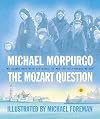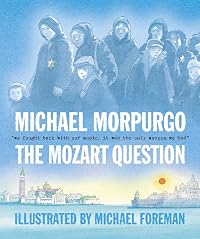
The Mozart Question
by Michael Morpurgo
On This Page
Description
A young journalist goes to Venice, Italy, to interview a famous violinist, who tells the story of his parents' incarceration by the Nazis, and explains why they can no longer listen to the music of Mozart.Tags
Recommendations






Member Reviews
I love Morpurgo (War Horse and Private Peaceful were cornerstones of my undergrad thesis and Kensuke's Kingdom was a tearjerker), but this one felt a little all over the place. It's a story in a story in a story, and only the most embedded story (regarding the Holocaust) was at all interesting - but it took up the least amount of the book. The frame story method for this just really fell flat for me. Emotion was minimal, details were sporadic, and it was hard to feel invested in any of the characters.
Michael Morpurgo writes so simply but with so much impact. The story is nominally about a young journalist who has an interview with a famous violinist. The journalist is told not to ask him the "Mozart question". Of course, she does somehow come around to it and thus begins the story of how musical inmates of certain concentration camps were made to play classical music (and especially Mozart) as trains of new inmates came in to the camps.
While these musical inmates were better fed and treated, it left them with terrible guilt which they continued to live with even after the war. Young readers would need to have some background information about the Holocaust to understand the full meaning of the book.
While these musical inmates were better fed and treated, it left them with terrible guilt which they continued to live with even after the war. Young readers would need to have some background information about the Holocaust to understand the full meaning of the book.
A poignant narrative about the life of Violinist Paolo Levi--it begins with the author, Morpurgo, recounting the time he was given a lucky break--the chance to interview this world-renowned musician. The humanity and kindness in Morpurgo's eyes elicits the never-before-told story of how Levi became what he is today. Themes include secrets, guilt, passion, music, and the holocaust. Morpurgo illustrates Levi's memories with words and beautiful watercolors. A short read that stirred my emotions in a positive way--portrays the beauty and horror that is the world in which we live.
I knew little about Paolo Levi, but I have to say that he is now my hero.
I knew little about Paolo Levi, but I have to say that he is now my hero.
This book, by British Children's Laureate (2003-2005), Michael Morpurgo, was first published in London in 2006. The Mozart Question is a small, short work of fiction that will leave a large and long-lasting impression on the reader.
Paolo Levi is a young boy in Venice. His parents are kind, working-class people; his father is a barber. The family lives in an apartment over the barbershop, where, hidden in a bedroom, is a broken violin. Paolo learns that his father used to play it, and he longs to hear him play; but there is a mystery. Mama tells Paolo that he must never mention the violin. He must not mention it to his father. He must pretend that it does not exist.
But Paolo is drawn by the mysterious violin and by the music of a street show more musician who plays near the bridge. Paolo becomes friends with Benjamin, the elderly musician. Paolo secrets the violin away from his apartment and Benjamin repairs it; then teaches him to play.
Paolo Levi becomes a famous musician, renowned as much for his musicianship as for his peculiar concert habits - no applause, no recordings, and no Mozart - ever.
Fast forward to today... a young reporter lands a plum assignment - an interview with the famously reticent, Paolo Levi. But the assignment comes with a warning - Don't ask the Mozart question. Young reporter, Lesley, does not ask the Mozart question, yet in a reflective mood, Paolo answers it; and in so doing, he draws the reader into the story of his parents, the Holocaust, and Mozart's role in their survival.
Morpurgo succeeds in conveying the horror of the Holocaust with the simple affecting tale of one family's survival. Both haunting and uplifting, The Mozart Question illustrates the power of music and love, and the indomitable nature of the human spirit. The watercolor illustrations of Michael Foreman are a beautiful addition to the story, muted colors and expressionless faces of Nazis in the concentration camps, contrasted with the beautiful scenery of modern Venice.
More a mystery than a Holocaust novel, this short (less than 70 pages) book is a perfect read-aloud or introduction to the Holocaust. For 5th grade and up. show less
Paolo Levi is a young boy in Venice. His parents are kind, working-class people; his father is a barber. The family lives in an apartment over the barbershop, where, hidden in a bedroom, is a broken violin. Paolo learns that his father used to play it, and he longs to hear him play; but there is a mystery. Mama tells Paolo that he must never mention the violin. He must not mention it to his father. He must pretend that it does not exist.
But Paolo is drawn by the mysterious violin and by the music of a street show more musician who plays near the bridge. Paolo becomes friends with Benjamin, the elderly musician. Paolo secrets the violin away from his apartment and Benjamin repairs it; then teaches him to play.
Paolo Levi becomes a famous musician, renowned as much for his musicianship as for his peculiar concert habits - no applause, no recordings, and no Mozart - ever.
Fast forward to today... a young reporter lands a plum assignment - an interview with the famously reticent, Paolo Levi. But the assignment comes with a warning - Don't ask the Mozart question. Young reporter, Lesley, does not ask the Mozart question, yet in a reflective mood, Paolo answers it; and in so doing, he draws the reader into the story of his parents, the Holocaust, and Mozart's role in their survival.
Morpurgo succeeds in conveying the horror of the Holocaust with the simple affecting tale of one family's survival. Both haunting and uplifting, The Mozart Question illustrates the power of music and love, and the indomitable nature of the human spirit. The watercolor illustrations of Michael Foreman are a beautiful addition to the story, muted colors and expressionless faces of Nazis in the concentration camps, contrasted with the beautiful scenery of modern Venice.
More a mystery than a Holocaust novel, this short (less than 70 pages) book is a perfect read-aloud or introduction to the Holocaust. For 5th grade and up. show less
This was a beautifully written and poignant novella that tells the story about why a famous violinist will not play Mozart. It begins with a young journalist travelling to Venice to interview this violinist. She has been cautioned to not ask the Mozart Question, but when she nervously blunders and says, "Well, I know that I cannot ask the Mozart Question," the old musician decides to tell her whole story for the first time. What follows is a tale of his parents imprisonment in the Nazi death camps, and their eventual release, forever changed and haunted by the horrific experience.
This book was written for older elementary children, but its short length and well done illustrations might make some think that it is really for the younger show more elementary crowd. Its themes and topic, however, make it much more suitable for the older child. It is a very short read, but excellently written and illustrated. Strongly recommended. show less
This book was written for older elementary children, but its short length and well done illustrations might make some think that it is really for the younger show more elementary crowd. Its themes and topic, however, make it much more suitable for the older child. It is a very short read, but excellently written and illustrated. Strongly recommended. show less
A young reporter gets her big break when she has to go to Venice to interview a famous violinist. Her boss cautions her not to ask the 'Mozart question'. When she gets to meet the man, she is so overawed that she blunders in 'Well, I know I can't ask you the Mozart question," but recovers to ask, "I wonder if you'd mind telling me how you got started. I mean, what made you pick up a violin and play that first time."
The famously touchy violinist decides to open up. He tells the story of how as a young boy he discovered what he thought was his father's violin hidden away, and how he meets an old violinist in the streets of Venice who teaches him. Old Benjamin also tells him about how he'd had to play his violin to live in the Nazi death show more camps, and young Paolo finds out why his father doesn't play any more ...
I found this to be a moving and poignant short novella. Although written in simple language, and presented as a beautifully illustrated edition, I think the story is not for under-tens who would need more background to understand and appreciate it. As an adult, I enjoyed it very much indeed. show less
The famously touchy violinist decides to open up. He tells the story of how as a young boy he discovered what he thought was his father's violin hidden away, and how he meets an old violinist in the streets of Venice who teaches him. Old Benjamin also tells him about how he'd had to play his violin to live in the Nazi death show more camps, and young Paolo finds out why his father doesn't play any more ...
I found this to be a moving and poignant short novella. Although written in simple language, and presented as a beautifully illustrated edition, I think the story is not for under-tens who would need more background to understand and appreciate it. As an adult, I enjoyed it very much indeed. show less
A young reporter relates how she got her first big break when her editor sent her to interview a great and very famous violinist called Paolo Levi. The one thing the editor insists on is: "whatever you do, don't ask the Mozart Question". The reporter has no idea what that means, and when she meets Levi she asks him to tell her how he got started playing the violin, which prompts the violinist to come clean once and for all and explain how his parents survived the concentration camps and why it is that up until that point, he was always refused to play any Mozart. A good and touching story.
Members
- Recently Added By
Lists

Best middle grade books
130 works; 23 members
Author Information

300+ Works 31,661 Members
British author Michael Morpurgo was born in St. Albans, Hertforshire in 1943. He attended the University of London and studied English and French. He became a primary school teacher in Kent for about ten years. He and his wife Clare started a charity called Farms for City Children. They currently own three farms where over 2000 children a year show more stay for a week and experience the countryside by taking part in purposeful farmwork. He has published over 100 books and several screenplays. He won the 1995 Whitbread Children's Book Award for The Wreck of the Zanzibar, the 1996 Nestle Smarties Book Prize for The Butterfly Lion, and the 2000 Children's Book Award for Kensuke's Kingdom. Private Peaceful won the 2005 Red House Children's Book Award and the Blue Peter Book of the Year Award. Five of his books have been made into movies and two have been adapted for television. He was named as the third Children's Laureate in May 2003. (Bowker Author Biography) show less
Some Editions
Awards and Honors
Common Knowledge
- Canonical title
- The Mozart Question
- Original title
- The Mozart Question
- Original publication date
- 2006
- People/Characters
- Paolo Levi; Benjamin Horowitz; Gino Levi; Laura Adler Levi; Lesley McInley
- Important places
- Venice, Veneto, Italy
- Important events
- World War II; Holocaust
- Dedication
- For Christine Baker - M.M. & M.F.
- First words
- The question that I am most often asked is always easy enough to answer.
- Last words
- (Click to show. Warning: May contain spoilers.)But mostly because you didn't ask the Mozart question.
- Original language
- English
- Disambiguation notice
- The Mozart Question was first published in Singing for Mrs. Pettigrew : stories and essays from a writing life.
Classifications
- Genres
- Kids, Children's Books, Fiction and Literature, Tween
- DDC/MDS
- 823.914 — Literature & rhetoric English & Old English literatures English fiction 1900- 1901-1999 1945-1999
- LCC
- PZ7 .M82712 .M — Language and Literature Fiction and juvenile belles lettres Fiction and juvenile belles lettres Juvenile belles lettres
- BISAC
Statistics
- Members
- 345
- Popularity
- 91,521
- Reviews
- 17
- Rating
- (3.85)
- Languages
- 5 — Dutch, English, French, Italian, Spanish
- Media
- Paper, Audiobook
- ISBNs
- 15
- UPCs
- 1
- ASINs
- 2