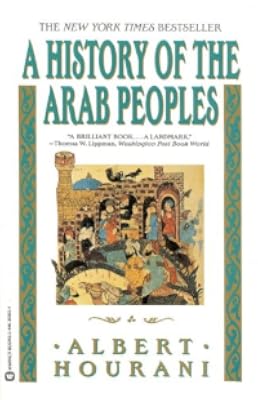
A History of the Arab Peoples
by Albert Hourani
On This Page
Description
Despite the turmoil of Arab nationalism and fundamentalism, Middle Eastern wars, and oil crises, the history of the Arab world has been little known and poorly understood in the West. One reason may be that, for more than half a century, there has been no up-to-date single-volume work that chronicles the story of Arab civilization-until now. Albert Hourani, distinguished historian and interpreter, has written a masterwork, a panoramic view encompassing twelve centuries of Arab history and show more culture. He looks at all sides of this rich and venerable civilization, including the beauty of the Alhambra and the great mosques, the importance attached to education, the achievements of Arab science-but also internal conflicts, widespread poverty, the role of women, and the contemporary Palestinian question. show lessTags
Recommendations



















Member Recommendations
Member Reviews
This is one of the best history books of this scope that I have read. We learn about the history of the Arab peoples from the early life of Mohammed and the birth of Islam, through the rapid Arab conquest through the Middle East, North Africa, and up to Spain. We hear of the Islamic golden age, the sporadic fracturing and reshuffling of dynasties across continents, the coming and going of empires, schools of Islamic thought, and their discord over the last 1400 years.
Somehow this account manages to stay engaging and entertaining while remaining even-handed and unbiased. What we come away with is some appreciation of the huge complexity of the political, religious, and cultural situation in the Middle East, based on a fascinating and show more turbulent history. This book is highly recommended for anyone wanting to gain some understanding of the history and culture of this section of the world. show less
Somehow this account manages to stay engaging and entertaining while remaining even-handed and unbiased. What we come away with is some appreciation of the huge complexity of the political, religious, and cultural situation in the Middle East, based on a fascinating and show more turbulent history. This book is highly recommended for anyone wanting to gain some understanding of the history and culture of this section of the world. show less
This book tackles a rather complicated and diverse topic and treats it fairly given the subject. Whether we like it or not, there is almost no way for most people to negotiate between the aspects of the amazingly diverse Arab people. We tend to "lump" them all together out of our ignorance. Then there is the issue with Islam and how the world views it. Most of the non-Islamic world has no idea what it is but they know they hate it. This creates a huge gulf of misunderstanding and that can create the conditions for strife and conflict. The author steps in to fill that void with a book that gives basic and fundamental information about who these people are and what they believe. The easiest way to get people to understand one another is show more to introduce yourself and share information. For a good part of the United States (as an example) much in this book will be new information because all they "know" has been headlines and news reports. Learning about the people themselves, who they are, what they do, where they go and how they live-all of this humanizes them and makes the Western world realize that that they are actual "real' people too. We can forget basic humanity when we write off whole populations due to the actions of a few. Not all people are bad. The author also walks us through the founding of Islam. He takes the established path and does not stray from it. There is a substantial body of scholarly work about this topic but this is not the time for that. He gives a clear telling of the foundation of this faith that carries so much impact today. There is quite a lot of serious scholarly material on the Quorn, Islam, the Prophet and the formation of the Islamic states in written and video formats. This book is a great introduction to a subject that people know almost nothing about and that makes it a valuable resource. show less
This book was a good, balanced chronicle of the history and evolution of Islam, the Arabic people, and the nations that arose as a result. It should be required reading for anyone elected into congress or the executive branch and all the empty suits appointed into cabinet or embassy positions that deal with the Middle East and Islamic issues. Very apropos now given the events that have taken place recently in Egypt and other countries.
Hourani takes us from Muhammad to about 1990 and then Malise Ruthven takes us to 2009 in his afterword. It looks like another afterword might be needed soon. It was especially refreshing to read that for much of the earlier history covered in the book and in many places in the Islamic empire that show more non-Muslims were not only tolerated but made important contributions to the societies. OK, they had to pay a head tax for being non-Muslim but that beats losing your head in a pogrom or purge.
This is stuff you never learned in school and that was probably never even taught. If you are feeling a tinge of Islamophobia coming on this book might help you get over it. show less
Hourani takes us from Muhammad to about 1990 and then Malise Ruthven takes us to 2009 in his afterword. It looks like another afterword might be needed soon. It was especially refreshing to read that for much of the earlier history covered in the book and in many places in the Islamic empire that show more non-Muslims were not only tolerated but made important contributions to the societies. OK, they had to pay a head tax for being non-Muslim but that beats losing your head in a pogrom or purge.
This is stuff you never learned in school and that was probably never even taught. If you are feeling a tinge of Islamophobia coming on this book might help you get over it. show less
http://nhw.livejournal.com/1048242.html
It's an interesting survey - I have been reading a bit about the origins of Islam (both Rogerson's books and this piece by Patricia Crone) but Hourani's book starts from there and takes the narrative up to the late 80s. (The 2002 afterword, by someone else, suffers from not saying enough about Iraq.)
What I most liked about the book was the emphasis on social and economic as well as political history - and that is a big admission for me, because normally I only like the political history bits. Hourani modestly claims that in this he is following the example of the great Ibn Khaldūn, but I'm sure he brings an extra six centuries of historiography to bear as well (I am sorry to say that I have read show more only extracts of Ibn Khaldūn; I see the Muqaddimah is on-line here though.) By concentrating on philosophy and culture he makes a good implicit case that currents of Islamic thought had a greater direct impact on local politics than perhaps the equivalents for Christianity.
Which links neatly to my only grounds of dissatisfaction with the book; which are (rather unreasonably of me, since he covers a pretty large chunk of the world) that it doesn't look widely enough. Iran and Persia are barely mentioned; likewise India, the Balkans and Cyprus, all of which are important interfaces between Islam and other faiths. Turkey proper, because of the longevity of the Ottoman Empire, gets a bit more coverage, as does Al-Andalus, but sub-Saharan Africa, Indonesia, Central Asia and Afghanistan are basically invisible. OK, the book is technically about Arabs rather than Muslims, but it concentrates so much on Islam (and correspondingly less on Arab Christians, except in Lebanon) that I felt the non-Arab Muslims got rather short shrift.
Anyway, well worth reading. show less
It's an interesting survey - I have been reading a bit about the origins of Islam (both Rogerson's books and this piece by Patricia Crone) but Hourani's book starts from there and takes the narrative up to the late 80s. (The 2002 afterword, by someone else, suffers from not saying enough about Iraq.)
What I most liked about the book was the emphasis on social and economic as well as political history - and that is a big admission for me, because normally I only like the political history bits. Hourani modestly claims that in this he is following the example of the great Ibn Khaldūn, but I'm sure he brings an extra six centuries of historiography to bear as well (I am sorry to say that I have read show more only extracts of Ibn Khaldūn; I see the Muqaddimah is on-line here though.) By concentrating on philosophy and culture he makes a good implicit case that currents of Islamic thought had a greater direct impact on local politics than perhaps the equivalents for Christianity.
Which links neatly to my only grounds of dissatisfaction with the book; which are (rather unreasonably of me, since he covers a pretty large chunk of the world) that it doesn't look widely enough. Iran and Persia are barely mentioned; likewise India, the Balkans and Cyprus, all of which are important interfaces between Islam and other faiths. Turkey proper, because of the longevity of the Ottoman Empire, gets a bit more coverage, as does Al-Andalus, but sub-Saharan Africa, Indonesia, Central Asia and Afghanistan are basically invisible. OK, the book is technically about Arabs rather than Muslims, but it concentrates so much on Islam (and correspondingly less on Arab Christians, except in Lebanon) that I felt the non-Arab Muslims got rather short shrift.
Anyway, well worth reading. show less
The imposing hardcover tome has been on my shelf for years, but finding this audiobook narrated by Nadia May (one of the very best narrators) prompted me to finally tackle it. First published in 1991, there are decades of recent developments not covered here. Indeed, the final content on hopeful trends toward parliamentary democracy in multiple Arab countries sure sounded promising...
As a general history of a religion born of the desert becoming the fiber of an empire and now multi-cultural, multi-ethnic group of nations is fascinating and detailed.
As a general history of a religion born of the desert becoming the fiber of an empire and now multi-cultural, multi-ethnic group of nations is fascinating and detailed.
I read this book because I have been so confused by the endless troubles in the Middle East. Now I understand that things actually ARE totally confusing and extremely complicated so I feel much better about that. The scope of this book is vast and the range of angles from which the author approaches his subject is remarkable. A great book. I just feel I need to read it all over again.
Albert Hourani - A History of the Arab Peoples, 1992 edition
This book is a mile-high overview of the history of Arab peoples from Mohammed to 1991. I imagine it is standard textbook in an Arab Culture or Middle Eastern studies curriculum. In certain eras, Hourani has little historic and archaeological information to go on but does his best to present what we know. He does not have the space to delve into the details of any particular events, personalities, or tribal distinctions. I would have liked for him to elaborate on the linguistic differences across Arab lands, but instead he closes the book with a look at the modern political languages of Arabs: nationalism, social justice, and Islam. He also is able to give little detail when he show more reports particular events, such as when a leader was assassinated, and why that event was important and what exactly the context was. If you're interested in a particular region or country, check out more specific books. Histories written with narratives and anecdotes of the time are easier to read, but may contain less information. This book contains nothing of the sort and is all information.
I learned much about Arab peoples and their history, the interaction with Turkish history via the Ottoman age, and a little about how modern borders were formed, although much of explanation of development of modern states is too detailed for this book.
Part I: (Seventh-Tenth Century)
pre-800 A.D. Muslims had copied/studied almost the entirety of know Greek texts, preserving them to be translated back into Latin in the Middle Ages. Arabs also developed on the science and mathematics found in the texts, publishing their own works.
Hourani explains how tradition on Mohammed differs, his sayings were compiled first during the reign of his third successor. There is much debate about his life and the authenticity of what is recorded. Hourani returns to Koranic interpretation throughout the book, explaining how the various schools of religious and philosophical thought developed. He looks at Persian Shiite beliefs as well, the Mahdi belief arose very early. Abbasids vs Shiites, etc. Mystical experiences and writings versus more strict traditions, etc.
Despite Mohammed's wishes, it appears monasticism in Christianity was influential on Muslim scholars, and some issues of Islamic doctrine mirror debates in the monophysite Christian churches as well. Paternalism was present well before Islam (and Judaism) in the Middle Eastern native cultures.
Part II: Arab Muslim Societies (11th-15th centuries)
Hourani looks at the spread of Islam and the interaction of Arabs, Persians, and Turks. There is a look at cities, Hourani notes that Cairo and Baghdad were likely metropolises of 250,000 before the plague. The Mamluk's controlled the land from Mecca to Cairo and ruled via vassals. Mamluk government differed from that of the Seljuk's in Anatolia. He describes the common architecture found in cities, houses, palaces, as well as the importance of Arabic writing in artwork. Wine seems to have been widely consumed despite prohibition. The Arabian Nights and other tales probably originated from other cultures and were translated into Arabic, the earliest roots seem to come from the 10th century.Schools of theology and laws became important. Islamic scholars were expected to travel around learning from various teachers to get a wide range of views. I found his discussion of "ishtihad," or "independent reasoning" in Sunni law as interesting. Only a "mujtahid" is qualified to exercise "ijtihad" in evaluating Islamic law. The Koran and Hadith were not sufficient, knowledge of history and reason were also required. (This is something ISIS apparently rejects, it is a pre-11th century version of Islam).
Part III: Ottoman Age (16th-18th centuries)
While the Ottomans are Turks, they ruled over the Arab people and set the stage for the modern struggles of Arab independence movements. I enjoyed the lengthy look at Ottoman government and culture. The Ottomans were innovative in that they codified their laws, including the Sharia aspects (just as Justinian had done with Roman law during the Byzantine Age, not mentioned by the author). We forget that besides the Crimean War of 1853-1856, there was the previous Russian-Ottoman conflict of 1768-1774 in which the Russians annexed Crimea. This has implications for events of today.
Hourani does a good job looking at reform attempts within the aging Ottoman empire and how that later affected Arab independence movements. Turkey also dominates much of Part IV. Hourani does look at Jewish relations with Arab Muslims over the centuries as well.
Part IV: The Age of European Empires (1800-1939)
As Europe grew stronger and the Ottomans grew weaker, Europe made its presence felt in North Africa and the Middle East. French colonization of Algeria is examined. U.S. aid money for Lebanese survivors of a civil war in 1860 was one of the first examples of a coordinated international aid effort. The U.S. later set up schools in the area, as well as France and other powers. Germany was of large assistance to Turkey and the British took more interest in Middle Eastern oil.
The first Western interest in Middle Eastern philosophy and history came in the early 1900s. Hourani mentions the 1908 Arab revolts and widespread killings of Armenians without the dreaded "g-word."
I learned a bit about the development of Salafism in the 20th century and the roots of Arab nationalism in Syria. He of course looks at T.E. Lawrence and WWI but remarks that the fabled Arab Revolt is of debatable value in the war. The division to modern borders is really only glossed over in Part IV and Part V.
Part V: The Age of Nation-States (since 1939)
As linguistic study and literacy increased in the 20th century, so did Arab/Islamic philosophy and poetry. Hourani makes remarks on several poets who choose to publish works in the colloquial Arabic. Economic growth happened post WWII, but stagnated as countries like Egypt tilted toward Socialism and became reliant on either the West or the USSR for aid and military support. Arabic socialism as promoted by Nasser had little appeal to Islam but rather to nationalism and anti-colonialism.
Hourani describes some of the political intrigue of the 1950s-1970s, with coups and assisinations. Rivalries and wars with Israel, etc. He gives an overview of how Arabs favor strong central governments, partly as a reaction to western colonialism, and partly in order to unite and subdue several competing factions within arbitrary borders (think Iraq). He also describes the evolution of the role of women both in economics and in politics. The rise of the Muslim brotherhood is described as one of several attempts to interpret Islam and its idea of social justice into modern contexts. The competition with Wahabist and Sufi schools of thought, critical today as Sunni Arabs are now at war with one another in Syria. Hourani makes no predictions about the future but clearly does not forsee current developments. The book was written before the Gulf War of 1991, so it is dated (while a later version adds an afterword with updates).
I learned a lot about the Arab peoples and have a greater appreciation for the cultural history. I'm giving it 4.5 stars out of 5. I partly wish the author had broken it down into five larger volumes with more detail, but am glad for this large overview. show less
This book is a mile-high overview of the history of Arab peoples from Mohammed to 1991. I imagine it is standard textbook in an Arab Culture or Middle Eastern studies curriculum. In certain eras, Hourani has little historic and archaeological information to go on but does his best to present what we know. He does not have the space to delve into the details of any particular events, personalities, or tribal distinctions. I would have liked for him to elaborate on the linguistic differences across Arab lands, but instead he closes the book with a look at the modern political languages of Arabs: nationalism, social justice, and Islam. He also is able to give little detail when he show more reports particular events, such as when a leader was assassinated, and why that event was important and what exactly the context was. If you're interested in a particular region or country, check out more specific books. Histories written with narratives and anecdotes of the time are easier to read, but may contain less information. This book contains nothing of the sort and is all information.
I learned much about Arab peoples and their history, the interaction with Turkish history via the Ottoman age, and a little about how modern borders were formed, although much of explanation of development of modern states is too detailed for this book.
Part I: (Seventh-Tenth Century)
pre-800 A.D. Muslims had copied/studied almost the entirety of know Greek texts, preserving them to be translated back into Latin in the Middle Ages. Arabs also developed on the science and mathematics found in the texts, publishing their own works.
Hourani explains how tradition on Mohammed differs, his sayings were compiled first during the reign of his third successor. There is much debate about his life and the authenticity of what is recorded. Hourani returns to Koranic interpretation throughout the book, explaining how the various schools of religious and philosophical thought developed. He looks at Persian Shiite beliefs as well, the Mahdi belief arose very early. Abbasids vs Shiites, etc. Mystical experiences and writings versus more strict traditions, etc.
Despite Mohammed's wishes, it appears monasticism in Christianity was influential on Muslim scholars, and some issues of Islamic doctrine mirror debates in the monophysite Christian churches as well. Paternalism was present well before Islam (and Judaism) in the Middle Eastern native cultures.
Part II: Arab Muslim Societies (11th-15th centuries)
Hourani looks at the spread of Islam and the interaction of Arabs, Persians, and Turks. There is a look at cities, Hourani notes that Cairo and Baghdad were likely metropolises of 250,000 before the plague. The Mamluk's controlled the land from Mecca to Cairo and ruled via vassals. Mamluk government differed from that of the Seljuk's in Anatolia. He describes the common architecture found in cities, houses, palaces, as well as the importance of Arabic writing in artwork. Wine seems to have been widely consumed despite prohibition. The Arabian Nights and other tales probably originated from other cultures and were translated into Arabic, the earliest roots seem to come from the 10th century.Schools of theology and laws became important. Islamic scholars were expected to travel around learning from various teachers to get a wide range of views. I found his discussion of "ishtihad," or "independent reasoning" in Sunni law as interesting. Only a "mujtahid" is qualified to exercise "ijtihad" in evaluating Islamic law. The Koran and Hadith were not sufficient, knowledge of history and reason were also required. (This is something ISIS apparently rejects, it is a pre-11th century version of Islam).
Part III: Ottoman Age (16th-18th centuries)
While the Ottomans are Turks, they ruled over the Arab people and set the stage for the modern struggles of Arab independence movements. I enjoyed the lengthy look at Ottoman government and culture. The Ottomans were innovative in that they codified their laws, including the Sharia aspects (just as Justinian had done with Roman law during the Byzantine Age, not mentioned by the author). We forget that besides the Crimean War of 1853-1856, there was the previous Russian-Ottoman conflict of 1768-1774 in which the Russians annexed Crimea. This has implications for events of today.
Hourani does a good job looking at reform attempts within the aging Ottoman empire and how that later affected Arab independence movements. Turkey also dominates much of Part IV. Hourani does look at Jewish relations with Arab Muslims over the centuries as well.
Part IV: The Age of European Empires (1800-1939)
As Europe grew stronger and the Ottomans grew weaker, Europe made its presence felt in North Africa and the Middle East. French colonization of Algeria is examined. U.S. aid money for Lebanese survivors of a civil war in 1860 was one of the first examples of a coordinated international aid effort. The U.S. later set up schools in the area, as well as France and other powers. Germany was of large assistance to Turkey and the British took more interest in Middle Eastern oil.
The first Western interest in Middle Eastern philosophy and history came in the early 1900s. Hourani mentions the 1908 Arab revolts and widespread killings of Armenians without the dreaded "g-word."
I learned a bit about the development of Salafism in the 20th century and the roots of Arab nationalism in Syria. He of course looks at T.E. Lawrence and WWI but remarks that the fabled Arab Revolt is of debatable value in the war. The division to modern borders is really only glossed over in Part IV and Part V.
Part V: The Age of Nation-States (since 1939)
As linguistic study and literacy increased in the 20th century, so did Arab/Islamic philosophy and poetry. Hourani makes remarks on several poets who choose to publish works in the colloquial Arabic. Economic growth happened post WWII, but stagnated as countries like Egypt tilted toward Socialism and became reliant on either the West or the USSR for aid and military support. Arabic socialism as promoted by Nasser had little appeal to Islam but rather to nationalism and anti-colonialism.
Hourani describes some of the political intrigue of the 1950s-1970s, with coups and assisinations. Rivalries and wars with Israel, etc. He gives an overview of how Arabs favor strong central governments, partly as a reaction to western colonialism, and partly in order to unite and subdue several competing factions within arbitrary borders (think Iraq). He also describes the evolution of the role of women both in economics and in politics. The rise of the Muslim brotherhood is described as one of several attempts to interpret Islam and its idea of social justice into modern contexts. The competition with Wahabist and Sufi schools of thought, critical today as Sunni Arabs are now at war with one another in Syria. Hourani makes no predictions about the future but clearly does not forsee current developments. The book was written before the Gulf War of 1991, so it is dated (while a later version adds an afterword with updates).
I learned a lot about the Arab peoples and have a greater appreciation for the cultural history. I'm giving it 4.5 stars out of 5. I partly wish the author had broken it down into five larger volumes with more detail, but am glad for this large overview. show less
Members
- Recently Added By
Lists

Best General History Books
50 works; 22 members

The Emergence of the Modern Middle East
289 works; 13 members

r/History Recommended Reading List
603 works; 12 members

r/AskHistorians' Recommended Books
1,068 works; 18 members
Author Information

Albert Hourani was Emeritus Fellow, St. Antony's College, Oxford. He died in 1993
Some Editions
Awards and Honors
Awards
Distinctions
Common Knowledge
- Canonical title
- A History of the Arab Peoples
- Original title
- A History of the Arab Peoples
- Alternate titles*
- Een geschiedenis van de Arabische volken
- Original publication date
- 1991
- Important places
- Arabia
- Dedication
- To my colleagues and students at St. Antony's College, Oxford
- First words
- The subject of this book is the history of the Arabic-speaking parts of the Islamic world, from the rise of Islam to the present day. (Preface)
- Last words
- (Click to show. Warning: May contain spoilers.)It might happen too that, at a certain stage of national development, the appeal of religious ideas - at least of ideas sanctified by the cumulative tradition - would cease to have the same force as another system of ideas: a blend of social morality and law which were basically secular, but might have some relationship to general principles of social justice inherent in the Qur'an.
- Blurbers
- Ajami, Fouad; Lapidus, Ira M.; Mottahedeh, Roy
- Original language
- English
*Some information comes from Common Knowledge in other languages. Click "Edit" for more information.
Classifications
Statistics
- Members
- 3,698
- Popularity
- 4,351
- Reviews
- 22
- Rating
- (3.75)
- Languages
- 14 — Danish, Dutch, English, French, German, Greek, Italian, Norwegian (Bokmål), Norwegian, Polish, Romanian, Spanish, Swedish, Portuguese (Portugal)
- Media
- Paper, Audiobook, Ebook
- ISBNs
- 68
- ASINs
- 24